 Add to Chrome
 Add to Firefox
 Add to Edge
SkillAudit: Ground-Truth-Free Skill Evolution via Paired Trajectory Auditing
Jun 12, 2026
Agent skills are structured procedural packages that guide frozen LLM agents in specialized workflows. Skills rarely remain sufficient after deployment: edge cases, API changes, and deployment constraints become visible only through use, making skill evolution a practical necessity. Existing methods depend on privileged feedback such as held-out validation scores, hidden test outcomes, or environment rewards -- signals often unavailable when a practitioner has only a task description and workspace data. We introduce SkillAudit, a framework for evolving agent skills without ground-truth feedback. The key idea is paired trajectory auditing: at each iteration, the same task is executed with and without the candidate skill, isolating how the skill changes agent behavior without external labels. To turn behavioral differences into edit guidance, SkillAudit uses Process-Aligned Contrastive Evaluation (PACE), a cluster of evaluators that maps trajectory divergences to diagnostic signals linked to specific passages in the skill document. A structural verifier, compiled once from the task specification and then fixed, checks task constraints and rolls back harmful updates. SkillAudit routes edits through two pipelines: Refine removes noisy or irrelevant guidance from broadly useful skills, while Repair replaces passages that conflict with the task. Across 89 containerized tasks spanning 8 professional domains, SkillAudit achieves 73.9% average task reward, outperforming an agent without skills (40.9%) and the static expert skill (56.7%). These gains are obtained without accessing hidden tests, reference solutions, or external scoring functions during evolution.

Flow-based Policy Adaptation without Policy Updates
Jun 04, 2026Leveraging prior knowledge from pretrained policies, foundation models, or human operators offers an efficient alternative to learning robot skills from scratch. However, these agents often provide actions that are suboptimal, noisy, or misaligned with task-specific expert behavior. We propose GLOVES, a family of flow-based adaptation methods that correct non-expert actions by transporting them toward an expert action distribution. Rather than replacing agentic control with full autonomy, GLOVES performs selective action-level adaptation, improving task success while preserving agent intent. The learned flow also provides a natural in-distribution scoring mechanism through reverse flow evaluation. We use this signal as an intervention gate: actions that appear consistent with the expert distribution are passed through unchanged, while anomalous or out-of-distribution (OOD) actions are corrected. In this way, assistance is only provided when necessary. GLOVES requires only limited expert supervision, using a small number of demonstrations or reusable successful skill segments. By learning local expert action patterns and stitching them during execution, GLOVES provides a lightweight shared-control module for robust action adaptation across tasks and environments. Code and demos are available at ripl.github.io/GLOVES_web.
CameraNoise: Enabling Faithful Camera Control in Video Diffusion through Geometry-Flow-Guided Noise Warping
May 29, 2026Precise camera pose control is critical for video diffusion, yet maintaining geometric consistency remains a challenge. Existing methods that directly inject numerical camera parameters into the diffusion backbone often fail to bridge the gap between abstract coordinates and visual content, leading to structural distortions. To address this issue, we propose CameraNoise, a flow-to-noise warping method that encodes camera motion into a temporally coherent stochastic representation. Unlike conventional conditioning, CameraNoise embeds camera poses directly into the noise space. This decouples motion from scene appearance while faithfully preserving trajectory dynamics. Specifically, we introduce a novel Geometry-guided Reprojection Flow and a noise warping algorithm, which jointly preserve the Gaussian prior of diffusion and ensure consistent noise propagation under camera transformations. By integrating CameraNoise into the diffusion process, our framework delivers stable, high-fidelity videos. Extensive experiments demonstrate that our approach significantly outperforms prior methods in both visual quality and trajectory faithfulness. The project page and code are available at: https://gulucaptain.github.io/CameraNoise/.
* 28 pages, 16 figures
Enhancing SignSGD: Small-Batch Convergence Analysis and a Hybrid Switching Strategy
Apr 28, 2026SignSGD compresses each stochastic gradient coordinate to a single bit, offering substantial memory and communication savings, but its 1-bit quantization removes magnitude information and is known to leave a generalization gap relative to well-tuned SGD. We revisit SignSGD from a 1-bit quantization and dithering perspective and contribute three improvements. First, we derive a small-batch convergence rate for SignSGD under unimodal symmetric gradient noise using a signal-to-noise weighted stationarity measure, removing the large-batch assumption of prior analyses. Second, we inject annealed Gaussian noise before the sign operator, which acts as a classical dithering mechanism and probabilistically restores magnitude information lost to hard thresholding. Third, we adapt the SWATS strategy to sign-based updates with a projection-based learning-rate calibration that smoothly transitions from SignSGD to SGD. Single-worker experiments on ResNet-18 isolate optimizer effects from communication aspects: pre-sign dithering surpasses Adam on CIFAR-100, and the calibrated switch reaches 92.18% test accuracy on CIFAR-10, outperforming both pure SGD 91.38% and pure SignSGD with momentum 90.82%.
CT-1: Vision-Language-Camera Models Transfer Spatial Reasoning Knowledge to Camera-Controllable Video Generation
Apr 10, 2026Camera-controllable video generation aims to synthesize videos with flexible and physically plausible camera movements. However, existing methods either provide imprecise camera control from text prompts or rely on labor-intensive manual camera trajectory parameters, limiting their use in automated scenarios. To address these issues, we propose a novel Vision-Language-Camera model, termed CT-1 (Camera Transformer 1), a specialized model designed to transfer spatial reasoning knowledge to video generation by accurately estimating camera trajectories. Built upon vision-language modules and a Diffusion Transformer model, CT-1 employs a Wavelet-based Regularization Loss in the frequency domain to effectively learn complex camera trajectory distributions. These trajectories are integrated into a video diffusion model to enable spatially aware camera control that aligns with user intentions. To facilitate the training of CT-1, we design a dedicated data curation pipeline and construct CT-200K, a large-scale dataset containing over 47M frames. Experimental results demonstrate that our framework successfully bridges the gap between spatial reasoning and video synthesis, yielding faithful and high-quality camera-controllable videos and improving camera control accuracy by 25.7% over prior methods.
Think, Then Verify: A Hypothesis-Verification Multi-Agent Framework for Long Video Understanding
Mar 05, 2026Long video understanding is challenging due to dense visual redundancy, long-range temporal dependencies, and the tendency of chain-of-thought and retrieval-based agents to accumulate semantic drift and correlation-driven errors. We argue that long-video reasoning should begin not with reactive retrieval, but with deliberate task formulation: the model must first articulate what must be true in the video for each candidate answer to hold. This thinking-before-finding principle motivates VideoHV-Agent, a framework that reformulates video question answering as a structured hypothesis-verification process. Based on video summaries, a Thinker rewrites answer candidates into testable hypotheses, a Judge derives a discriminative clue specifying what evidence must be checked, a Verifier grounds and tests the clue using localized, fine-grained video content, and an Answer agent integrates validated evidence to produce the final answer. Experiments on three long-video understanding benchmarks show that VideoHV-Agent achieves state-of-the-art accuracy while providing enhanced interpretability, improved logical soundness, and lower computational cost. We make our code publicly available at: https://github.com/Haorane/VideoHV-Agent.
Dense Feature Learning via Linear Structure Preservation in Medical Data
Feb 07, 2026Deep learning models for medical data are typically trained using task specific objectives that encourage representations to collapse onto a small number of discriminative directions. While effective for individual prediction problems, this paradigm underutilizes the rich structure of clinical data and limits the transferability, stability, and interpretability of learned features. In this work, we propose dense feature learning, a representation centric framework that explicitly shapes the linear structure of medical embeddings. Our approach operates directly on embedding matrices, encouraging spectral balance, subspace consistency, and feature orthogonality through objectives defined entirely in terms of linear algebraic properties. Without relying on labels or generative reconstruction, dense feature learning produces representations with higher effective rank, improved conditioning, and greater stability across time. Empirical evaluations across longitudinal EHR data, clinical text, and multimodal patient representations demonstrate consistent improvements in downstream linear performance, robustness, and subspace alignment compared to supervised and self supervised baselines. These results suggest that learning to span clinical variation may be as important as learning to predict clinical outcomes, and position representation geometry as a first class objective in medical AI.
Soft Responsive Materials Enhance Humanoid Safety
Jan 06, 2026Humanoid robots are envisioned as general-purpose platforms in human-centered environments, yet their deployment is limited by vulnerability to falls and the risks posed by rigid metal-plastic structures to people and surroundings. We introduce a soft-rigid co-design framework that leverages non-Newtonian fluid-based soft responsive materials to enhance humanoid safety. The material remains compliant during normal interaction but rapidly stiffens under impact, absorbing and dissipating fall-induced forces. Physics-based simulations guide protector placement and thickness and enable learning of active fall policies. Applied to a 42 kg life-size humanoid, the protector markedly reduces peak impact and allows repeated falls without hardware damage, including drops from 3 m and tumbles down long staircases. Across diverse scenarios, the approach improves robot robustness and environmental safety. By uniting responsive materials, structural co-design, and learning-based control, this work advances interact-safe, industry-ready humanoid robots.
JDPNet: A Network Based on Joint Degradation Processing for Underwater Image Enhancement
Dec 23, 2025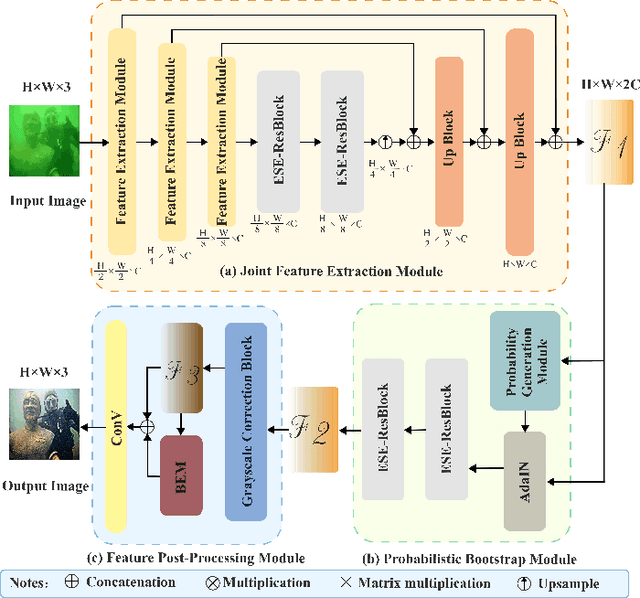
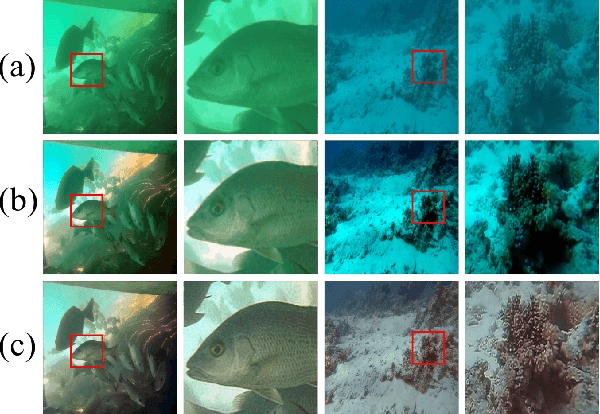
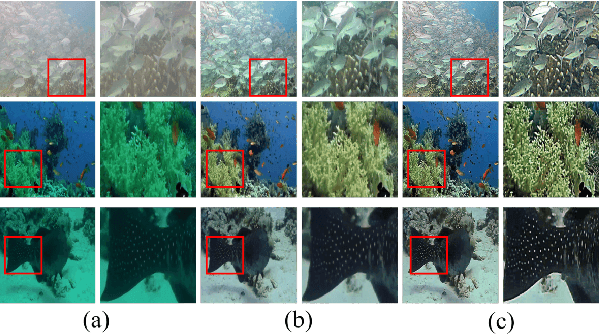
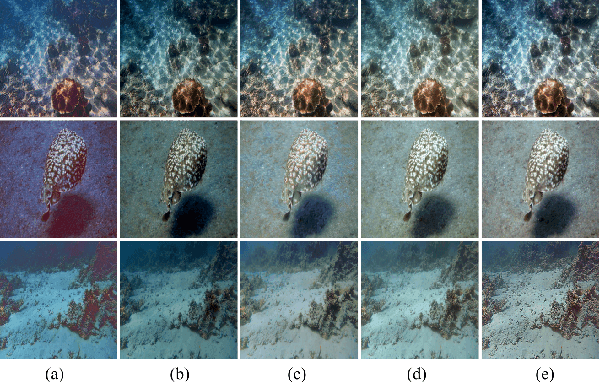
Given the complexity of underwater environments and the variability of water as a medium, underwater images are inevitably subject to various types of degradation. The degradations present nonlinear coupling rather than simple superposition, which renders the effective processing of such coupled degradations particularly challenging. Most existing methods focus on designing specific branches, modules, or strategies for specific degradations, with little attention paid to the potential information embedded in their coupling. Consequently, they struggle to effectively capture and process the nonlinear interactions of multiple degradations from a bottom-up perspective. To address this issue, we propose JDPNet, a joint degradation processing network, that mines and unifies the potential information inherent in coupled degradations within a unified framework. Specifically, we introduce a joint feature-mining module, along with a probabilistic bootstrap distribution strategy, to facilitate effective mining and unified adjustment of coupled degradation features. Furthermore, to balance color, clarity, and contrast, we design a novel AquaBalanceLoss to guide the network in learning from multiple coupled degradation losses. Experiments on six publicly available underwater datasets, as well as two new datasets constructed in this study, show that JDPNet exhibits state-of-the-art performance while offering a better tradeoff between performance, parameter size, and computational cost.
Preserving Cross-Modal Consistency for CLIP-based Class-Incremental Learning
Nov 14, 2025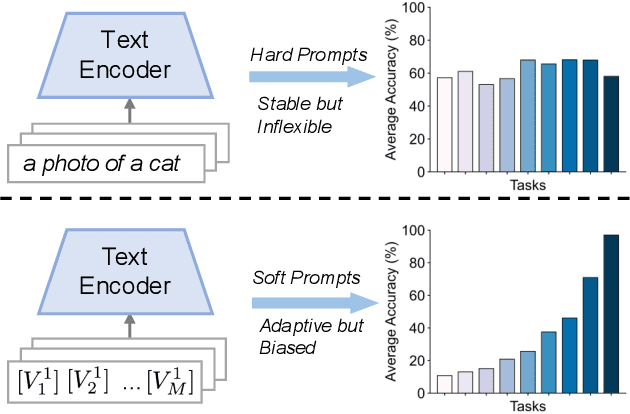
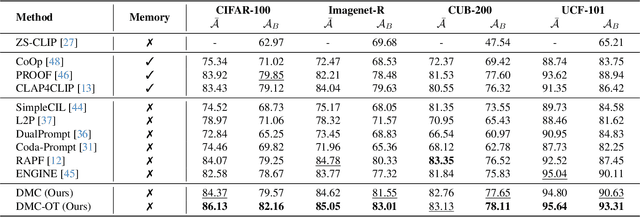
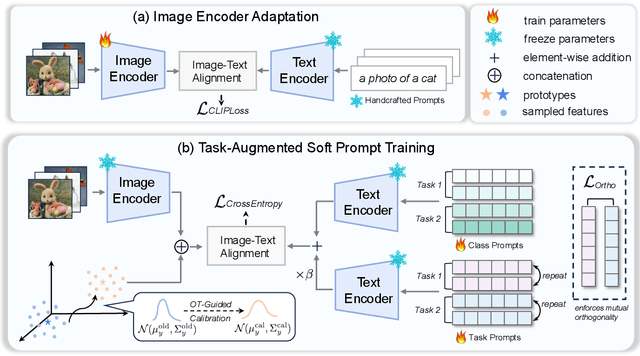
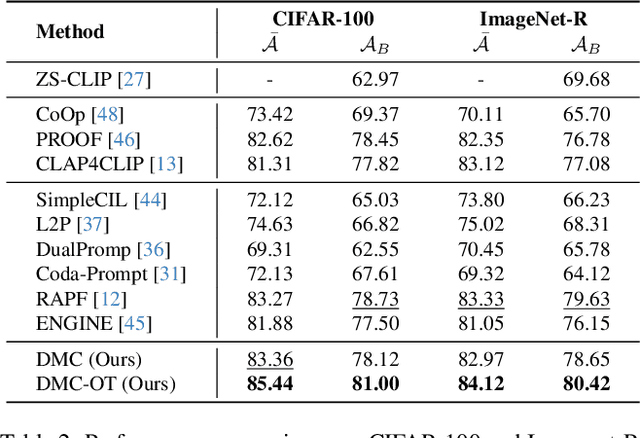
Class-incremental learning (CIL) enables models to continuously learn new categories from sequential tasks without forgetting previously acquired knowledge. While recent advances in vision-language models such as CLIP have demonstrated strong generalization across domains, extending them to continual settings remains challenging. In particular, learning task-specific soft prompts for newly introduced classes often leads to severe classifier bias, as the text prototypes overfit to recent categories when prior data are unavailable. In this paper, we propose DMC, a simple yet effective two-stage framework for CLIP-based CIL that decouples the adaptation of the vision encoder and the optimization of textual soft prompts. Each stage is trained with the other frozen, allowing one modality to act as a stable semantic anchor for the other to preserve cross-modal alignment. Furthermore, current CLIP-based CIL approaches typically store class-wise Gaussian statistics for generative replay, yet they overlook the distributional drift that arises when the vision encoder is updated over time. To address this issue, we introduce DMC-OT, an enhanced version of DMC that incorporates an optimal-transport guided calibration strategy to align memory statistics across evolving encoders, along with a task-specific prompting design that enhances inter-task separability. Extensive experiments on CIFAR-100, Imagenet-R, CUB-200, and UCF-101 demonstrate that both DMC and DMC-OT achieve state-of-the-art performance, with DMC-OT further improving accuracy by an average of 1.80%.