 Add to Chrome
 Add to Firefox
 Add to Edge
Tianmu-TC: Physics-constraints Generative Artificial Intelligence for Global Tropical Cyclone Forecasting
Aug 19, 2026
Tropical cyclones (TCs) pose severe risks from strong winds and heavy rainfall. However, forecasting their track and intensity remains challenging due to chaotic atmosphere and the rapid amplification of initial condition errors, leading to growing forecast uncertainty. While numerical weather prediction (NWP) and deep learning models have made progress, they remain computationally demanding and often fail under complex meteorological scenarios. Here, we present Tianmu-TC, a physics-constraints generative framework for global TC forecasting. Trained on Western North Pacific data, Tianmu-TC leverages physics-constraints to generate controllable outputs with reduced uncertainty thus improving forecast reliability. Experiments show Tianmu-TC outperforms deterministic and ensemble meteorological artificial intelligence models and authoritative NWP systems such as ECMWF in global ocean basins, with significantly lower computational cost. We further show Tianmu-TC performs well in challenging scenarios such as data sparsity, anomaly tracks, rapid intensification and weakening. These findings suggest physics-constraints generative AI offers a promising approach for reliable, efficient global TC forecasting.

MVG-KAN: Multi-View Geo-Wind Guided KAN for PM$_{2.5}$ Forecasting
Jun 23, 2026Accurate short-term PM$_{2.5}$ forecasting is important for public health protection, air-quality early warning, and urban environmental management. However, PM$_{2.5}$ variation is driven by multiple coupled factors, including stable periodic changes induced by human activities and meteorological regularity, station-specific short-term concentration evolution, and meteorology-driven pollutant dispersion among monitoring stations. Existing spatio-temporal forecasting methods may capture station relationships to some extent, but distance-only, correlation-based, or purely adaptive graphs are often insufficient to comprehensively represent these heterogeneous factors, especially wind-direction-dependent pollutant transport. To address this problem, we propose a Multi-View Geo-Wind Guided KAN model for PM$_{2.5}$ forecasting, named \textbf{MVG-KAN}, which models station-level PM$_{2.5}$ evolution from three complementary views: local periodic regularity, station-wise residual temporal dynamics, and meteorological-environment-guided spatial dispersion. Specifically, the periodic-residual forecasting backbone first separates stable daily and weekly patterns from non-periodic residual variations. A Geo-Wind Graph is constructed by combining geographic distance decay with wind-direction- and wind-speed-aware transport, providing a lightweight physically motivated directed spatial prior for residual propagation among stations. In addition, a temporal Kolmogorov-Arnold network (TKAN) residual head is then introduced to learn station-wise nonlinear autoregressive correction from de-periodized PM$_{2.5}$ residuals and historical multi-pollutant sequences, thereby enhancing the modeling of local residual inertia and pollutant co-variation.
Unification of Closed-Open Industrial Detection Scenarios: New Large-Scale Benchmarks,Challenges and Baselines
Jun 06, 2026Large-scale Visual-Language Models (LVLMs) have achieved remarkable success in natural visual tasks, yet their application to industrial defect detection remains challenging due to two fundamental limitations: (i) the scarcity of large-scale industrial datasets that cover diverse defect categories across multiple domains, and (ii) the reliance on manual prompts (points, boxes, masks) that introduce subjective noise and lack text-visual interaction for fine-grained understanding. To address these challenges, we introduce a Large-Scale Multi-Modal Industrial Open-Closed benchmark (MMIOC-1M) containing over one million samples across $14$ super-categories, $29$ industrial scenes, and $351$ defect subcategories. To our knowledge, MMIOC-1M is the first unified largest benchmark supporting both open-vocabulary and closed-set industrial detection, providing valuable pre-training data for LVLMs in industrial scenarios. Furthermore, we propose a Refined Text-Visual Prompt Network (RTVPNet) that incorporates three key innovations: (1) an expert-assisted domain projection mechanism that enables rapid adaptation of general vision models to industrial domains, (2) an energy-based sparse sampling strategy that automatically generates refined visual prompts without manual intervention, and (3) a bidirectional text-visual interaction module that enhances cross-modal semantic alignment and understanding. Extensive experiments demonstrate that RTVPNet achieves state-of-the-art performance on MMIOC-1M, LVIS, and COCO benchmarks while maintaining computational efficiency. The dataset and code are available at https://github.com/hellozzk/MMIO.
Zero-Shot Learning in Industrial Scenarios: New Large-Scale Benchmark, Challenges and Baseline
Jun 06, 2026Large Visual Language Models (LVLMs) have achieved remarkable success in vision tasks. However, the significant differences between industrial and natural scenes make applying LVLMs challenging. Existing LVLMs rely on user-provided prompts to segment objects. This often leads to suboptimal performance due to the inclusion of irrelevant pixels. In addition, the scarcity of data also makes the application of LVLMs in industrial scenarios remain unexplored. To fill this gap, this paper proposes an open industrial dataset and a Refined Text-Visual Prompt (RTVP) for zero-shot industrial defect detection. First, this paper constructs the Multi-Modal Industrial Open Dataset (MMIO) containing 80K+ samples. MMIO contains diverse industrial categories, including 6 super categories and 18 subcategories. MMIO is the first large-scale multi-scenes pre-training dataset for industrial zero-shot learning, and provides valuable training data for open models in future industrial scenarios. Based on MMIO, this paper provides a RTVP specifically for industrial zero-shot tasks. RTVP has two significant advantages: First, this paper designs an expert-guided large model domain adaptation mechanism and designs an industrial zero-shot method based on Mobile-SAM, which enhances the generalization ability of large models in industrial scenarios. Second, RTVP automatically generates visual prompts directly from images and considers text-visual prompt interactions ignored by previous LVLM, improving visual and textual content understanding. RTVP achieves SOTA with 42.2% and 24.7% AP in zero-shot and closed scenes of MMIO.
Integrating Weather Foundation Model and Satellite to Enable Fine-Grained Solar Irradiance Forecasting
Mar 17, 2026Accurate day-ahead solar irradiance forecasting is essential for integrating solar energy into the power grid. However, it remains challenging due to the pronounced diurnal cycle and inherently complex cloud dynamics. Current methods either lack fine-scale resolution (e.g., numerical weather prediction, weather foundation models) or degrade at longer lead times (e.g., satellite extrapolation). We propose Baguan-solar, a two-stage multimodal framework that fuses forecasts from Baguan, a global weather foundation model, with high-resolution geostationary satellite imagery to produce 24- hour irradiance forecasts at kilometer scale. Its decoupled two-stage design first forecasts day-night continuous intermediates (e.g., cloud cover) and then infers irradiance, while its modality fusion jointly preserves fine-scale cloud structures from satellite and large-scale constraints from Baguan forecasts. Evaluated over East Asia using CLDAS as ground truth, Baguan-solar outperforms strong baselines (including ECMWF IFS, vanilla Baguan, and SolarSeer), reducing RMSE by 16.08% and better resolving cloud-induced transients. An operational deployment of Baguan-solar has supported solar power forecasting in an eastern province in China, since July 2025. Our code is accessible at https://github.com/DAMO-DI-ML/Baguansolar. git.
Think, Then Verify: A Hypothesis-Verification Multi-Agent Framework for Long Video Understanding
Mar 05, 2026Long video understanding is challenging due to dense visual redundancy, long-range temporal dependencies, and the tendency of chain-of-thought and retrieval-based agents to accumulate semantic drift and correlation-driven errors. We argue that long-video reasoning should begin not with reactive retrieval, but with deliberate task formulation: the model must first articulate what must be true in the video for each candidate answer to hold. This thinking-before-finding principle motivates VideoHV-Agent, a framework that reformulates video question answering as a structured hypothesis-verification process. Based on video summaries, a Thinker rewrites answer candidates into testable hypotheses, a Judge derives a discriminative clue specifying what evidence must be checked, a Verifier grounds and tests the clue using localized, fine-grained video content, and an Answer agent integrates validated evidence to produce the final answer. Experiments on three long-video understanding benchmarks show that VideoHV-Agent achieves state-of-the-art accuracy while providing enhanced interpretability, improved logical soundness, and lower computational cost. We make our code publicly available at: https://github.com/Haorane/VideoHV-Agent.
KAN-FIF: Spline-Parameterized Lightweight Physics-based Tropical Cyclone Estimation on Meteorological Satellite
Feb 12, 2026Tropical cyclones (TC) are among the most destructive natural disasters, causing catastrophic damage to coastal regions through extreme winds, heavy rainfall, and storm surges. Timely monitoring of tropical cyclones is crucial for reducing loss of life and property, yet it is hindered by the computational inefficiency and high parameter counts of existing methods on resource-constrained edge devices. Current physics-guided models suffer from linear feature interactions that fail to capture high-order polynomial relationships between TC attributes, leading to inflated model sizes and hardware incompatibility. To overcome these challenges, this study introduces the Kolmogorov-Arnold Network-based Feature Interaction Framework (KAN-FIF), a lightweight multimodal architecture that integrates MLP and CNN layers with spline-parameterized KAN layers. For Maximum Sustained Wind (MSW) prediction, experiments demonstrate that the KAN-FIF framework achieves a $94.8\%$ reduction in parameters (0.99MB vs 19MB) and $68.7\%$ faster inference per sample (2.3ms vs 7.35ms) compared to baseline model Phy-CoCo, while maintaining superior accuracy with $32.5\%$ lower MAE. The offline deployment experiment of the FY-4 series meteorological satellite processor on the Qingyun-1000 development board achieved a 14.41ms per-sample inference latency with the KAN-FIF framework, demonstrating promising feasibility for operational TC monitoring and extending deployability to edge-device AI applications. The code is released at https://github.com/Jinglin-Zhang/KAN-FIF.
PMPGuard: Catching Pseudo-Matched Pairs in Remote Sensing Image-Text Retrieval
Dec 21, 2025Remote sensing (RS) image-text retrieval faces significant challenges in real-world datasets due to the presence of Pseudo-Matched Pairs (PMPs), semantically mismatched or weakly aligned image-text pairs, which hinder the learning of reliable cross-modal alignments. To address this issue, we propose a novel retrieval framework that leverages Cross-Modal Gated Attention and a Positive-Negative Awareness Attention mechanism to mitigate the impact of such noisy associations. The gated module dynamically regulates cross-modal information flow, while the awareness mechanism explicitly distinguishes informative (positive) cues from misleading (negative) ones during alignment learning. Extensive experiments on three benchmark RS datasets, i.e., RSICD, RSITMD, and RS5M, demonstrate that our method consistently achieves state-of-the-art performance, highlighting its robustness and effectiveness in handling real-world mismatches and PMPs in RS image-text retrieval tasks.
IDOL: Meeting Diverse Distribution Shifts with Prior Physics for Tropical Cyclone Multi-Task Estimation
Nov 13, 2025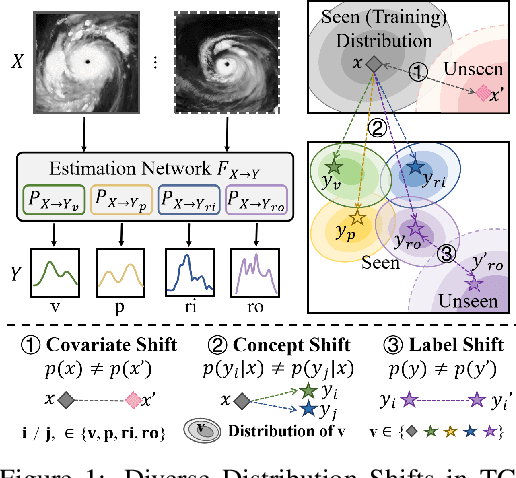
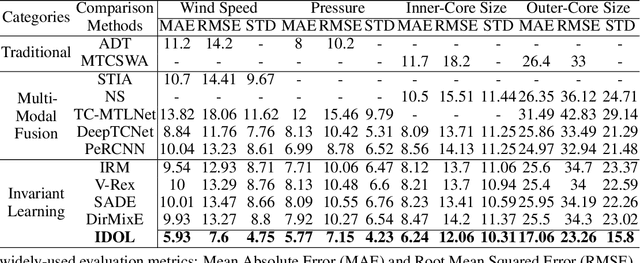
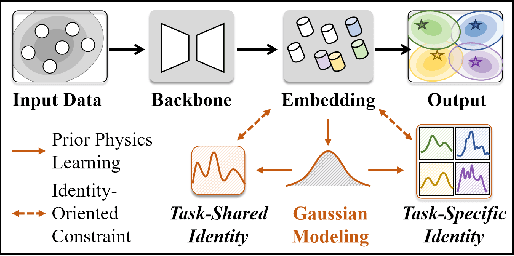

Tropical Cyclone (TC) estimation aims to accurately estimate various TC attributes in real time. However, distribution shifts arising from the complex and dynamic nature of TC environmental fields, such as varying geographical conditions and seasonal changes, present significant challenges to reliable estimation. Most existing methods rely on multi-modal fusion for feature extraction but overlook the intrinsic distribution of feature representations, leading to poor generalization under out-of-distribution (OOD) scenarios. To address this, we propose an effective Identity Distribution-Oriented Physical Invariant Learning framework (IDOL), which imposes identity-oriented constraints to regulate the feature space under the guidance of prior physical knowledge, thereby dealing distribution variability with physical invariance. Specifically, the proposed IDOL employs the wind field model and dark correlation knowledge of TC to model task-shared and task-specific identity tokens. These tokens capture task dependencies and intrinsic physical invariances of TC, enabling robust estimation of TC wind speed, pressure, inner-core, and outer-core size under distribution shifts. Extensive experiments conducted on multiple datasets and tasks demonstrate the outperformance of the proposed IDOL, verifying that imposing identity-oriented constraints based on prior physical knowledge can effectively mitigates diverse distribution shifts in TC estimation.Code is available at https://github.com/Zjut-MultimediaPlus/IDOL.
From Swath to Full-Disc: Advancing Precipitation Retrieval with Multimodal Knowledge Expansion
Jun 08, 2025Accurate near-real-time precipitation retrieval has been enhanced by satellite-based technologies. However, infrared-based algorithms have low accuracy due to weak relations with surface precipitation, whereas passive microwave and radar-based methods are more accurate but limited in range. This challenge motivates the Precipitation Retrieval Expansion (PRE) task, which aims to enable accurate, infrared-based full-disc precipitation retrievals beyond the scanning swath. We introduce Multimodal Knowledge Expansion, a two-stage pipeline with the proposed PRE-Net model. In the Swath-Distilling stage, PRE-Net transfers knowledge from a multimodal data integration model to an infrared-based model within the scanning swath via Coordinated Masking and Wavelet Enhancement (CoMWE). In the Full-Disc Adaptation stage, Self-MaskTune refines predictions across the full disc by balancing multimodal and full-disc infrared knowledge. Experiments on the introduced PRE benchmark demonstrate that PRE-Net significantly advanced precipitation retrieval performance, outperforming leading products like PERSIANN-CCS, PDIR, and IMERG. The code will be available at https://github.com/Zjut-MultimediaPlus/PRE-Net.