 Add to Chrome
 Add to Firefox
 Add to Edge
JDPNet: A Network Based on Joint Degradation Processing for Underwater Image Enhancement
Dec 23, 2025
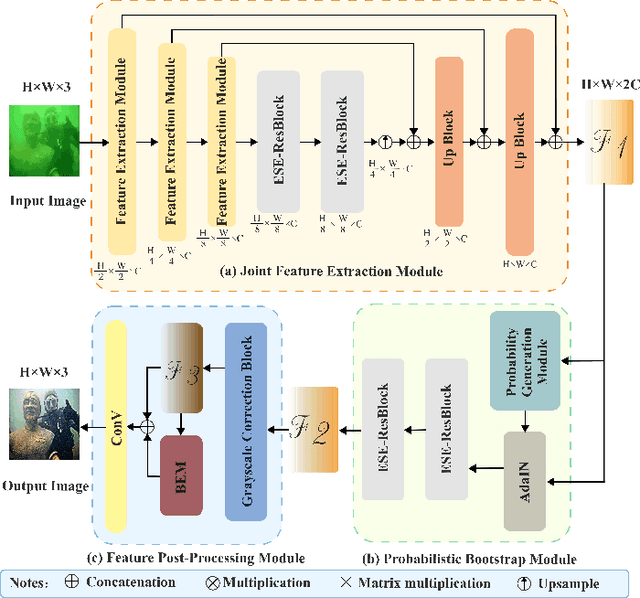
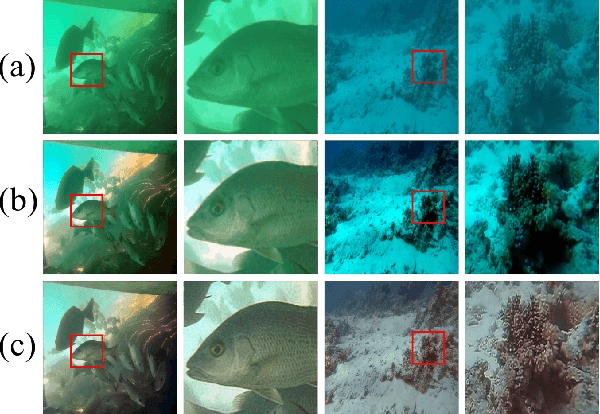
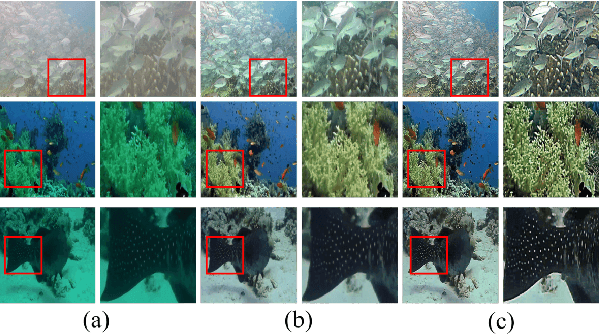
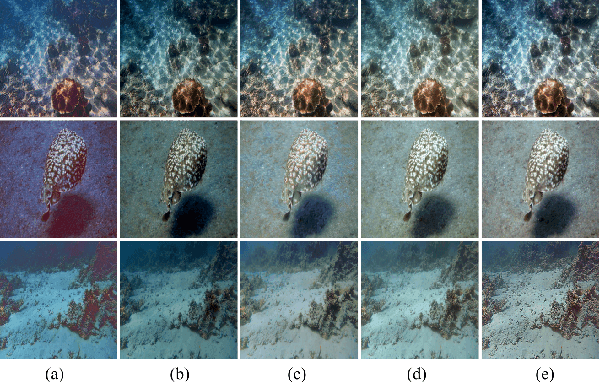
Given the complexity of underwater environments and the variability of water as a medium, underwater images are inevitably subject to various types of degradation. The degradations present nonlinear coupling rather than simple superposition, which renders the effective processing of such coupled degradations particularly challenging. Most existing methods focus on designing specific branches, modules, or strategies for specific degradations, with little attention paid to the potential information embedded in their coupling. Consequently, they struggle to effectively capture and process the nonlinear interactions of multiple degradations from a bottom-up perspective. To address this issue, we propose JDPNet, a joint degradation processing network, that mines and unifies the potential information inherent in coupled degradations within a unified framework. Specifically, we introduce a joint feature-mining module, along with a probabilistic bootstrap distribution strategy, to facilitate effective mining and unified adjustment of coupled degradation features. Furthermore, to balance color, clarity, and contrast, we design a novel AquaBalanceLoss to guide the network in learning from multiple coupled degradation losses. Experiments on six publicly available underwater datasets, as well as two new datasets constructed in this study, show that JDPNet exhibits state-of-the-art performance while offering a better tradeoff between performance, parameter size, and computational cost.

Lumine: An Open Recipe for Building Generalist Agents in 3D Open Worlds
Nov 12, 2025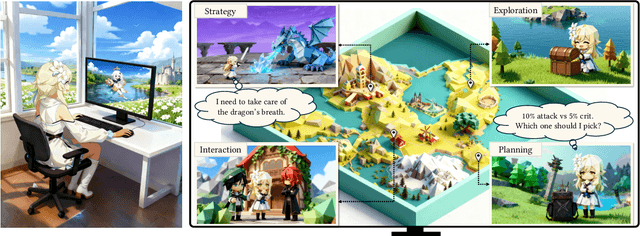
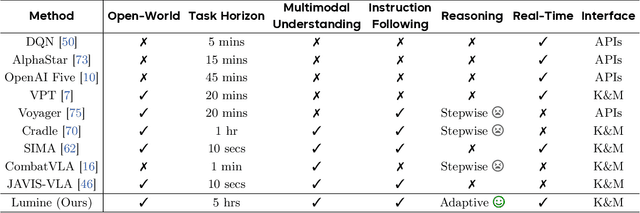
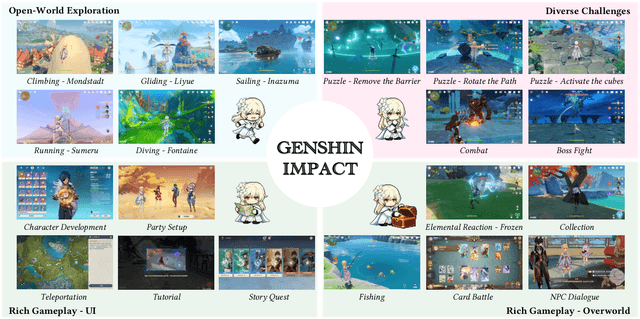
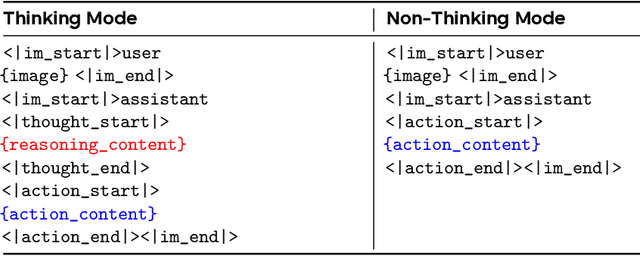
We introduce Lumine, the first open recipe for developing generalist agents capable of completing hours-long complex missions in real time within challenging 3D open-world environments. Lumine adopts a human-like interaction paradigm that unifies perception, reasoning, and action in an end-to-end manner, powered by a vision-language model. It processes raw pixels at 5 Hz to produce precise 30 Hz keyboard-mouse actions and adaptively invokes reasoning only when necessary. Trained in Genshin Impact, Lumine successfully completes the entire five-hour Mondstadt main storyline on par with human-level efficiency and follows natural language instructions to perform a broad spectrum of tasks in both 3D open-world exploration and 2D GUI manipulation across collection, combat, puzzle-solving, and NPC interaction. In addition to its in-domain performance, Lumine demonstrates strong zero-shot cross-game generalization. Without any fine-tuning, it accomplishes 100-minute missions in Wuthering Waves and the full five-hour first chapter of Honkai: Star Rail. These promising results highlight Lumine's effectiveness across distinct worlds and interaction dynamics, marking a concrete step toward generalist agents in open-ended environments.
Model Merging in Pre-training of Large Language Models
May 17, 2025Model merging has emerged as a promising technique for enhancing large language models, though its application in large-scale pre-training remains relatively unexplored. In this paper, we present a comprehensive investigation of model merging techniques during the pre-training process. Through extensive experiments with both dense and Mixture-of-Experts (MoE) architectures ranging from millions to over 100 billion parameters, we demonstrate that merging checkpoints trained with constant learning rates not only achieves significant performance improvements but also enables accurate prediction of annealing behavior. These improvements lead to both more efficient model development and significantly lower training costs. Our detailed ablation studies on merging strategies and hyperparameters provide new insights into the underlying mechanisms while uncovering novel applications. Through comprehensive experimental analysis, we offer the open-source community practical pre-training guidelines for effective model merging.