 Add to Chrome
 Add to Firefox
 Add to Edge
CameraNoise: Enabling Faithful Camera Control in Video Diffusion through Geometry-Flow-Guided Noise Warping
May 29, 2026
Precise camera pose control is critical for video diffusion, yet maintaining geometric consistency remains a challenge. Existing methods that directly inject numerical camera parameters into the diffusion backbone often fail to bridge the gap between abstract coordinates and visual content, leading to structural distortions. To address this issue, we propose CameraNoise, a flow-to-noise warping method that encodes camera motion into a temporally coherent stochastic representation. Unlike conventional conditioning, CameraNoise embeds camera poses directly into the noise space. This decouples motion from scene appearance while faithfully preserving trajectory dynamics. Specifically, we introduce a novel Geometry-guided Reprojection Flow and a noise warping algorithm, which jointly preserve the Gaussian prior of diffusion and ensure consistent noise propagation under camera transformations. By integrating CameraNoise into the diffusion process, our framework delivers stable, high-fidelity videos. Extensive experiments demonstrate that our approach significantly outperforms prior methods in both visual quality and trajectory faithfulness. The project page and code are available at: https://gulucaptain.github.io/CameraNoise/.
* 28 pages, 16 figures

Mixture of Complementary Agents for Robust LLM Ensemble
May 21, 2026Multi-AI collaboration, such as ensembling or debating large language models (LLMs), is a promising paradigm for aggregating information and boosting performance. A foundational step in these pipelines is to feed the responses of several proposer LLMs into a summarizer LLM, which synthesizes a better answer. However, choosing which proposers to include is non-trivial. Existing approaches primarily focus either on accuracy (picking the strongest models) or diversity (ensuring variety), and often overlook the interactions among proposers and with the summarizer. We reframe proposer selection as a combinatorial selection problem akin to feature selection, where the value of an LLM lies in its complementarity with others. However, directly applying standard feature-selection algorithms is impractical in the LLM setting due to prohibitive time complexity. Motivated by this limitation, we explore an extensive range of computationally feasible, greedy-style selection algorithms that assess complementarity using a small labeled set. Our experiments validate complementarity as a guiding principle for proposer selection and identify methods that achieve the best performance-cost trade-offs in practice.
Prototype-Guided Classification Sub-Task Decoupling Framework: Enhancing Generalization and Interpretability for Multivariate Time Series
May 21, 2026Time Series Classification (TSC) is a long-standing research problem that has gained increasing attention in recent years with the rapid growth of large-scale temporal data. Despite substantial progress enabled by deep learning, designing TSC models that are both accurate and interpretable remains a challenging task. Many existing approaches adopt a direct feature-to-label classification paradigm, by collapsing high-dimensional temporal embeddings into class logits via a single linear projection (often after global pooling), the paradigm conflates feature extraction and decision logic into an inseparable mapping. To address these limitations, we propose PDFTime, a prototype-guided framework that reformulates time series classification as a multi-stage decision process. Instead of direct feature-to-label mapping, PDFTime leverages learned prototypes to approximate class-conditional feature distributions in the latent space, enabling progressive discrimination through classification sub-tasks of varying granularity. To our knowledge, PDFTime is the first framework to reformulate time series classification as a decoupled, multi-stage similarity-based reasoning process, breaking the long-standing paradigm of direct, black-box feature-to-label mapping. Extensive evaluations demonstrate that PDFTime achieves state-of-the-art (SOTA) performance across UEA and UCR benchmarks. Notably, it secures the top-$1$ accuracy on 80 out of 128 datasets in the UCR archive, significantly outperforming recent strong baselines in both consistency and generalization.
Agent-Centric Visual Reinforcement Learning under Dynamic Perturbations
Apr 28, 2026Visual reinforcement learning aims to empower an agent to learn policies from visual observations, yet it remains vulnerable to dynamic visual perturbations, such as unpredictable shifts in corruption types. To systematically study this, we introduce the Visual Degraded Control Suite (VDCS), a benchmark extending DeepMind Control Suite with Markov-switching degradations to simulate non-stationary real-world perturbations. Experiments on VDCS reveal severe performance degradation in existing methods. We theoretically prove via information-theoretic analysis that this failure stems from reconstruction-based objectives inevitably entangling perturbation artifacts into latent representations. To mitigate this negative impact, we propose Agent-Centric Observations with Mixture-of-Experts (ACO-MoE) to robustify visual RL against perturbations. The proposed framework leverages unique agent-centric restoration experts, achieving restoration from corruptions and task-relevant foreground extraction, thereby decoupling perception from perturbation before being processed by the RL agent. Extensive experiments on VDCS show our ACO-MoE outperforms strong baselines, recovering 95.3% of clean performance under challenging Markov-switching corruptions. Moreover, it achieves SOTA results on DMControl Generalization with random-color and video-background perturbations, demonstrating a high level of robustness.
Optimally Auditing Adversarial Agents
Apr 28, 2026Fraud can pose a challenge in many resource allocation domains, including social service delivery and credit provision. For example, agents may misreport private information in order to gain benefits or access to credit. To mitigate this, a principal can design strategic audits to verify claims and penalize misreporting. In this paper, we introduce a general model of audit policy design as a principal-agent game with multiple agents, where the principal commits to an audit policy, and agents collectively choose an equilibrium that minimizes the principal's utility. We examine both adaptive and non-adaptive settings, depending on whether the principal's policy can be responsive to the distribution of agent reports. Our work provides efficient algorithms for computing optimal audit policies in both settings and extends these results to a setting with limited audit budgets.
* Published in Proceedings of the AAAI Conference on Artificial Intelligence (AAAI), 2026, pages 16787-16794
CT-1: Vision-Language-Camera Models Transfer Spatial Reasoning Knowledge to Camera-Controllable Video Generation
Apr 10, 2026Camera-controllable video generation aims to synthesize videos with flexible and physically plausible camera movements. However, existing methods either provide imprecise camera control from text prompts or rely on labor-intensive manual camera trajectory parameters, limiting their use in automated scenarios. To address these issues, we propose a novel Vision-Language-Camera model, termed CT-1 (Camera Transformer 1), a specialized model designed to transfer spatial reasoning knowledge to video generation by accurately estimating camera trajectories. Built upon vision-language modules and a Diffusion Transformer model, CT-1 employs a Wavelet-based Regularization Loss in the frequency domain to effectively learn complex camera trajectory distributions. These trajectories are integrated into a video diffusion model to enable spatially aware camera control that aligns with user intentions. To facilitate the training of CT-1, we design a dedicated data curation pipeline and construct CT-200K, a large-scale dataset containing over 47M frames. Experimental results demonstrate that our framework successfully bridges the gap between spatial reasoning and video synthesis, yielding faithful and high-quality camera-controllable videos and improving camera control accuracy by 25.7% over prior methods.
TAU-R1: Visual Language Model for Traffic Anomaly Understanding
Mar 19, 2026Traffic Anomaly Understanding (TAU) is important for traffic safety in Intelligent Transportation Systems. Recent vision-language models (VLMs) have shown strong capabilities in video understanding. However, progress on TAU remains limited due to the lack of benchmarks and task-specific methodologies. To address this limitation, we introduce Roundabout-TAU, a dataset constructed from real-world roundabout videos collected in collaboration with the City of Carmel, Indiana. The dataset contains 342 clips and is annotated with more than 2,000 question-answer pairs covering multiple aspects of traffic anomaly understanding. Building on this benchmark, we propose TAU-R1, a two-layer vision-language framework for TAU. The first layer is a lightweight anomaly classifier that performs coarse anomaly categorisation, while the second layer is a larger anomaly reasoner that generates detailed event summaries. To improve task-specific reasoning, we introduce a two-stage training strategy consisting of decomposed-QA-enhanced supervised fine-tuning followed by TAU-GRPO, a GRPO-based post-training method with TAU-specific reward functions. Experimental results show that TAU-R1 achieves strong performance on both anomaly classification and reasoning tasks while maintaining deployment efficiency. The dataset and code are available at: https://github.com/siri-rouser/TAU-R1
DCDM: Divide-and-Conquer Diffusion Models for Consistency-Preserving Video Generation
Feb 14, 2026Recent video generative models have demonstrated impressive visual fidelity, yet they often struggle with semantic, geometric, and identity consistency. In this paper, we propose a system-level framework, termed the Divide-and-Conquer Diffusion Model (DCDM), to address three key challenges: (1) intra-clip world knowledge consistency, (2) inter-clip camera consistency, and (3) inter-shot element consistency. DCDM decomposes video consistency modeling under these scenarios into three dedicated components while sharing a unified video generation backbone. For intra-clip consistency, DCDM leverages a large language model to parse input prompts into structured semantic representations, which are subsequently translated into coherent video content by a diffusion transformer. For inter-clip camera consistency, we propose a temporal camera representation in the noise space that enables precise and stable camera motion control, along with a text-to-image initialization mechanism to further enhance controllability. For inter-shot consistency, DCDM adopts a holistic scene generation paradigm with windowed cross-attention and sparse inter-shot self-attention, ensuring long-range narrative coherence while maintaining computational efficiency. We validate our framework on the test set of the CVM Competition at AAAI'26, and the results demonstrate that the proposed strategies effectively address these challenges.
Shared Spatial Memory Through Predictive Coding
Nov 06, 2025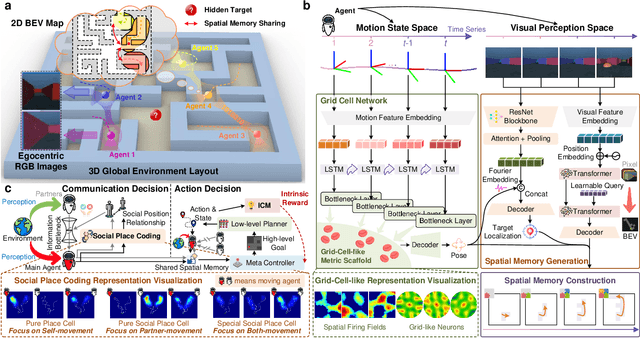
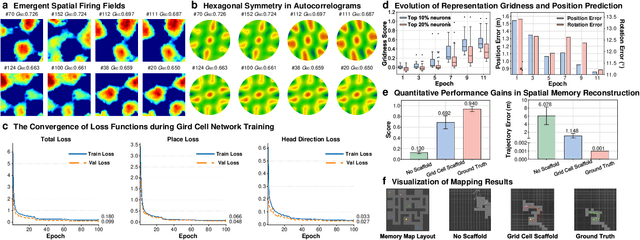
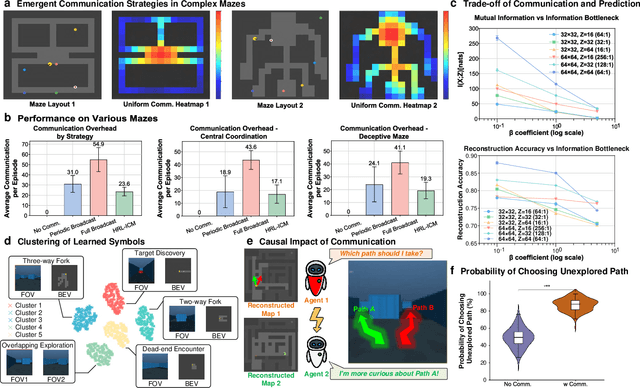
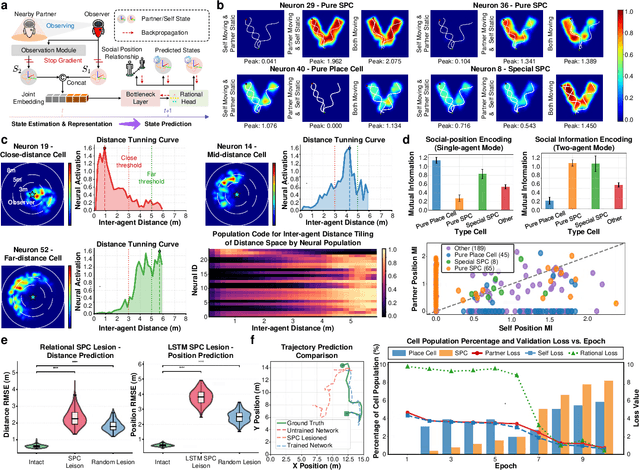
Sharing and reconstructing a consistent spatial memory is a critical challenge in multi-agent systems, where partial observability and limited bandwidth often lead to catastrophic failures in coordination. We introduce a multi-agent predictive coding framework that formulate coordination as the minimization of mutual uncertainty among agents. Instantiated as an information bottleneck objective, it prompts agents to learn not only who and what to communicate but also when. At the foundation of this framework lies a grid-cell-like metric as internal spatial coding for self-localization, emerging spontaneously from self-supervised motion prediction. Building upon this internal spatial code, agents gradually develop a bandwidth-efficient communication mechanism and specialized neural populations that encode partners' locations: an artificial analogue of hippocampal social place cells (SPCs). These social representations are further enacted by a hierarchical reinforcement learning policy that actively explores to reduce joint uncertainty. On the Memory-Maze benchmark, our approach shows exceptional resilience to bandwidth constraints: success degrades gracefully from 73.5% to 64.4% as bandwidth shrinks from 128 to 4 bits/step, whereas a full-broadcast baseline collapses from 67.6% to 28.6%. Our findings establish a theoretically principled and biologically plausible basis for how complex social representations emerge from a unified predictive drive, leading to social collective intelligence.
Diffusion^2: Dual Diffusion Model with Uncertainty-Aware Adaptive Noise for Momentary Trajectory Prediction
Oct 05, 2025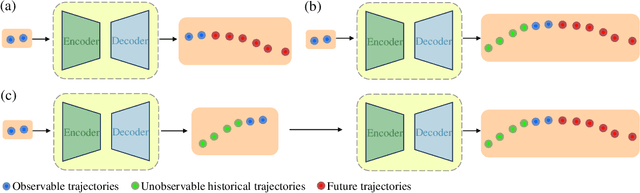
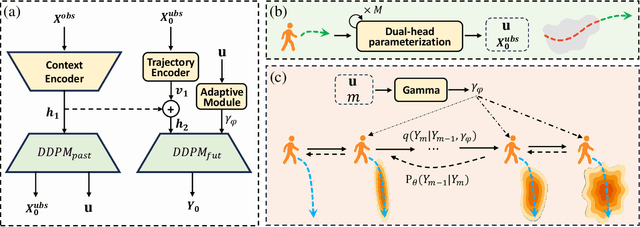
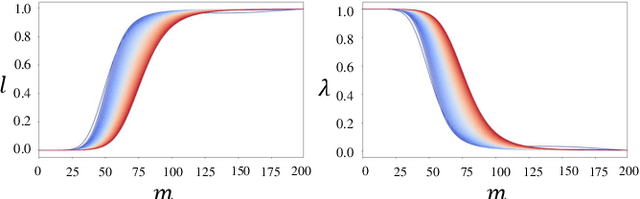
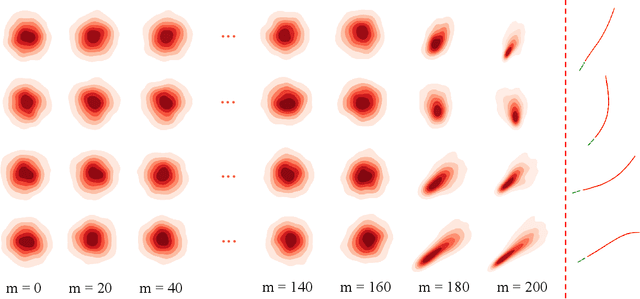
Accurate pedestrian trajectory prediction is crucial for ensuring safety and efficiency in autonomous driving and human-robot interaction scenarios. Earlier studies primarily utilized sufficient observational data to predict future trajectories. However, in real-world scenarios, such as pedestrians suddenly emerging from blind spots, sufficient observational data is often unavailable (i.e. momentary trajectory), making accurate prediction challenging and increasing the risk of traffic accidents. Therefore, advancing research on pedestrian trajectory prediction under extreme scenarios is critical for enhancing traffic safety. In this work, we propose a novel framework termed Diffusion^2, tailored for momentary trajectory prediction. Diffusion^2 consists of two sequentially connected diffusion models: one for backward prediction, which generates unobserved historical trajectories, and the other for forward prediction, which forecasts future trajectories. Given that the generated unobserved historical trajectories may introduce additional noise, we propose a dual-head parameterization mechanism to estimate their aleatoric uncertainty and design a temporally adaptive noise module that dynamically modulates the noise scale in the forward diffusion process. Empirically, Diffusion^2 sets a new state-of-the-art in momentary trajectory prediction on ETH/UCY and Stanford Drone datasets.