 Add to Chrome
 Add to Firefox
 Add to Edge
ID-VTG: Image-Disambiguated Video Temporal Grounding
Aug 20, 2026
Video Temporal Grounding (VTG) faces significant challenges when natural language queries must distinguish between multiple events involving visually similar entities, particularly when relying on fine-grained visual attributes that are difficult to describe accurately in words alone. To address this, we introduce Image-Disambiguated Video Temporal Grounding (ID-VTG), a task that leverages multimodal queries combining a reference image and a text description to precisely localize segments where a specific instance performs a described action. To facilitate research, we construct two benchmarks: IDVTG-Gym, focusing on fine-grained, compositionally ordered gymnastics actions with athletes in similar uniforms; and IDVTG-InternVid, an open-world dataset featuring diverse entities (e.g., humans, animals, fictional characters) and significant temporal distractors. Methodologically, we propose the Visually-Guided Disambiguation Aggregation (VGD-Agg) framework based on a dual-branch fast-slow architecture. The fast branch efficiently generates preliminary event proposals, while the slow branch performs fine-grained frame-level matching between video frames and the reference image. We enhance discriminability via two learnable tokens: a Compare Token, which represents hard negatives to probe for the presence of the target instance (as referred to by the query image), and a Depress Value, which represents text-irrelevant events. Proposals that the Compare Token identifies as lacking the target instance are pushed toward the Depress Value, thus easing disambiguation via the text query. Extensive experiments validate our approach, which achieves state-of-the-art results on the proposed benchmarks. Code is available at https://github.com/oceanflowlab/ID-VTG.

CameraNoise: Enabling Faithful Camera Control in Video Diffusion through Geometry-Flow-Guided Noise Warping
May 29, 2026Precise camera pose control is critical for video diffusion, yet maintaining geometric consistency remains a challenge. Existing methods that directly inject numerical camera parameters into the diffusion backbone often fail to bridge the gap between abstract coordinates and visual content, leading to structural distortions. To address this issue, we propose CameraNoise, a flow-to-noise warping method that encodes camera motion into a temporally coherent stochastic representation. Unlike conventional conditioning, CameraNoise embeds camera poses directly into the noise space. This decouples motion from scene appearance while faithfully preserving trajectory dynamics. Specifically, we introduce a novel Geometry-guided Reprojection Flow and a noise warping algorithm, which jointly preserve the Gaussian prior of diffusion and ensure consistent noise propagation under camera transformations. By integrating CameraNoise into the diffusion process, our framework delivers stable, high-fidelity videos. Extensive experiments demonstrate that our approach significantly outperforms prior methods in both visual quality and trajectory faithfulness. The project page and code are available at: https://gulucaptain.github.io/CameraNoise/.
* 28 pages, 16 figures
Dynamic Throwing with Robotic Material Handling Machines
May 29, 2024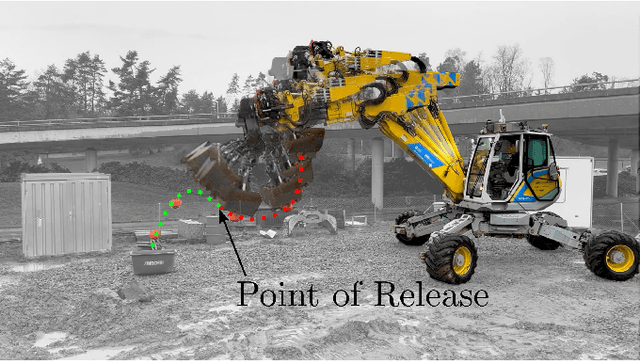
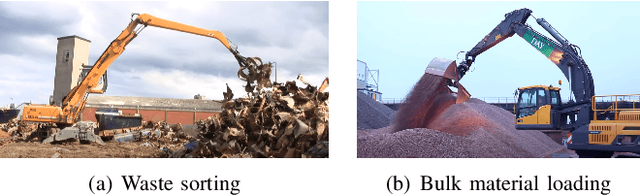
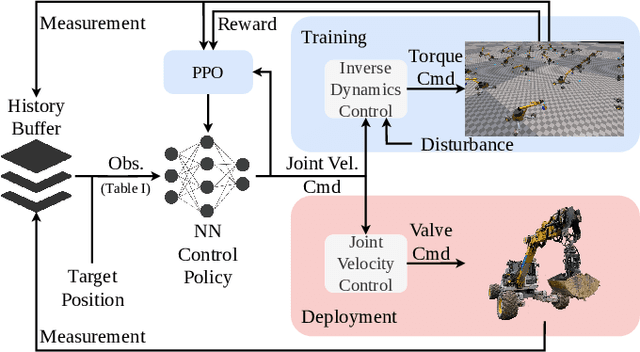
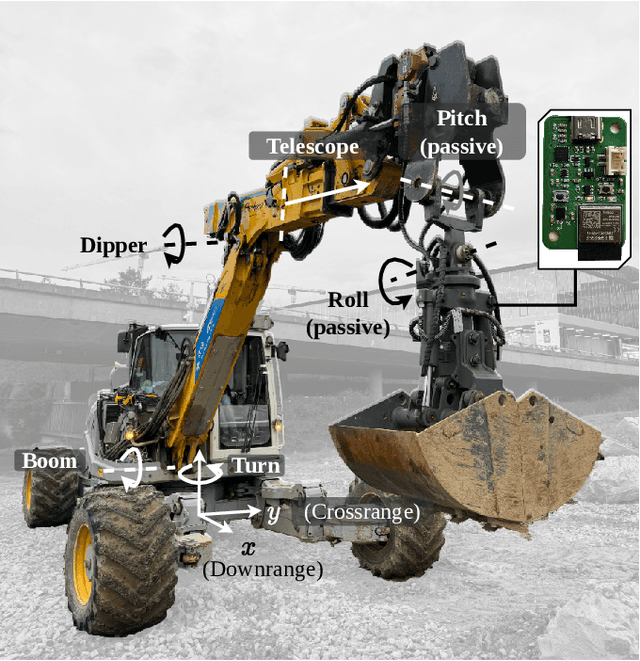
Automation of hydraulic material handling machinery is currently limited to semi-static pick-and-place cycles. Dynamic throwing motions which utilize the passive joints, can greatly improve time efficiency as well as increase the dumping workspace. In this work, we use Reinforcement Learning (RL) to design dynamic controllers for material handlers with underactuated arms as commonly used in logistics. The controllers are tested both in simulation and in real-world experiments on a 12-ton test platform. The method is able to exploit the passive joints of the gripper to perform dynamic throwing motions. With the proposed controllers, the machine is able to throw individual objects to targets outside the static reachability zone with good accuracy for its practical applications. The work demonstrates the possibility of using RL to perform highly dynamic tasks with heavy machinery, suggesting a potential for improving the efficiency and precision of autonomous material handling tasks.
Application of Artificial Intelligence in Schizophrenia Rehabilitation Management: Systematic Literature Review
May 17, 2024This review aims to systematically assess the current status and prospects of artificial intelligence (AI) in the rehabilitation management of patients with schizophrenia and their impact on the rehabilitation process. We selected 70 studies from 2012 to the present, focusing on application, technology categories, products, and data types of machine learning, deep learning, reinforcement learning, and other technologies in mental health interventions and management. The results indicate that AI can be widely used in symptom monitoring, relapse risk prediction, and rehabilitation treatment by analyzing ecological momentary assessment, behavioral, and speech data. This review further explores the potential challenges and future directions of emerging products, technologies, and analytical methods based on AI, such as social media analysis, serious games, and large language models in rehabilitation. In summary, this study systematically reviews the application status of AI in schizophrenia rehabilitation management and provides valuable insights and recommendations for future research paths.