 Add to Chrome
 Add to Firefox
 Add to Edge
CameraNoise: Enabling Faithful Camera Control in Video Diffusion through Geometry-Flow-Guided Noise Warping
May 29, 2026
Precise camera pose control is critical for video diffusion, yet maintaining geometric consistency remains a challenge. Existing methods that directly inject numerical camera parameters into the diffusion backbone often fail to bridge the gap between abstract coordinates and visual content, leading to structural distortions. To address this issue, we propose CameraNoise, a flow-to-noise warping method that encodes camera motion into a temporally coherent stochastic representation. Unlike conventional conditioning, CameraNoise embeds camera poses directly into the noise space. This decouples motion from scene appearance while faithfully preserving trajectory dynamics. Specifically, we introduce a novel Geometry-guided Reprojection Flow and a noise warping algorithm, which jointly preserve the Gaussian prior of diffusion and ensure consistent noise propagation under camera transformations. By integrating CameraNoise into the diffusion process, our framework delivers stable, high-fidelity videos. Extensive experiments demonstrate that our approach significantly outperforms prior methods in both visual quality and trajectory faithfulness. The project page and code are available at: https://gulucaptain.github.io/CameraNoise/.
* 28 pages, 16 figures

CT-1: Vision-Language-Camera Models Transfer Spatial Reasoning Knowledge to Camera-Controllable Video Generation
Apr 10, 2026Camera-controllable video generation aims to synthesize videos with flexible and physically plausible camera movements. However, existing methods either provide imprecise camera control from text prompts or rely on labor-intensive manual camera trajectory parameters, limiting their use in automated scenarios. To address these issues, we propose a novel Vision-Language-Camera model, termed CT-1 (Camera Transformer 1), a specialized model designed to transfer spatial reasoning knowledge to video generation by accurately estimating camera trajectories. Built upon vision-language modules and a Diffusion Transformer model, CT-1 employs a Wavelet-based Regularization Loss in the frequency domain to effectively learn complex camera trajectory distributions. These trajectories are integrated into a video diffusion model to enable spatially aware camera control that aligns with user intentions. To facilitate the training of CT-1, we design a dedicated data curation pipeline and construct CT-200K, a large-scale dataset containing over 47M frames. Experimental results demonstrate that our framework successfully bridges the gap between spatial reasoning and video synthesis, yielding faithful and high-quality camera-controllable videos and improving camera control accuracy by 25.7% over prior methods.
DCDM: Divide-and-Conquer Diffusion Models for Consistency-Preserving Video Generation
Feb 14, 2026Recent video generative models have demonstrated impressive visual fidelity, yet they often struggle with semantic, geometric, and identity consistency. In this paper, we propose a system-level framework, termed the Divide-and-Conquer Diffusion Model (DCDM), to address three key challenges: (1) intra-clip world knowledge consistency, (2) inter-clip camera consistency, and (3) inter-shot element consistency. DCDM decomposes video consistency modeling under these scenarios into three dedicated components while sharing a unified video generation backbone. For intra-clip consistency, DCDM leverages a large language model to parse input prompts into structured semantic representations, which are subsequently translated into coherent video content by a diffusion transformer. For inter-clip camera consistency, we propose a temporal camera representation in the noise space that enables precise and stable camera motion control, along with a text-to-image initialization mechanism to further enhance controllability. For inter-shot consistency, DCDM adopts a holistic scene generation paradigm with windowed cross-attention and sparse inter-shot self-attention, ensuring long-range narrative coherence while maintaining computational efficiency. We validate our framework on the test set of the CVM Competition at AAAI'26, and the results demonstrate that the proposed strategies effectively address these challenges.
ShoulderShot: Generating Over-the-Shoulder Dialogue Videos
Aug 11, 2025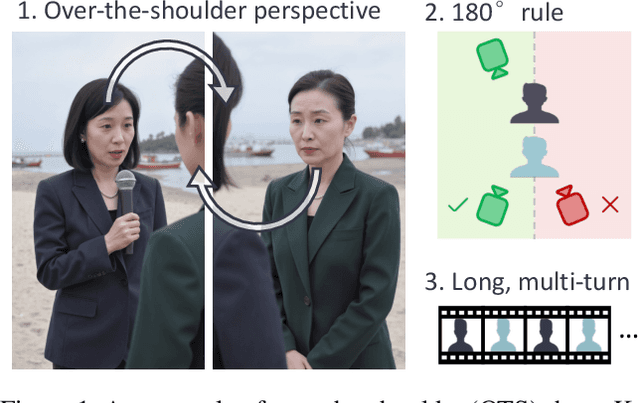
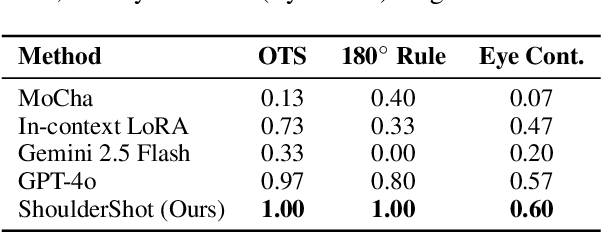

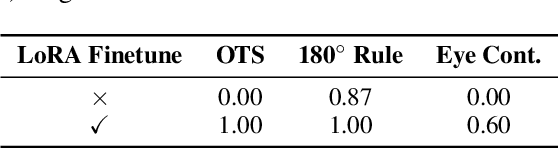
Over-the-shoulder dialogue videos are essential in films, short dramas, and advertisements, providing visual variety and enhancing viewers' emotional connection. Despite their importance, such dialogue scenes remain largely underexplored in video generation research. The main challenges include maintaining character consistency across different shots, creating a sense of spatial continuity, and generating long, multi-turn dialogues within limited computational budgets. Here, we present ShoulderShot, a framework that combines dual-shot generation with looping video, enabling extended dialogues while preserving character consistency. Our results demonstrate capabilities that surpass existing methods in terms of shot-reverse-shot layout, spatial continuity, and flexibility in dialogue length, thereby opening up new possibilities for practical dialogue video generation. Videos and comparisons are available at https://shouldershot.github.io.
Real-time Ad retrieval via LLM-generative Commercial Intention for Sponsored Search Advertising
Apr 02, 2025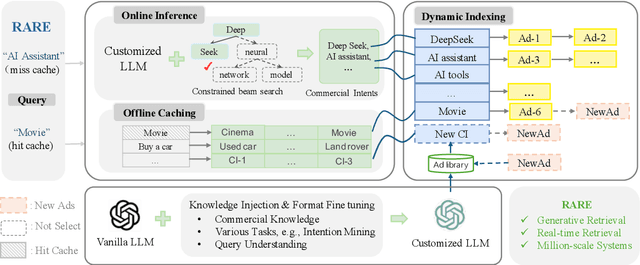
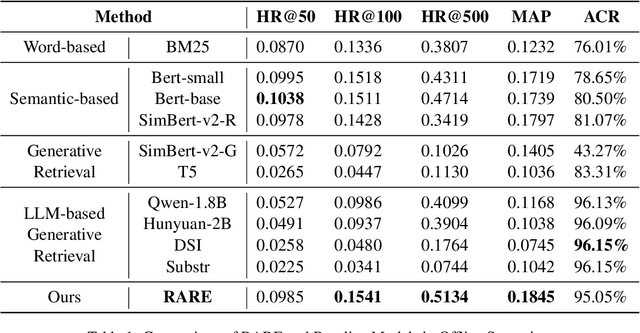
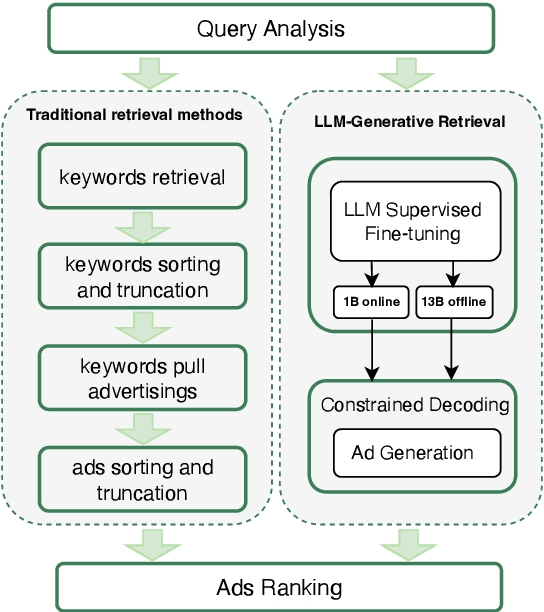
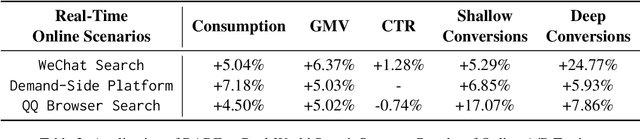
The integration of Large Language Models (LLMs) with retrieval systems has shown promising potential in retrieving documents (docs) or advertisements (ads) for a given query. Existing LLM-based retrieval methods generate numeric or content-based DocIDs to retrieve docs/ads. However, the one-to-few mapping between numeric IDs and docs, along with the time-consuming content extraction, leads to semantic inefficiency and limits scalability in large-scale corpora. In this paper, we propose the Real-time Ad REtrieval (RARE) framework, which leverages LLM-generated text called Commercial Intentions (CIs) as an intermediate semantic representation to directly retrieve ads for queries in real-time. These CIs are generated by a customized LLM injected with commercial knowledge, enhancing its domain relevance. Each CI corresponds to multiple ads, yielding a lightweight and scalable set of CIs. RARE has been implemented in a real-world online system, handling daily search volumes in the hundreds of millions. The online implementation has yielded significant benefits: a 5.04% increase in consumption, a 6.37% rise in Gross Merchandise Volume (GMV), a 1.28% enhancement in click-through rate (CTR) and a 5.29% increase in shallow conversions. Extensive offline experiments show RARE's superiority over ten competitive baselines in four major categories.