 Add to Chrome
 Add to Firefox
 Add to Edge
Explicit Language Memory for Long-Horizon Planning in Vision-Language-Action Models
Aug 05, 2026
Vision-language-action (VLA) models provide a unified paradigm for connecting visual perception, language understanding, and robotic control. However, existing VLA models still face major challenges in long-horizon tasks: sparse expert demonstrations constrain cross-task compositional generalization; the non-Markovian nature of long-horizon tasks makes it difficult for policies conditioned only on current observations to maintain temporal consistency; limited closed-loop error correction allows execution errors to accumulate; and end-to-end action fine-tuning may weaken the high-level semantic representations of vision-language model (VLM) backbones. To address these issues, we propose a hierarchical long-horizon VLA architecture with an explicit language-memory module. The central idea is to convert discrete temporal observations into a coherent textual memory sequence with temporal logic. The system is decoupled into a high-level VLM and a low-level VLA: the high-level VLM performs semantic reasoning through a visual question answering training paradigm, while the low-level VLA executes precise continuous control conditioned on subtask instructions and visual observations. The high-level VLM recursively updates both language memory and subtask instructions using the previous memory as a contextual anchor, enabling persistent temporal tracking and dynamic correction during long-horizon execution. We evaluate the proposed method in multiple simulation environments and conduct sim-to-real experiments on a real robotic platform. The results demonstrate that explicit language memory improves the success rate and robustness of VLA models on complex long-horizon tasks while providing an interpretable semantic account of the decision process.

Preserving Cross-Modal Consistency for CLIP-based Class-Incremental Learning
Nov 14, 2025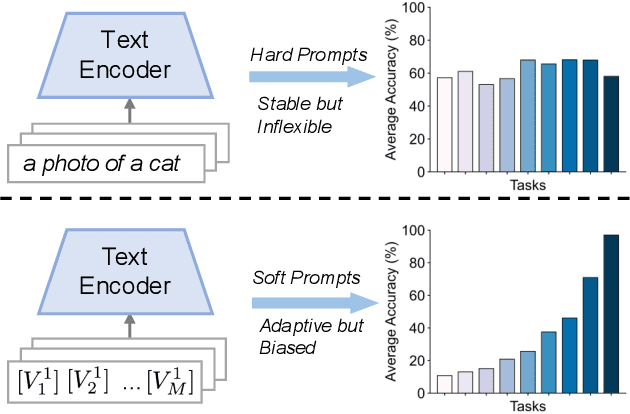
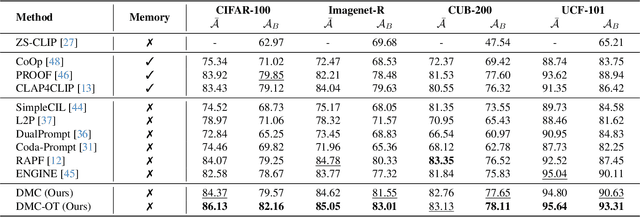
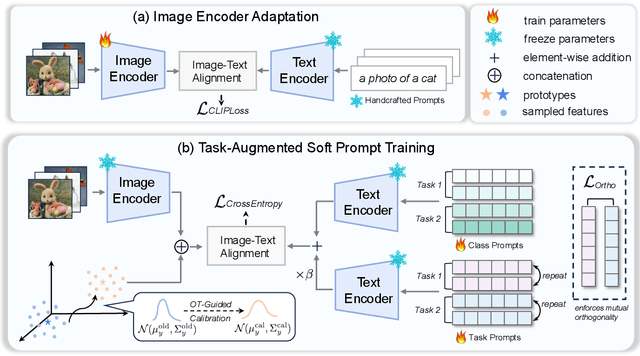
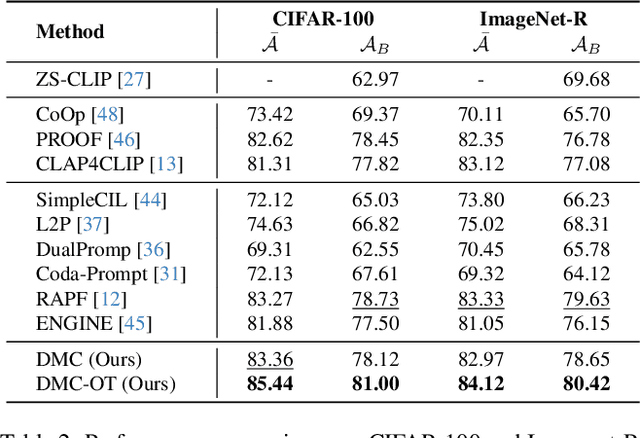
Class-incremental learning (CIL) enables models to continuously learn new categories from sequential tasks without forgetting previously acquired knowledge. While recent advances in vision-language models such as CLIP have demonstrated strong generalization across domains, extending them to continual settings remains challenging. In particular, learning task-specific soft prompts for newly introduced classes often leads to severe classifier bias, as the text prototypes overfit to recent categories when prior data are unavailable. In this paper, we propose DMC, a simple yet effective two-stage framework for CLIP-based CIL that decouples the adaptation of the vision encoder and the optimization of textual soft prompts. Each stage is trained with the other frozen, allowing one modality to act as a stable semantic anchor for the other to preserve cross-modal alignment. Furthermore, current CLIP-based CIL approaches typically store class-wise Gaussian statistics for generative replay, yet they overlook the distributional drift that arises when the vision encoder is updated over time. To address this issue, we introduce DMC-OT, an enhanced version of DMC that incorporates an optimal-transport guided calibration strategy to align memory statistics across evolving encoders, along with a task-specific prompting design that enhances inter-task separability. Extensive experiments on CIFAR-100, Imagenet-R, CUB-200, and UCF-101 demonstrate that both DMC and DMC-OT achieve state-of-the-art performance, with DMC-OT further improving accuracy by an average of 1.80%.