 Add to Chrome
 Add to Firefox
 Add to Edge
MILD: Tractable Terrain Modeling for Learning Improved Bipedal Locomotion on Deformable Surfaces
Aug 20, 2026
Enabling robots to walk on yielding terrain is vital for applications ranging from disaster response to planetary exploration. While bipedal robots hold immense potential, their locomotion on deformable surfaces remains limited as current simulators fail to capture the spatiotemporal heterogeneity of such yielding substrates. We present MILD, featuring a physics-grounded discrete-element contact solver that accurately simulates spatially varying foot-terrain interactions. Complementing this model, we train a terrain-aware locomotion controller via deep reinforcement learning with latent modulation and proprioceptive estimation. Quantitative comparisons against state-of-the-art methods show our approach generates more diverse and realistic contact scenarios during training, resulting in controllers that exhibit natural adaptation on real deformable surfaces. Through hardware experiments, we demonstrate the system's capability for online terrain identification and adaptation across a wide range of surface stiffness.
* 8 pages, 9 figures

Soft Responsive Materials Enhance Humanoid Safety
Jan 06, 2026Humanoid robots are envisioned as general-purpose platforms in human-centered environments, yet their deployment is limited by vulnerability to falls and the risks posed by rigid metal-plastic structures to people and surroundings. We introduce a soft-rigid co-design framework that leverages non-Newtonian fluid-based soft responsive materials to enhance humanoid safety. The material remains compliant during normal interaction but rapidly stiffens under impact, absorbing and dissipating fall-induced forces. Physics-based simulations guide protector placement and thickness and enable learning of active fall policies. Applied to a 42 kg life-size humanoid, the protector markedly reduces peak impact and allows repeated falls without hardware damage, including drops from 3 m and tumbles down long staircases. Across diverse scenarios, the approach improves robot robustness and environmental safety. By uniting responsive materials, structural co-design, and learning-based control, this work advances interact-safe, industry-ready humanoid robots.
HumanMimic: Learning Natural Locomotion and Transitions for Humanoid Robot via Wasserstein Adversarial Imitation
Sep 28, 2023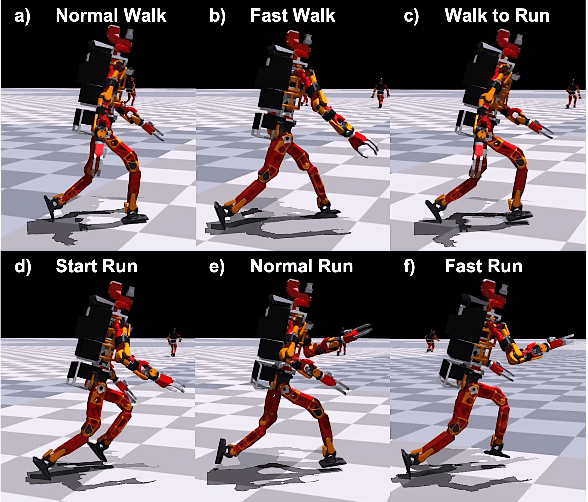

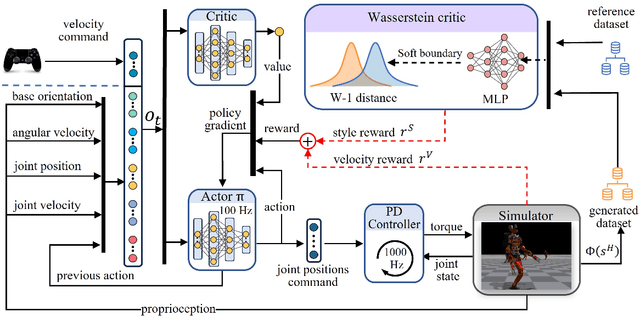
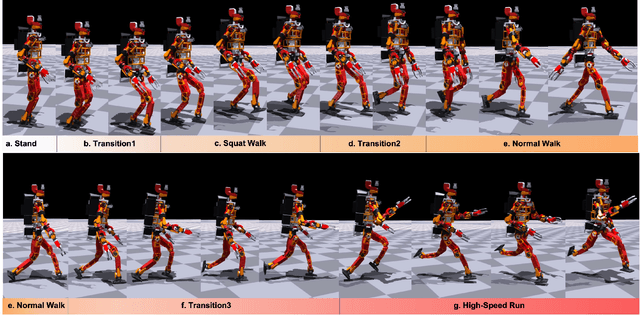
Transferring human motion skills to humanoid robots remains a significant challenge. In this study, we introduce a Wasserstein adversarial imitation learning system, allowing humanoid robots to replicate natural whole-body locomotion patterns and execute seamless transitions by mimicking human motions. First, we present a unified primitive-skeleton motion retargeting to mitigate morphological differences between arbitrary human demonstrators and humanoid robots. An adversarial critic component is integrated with Reinforcement Learning (RL) to guide the control policy to produce behaviors aligned with the data distribution of mixed reference motions. Additionally, we employ a specific Integral Probabilistic Metric (IPM), namely the Wasserstein-1 distance with a novel soft boundary constraint to stabilize the training process and prevent model collapse. Our system is evaluated on a full-sized humanoid JAXON in the simulator. The resulting control policy demonstrates a wide range of locomotion patterns, including standing, push-recovery, squat walking, human-like straight-leg walking, and dynamic running. Notably, even in the absence of transition motions in the demonstration dataset, robots showcase an emerging ability to transit naturally between distinct locomotion patterns as desired speed changes.