 Add to Chrome
 Add to Firefox
 Add to Edge
From Trajectories to Evidence: Auditable Experimental Records for Industrial Research Agents
Aug 05, 2026
Research agents increasingly conduct multi-round machine-learning experiments in industrial recommendation settings and retain the resulting trajectories to guide later decisions. Yet a completed trajectory is not automatically evidence: generated artifacts may be unsupported or incomplete, executed rounds may be invalid or confounded, and later modifications may obscure earlier findings. We study \textbf{trajectory-to-evidence conversion}, asking what a completed research process has actually established. We introduce an evidence-grounded framework that couples bounded verification of consequential artifacts with post-execution claim qualification. A context-isolated generate--verify--repair process checks artifacts for evidence violations and missing downstream requirements before release. After execution, validity and attribution checks consolidate evidence across rounds, qualify intervention-level claims as actionable repairs, diagnostic guards, or withheld findings, and preserve admitted claims as auditable records with explicit provenance and applicability boundaries. A hybrid LLM-assisted controller subsequently applies, defers, or rejects records based on available target evidence. Record audits characterize which claims survive qualification, while downstream diagnostics identify affirmative applicability judgment as a bottleneck for the tested controller. Across paper-to-target adaptations, later rounds often improve on the first, while final rounds frequently underperform an earlier best, exposing non-monotonic trajectory evolution. Candidates produced through the complete workflow also yielded positive online lifts relative to deployed baselines.

OrganLens: Organ-Specific Representation Learning for CT Foundation Models
Jul 28, 2026A CT examination captures multiple organs, but many biomedical questions concern abnormalities, prognosis, or longitudinal change in a specific organ. These questions require a separate representation for each organ within the same CT volume. Existing CT foundation models commonly produce a single volume-level representation, while recent anatomy-aware methods either encode pre-separated organ volumes or explicitly disentangle images into organ token groups. The former may remove clinically relevant surrounding context, while the latter does not condition a shared encoder on a selected organ before its features are formed. We introduce OrganLens for organ-specific representation learning through self-supervision. An organ identity conditions a shared CT encoder, while organ-specific distillation and anatomy-mask supervision shape features for anatomy-weighted pooling into organ-specific representations. At inference, the shared model produces 11 organ-specific representations without external segmentation masks. We evaluate OrganLens on CT-RATE, RAD-ChestCT, INSPECT, and NLST across diverse acquisitions and downstream evaluations. Relative to CT-pretrained DINOv2, heart representations raise CT-RATE cardiomegaly AUROC from 0.910 to 0.953, while lung representations improve the Harrell C-index for NLST lung-cancer mortality by 14.2\%. The global representation reaches INSPECT Recall@10 of 33.09\% and 32.04\% for text-to-image and image-to-text retrieval, respectively. Across organ-related tasks, anatomically matched representations provide stronger task-relevant signal, while the global representation retains broad utility. OrganLens offers a scalable approach to organ-specific CT representation learning with a shared encoder. More broadly, it provides the medical research community with a reusable framework for studying organ-specific disease across cohorts and clinical endpoints.
GigaPath-Flash and GigaTIME-Flash: Efficient Pathology Foundation Models for Whole-Slide and Tumor Microenvironment Analysis
Jul 20, 2026Foundation models have emerged as a driving force in computational pathology, with the potential to transform cancer diagnosis, prognosis, and treatment selection by learning transferable representations from large-scale histopathology data. A growing landscape of pathology foundation models now spans diverse data sources, architectures, and downstream applications. However, most pretrained models operate only at the image-tile level, use restrictive licenses, and remain computationally expensive, limiting large-scale slide-level clinical and research use. Here, we introduce GigaPath-Flash and GigaTIME-Flash, efficient models for whole-slide pathology AI and spatial proteomics prediction. GigaPath-Flash combines a 22M-parameter ViT-S tile encoder with a 21M-parameter LongNet slide encoder, both pretrained on large-scale real-world histopathology data. Its compact tile encoder is distilled from the billion-parameter GigaPath (ViT-g) teacher and shared by both models. GigaPath-Flash retains 97% of GigaPath's average slide-level performance with 50x less compute. GigaTIME-Flash extends this backbone to predict the tumor immune microenvironment directly from routine H&E images. It surpasses the original CNN-based GigaTIME in prediction quality while running 6x faster and using 8x less GPU memory. Together with GigaPath and GigaTIME, these models form an open-weight, Apache-2.0-licensed family pretrained on large-scale real-world clinical data. By releasing all models and weights, we provide accessible building blocks for computational pathology, immuno-oncology, and precision health.
AgentX: Towards Agent-Driven Self-Iteration of Industrial Recommender Systems
Jun 25, 2026Recommendation algorithm iteration is moving from an artisanal, engineer-bound process toward an industrialized research loop, but this transition remains blocked by a structural execution bottleneck: the idea-to-launch cycle still depends on human engineers to generate hypotheses, modify production code, launch A/B experiments, and attribute online results. Innovation therefore scales linearly with headcount rather than compounding with evidence, compute, and accumulated experimental knowledge. We present AgentX, a production-deployed multi-agent system that fundamentally restructures this production function. AgentX operates as a self-evolving development engine: it autonomously generates, implements, evaluates, and learns from recommendation experiments at a scale and pace that no manual workflow can sustain. The system orchestrates four tightly coupled stages in a closed loop. A Brainstorm Agent synthesizes evidence from historical experiments, system architecture, data analysis, and external research into ranked, executable proposals. A Developing Agent translates each proposal into production-ready code through repository-grounded generation and multi-dimensional reliability verification. An Evaluation Agent conducts safe online rollout with guardrail-vetoed A/B judgment, converting both successes and failures into structured knowledge assets. A Harness Evolution layer (SGPO) then distills execution trajectories into semantic-gradient updates that continuously sharpen the agents themselves -- making the system not merely automated, but self-improving.
A multi-agent system for spine MRI report generation from multi-sequence imaging
Jun 08, 2026Spinal pathology is a leading cause of pain and disability worldwide. Spine MRI is central to clinical evaluation, yet its interpretation remains complex and time-consuming, requiring integration of information across multiple imaging sequences and anatomical regions. Despite recent advances in automated MRI analysis, effectively combining multi-sequence data while preserving sequence-specific diagnostic information remains an open challenge. Here we present SpineAgent, a multi-agent framework for spine MRI report generation built upon a multi-sequence foundation model trained on routine clinical data from 32,047 patients and 453,683 MRI series, comprising a total of 13,441,191 MRI slices. To accommodate diverse modalities of sequences, we first pre-train two DINOv3-based encoders separately on T1- and T2-weighted sequences. We then introduce a continual training strategy that learns a synthesizer to embed images of other sequences using the T1 and T2 encoders, producing patient-level embedding that integrates various signals across MRI sequences. Using these embeddings, SpineAgent achieves state-of-the-art performance, and demonstrates strong generalizability under cross-manufacturer and cross-cohort evaluation. Beyond classification, SpineAgent enables pathology localization by identifying findings-relevant slices and segmenting pathological regions. It also supports multimodal image-report retrieval, providing a solid foundation for scalable and explainable MRI report generation. We further integrate these validated capabilities of SpineAgent into 37 specialized agents. Finally, we incorporate their outputs as structured tokens within a Medical Report Agent trained end-to-end for report generation. Through both automated metrics and expert evaluation by five radiologists, SpineAgent achieves leading performance in spine MRI report generation.
LLM Agents Enable User-Governed Personalization Beyond Platform Boundaries
May 10, 2026Personalization today is fundamentally platform-centric: services build user representations from the behavioral fragments they observe. Yet no platform can construct a complete picture of the user, as competitive incentives, legal constraints, user privacy concerns, and epistemic limits create persistent data barriers. This paper argues for a shift from platform-centric personalization to user-governed personalization, where only the user can integrate fragmented contexts across platforms and the offline world. The key asymmetry lies in data access: only users can aggregate their own cross-platform and offline information. Large language model (LLM) agents make such integration practically feasible for the first time by enabling reasoning over heterogeneous personal data and transforming users' cross-context information into actionable personalization capabilities. We provide proof-of-concept evidence that users equipped with cross-platform data exports and an off-the-shelf LLM agent can outperform single-platform personalization baselines. We conclude by outlining a research agenda for building scalable user-governed personalization systems.
Adaptation of Agentic AI
Dec 22, 2025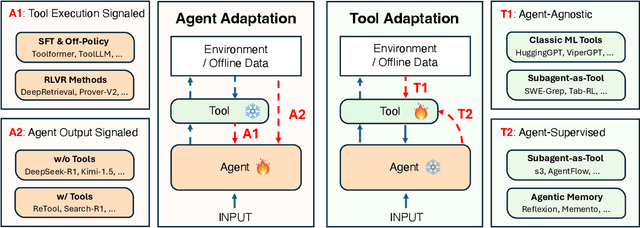
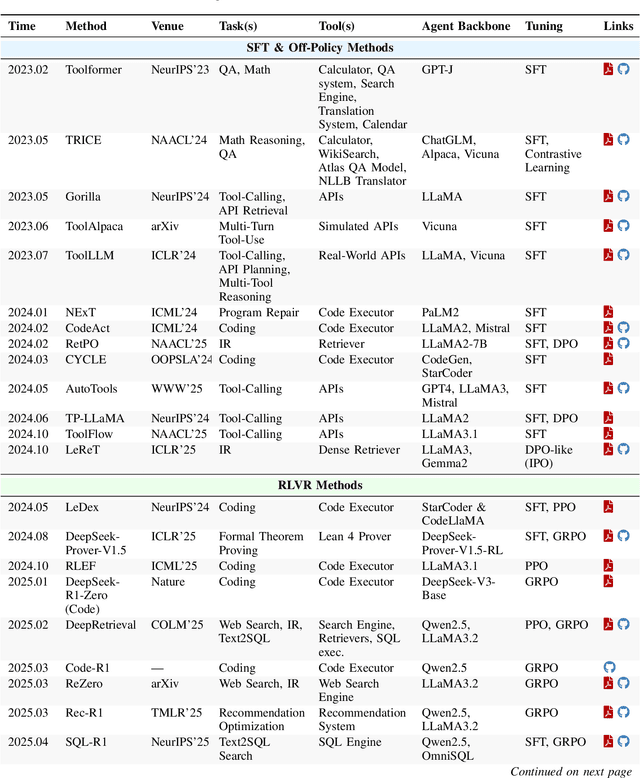
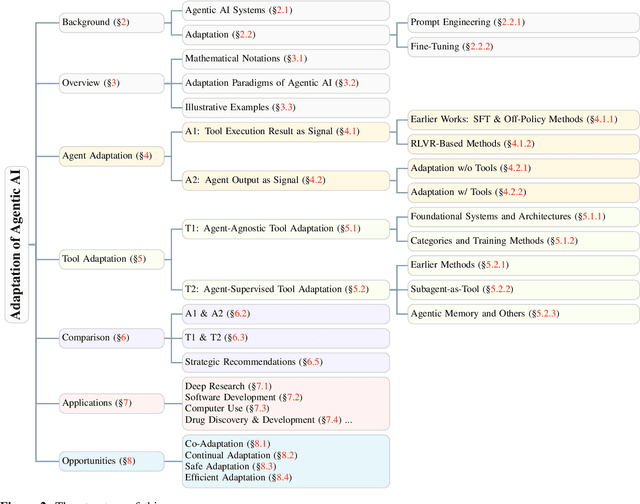
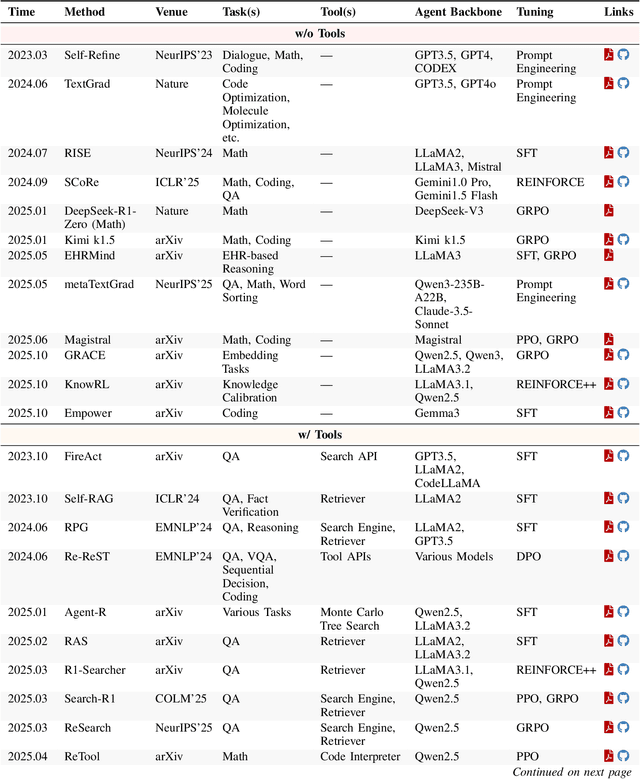
Cutting-edge agentic AI systems are built on foundation models that can be adapted to plan, reason, and interact with external tools to perform increasingly complex and specialized tasks. As these systems grow in capability and scope, adaptation becomes a central mechanism for improving performance, reliability, and generalization. In this paper, we unify the rapidly expanding research landscape into a systematic framework that spans both agent adaptations and tool adaptations. We further decompose these into tool-execution-signaled and agent-output-signaled forms of agent adaptation, as well as agent-agnostic and agent-supervised forms of tool adaptation. We demonstrate that this framework helps clarify the design space of adaptation strategies in agentic AI, makes their trade-offs explicit, and provides practical guidance for selecting or switching among strategies during system design. We then review the representative approaches in each category, analyze their strengths and limitations, and highlight key open challenges and future opportunities. Overall, this paper aims to offer a conceptual foundation and practical roadmap for researchers and practitioners seeking to build more capable, efficient, and reliable agentic AI systems.
Which Data Attributes Stimulate Math and Code Reasoning? An Investigation via Influence Functions
May 26, 2025Large language models (LLMs) have demonstrated remarkable reasoning capabilities in math and coding, often bolstered by post-training on the chain-of-thoughts (CoTs) generated by stronger models. However, existing strategies for curating such training data predominantly rely on heuristics, limiting generalizability and failing to capture subtleties underlying in data. To address these limitations, we leverage influence functions to systematically attribute LLMs' reasoning ability on math and coding to individual training examples, sequences, and tokens, enabling deeper insights into effective data characteristics. Our Influence-based Reasoning Attribution (Infra) uncovers nontrivial cross-domain effects across math and coding tasks: high-difficulty math examples improve both math and code reasoning, while low-difficulty code tasks most effectively benefit code reasoning. Based on these findings, we introduce a simple yet effective dataset reweighting strategy by flipping task difficulty, which doubles AIME24 accuracy from 10\% to 20\% and boosts LiveCodeBench accuracy from 33.8\% to 35.3\% for Qwen2.5-7B-Instruct. Moreover, our fine-grained attribution reveals that the sequence-level exploratory behaviors enhance reasoning performance in both math and code, and the token-level influence patterns are distinct for math and code reasoning: the former prefers natural language logic connectors and the latter emphasizes structural syntax.
OCTCube: A 3D foundation model for optical coherence tomography that improves cross-dataset, cross-disease, cross-device and cross-modality analysis
Aug 20, 2024Optical coherence tomography (OCT) has become critical for diagnosing retinal diseases as it enables 3D images of the retina and optic nerve. OCT acquisition is fast, non-invasive, affordable, and scalable. Due to its broad applicability, massive numbers of OCT images have been accumulated in routine exams, making it possible to train large-scale foundation models that can generalize to various diagnostic tasks using OCT images. Nevertheless, existing foundation models for OCT only consider 2D image slices, overlooking the rich 3D structure. Here, we present OCTCube, a 3D foundation model pre-trained on 26,605 3D OCT volumes encompassing 1.62 million 2D OCT images. OCTCube is developed based on 3D masked autoencoders and exploits FlashAttention to reduce the larger GPU memory usage caused by modeling 3D volumes. OCTCube outperforms 2D models when predicting 8 retinal diseases in both inductive and cross-dataset settings, indicating that utilizing the 3D structure in the model instead of 2D data results in significant improvement. OCTCube further shows superior performance on cross-device prediction and when predicting systemic diseases, such as diabetes and hypertension, further demonstrating its strong generalizability. Finally, we propose a contrastive-self-supervised-learning-based OCT-IR pre-training framework (COIP) for cross-modality analysis on OCT and infrared retinal (IR) images, where the OCT volumes are embedded using OCTCube. We demonstrate that COIP enables accurate alignment between OCT and IR en face images. Collectively, OCTCube, a 3D OCT foundation model, demonstrates significantly better performance against 2D models on 27 out of 29 tasks and comparable performance on the other two tasks, paving the way for AI-based retinal disease diagnosis.
Training Small Multimodal Models to Bridge Biomedical Competency Gap: A Case Study in Radiology Imaging
Mar 20, 2024


The scaling laws and extraordinary performance of large foundation models motivate the development and utilization of such large models in biomedicine. However, despite early promising results on some biomedical benchmarks, there are still major challenges that need to be addressed before these models can be used in real-world applications. Frontier models such as GPT-4V still have major competency gaps in multimodal capabilities for biomedical applications. Moreover, pragmatic issues such as access, cost, latency, and compliance make it hard for clinicians to use privately-hosted state-of-the-art large models directly on private patient data. In this paper, we explore training open-source small multimodal models (SMMs) to bridge biomedical competency gaps for unmet clinical needs. To maximize data efficiency, we adopt a modular approach by incorporating state-of-the-art pre-trained models for image and text modalities, and focusing on training a lightweight adapter to ground each modality to the text embedding space. We conduct a comprehensive study of this approach on radiology imaging. For training, we assemble a large dataset with over 1 million image-text pairs. For evaluation, we propose a clinically driven novel approach using GPT-4 and demonstrate its parity with expert evaluation. We also study grounding qualitatively using attention. For best practice, we conduct a systematic ablation study on various choices in data engineering and multimodal training. The resulting LLaVA-Rad (7B) model attains state-of-the-art results on radiology tasks such as report generation and cross-modal retrieval, even outperforming much larger models such as GPT-4V and Med-PaLM M (84B). LLaVA-Rad is fast and can be run on a single V100 GPU in private settings, offering a promising state-of-the-art tool for real-world clinical applications.