 Add to Chrome
 Add to Firefox
 Add to Edge
AgentX: Towards Agent-Driven Self-Iteration of Industrial Recommender Systems
Jun 25, 2026
Recommendation algorithm iteration is moving from an artisanal, engineer-bound process toward an industrialized research loop, but this transition remains blocked by a structural execution bottleneck: the idea-to-launch cycle still depends on human engineers to generate hypotheses, modify production code, launch A/B experiments, and attribute online results. Innovation therefore scales linearly with headcount rather than compounding with evidence, compute, and accumulated experimental knowledge. We present AgentX, a production-deployed multi-agent system that fundamentally restructures this production function. AgentX operates as a self-evolving development engine: it autonomously generates, implements, evaluates, and learns from recommendation experiments at a scale and pace that no manual workflow can sustain. The system orchestrates four tightly coupled stages in a closed loop. A Brainstorm Agent synthesizes evidence from historical experiments, system architecture, data analysis, and external research into ranked, executable proposals. A Developing Agent translates each proposal into production-ready code through repository-grounded generation and multi-dimensional reliability verification. An Evaluation Agent conducts safe online rollout with guardrail-vetoed A/B judgment, converting both successes and failures into structured knowledge assets. A Harness Evolution layer (SGPO) then distills execution trajectories into semantic-gradient updates that continuously sharpen the agents themselves -- making the system not merely automated, but self-improving.

InTrain: Intrinsic Trainability for Zero-Cost Neural Architecture Search
Jun 17, 2026Training-free neural architecture search promises efficient discovery of high-performance networks without costly training. However, existing zero-cost proxies rely on fragmented heuristics that fail to capture the fundamental question: what makes an architecture trainable? This paper introduces Intrinsic Trainability (InTrain), a unified theoretical proxy that formalizes trainability as an architectural invariant emerging from two synergistic components: geometric capacity and optimization resilience. We operationalize intrinsic trainability through analysis of neural information processing. Geometric capacity is quantified via the participation ratio of activation covariance eigenspectrum, capturing the effective dimensionality of representation manifolds. Optimization resilience is measured through cumulative gradient health, assessing the robustness of backpropagation across network depth. InTrain synthesizes these dimensions through a scale-invariant multiplicative coupling, which we hypothesize is essential for capturing their synergistic, non-additive relationship. Extensive experiments on standard NAS benchmarks and search spaces demonstrate that InTrain achieves ranking correlations on par with state-of-the-art ensemble-based proxies and outperforms other single-metric methods.
Training-free Transformer Architecture Search
Mar 23, 2022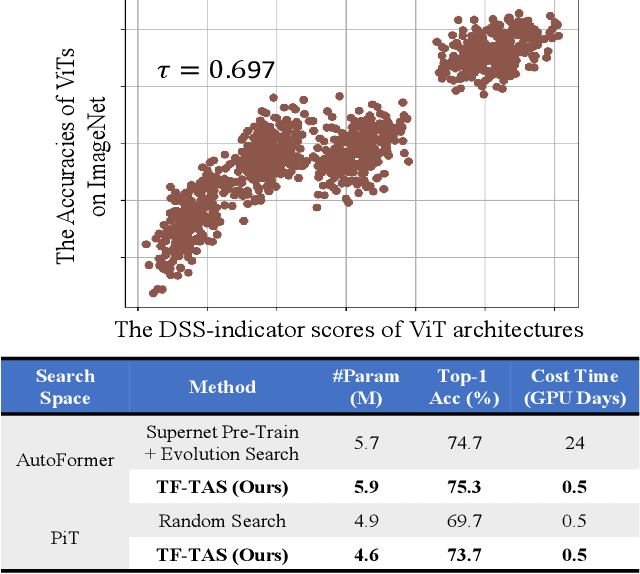
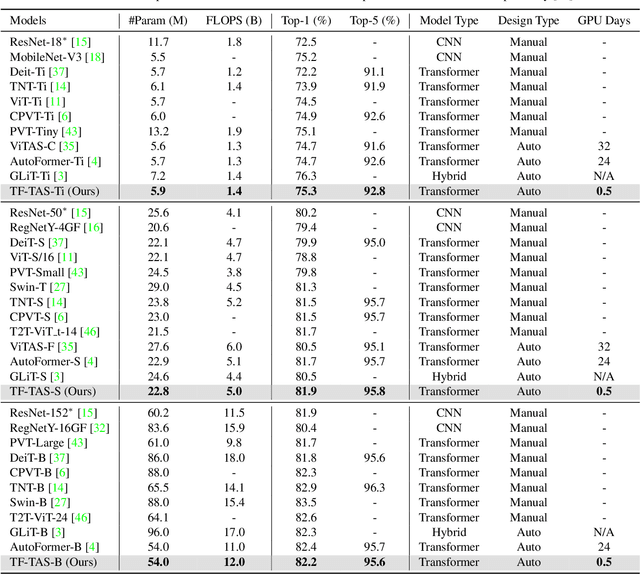
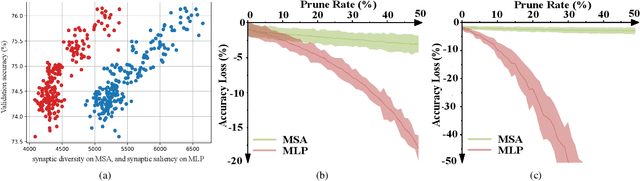
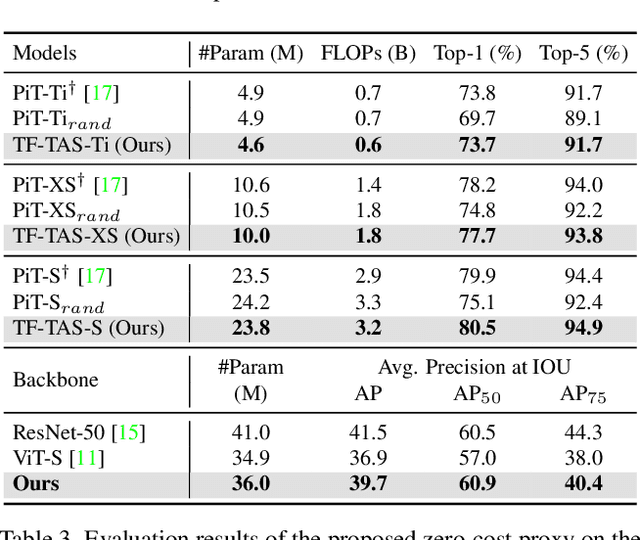
Recently, Vision Transformer (ViT) has achieved remarkable success in several computer vision tasks. The progresses are highly relevant to the architecture design, then it is worthwhile to propose Transformer Architecture Search (TAS) to search for better ViTs automatically. However, current TAS methods are time-consuming and existing zero-cost proxies in CNN do not generalize well to the ViT search space according to our experimental observations. In this paper, for the first time, we investigate how to conduct TAS in a training-free manner and devise an effective training-free TAS (TF-TAS) scheme. Firstly, we observe that the properties of multi-head self-attention (MSA) and multi-layer perceptron (MLP) in ViTs are quite different and that the synaptic diversity of MSA affects the performance notably. Secondly, based on the observation, we devise a modular strategy in TF-TAS that evaluates and ranks ViT architectures from two theoretical perspectives: synaptic diversity and synaptic saliency, termed as DSS-indicator. With DSS-indicator, evaluation results are strongly correlated with the test accuracies of ViT models. Experimental results demonstrate that our TF-TAS achieves a competitive performance against the state-of-the-art manually or automatically design ViT architectures, and it promotes the searching efficiency in ViT search space greatly: from about $24$ GPU days to less than $0.5$ GPU days. Moreover, the proposed DSS-indicator outperforms the existing cutting-edge zero-cost approaches (e.g., TE-score and NASWOT).
Small Object Detection Based on Modified FSSD and Model Compression
Aug 24, 2021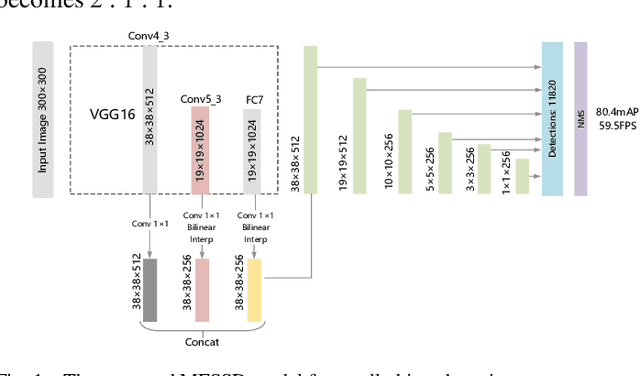
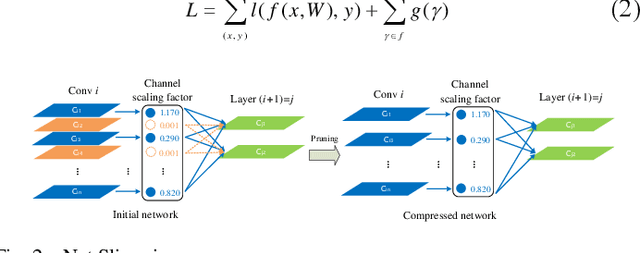
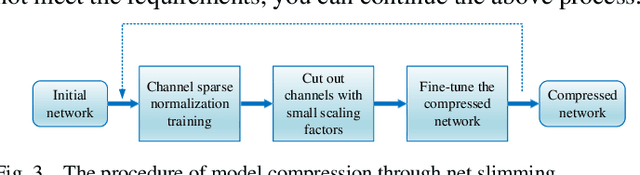
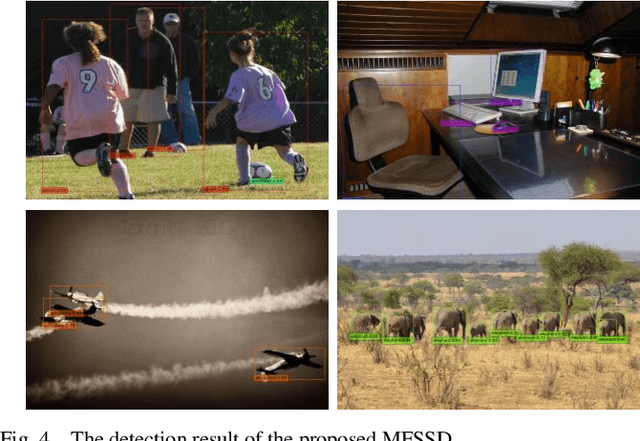
Small objects have relatively low resolution, the unobvious visual features which are difficult to be extracted, so the existing object detection methods cannot effectively detect small objects, and the detection speed and stability are poor. Thus, this paper proposes a small object detection algorithm based on FSSD, meanwhile, in order to reduce the computational cost and storage space, pruning is carried out to achieve model compression. Firstly, the semantic information contained in the features of different layers can be used to detect different scale objects, and the feature fusion method is improved to obtain more information beneficial to small objects; secondly, batch normalization layer is introduced to accelerate the training of neural network and make the model sparse; finally, the model is pruned by scaling factor to get the corresponding compressed model. The experimental results show that the average accuracy (mAP) of the algorithm can reach 80.4% on PASCAL VOC and the speed is 59.5 FPS on GTX1080ti. After pruning, the compressed model can reach 79.9% mAP, and 79.5 FPS in detection speed. On MS COCO, the best detection accuracy (APs) is 12.1%, and the overall detection accuracy is 49.8% AP when IoU is 0.5. The algorithm can not only improve the detection accuracy of small objects, but also greatly improves the detection speed, which reaches a balance between speed and accuracy.