 Add to Chrome
 Add to Firefox
 Add to Edge
From Trajectories to Evidence: Auditable Experimental Records for Industrial Research Agents
Aug 05, 2026
Research agents increasingly conduct multi-round machine-learning experiments in industrial recommendation settings and retain the resulting trajectories to guide later decisions. Yet a completed trajectory is not automatically evidence: generated artifacts may be unsupported or incomplete, executed rounds may be invalid or confounded, and later modifications may obscure earlier findings. We study \textbf{trajectory-to-evidence conversion}, asking what a completed research process has actually established. We introduce an evidence-grounded framework that couples bounded verification of consequential artifacts with post-execution claim qualification. A context-isolated generate--verify--repair process checks artifacts for evidence violations and missing downstream requirements before release. After execution, validity and attribution checks consolidate evidence across rounds, qualify intervention-level claims as actionable repairs, diagnostic guards, or withheld findings, and preserve admitted claims as auditable records with explicit provenance and applicability boundaries. A hybrid LLM-assisted controller subsequently applies, defers, or rejects records based on available target evidence. Record audits characterize which claims survive qualification, while downstream diagnostics identify affirmative applicability judgment as a bottleneck for the tested controller. Across paper-to-target adaptations, later rounds often improve on the first, while final rounds frequently underperform an earlier best, exposing non-monotonic trajectory evolution. Candidates produced through the complete workflow also yielded positive online lifts relative to deployed baselines.

Reward Guided Decoding for Generative Recommendation
Jul 28, 2026Generative recommendation formulates recommendation task into an SID sequence autoregressive generation paradigm, but the decoding process is often dominated by generation likelihood. This may conflict with real-world business objectives, where high-value candidates can receive low generation probability and be pruned early during beam search. Existing reranking or training-time alignment methods either intervene too late or require costly model retraining when business preferences change. To this end, we propose \textbf{R}eward \textbf{G}uided \textbf{D}ecoding, named \textbf{RGD}, a controllable decoding framework for industrial value-oriented generative recommendation. We formulate value-guided decoding as a KL-regularized reward maximization problem, deriving a closed-form reward guided decoding distribution that principledly combines generation probability with reward signals. RGD treats the base generator as a reference policy and introduces a reward model as a test-time controller, injecting reward into each decoding step to reshape the search trajectory without retraining the generator. Extensive offline and online experiments demonstrate the effectiveness of our approach for aligning personalization and business value. RGD has been deployed on the Kuaishou platform, bringing consistent improvements in real-world recommendation scenarios.
Unifying Generative Recall and Multi-Objective Ranking in a Single Decoder-Only Sequence
Jul 27, 2026Modern industrial recommendation systems typically separate recall and ranking into two independent stages. Although this cascade supports corpus-level retrieval and fine-grained multi-objective scoring, it causes objective inconsistency, information loss at the candidate hand-off, and redundant user-side context computation. Meanwhile, the generative recall and ranking scaling share a common Transformer-based modeling philosophy, where architectural consistency creates a natural opportunity for unified integration. However, direct sharing remains challenging since the two tasks require different information visibility and optimization methods. Therefore, we propose \textbf{UniR$^2$}, a \textbf{Uni}fied decoder-only Transformer that unifies Generative \textbf{R}ecall and Multi-Objective \textbf{R}anking within a single heterogeneous sequence comprising user context, SID trajectory, and item features. Within this sequence, the generated trajectory serves as a representation bridge between recall and ranking, where Dual-Query Prefix-Causal Attention provides task-specific visibility. The two tasks share the base attention weights but retain separate optimization boundaries, with ranking-side LoRA preserving ranking adaptability without disrupting the generative backbone. Extensive offline experiments on large-scale industrial data demonstrate the effectiveness and efficiency of UniR$^2$ for both recall and ranking. Long-term online A/B tests on Kuaishou platform further show consistent positive gains, validating the practicality of unified model in large-scale recommendation systems.
AgentX: Towards Agent-Driven Self-Iteration of Industrial Recommender Systems
Jun 25, 2026Recommendation algorithm iteration is moving from an artisanal, engineer-bound process toward an industrialized research loop, but this transition remains blocked by a structural execution bottleneck: the idea-to-launch cycle still depends on human engineers to generate hypotheses, modify production code, launch A/B experiments, and attribute online results. Innovation therefore scales linearly with headcount rather than compounding with evidence, compute, and accumulated experimental knowledge. We present AgentX, a production-deployed multi-agent system that fundamentally restructures this production function. AgentX operates as a self-evolving development engine: it autonomously generates, implements, evaluates, and learns from recommendation experiments at a scale and pace that no manual workflow can sustain. The system orchestrates four tightly coupled stages in a closed loop. A Brainstorm Agent synthesizes evidence from historical experiments, system architecture, data analysis, and external research into ranked, executable proposals. A Developing Agent translates each proposal into production-ready code through repository-grounded generation and multi-dimensional reliability verification. An Evaluation Agent conducts safe online rollout with guardrail-vetoed A/B judgment, converting both successes and failures into structured knowledge assets. A Harness Evolution layer (SGPO) then distills execution trajectories into semantic-gradient updates that continuously sharpen the agents themselves -- making the system not merely automated, but self-improving.
MaRI: Accelerating Ranking Model Inference via Structural Re-parameterization in Large Scale Recommendation System
Feb 26, 2026Ranking models, i.e., coarse-ranking and fine-ranking models, serve as core components in large-scale recommendation systems, responsible for scoring massive item candidates based on user preferences. To meet the stringent latency requirements of online serving, structural lightweighting or knowledge distillation techniques are commonly employed for ranking model acceleration. However, these approaches typically lead to a non-negligible drop in accuracy. Notably, the angle of lossless acceleration by optimizing feature fusion matrix multiplication, particularly through structural reparameterization, remains underexplored. In this paper, we propose MaRI, a novel Matrix Re-parameterized Inference framework, which serves as a complementary approach to existing techniques while accelerating ranking model inference without any accuracy loss. MaRI is motivated by the observation that user-side computation is redundant in feature fusion matrix multiplication, and we therefore adopt the philosophy of structural reparameterization to alleviate such redundancy.
OneLive: Dynamically Unified Generative Framework for Live-Streaming Recommendation
Feb 09, 2026Live-streaming recommender system serves as critical infrastructure that bridges the patterns of real-time interactions between users and authors. Similar to traditional industrial recommender systems, live-streaming recommendation also relies on cascade architectures to support large-scale concurrency. Recent advances in generative recommendation unify the multi-stage recommendation process with Transformer-based architectures, offering improved scalability and higher computational efficiency. However, the inherent complexity of live-streaming prevents the direct transfer of these methods to live-streaming scenario, where continuously evolving content, limited lifecycles, strict real-time constraints, and heterogeneous multi-objectives introduce unique challenges that invalidate static tokenization and conventional model framework. To address these issues, we propose OneLive, a dynamically unified generative recommendation framework tailored for live-streaming scenario. OneLive integrates four key components: (i) A Dynamic Tokenizer that continuously encodes evolving real-time live content fused with behavior signal through residual quantization; (ii) A Time-Aware Gated Attention mechanism that explicitly models temporal dynamics for timely decision making; (iii) An efficient decoder-only generative architecture enhanced with Sequential MTP and QK Norm for stable training and accelerated inference; (iv) A Unified Multi-Objective Alignment Framework reinforces policy optimization for personalized preferences.
Unleashing the Infinity Power of Geometry: A Novel Geometry-Aware Transformer for Whole Slide Histopathology Image Analysis
Feb 08, 2024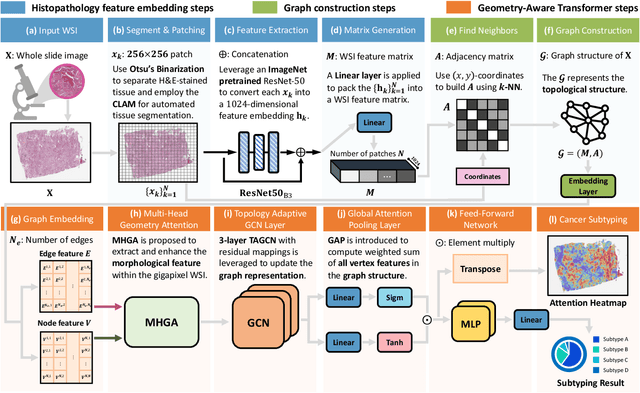
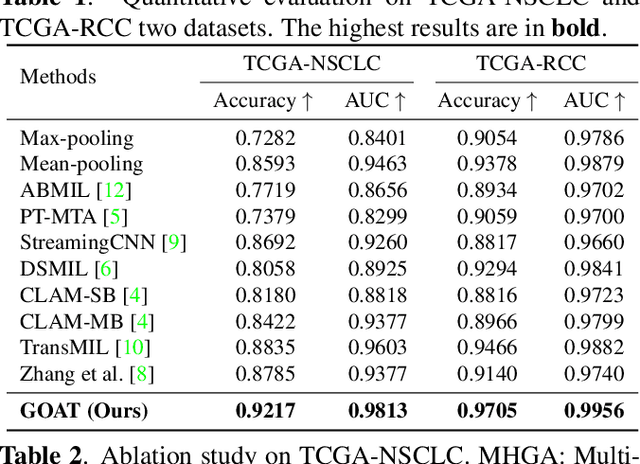
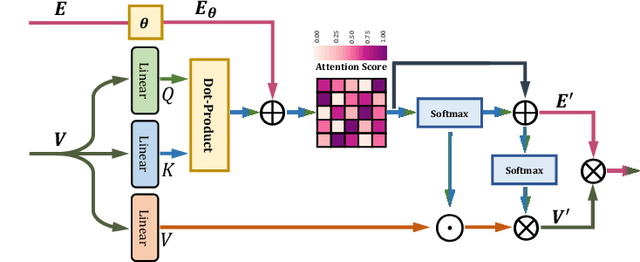
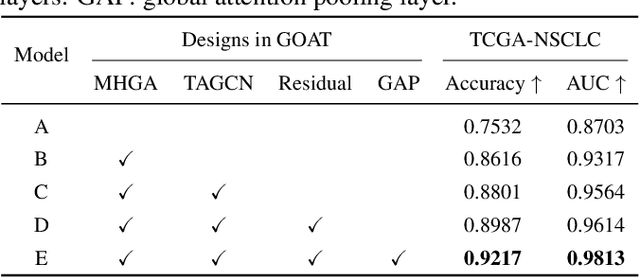
The histopathology analysis is of great significance for the diagnosis and prognosis of cancers, however, it has great challenges due to the enormous heterogeneity of gigapixel whole slide images (WSIs) and the intricate representation of pathological features. However, recent methods have not adequately exploited geometrical representation in WSIs which is significant in disease diagnosis. Therefore, we proposed a novel weakly-supervised framework, Geometry-Aware Transformer (GOAT), in which we urge the model to pay attention to the geometric characteristics within the tumor microenvironment which often serve as potent indicators. In addition, a context-aware attention mechanism is designed to extract and enhance the morphological features within WSIs.
Bootstrapping OTS-Funcimg Pre-training Model (Botfip) -- A Comprehensive Symbolic Regression Framework
Jan 18, 2024In the field of scientific computing, many problem-solving approaches tend to focus only on the process and final outcome, even in AI for science, there is a lack of deep multimodal information mining behind the data, missing a multimodal framework akin to that in the image-text domain. In this paper, we take Symbolic Regression(SR) as our focal point and, drawing inspiration from the BLIP model in the image-text domain, propose a scientific computing multimodal framework based on Function Images (Funcimg) and Operation Tree Sequence (OTS), named Bootstrapping OTS-Funcimg Pre-training Model (Botfip). In SR experiments, we validate the advantages of Botfip in low-complexity SR problems, showcasing its potential. As a MED framework, Botfip holds promise for future applications in a broader range of scientific computing problems.