 Add to Chrome
 Add to Firefox
 Add to Edge
Apodex Discovery: Reality Benchmarks and Environments for Evaluating and Building Discoverative Artificial Intelligence
Aug 11, 2026
Apollo did not reach the Moon merely because its engineers could solve difficult equations. It succeeded by turning a distant ambition into a mission architecture of explicit objectives, simulation, verification, and repeated correction. AI now faces a similar transition: frontier models can solve difficult tasks once the problem, tools, and success criteria are specified, yet consequential real-world challenges rarely arrive in an executable or verifiable form. We introduce Apodex Discovery, a framework for building and evaluating discoverative AI through the heavy-duty solver, a system comprising a foundation model, harness, tools, and control policies that pursues extended, stateful, verifiable investigations. It has three core components. First, a problem-scouting process surveyed 561 industries across 16 sectors, assembled 423 high-value real-world problems, and selected 20 for the initial release. Second, a common environment-task-episode abstraction provides data, tools, constraints, feedback, trajectory recording, and verification of intermediate artifacts and final submissions. Third, HDS6 evaluates Tools, Repair, Alternatives, Coherence, Evidence, and Scope independently of final-task success. In AAV capsid design, Apodex surpassed the published state of the art by 7% across viability, tropism, structure prediction, and generative design. In drug repurposing and reformulation, a task-specific biomedical environment improved the mean normalized prediction score of GPT-5.5 and GPT-5.6-sol by 2.5 and 7.6 points over the same closed-book backbone. Controlled ablations show that the fixed TRACES episode interface enables attribution of performance differences to specific solver components. Apodex Discovery moves AI evaluation beyond predefined benchmarks toward verifiable investigations aimed at genuine discovery.

A multi-agent system for spine MRI report generation from multi-sequence imaging
Jun 08, 2026Spinal pathology is a leading cause of pain and disability worldwide. Spine MRI is central to clinical evaluation, yet its interpretation remains complex and time-consuming, requiring integration of information across multiple imaging sequences and anatomical regions. Despite recent advances in automated MRI analysis, effectively combining multi-sequence data while preserving sequence-specific diagnostic information remains an open challenge. Here we present SpineAgent, a multi-agent framework for spine MRI report generation built upon a multi-sequence foundation model trained on routine clinical data from 32,047 patients and 453,683 MRI series, comprising a total of 13,441,191 MRI slices. To accommodate diverse modalities of sequences, we first pre-train two DINOv3-based encoders separately on T1- and T2-weighted sequences. We then introduce a continual training strategy that learns a synthesizer to embed images of other sequences using the T1 and T2 encoders, producing patient-level embedding that integrates various signals across MRI sequences. Using these embeddings, SpineAgent achieves state-of-the-art performance, and demonstrates strong generalizability under cross-manufacturer and cross-cohort evaluation. Beyond classification, SpineAgent enables pathology localization by identifying findings-relevant slices and segmenting pathological regions. It also supports multimodal image-report retrieval, providing a solid foundation for scalable and explainable MRI report generation. We further integrate these validated capabilities of SpineAgent into 37 specialized agents. Finally, we incorporate their outputs as structured tokens within a Medical Report Agent trained end-to-end for report generation. Through both automated metrics and expert evaluation by five radiologists, SpineAgent achieves leading performance in spine MRI report generation.
Humanity's Last Exam
Jan 24, 2025Benchmarks are important tools for tracking the rapid advancements in large language model (LLM) capabilities. However, benchmarks are not keeping pace in difficulty: LLMs now achieve over 90\% accuracy on popular benchmarks like MMLU, limiting informed measurement of state-of-the-art LLM capabilities. In response, we introduce Humanity's Last Exam (HLE), a multi-modal benchmark at the frontier of human knowledge, designed to be the final closed-ended academic benchmark of its kind with broad subject coverage. HLE consists of 3,000 questions across dozens of subjects, including mathematics, humanities, and the natural sciences. HLE is developed globally by subject-matter experts and consists of multiple-choice and short-answer questions suitable for automated grading. Each question has a known solution that is unambiguous and easily verifiable, but cannot be quickly answered via internet retrieval. State-of-the-art LLMs demonstrate low accuracy and calibration on HLE, highlighting a significant gap between current LLM capabilities and the expert human frontier on closed-ended academic questions. To inform research and policymaking upon a clear understanding of model capabilities, we publicly release HLE at https://lastexam.ai.
A Hybrid RAG System with Comprehensive Enhancement on Complex Reasoning
Aug 09, 2024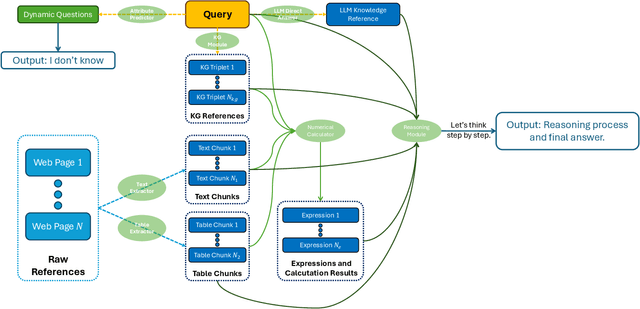
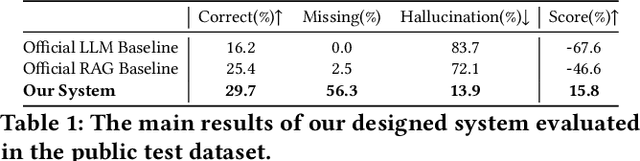
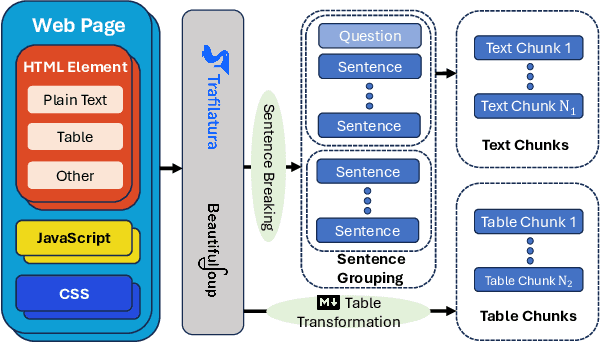
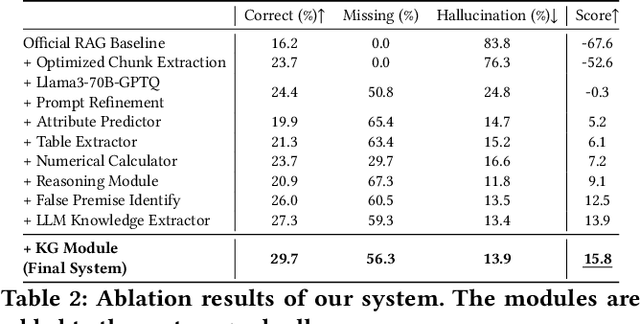
Retrieval-augmented generation (RAG) is a framework enabling large language models (LLMs) to enhance their accuracy and reduce hallucinations by integrating external knowledge bases. In this paper, we introduce a hybrid RAG system enhanced through a comprehensive suite of optimizations that significantly improve retrieval quality, augment reasoning capabilities, and refine numerical computation ability. We refined the text chunks and tables in web pages, added attribute predictors to reduce hallucinations, conducted LLM Knowledge Extractor and Knowledge Graph Extractor, and finally built a reasoning strategy with all the references. We evaluated our system on the CRAG dataset through the Meta CRAG KDD Cup 2024 Competition. Both the local and online evaluations demonstrate that our system significantly enhances complex reasoning capabilities. In local evaluations, we have significantly improved accuracy and reduced error rates compared to the baseline model, achieving a notable increase in scores. In the meanwhile, we have attained outstanding results in online assessments, demonstrating the performance and generalization capabilities of the proposed system. The source code for our system is released in \url{https://gitlab.aicrowd.com/shizueyy/crag-new}.
End-to-End Rubbing Restoration Using Generative Adversarial Networks
May 08, 2022Rubbing restorations are significant for preserving world cultural history. In this paper, we propose the RubbingGAN model for restoring incomplete rubbing characters. Specifically, we collect characters from the Zhang Menglong Bei and build up the first rubbing restoration dataset. We design the first generative adversarial network for rubbing restoration. Based on the dataset we collect, we apply the RubbingGAN to learn the Zhang Menglong Bei font style and restore the characters. The results of experiments show that RubbingGAN can repair both slightly and severely incomplete rubbing characters fast and effectively.