 Add to Chrome
 Add to Firefox
 Add to Edge
AnyScene: Towards Highly Controllable Driving Scene Generation at Anywhere and Beyond
May 25, 2026
Generating high-fidelity and controllable synthetic data is critical for advancing end-to-end autonomous driving, particularly for addressing the long tail of rare safety-critical scenarios. Existing occupancy-guided methods typically rely on shallow conditioning mechanisms and reference-frame-dependent video synthesis, which limits fine-grained controllability from arbitrary BEV layouts and restricts their applicability for scalable simulation. In this paper, we propose AnyScene, a unified occupancy-centric framework for driving scene generation. AnyScene generates semantic occupancy sequences from BEV layouts through a Spatial-Temporal Occupancy Diffusion Transformer that jointly tokenizes BEV and occupancy features in an autoregressive manner. This design enables precise controllability from cross-dataset and user-defined BEV inputs while naturally supporting long-horizon generation. Building upon the generated occupancy, a Geometry-Grounded View Expansion module treats occupancy as the canonical spatial representation and synthesizes temporally consistent multi-view driving videos in a reference-free and autoregressive fashion, supporting flexible camera configurations at inference time. Extensive experiments demonstrate that AnyScene achieves state-of-the-art performance in both occupancy and video generation. It exhibits strong generalization to unseen and customized layouts, and provides measurable benefits for downstream tasks such as sparse-view 3D reconstruction.

Abductive Ego-View Accident Video Understanding for Safe Driving Perception
Mar 01, 2024
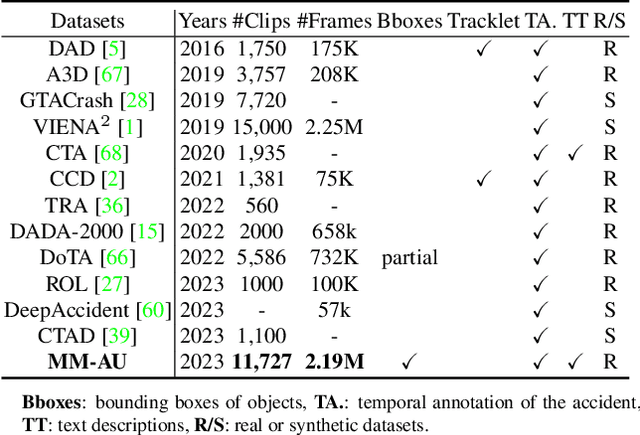

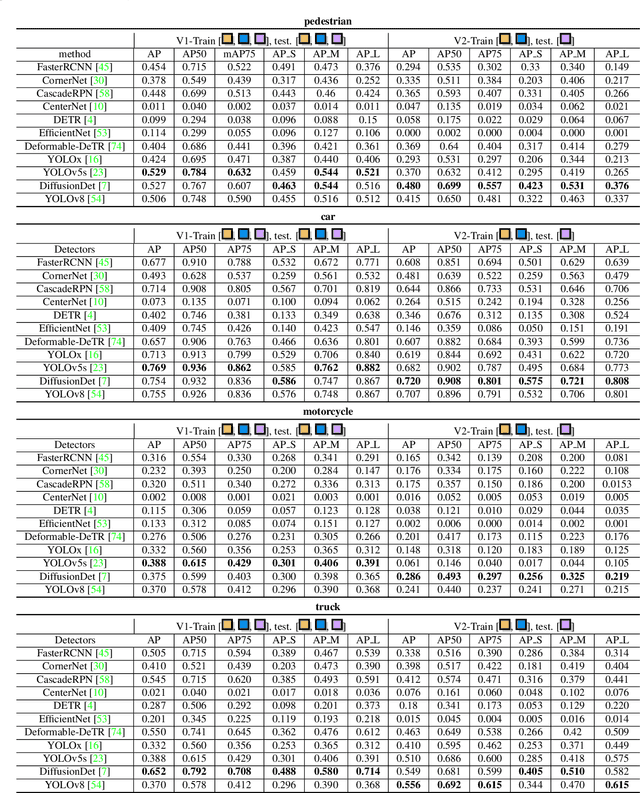
We present MM-AU, a novel dataset for Multi-Modal Accident video Understanding. MM-AU contains 11,727 in-the-wild ego-view accident videos, each with temporally aligned text descriptions. We annotate over 2.23 million object boxes and 58,650 pairs of video-based accident reasons, covering 58 accident categories. MM-AU supports various accident understanding tasks, particularly multimodal video diffusion to understand accident cause-effect chains for safe driving. With MM-AU, we present an Abductive accident Video understanding framework for Safe Driving perception (AdVersa-SD). AdVersa-SD performs video diffusion via an Object-Centric Video Diffusion (OAVD) method which is driven by an abductive CLIP model. This model involves a contrastive interaction loss to learn the pair co-occurrence of normal, near-accident, accident frames with the corresponding text descriptions, such as accident reasons, prevention advice, and accident categories. OAVD enforces the causal region learning while fixing the content of the original frame background in video generation, to find the dominant cause-effect chain for certain accidents. Extensive experiments verify the abductive ability of AdVersa-SD and the superiority of OAVD against the state-of-the-art diffusion models. Additionally, we provide careful benchmark evaluations for object detection and accident reason answering since AdVersa-SD relies on precise object and accident reason information.