 Add to Chrome
 Add to Firefox
 Add to Edge
AnyScene: Towards Highly Controllable Driving Scene Generation at Anywhere and Beyond
May 25, 2026
Generating high-fidelity and controllable synthetic data is critical for advancing end-to-end autonomous driving, particularly for addressing the long tail of rare safety-critical scenarios. Existing occupancy-guided methods typically rely on shallow conditioning mechanisms and reference-frame-dependent video synthesis, which limits fine-grained controllability from arbitrary BEV layouts and restricts their applicability for scalable simulation. In this paper, we propose AnyScene, a unified occupancy-centric framework for driving scene generation. AnyScene generates semantic occupancy sequences from BEV layouts through a Spatial-Temporal Occupancy Diffusion Transformer that jointly tokenizes BEV and occupancy features in an autoregressive manner. This design enables precise controllability from cross-dataset and user-defined BEV inputs while naturally supporting long-horizon generation. Building upon the generated occupancy, a Geometry-Grounded View Expansion module treats occupancy as the canonical spatial representation and synthesizes temporally consistent multi-view driving videos in a reference-free and autoregressive fashion, supporting flexible camera configurations at inference time. Extensive experiments demonstrate that AnyScene achieves state-of-the-art performance in both occupancy and video generation. It exhibits strong generalization to unseen and customized layouts, and provides measurable benefits for downstream tasks such as sparse-view 3D reconstruction.

Action Emergence from Streaming Intent
May 14, 2026We formalize action emergence as a target capability for end-to-end autonomous driving: the ability to generate physically feasible, semantically appropriate, and safety-compliant actions in arbitrary, long-tail traffic scenes through scene-conditioned reasoning rather than retrieval or interpolation of learned scene-action mappings. We show that previous paradigms cannot deliver action emergence: autoregressive trajectory decoders collapse the inherently multimodal future into a single averaged output, while diffusion and flow-matching generators express multimodality but are not steerable by reasoned intent. We propose Streaming Intent as a concrete way to approach action emergence: a mechanism that makes driving intent (i) semantically streamed through a continuous chain-of-thought that causally derives the intent from scene understanding, and (ii) temporally streamed across clips so that intent commitments remain coherent along the driving horizon. We realize Streaming Intent in a VLA model we call SI (Streaming Intent). SI autoregressively decodes a four-step chain-of-thought and emits an intent token; the decoded intent then drives classifier-free guidance (CFG) on a flow-matching action head, requiring only two denoising steps to generate the final trajectory. On the Waymo End-to-End benchmark, SI achieves competitive aggregate performance, with an RFS score of 7.96 on the validation set and 7.74 on the test set. Beyond aggregate metrics, the model demonstrates -- to our knowledge for the first time in a fully end-to-end VLA -- intent-faithful controllability: for a fixed scene, varying the intent class at inference yields qualitatively distinct yet consistently high-quality plans, arising purely from data-driven learning without any pre-built trajectory bank or hand-coded post-hoc selector.
Driving Intents Amplify Planning-Oriented Reinforcement Learning
May 14, 2026Continuous-action policies trained on a single demonstrated trajectory per scene suffer from mode collapse: samples cluster around the demonstrated maneuver and the policy cannot represent semantically distinct alternatives. Under preference-based evaluation, this caps best-of-N performance -- even oracle selection cannot recover what the sampling distribution does not contain. We introduce DIAL, a two-stage Driving-Intent-Amplified reinforcement Learning framework for preference-aligned continuous-action driving policies. In the first stage, DIAL conditions the flow-matching action head on a discrete intent label with classifier-free guidance (CFG), which expands the sampling distribution along distinct maneuver modes and breaks single-demonstration mode collapse. In the second stage, DIAL carries this expanded distribution into preference RL through multi-intent GRPO, which spans all intent classes within every preference group and prevents fine-tuning from re-collapsing around the currently preferred mode. Instantiated for end-to-end driving with eight rule-derived intents and evaluated on WOD-E2E: competitive Vision-to-Action (VA) and Vision-Language-Action (VLA) Supervised Finetuning (SFT) baselines plateau below the human-driven demonstration at best-of-128, with the strongest prior (RAP) capping at Rater Feedback Score (RFS) 8.5 even with best-of-64; intent-CFG sampling lifts this ceiling to RFS 9.14 at best-of-128, surpassing both the prior best (RAP 8.5) and the human-driven demonstration (8.13) for the first time; and multi-intent GRPO improves held-out RFS from 7.681 to 8.211, while every single-intent baseline peaks lower and degrades by training end. These results suggest that the bottleneck of preference RL on continuous-action policies trained from demonstrations is not only how to update the policy, but to expand and preserve the sampling distribution being optimized.
MindVLA-U1: VLA Beats VA with Unified Streaming Architecture for Autonomous Driving
May 14, 2026Autonomous driving has progressed from modular pipelines toward end-to-end unification, and Vision-Language-Action (VLA) models are a natural extension of this journey beyond Vision-to-Action (VA). In practice, driving VLAs have often trailed VA on planning quality, suggesting that the difficulty is not simply model scale but the interface through which semantic reasoning, temporal context, and continuous control are combined. We argue that this gap reflects how VLA has been built -- as isolated subtask improvements that fail to compose coherent driving capabilities -- rather than what VLA is. We present MindVLA-U1, the first unified streaming VLA architecture for autonomous driving. A unified VLM backbone produces AR language tokens (optional) and flow-matching continuous action trajectories in a single forward pass over one shared representation, preserving the natural output form of each modality. A full streaming design processes the driving video framewise rather than as fixed video-action chunks under costly temporal VLM modeling. Planned trajectories evolve smoothly across frames while a learned streaming memory channel carries temporal context and updates. The unified architecture enables fast/slow systems on dense & sparse MoT backbones via flexible self-attention context management, and exposes a measurable language-control path for action: language-predicted driving intents steers the action diffusion via classifier-free guidance (CFG), turning language-side intent into control signals for continuous action planning. On the long-tail WOD-E2E benchmark, MindVLA-U1 surpasses experienced human drivers for the first time (8.20 RFS vs. 8.13 GT RFS) with 2 diffusion steps, achieves state-of-the-art planning ADEs over prior VA/VLA by large margins, and matches VA latency (16 FPS vs. RAP's 18 FPS at 1B scale) while preserving natural language interfaces for human-vehicle interaction.
TrajectoryFormer: 3D Object Tracking Transformer with Predictive Trajectory Hypotheses
Jun 09, 2023


3D multi-object tracking (MOT) is vital for many applications including autonomous driving vehicles and service robots. With the commonly used tracking-by-detection paradigm, 3D MOT has made important progress in recent years. However, these methods only use the detection boxes of the current frame to obtain trajectory-box association results, which makes it impossible for the tracker to recover objects missed by the detector. In this paper, we present TrajectoryFormer, a novel point-cloud-based 3D MOT framework. To recover the missed object by detector, we generates multiple trajectory hypotheses with hybrid candidate boxes, including temporally predicted boxes and current-frame detection boxes, for trajectory-box association. The predicted boxes can propagate object's history trajectory information to the current frame and thus the network can tolerate short-term miss detection of the tracked objects. We combine long-term object motion feature and short-term object appearance feature to create per-hypothesis feature embedding, which reduces the computational overhead for spatial-temporal encoding. Additionally, we introduce a Global-Local Interaction Module to conduct information interaction among all hypotheses and models their spatial relations, leading to accurate estimation of hypotheses. Our TrajectoryFormer achieves state-of-the-art performance on the Waymo 3D MOT benchmarks.
ConQueR: Query Contrast Voxel-DETR for 3D Object Detection
Dec 14, 2022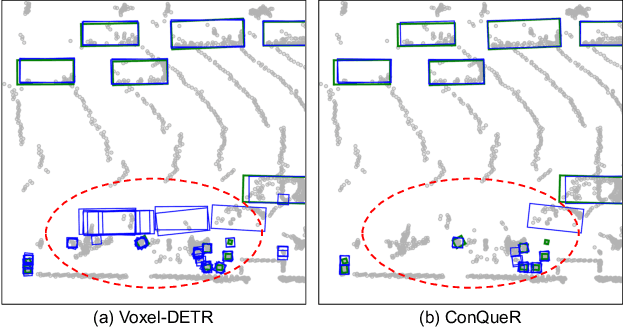
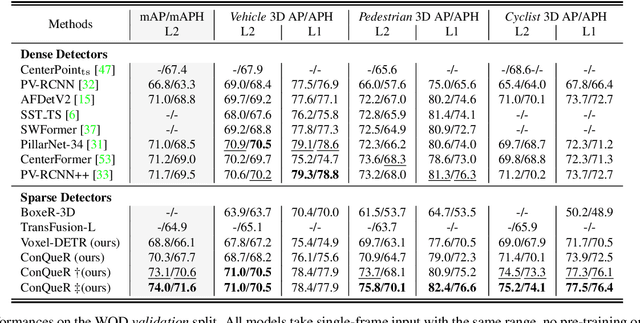
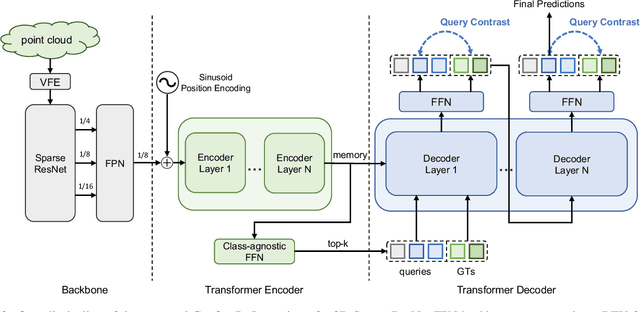
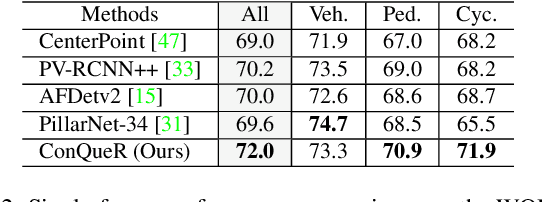
Although DETR-based 3D detectors can simplify the detection pipeline and achieve direct sparse predictions, their performance still lags behind dense detectors with post-processing for 3D object detection from point clouds. DETRs usually adopt a larger number of queries than GTs (e.g., 300 queries v.s. 40 objects in Waymo) in a scene, which inevitably incur many false positives during inference. In this paper, we propose a simple yet effective sparse 3D detector, named Query Contrast Voxel-DETR (ConQueR), to eliminate the challenging false positives, and achieve more accurate and sparser predictions. We observe that most false positives are highly overlapping in local regions, caused by the lack of explicit supervision to discriminate locally similar queries. We thus propose a Query Contrast mechanism to explicitly enhance queries towards their best-matched GTs over all unmatched query predictions. This is achieved by the construction of positive and negative GT-query pairs for each GT, and a contrastive loss to enhance positive GT-query pairs against negative ones based on feature similarities. ConQueR closes the gap of sparse and dense 3D detectors, and reduces up to ~60% false positives. Our single-frame ConQueR achieves new state-of-the-art (sota) 71.6 mAPH/L2 on the challenging Waymo Open Dataset validation set, outperforming previous sota methods (e.g., PV-RCNN++) by over 2.0 mAPH/L2.
MPPNet: Multi-Frame Feature Intertwining with Proxy Points for 3D Temporal Object Detection
May 12, 2022
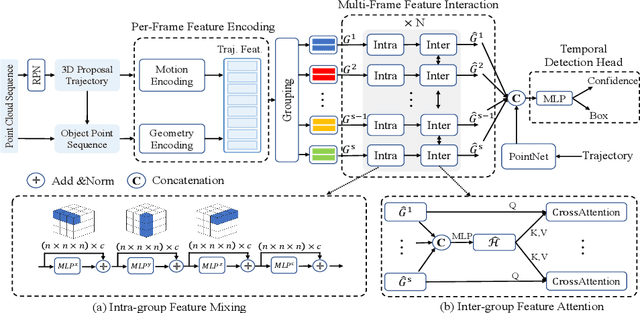
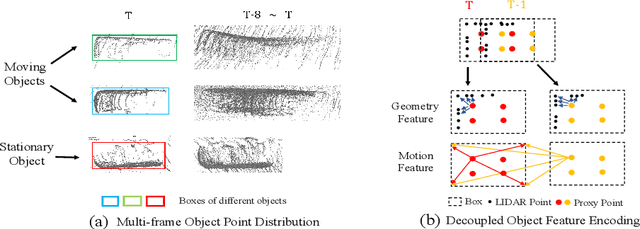
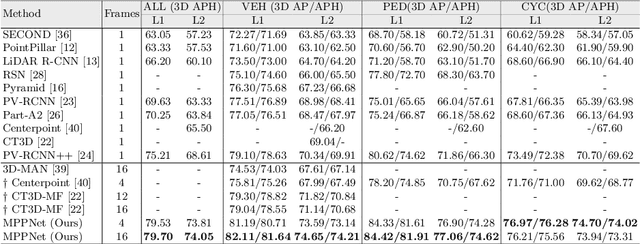
Accurate and reliable 3D detection is vital for many applications including autonomous driving vehicles and service robots. In this paper, we present a flexible and high-performance 3D detection framework, named MPPNet, for 3D temporal object detection with point cloud sequences. We propose a novel three-hierarchy framework with proxy points for multi-frame feature encoding and interactions to achieve better detection. The three hierarchies conduct per-frame feature encoding, short-clip feature fusion, and whole-sequence feature aggregation, respectively. To enable processing long-sequence point clouds with reasonable computational resources, intra-group feature mixing and inter-group feature attention are proposed to form the second and third feature encoding hierarchies, which are recurrently applied for aggregating multi-frame trajectory features. The proxy points not only act as consistent object representations for each frame, but also serve as the courier to facilitate feature interaction between frames. The experiments on largeWaymo Open dataset show that our approach outperforms state-of-the-art methods with large margins when applied to both short (e.g., 4-frame) and long (e.g., 16-frame) point cloud sequences. Specifically, MPPNet achieves 74.21%, 74.62% and 73.31% for vehicle, pedestrian and cyclist classes on the LEVEL 2 mAPH metric with 16-frame input.
EqCo: Equivalent Rules for Self-supervised Contrastive Learning
Oct 05, 2020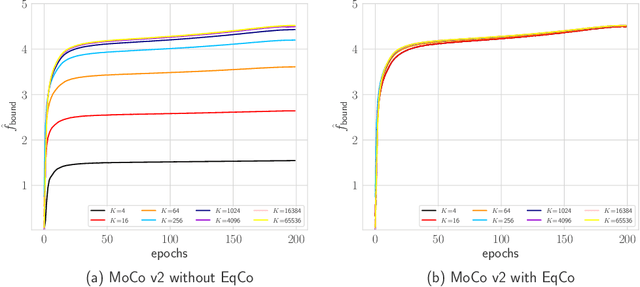

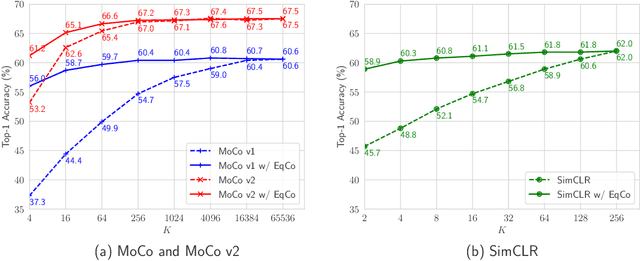
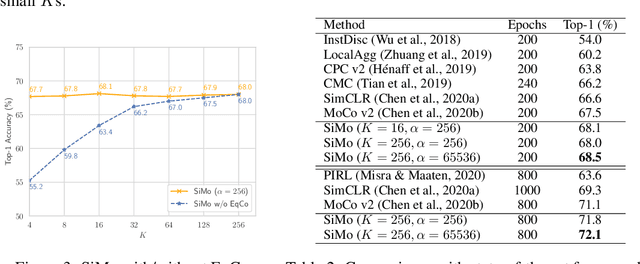
In this paper, we propose a method, named EqCo (Equivalent Rules for Contrastive Learning), to make self-supervised learning irrelevant to the number of negative samples in the contrastive learning framework. Inspired by the infomax principle, we point that the margin term in contrastive loss needs to be adaptively scaled according to the number of negative pairs in order to keep steady mutual information bound and gradient magnitude. EqCo bridges the performance gap among a wide range of negative sample sizes, so that for the first time, we can perform self-supervised contrastive training using only a few negative pairs (e.g.smaller than 256 per query) on large-scale vision tasks like ImageNet, while with little accuracy drop. This is quite a contrast to the widely used large batch training or memory bank mechanism in current practices. Equipped with EqCo, our simplified MoCo (SiMo) achieves comparable accuracy with MoCo v2 on ImageNet (linear evaluation protocol) while only involves 16 negative pairs per query instead of 65536, suggesting that large quantities of negative samples might not be a critical factor in contrastive learning frameworks.
AutoAssign: Differentiable Label Assignment for Dense Object Detection
Jul 07, 2020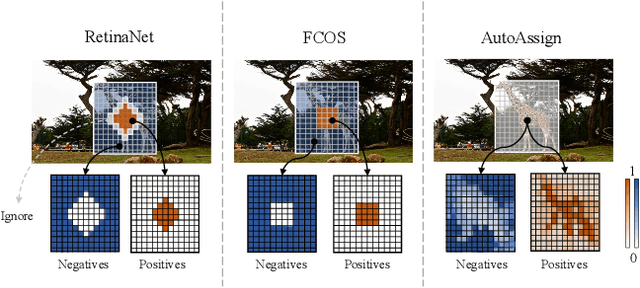
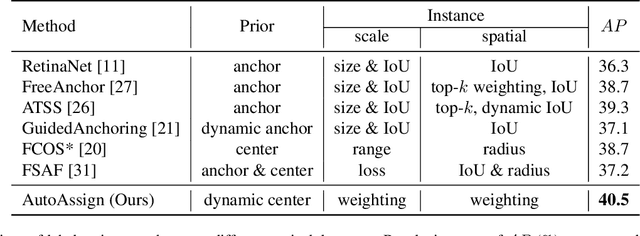
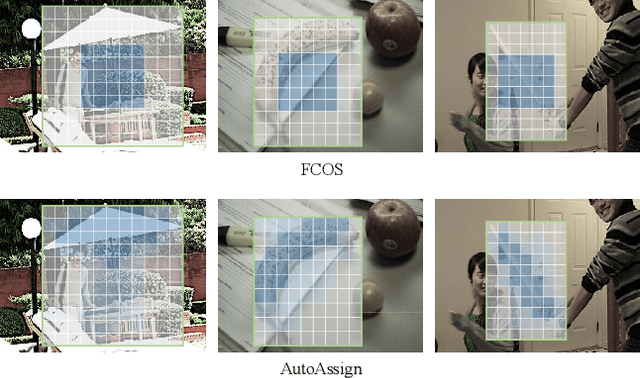
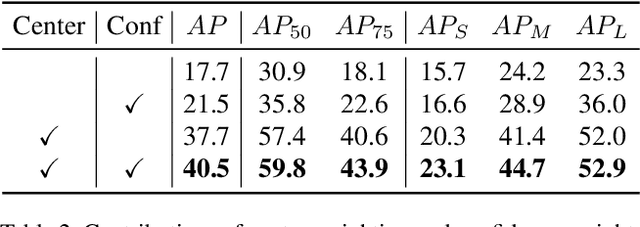
In this paper, we propose an anchor-free object detector with a fully differentiable label assignment strategy, named AutoAssign. It automatically determines positive/negative samples by generating positive and negative weight maps to modify each location's prediction dynamically. Specifically, we present a center weighting module to adjust the category-specific prior distributions and a confidence weighting module to adapt the specific assign strategy of each instance. The entire label assignment process is differentiable and requires no additional modification to transfer to different datasets and tasks. Extensive experiments on MS COCO show that our method steadily surpasses other best sampling strategies by $ \sim $ 1\% AP with various backbones. Moreover, our best model achieves 52.1\% AP, outperforming all existing one-stage detectors. Besides, experiments on other datasets, \emph{e.g.}, PASCAL VOC, Objects365, and WiderFace, demonstrate the broad applicability of AutoAssign.
Class-balanced Grouping and Sampling for Point Cloud 3D Object Detection
Aug 26, 2019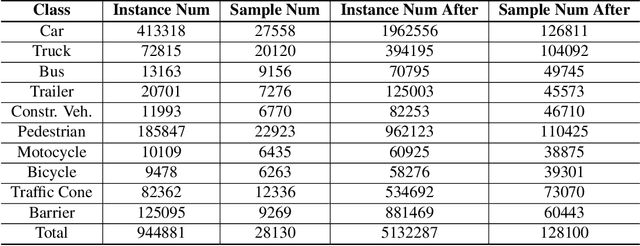
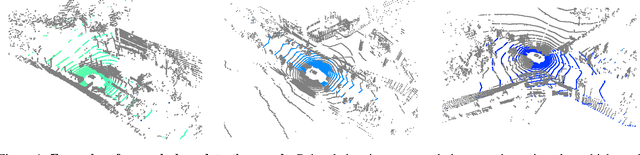
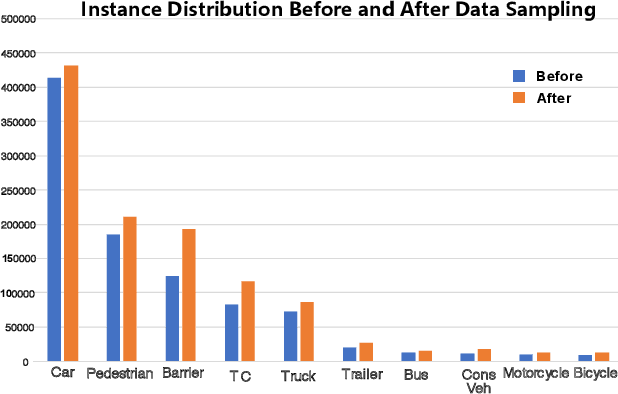

This report presents our method which wins the nuScenes3D Detection Challenge [17] held in Workshop on Autonomous Driving(WAD, CVPR 2019). Generally, we utilize sparse 3D convolution to extract rich semantic features, which are then fed into a class-balanced multi-head network to perform 3D object detection. To handle the severe class imbalance problem inherent in the autonomous driving scenarios, we design a class-balanced sampling and augmentation strategy to generate a more balanced data distribution. Furthermore, we propose a balanced group-ing head to boost the performance for the categories withsimilar shapes. Based on the Challenge results, our methodoutperforms the PointPillars [14] baseline by a large mar-gin across all metrics, achieving state-of-the-art detection performance on the nuScenes dataset. Code will be released at CBGS.