 Add to Chrome
 Add to Firefox
 Add to Edge
Change2Task: From Repository Changes to Executable Coding Agent Tasks and Environments
Jul 30, 2026
Scaling coding agents requires a continuing supply of executable data for training, benchmarking, and continuous evaluation. Each task must couple a realistic software state with a specification, development tools, and reliable verification. To expand this supply, we present Change2Task, a system grounded in repository history that converts merged pull requests into verified tasks on healthy modern revisions of the same repository. It aligns historical evidence with evolved code, reconstructs task states through Patch Reversal, Code Mapping, or Agent Reconstruction, and validates the lifecycle from a healthy base to a task state and a restored state. By deriving multiple tasks grounded in developer evidence from maintained environments, Change2Task provides executable data for coding agent training and evaluation while reducing repeated environment setup, storage, and task construction effort. We evaluate the system through five common and widely adopted coding agent task families: Bug Fix, Feature Addition, Test Generation, Application Programming Interface Migration, and Security Repair. Starting from 1,130 source changes eligible for construction, Change2Task achieves 79.6% verified task construction success across these task families. On a matched candidate set, it recovers 29.2% more verified tasks than a construction baseline based on pull requests. Historical and reconstructed cases achieve up to 98.0% matched outcome agreement under agent evaluation, while reuse of modern bases reduces measured expenditure across the complete pipeline by 10.8%.

Learning from Mistakes: Negative Reasoning Samples Enhance Out-of-Domain Generalization
Jan 08, 2026Supervised fine-tuning (SFT) on chain-of-thought (CoT) trajectories demonstrations is a common approach for enabling reasoning in large language models. Standard practices typically only retain trajectories with correct final answers (positives) while ignoring the rest (negatives). We argue that this paradigm discards substantial supervision and exacerbates overfitting, limiting out-of-domain (OOD) generalization. Specifically, we surprisingly find that incorporating negative trajectories into SFT yields substantial OOD generalization gains over positive-only training, as these trajectories often retain valid intermediate reasoning despite incorrect final answers. To understand this effect in depth, we systematically analyze data, training dynamics, and inference behavior, identifying 22 recurring patterns in negative chains that serve a dual role: they moderate loss descent to mitigate overfitting during training and boost policy entropy by 35.67% during inference to facilitate exploration. Motivated by these observations, we further propose Gain-based LOss Weighting (GLOW), an adaptive, sample-aware scheme that exploits such distinctive training dynamics by rescaling per-sample loss based on inter-epoch progress. Empirically, GLOW efficiently leverages unfiltered trajectories, yielding a 5.51% OOD gain over positive-only SFT on Qwen2.5-7B and boosting MMLU from 72.82% to 76.47% as an RL initialization.
GUI-360$^\circ$: A Comprehensive Dataset and Benchmark for Computer-Using Agents
Nov 10, 2025We introduce GUI-360$^\circ$, a large-scale, comprehensive dataset and benchmark suite designed to advance computer-using agents (CUAs). CUAs present unique challenges and is constrained by three persistent gaps: a scarcity of real-world CUA tasks, the lack of automated collection-and-annotation pipelines for multi-modal trajectories, and the absence of a unified benchmark that jointly evaluates GUI grounding, screen parsing, and action prediction. GUI-360$^\circ$ addresses these gaps with an LLM-augmented, largely automated pipeline for query sourcing, environment-template construction, task instantiation, batched execution, and LLM-driven quality filtering. The released corpus contains over 1.2M executed action steps across thousands of trajectories in popular Windows office applications, and includes full-resolution screenshots, accessibility metadata when available, instantiated goals, intermediate reasoning traces, and both successful and failed action trajectories. The dataset supports three canonical tasks, GUI grounding, screen parsing, and action prediction, and a hybrid GUI+API action space that reflects modern agent designs. Benchmarking state-of-the-art vision--language models on GUI-360$^\circ$ reveals substantial out-of-the-box shortcomings in grounding and action prediction; supervised fine-tuning and reinforcement learning yield significant gains but do not close the gap to human-level reliability. We release GUI-360$^\circ$ and accompanying code to facilitate reproducible research and accelerate progress on robust desktop CUAs. The full dataset has been made public on https://huggingface.co/datasets/vyokky/GUI-360.
GUI-360: A Comprehensive Dataset and Benchmark for Computer-Using Agents
Nov 06, 2025We introduce GUI-360$^\circ$, a large-scale, comprehensive dataset and benchmark suite designed to advance computer-using agents (CUAs). CUAs present unique challenges and is constrained by three persistent gaps: a scarcity of real-world CUA tasks, the lack of automated collection-and-annotation pipelines for multi-modal trajectories, and the absence of a unified benchmark that jointly evaluates GUI grounding, screen parsing, and action prediction. GUI-360$^\circ$ addresses these gaps with an LLM-augmented, largely automated pipeline for query sourcing, environment-template construction, task instantiation, batched execution, and LLM-driven quality filtering. The released corpus contains over 1.2M executed action steps across thousands of trajectories in popular Windows office applications, and includes full-resolution screenshots, accessibility metadata when available, instantiated goals, intermediate reasoning traces, and both successful and failed action trajectories. The dataset supports three canonical tasks, GUI grounding, screen parsing, and action prediction, and a hybrid GUI+API action space that reflects modern agent designs. Benchmarking state-of-the-art vision--language models on GUI-360$^\circ$ reveals substantial out-of-the-box shortcomings in grounding and action prediction; supervised fine-tuning and reinforcement learning yield significant gains but do not close the gap to human-level reliability. We release GUI-360$^\circ$ and accompanying code to facilitate reproducible research and accelerate progress on robust desktop CUAs. The full dataset has been made public on https://huggingface.co/datasets/vyokky/GUI-360.
Semantic Scheduling for LLM Inference
Jun 13, 2025Conventional operating system scheduling algorithms are largely content-ignorant, making decisions based on factors such as latency or fairness without considering the actual intents or semantics of processes. Consequently, these algorithms often do not prioritize tasks that require urgent attention or carry higher importance, such as in emergency management scenarios. However, recent advances in language models enable semantic analysis of processes, allowing for more intelligent and context-aware scheduling decisions. In this paper, we introduce the concept of semantic scheduling in scheduling of requests from large language models (LLM), where the semantics of the process guide the scheduling priorities. We present a novel scheduling algorithm with optimal time complexity, designed to minimize the overall waiting time in LLM-based prompt scheduling. To illustrate its effectiveness, we present a medical emergency management application, underscoring the potential benefits of semantic scheduling for critical, time-sensitive tasks. The code and data are available at https://github.com/Wenyueh/latency_optimization_with_priority_constraints.
UFO2: The Desktop AgentOS
Apr 20, 2025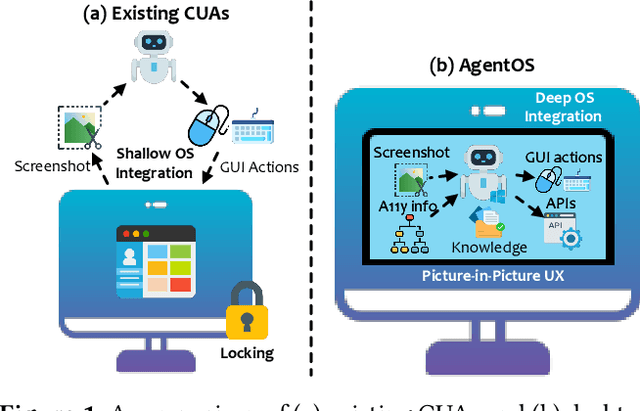
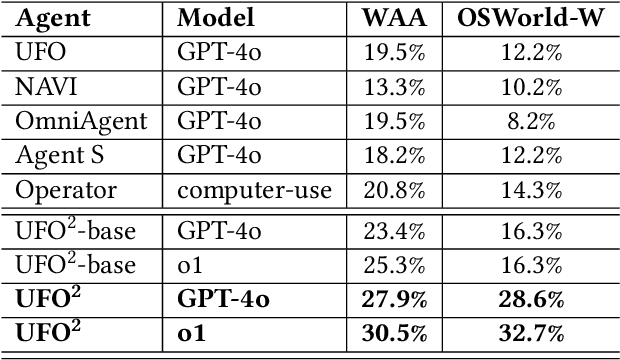
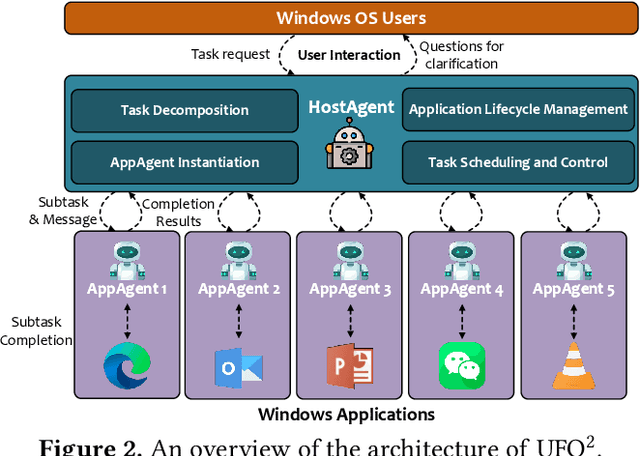
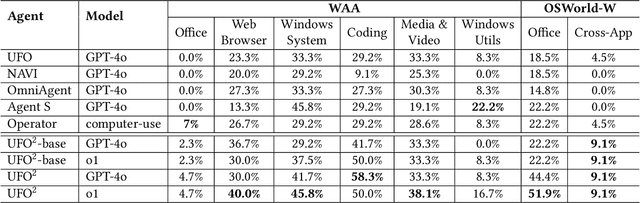
Recent Computer-Using Agents (CUAs), powered by multimodal large language models (LLMs), offer a promising direction for automating complex desktop workflows through natural language. However, most existing CUAs remain conceptual prototypes, hindered by shallow OS integration, fragile screenshot-based interaction, and disruptive execution. We present UFO2, a multiagent AgentOS for Windows desktops that elevates CUAs into practical, system-level automation. UFO2 features a centralized HostAgent for task decomposition and coordination, alongside a collection of application-specialized AppAgent equipped with native APIs, domain-specific knowledge, and a unified GUI--API action layer. This architecture enables robust task execution while preserving modularity and extensibility. A hybrid control detection pipeline fuses Windows UI Automation (UIA) with vision-based parsing to support diverse interface styles. Runtime efficiency is further enhanced through speculative multi-action planning, reducing per-step LLM overhead. Finally, a Picture-in-Picture (PiP) interface enables automation within an isolated virtual desktop, allowing agents and users to operate concurrently without interference. We evaluate UFO2 across over 20 real-world Windows applications, demonstrating substantial improvements in robustness and execution accuracy over prior CUAs. Our results show that deep OS integration unlocks a scalable path toward reliable, user-aligned desktop automation.
AIOpsLab: A Holistic Framework to Evaluate AI Agents for Enabling Autonomous Clouds
Jan 12, 2025


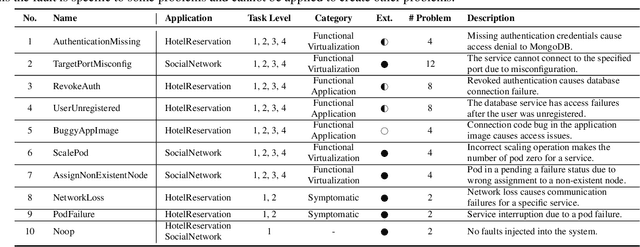
AI for IT Operations (AIOps) aims to automate complex operational tasks, such as fault localization and root cause analysis, to reduce human workload and minimize customer impact. While traditional DevOps tools and AIOps algorithms often focus on addressing isolated operational tasks, recent advances in Large Language Models (LLMs) and AI agents are revolutionizing AIOps by enabling end-to-end and multitask automation. This paper envisions a future where AI agents autonomously manage operational tasks throughout the entire incident lifecycle, leading to self-healing cloud systems, a paradigm we term AgentOps. Realizing this vision requires a comprehensive framework to guide the design, development, and evaluation of these agents. To this end, we present AIOPSLAB, a framework that not only deploys microservice cloud environments, injects faults, generates workloads, and exports telemetry data but also orchestrates these components and provides interfaces for interacting with and evaluating agents. We discuss the key requirements for such a holistic framework and demonstrate how AIOPSLAB can facilitate the evaluation of next-generation AIOps agents. Through evaluations of state-of-the-art LLM agents within the benchmark created by AIOPSLAB, we provide insights into their capabilities and limitations in handling complex operational tasks in cloud environments.
Large Language Model-Brained GUI Agents: A Survey
Dec 03, 2024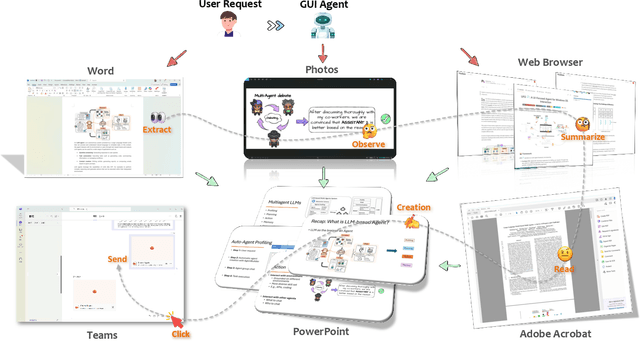


GUIs have long been central to human-computer interaction, providing an intuitive and visually-driven way to access and interact with digital systems. The advent of LLMs, particularly multimodal models, has ushered in a new era of GUI automation. They have demonstrated exceptional capabilities in natural language understanding, code generation, and visual processing. This has paved the way for a new generation of LLM-brained GUI agents capable of interpreting complex GUI elements and autonomously executing actions based on natural language instructions. These agents represent a paradigm shift, enabling users to perform intricate, multi-step tasks through simple conversational commands. Their applications span across web navigation, mobile app interactions, and desktop automation, offering a transformative user experience that revolutionizes how individuals interact with software. This emerging field is rapidly advancing, with significant progress in both research and industry. To provide a structured understanding of this trend, this paper presents a comprehensive survey of LLM-brained GUI agents, exploring their historical evolution, core components, and advanced techniques. We address research questions such as existing GUI agent frameworks, the collection and utilization of data for training specialized GUI agents, the development of large action models tailored for GUI tasks, and the evaluation metrics and benchmarks necessary to assess their effectiveness. Additionally, we examine emerging applications powered by these agents. Through a detailed analysis, this survey identifies key research gaps and outlines a roadmap for future advancements in the field. By consolidating foundational knowledge and state-of-the-art developments, this work aims to guide both researchers and practitioners in overcoming challenges and unlocking the full potential of LLM-brained GUI agents.
Enhanced Fine-Tuning of Lightweight Domain-Specific Q&A Model Based on Large Language Models
Aug 23, 2024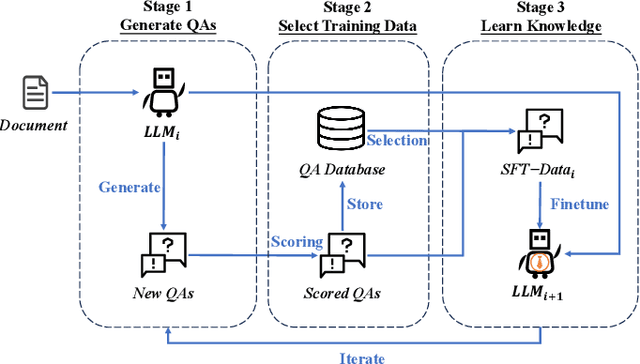
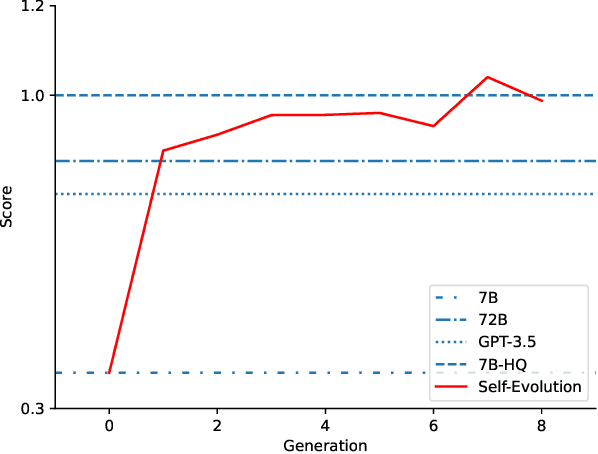
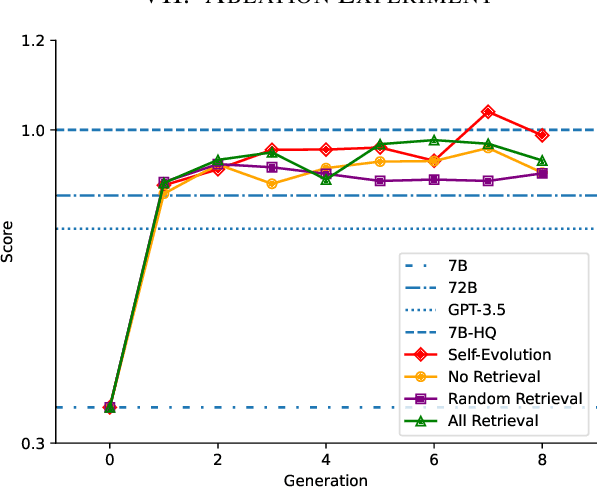
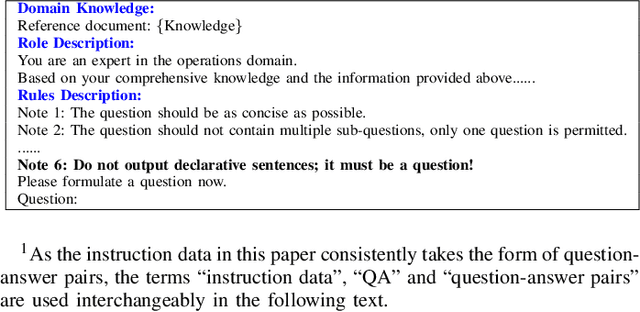
Large language models (LLMs) excel at general question-answering (Q&A) but often fall short in specialized domains due to a lack of domain-specific knowledge. Commercial companies face the dual challenges of privacy protection and resource constraints when involving LLMs for fine-tuning. This paper propose a novel framework, Self-Evolution, designed to address these issues by leveraging lightweight open-source LLMs through multiple iterative fine-tuning rounds. To enhance the efficiency of iterative fine-tuning, Self-Evolution employ a strategy that filters and reinforces the knowledge with higher value during the iterative process. We employed Self-Evolution on Qwen1.5-7B-Chat using 4,000 documents containing rich domain knowledge from China Mobile, achieving a performance score 174% higher on domain-specific question-answering evaluations than Qwen1.5-7B-Chat and even 22% higher than Qwen1.5-72B-Chat. Self-Evolution has been deployed in China Mobile's daily operation and maintenance for 117 days, and it improves the efficiency of locating alarms, fixing problems, and finding related reports, with an average efficiency improvement of over 18.6%. In addition, we release Self-Evolution framework code in https://github.com/Zero-Pointer/Self-Evolution.
Building AI Agents for Autonomous Clouds: Challenges and Design Principles
Jul 16, 2024


The rapid growth in the use of Large Language Models (LLMs) and AI Agents as part of software development and deployment is revolutionizing the information technology landscape. While code generation receives significant attention, a higher-impact application lies in using AI agents for operational resilience of cloud services, which currently require significant human effort and domain knowledge. There is a growing interest in AI for IT Operations (AIOps) which aims to automate complex operational tasks, like fault localization and root cause analysis, thereby reducing human intervention and customer impact. However, achieving the vision of autonomous and self-healing clouds though AIOps is hampered by the lack of standardized frameworks for building, evaluating, and improving AIOps agents. This vision paper lays the groundwork for such a framework by first framing the requirements and then discussing design decisions that satisfy them. We also propose AIOpsLab, a prototype implementation leveraging agent-cloud-interface that orchestrates an application, injects real-time faults using chaos engineering, and interfaces with an agent to localize and resolve the faults. We report promising results and lay the groundwork to build a modular and robust framework for building, evaluating, and improving agents for autonomous clouds.