 Add to Chrome
 Add to Firefox
 Add to Edge
OneMall: One Model, More Scenarios -- End-to-End Generative Recommender Family at Kuaishou E-Commerce
Jan 29, 2026
In the wave of generative recommendation, we present OneMall, an end-to-end generative recommendation framework tailored for e-commerce services at Kuaishou. Our OneMall systematically unifies the e-commerce's multiple item distribution scenarios, such as Product-card, short-video and live-streaming. Specifically, it comprises three key components, aligning the entire model training pipeline to the LLM's pre-training/post-training: (1) E-commerce Semantic Tokenizer: we provide a tokenizer solution that captures both real-world semantics and business-specific item relations across different scenarios; (2) Transformer-based Architecture: we largely utilize Transformer as our model backbone, e.g., employing Query-Former for long sequence compression, Cross-Attention for multi-behavior sequence fusion, and Sparse MoE for scalable auto-regressive generation; (3) Reinforcement Learning Pipeline: we further connect retrieval and ranking models via RL, enabling the ranking model to serve as a reward signal for end-to-end policy retrieval model optimization. Extensive experiments demonstrate that OneMall achieves consistent improvements across all e-commerce scenarios: +13.01\% GMV in product-card, +15.32\% Orders in Short-Video, and +2.78\% Orders in Live-Streaming. OneMall has been deployed, serving over 400 million daily active users at Kuaishou.

DPWriter: Reinforcement Learning with Diverse Planning Branching for Creative Writing
Jan 14, 2026Reinforcement learning (RL)-based enhancement of large language models (LLMs) often leads to reduced output diversity, undermining their utility in open-ended tasks like creative writing. Current methods lack explicit mechanisms for guiding diverse exploration and instead prioritize optimization efficiency and performance over diversity. This paper proposes an RL framework structured around a semi-structured long Chain-of-Thought (CoT), in which the generation process is decomposed into explicitly planned intermediate steps. We introduce a Diverse Planning Branching method that strategically introduces divergence at the planning phase based on diversity variation, alongside a group-aware diversity reward to encourage distinct trajectories. Experimental results on creative writing benchmarks demonstrate that our approach significantly improves output diversity without compromising generation quality, consistently outperforming existing baselines.
Unleashing the Native Recommendation Potential: LLM-Based Generative Recommendation via Structured Term Identifiers
Jan 11, 2026Leveraging the vast open-world knowledge and understanding capabilities of Large Language Models (LLMs) to develop general-purpose, semantically-aware recommender systems has emerged as a pivotal research direction in generative recommendation. However, existing methods face bottlenecks in constructing item identifiers. Text-based methods introduce LLMs' vast output space, leading to hallucination, while methods based on Semantic IDs (SIDs) encounter a semantic gap between SIDs and LLMs' native vocabulary, requiring costly vocabulary expansion and alignment training. To address this, this paper introduces Term IDs (TIDs), defined as a set of semantically rich and standardized textual keywords, to serve as robust item identifiers. We propose GRLM, a novel framework centered on TIDs, employs Context-aware Term Generation to convert item's metadata into standardized TIDs and utilizes Integrative Instruction Fine-tuning to collaboratively optimize term internalization and sequential recommendation. Additionally, Elastic Identifier Grounding is designed for robust item mapping. Extensive experiments on real-world datasets demonstrate that GRLM significantly outperforms baselines across multiple scenarios, pointing a promising direction for generalizable and high-performance generative recommendation systems.
PROMISE: Process Reward Models Unlock Test-Time Scaling Laws in Generative Recommendations
Jan 08, 2026Generative Recommendation has emerged as a promising paradigm, reformulating recommendation as a sequence-to-sequence generation task over hierarchical Semantic IDs. However, existing methods suffer from a critical issue we term Semantic Drift, where errors in early, high-level tokens irreversibly divert the generation trajectory into irrelevant semantic subspaces. Inspired by Process Reward Models (PRMs) that enhance reasoning in Large Language Models, we propose Promise, a novel framework that integrates dense, step-by-step verification into generative models. Promise features a lightweight PRM to assess the quality of intermediate inference steps, coupled with a PRM-guided Beam Search strategy that leverages dense feedback to dynamically prune erroneous branches. Crucially, our approach unlocks Test-Time Scaling Laws for recommender systems: by increasing inference compute, smaller models can match or surpass larger models. Extensive offline experiments and online A/B tests on a large-scale platform demonstrate that Promise effectively mitigates Semantic Drift, significantly improving recommendation accuracy while enabling efficient deployment.
DeepSynth-Eval: Objectively Evaluating Information Consolidation in Deep Survey Writing
Jan 07, 2026The evolution of Large Language Models (LLMs) towards autonomous agents has catalyzed progress in Deep Research. While retrieval capabilities are well-benchmarked, the post-retrieval synthesis stage--where agents must digest massive amounts of context and consolidate fragmented evidence into coherent, long-form reports--remains under-evaluated due to the subjectivity of open-ended writing. To bridge this gap, we introduce DeepSynth-Eval, a benchmark designed to objectively evaluate information consolidation capabilities. We leverage high-quality survey papers as gold standards, reverse-engineering research requests and constructing "Oracle Contexts" from their bibliographies to isolate synthesis from retrieval noise. We propose a fine-grained evaluation protocol using General Checklists (for factual coverage) and Constraint Checklists (for structural organization), transforming subjective judgment into verifiable metrics. Experiments across 96 tasks reveal that synthesizing information from hundreds of references remains a significant challenge. Our results demonstrate that agentic plan-and-write workflows significantly outperform single-turn generation, effectively reducing hallucinations and improving adherence to complex structural constraints.
OpenOneRec Technical Report
Dec 31, 2025While the OneRec series has successfully unified the fragmented recommendation pipeline into an end-to-end generative framework, a significant gap remains between recommendation systems and general intelligence. Constrained by isolated data, they operate as domain specialists-proficient in pattern matching but lacking world knowledge, reasoning capabilities, and instruction following. This limitation is further compounded by the lack of a holistic benchmark to evaluate such integrated capabilities. To address this, our contributions are: 1) RecIF Bench & Open Data: We propose RecIF-Bench, a holistic benchmark covering 8 diverse tasks that thoroughly evaluate capabilities from fundamental prediction to complex reasoning. Concurrently, we release a massive training dataset comprising 96 million interactions from 160,000 users to facilitate reproducible research. 2) Framework & Scaling: To ensure full reproducibility, we open-source our comprehensive training pipeline, encompassing data processing, co-pretraining, and post-training. Leveraging this framework, we demonstrate that recommendation capabilities can scale predictably while mitigating catastrophic forgetting of general knowledge. 3) OneRec-Foundation: We release OneRec Foundation (1.7B and 8B), a family of models establishing new state-of-the-art (SOTA) results across all tasks in RecIF-Bench. Furthermore, when transferred to the Amazon benchmark, our models surpass the strongest baselines with an average 26.8% improvement in Recall@10 across 10 diverse datasets (Figure 1). This work marks a step towards building truly intelligent recommender systems. Nonetheless, realizing this vision presents significant technical and theoretical challenges, highlighting the need for broader research engagement in this promising direction.
PushGen: Push Notifications Generation with LLM
Dec 16, 2025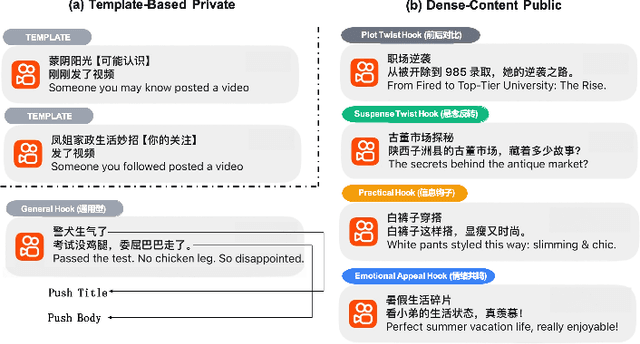
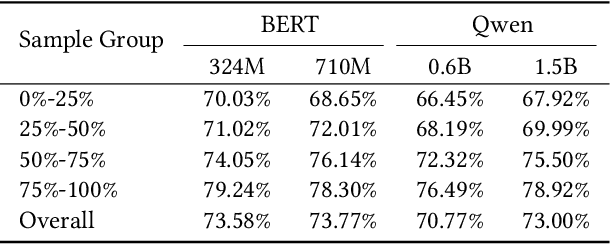
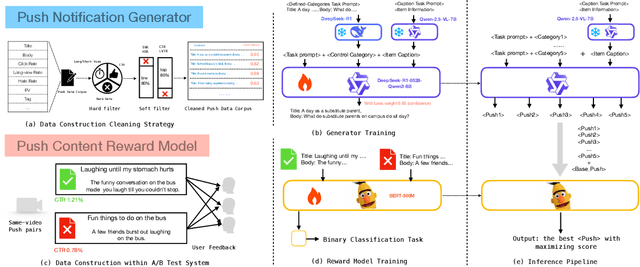
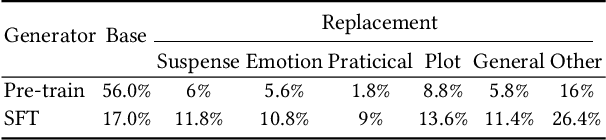
We present PushGen, an automated framework for generating high-quality push notifications comparable to human-crafted content. With the rise of generative models, there is growing interest in leveraging LLMs for push content generation. Although LLMs make content generation straightforward and cost-effective, maintaining stylistic control and reliable quality assessment remains challenging, as both directly impact user engagement. To address these issues, PushGen combines two key components: (1) a controllable category prompt technique to guide LLM outputs toward desired styles, and (2) a reward model that ranks and selects generated candidates. Extensive offline and online experiments demonstrate its effectiveness, which has been deployed in large-scale industrial applications, serving hundreds of millions of users daily.
LLM-Aligned Geographic Item Tokenization for Local-Life Recommendation
Nov 18, 2025Recent advances in Large Language Models (LLMs) have enhanced text-based recommendation by enriching traditional ID-based methods with semantic generalization capabilities. Text-based methods typically encode item textual information via prompt design and generate discrete semantic IDs through item tokenization. However, in domain-specific tasks such as local-life services, simply injecting location information into prompts fails to capture fine-grained spatial characteristics and real-world distance awareness among items. To address this, we propose LGSID, an LLM-Aligned Geographic Item Tokenization Framework for Local-life Recommendation. This framework consists of two key components: (1) RL-based Geographic LLM Alignment, and (2) Hierarchical Geographic Item Tokenization. In the RL-based alignment module, we initially train a list-wise reward model to capture real-world spatial relationships among items. We then introduce a novel G-DPO algorithm that uses pre-trained reward model to inject generalized spatial knowledge and collaborative signals into LLMs while preserving their semantic understanding. Furthermore, we propose a hierarchical geographic item tokenization strategy, where primary tokens are derived from discrete spatial and content attributes, and residual tokens are refined using the aligned LLM's geographic representation vectors. Extensive experiments on real-world Kuaishou industry datasets show that LGSID consistently outperforms state-of-the-art discriminative and generative recommendation models. Ablation studies, visualizations, and case studies further validate its effectiveness.
A Plug-and-Play Spatially-Constrained Representation Enhancement Framework for Local-Life Recommendation
Nov 17, 2025Local-life recommendation have witnessed rapid growth, providing users with convenient access to daily essentials. However, this domain faces two key challenges: (1) spatial constraints, driven by the requirements of the local-life scenario, where items are usually shown only to users within a limited geographic area, indirectly reducing their exposure probability; and (2) long-tail sparsity, where few popular items dominate user interactions, while many high-quality long-tail items are largely overlooked due to imbalanced interaction opportunities. Existing methods typically adopt a user-centric perspective, such as modeling spatial user preferences or enhancing long-tail representations with collaborative filtering signals. However, we argue that an item-centric perspective is more suitable for this domain, focusing on enhancing long-tail items representation that align with the spatially-constrained characteristics of local lifestyle services. To tackle this issue, we propose ReST, a Plug-And-Play Spatially-Constrained Representation Enhancement Framework for Long-Tail Local-Life Recommendation. Specifically, we first introduce a Meta ID Warm-up Network, which initializes fundamental ID representations by injecting their basic attribute-level semantic information. Subsequently, we propose a novel Spatially-Constrained ID Representation Enhancement Network (SIDENet) based on contrastive learning, which incorporates two efficient strategies: a spatially-constrained hard sampling strategy and a dynamic representation alignment strategy. This design adaptively identifies weak ID representations based on their attribute-level information during training. It additionally enhances them by capturing latent item relationships within the spatially-constrained characteristics of local lifestyle services, while preserving compatibility with popular items.
Compression then Matching: An Efficient Pre-training Paradigm for Multimodal Embedding
Nov 11, 2025Vision-language models advance multimodal representation learning by acquiring transferable semantic embeddings, thereby substantially enhancing performance across a range of vision-language tasks, including cross-modal retrieval, clustering, and classification. An effective embedding is expected to comprehensively preserve the semantic content of the input while simultaneously emphasizing features that are discriminative for downstream tasks. Recent approaches demonstrate that VLMs can be adapted into competitive embedding models via large-scale contrastive learning, enabling the simultaneous optimization of two complementary objectives. We argue that the two aforementioned objectives can be decoupled: a comprehensive understanding of the input facilitates the embedding model in achieving superior performance in downstream tasks via contrastive learning. In this paper, we propose CoMa, a compressed pre-training phase, which serves as a warm-up stage for contrastive learning. Experiments demonstrate that with only a small amount of pre-training data, we can transform a VLM into a competitive embedding model. CoMa achieves new state-of-the-art results among VLMs of comparable size on the MMEB, realizing optimization in both efficiency and effectiveness.