 Add to Chrome
 Add to Firefox
 Add to Edge
Interpretable Representation via LLM-Driven Generative Disentanglement for Local-Life Service Recommendation
Jul 30, 2026
While large language models (LLMs) have advanced ID-based recommendation through Semantic ID (SID) modeling, existing SID generation frameworks largely follow a single-representation-then-quantization paradigm. This design faces two bottlenecks: semantic entanglement mixes heterogeneous attributes, such as geography, brand, and category, causing information loss during quantization, low-quality SIDs, and severe collisions; moreover, black-box representation learning provides neither explicit attribute semantics nor clear geographic or semantic meanings for SID positions. These limitations weaken both retrieval reliability and the ability to diagnose or control SID generation. We propose Interpretable Representation via LLM-Driven Generative Disentanglement for Local-Life Service Recommendation (LGRID). LGRID introduces a generative disentanglement paradigm through an Encode -> Disentangle -> Align -> Quantize pipeline. It first uses joint LLM encoding to preserve cross-attribute geographic-semantic dependencies, rather than encoding fields independently. A Structured Disentangled Block then routes hidden states into attribute-aligned slots for geographic and semantic factors. Synergistic Alignment Learning makes these slots both generatively decodable and discriminative for retrieval, while Dual-Stream Residual Quantization separately discretizes the two streams into compact SIDs with explicit attribute correspondence. This design yields interpretable SIDs with positions grounded in item attributes and local-service semantics. Experiments on Kuaishou and Foursquare show that LGRID consistently outperforms strong SID baselines, achieving up to a 5.44 percent relative AUC gain. It also achieves over 99 percent attribute-decoding accuracy for coarse geographic fields and reduces the full-SID collision rate to 39.9 percent, compared with 97.0 percent for LGSID.

WhisperRec: Latent Reasoning for Efficient Foundation Recommendation Models
Jul 29, 2026Large language models (LLMs) have demonstrated strong reasoning capabilities, motivating their adoption as backbones for foundation recommendation models (FRMs). Existing approaches typically enhance recommendation with explicit Chain-of-Thought (CoT) under the Think-then-Answer paradigm. However, generating lengthy rationales introduces substantial inference overhead, while fixed CoT templates struggle to model diverse, dynamic, and context-dependent user interests. We propose WhisperRec, an efficient latent reasoning framework for FRMs. WhisperRec compresses teacher-generated CoT into learnable latent reasoning tokens, enabling a Latent-Reason-then-Answer paradigm that performs reasoning in latent space without producing verbose rationales. This design retains decision-relevant reasoning information while avoiding the latency bottleneck of autoregressive rationale generation. Specifically, it first introduces Multi-View Adaptive CoT (MV-ACoT) to construct diverse, high-quality supervision from complementary perspectives on user interests. MV-ACoT also adapts reasoning complexity to each instance, applying lightweight analysis to clear cases and targeted multi-factor reasoning to challenging ones. Building on a pre-trained FRM, WhisperRec then employs a three-stage Latent Reasoning Alignment procedure to progressively internalize teacher CoT into latent representations. Finally, curriculum-based post-training activates latent-token reasoning for downstream recommendation while preserving standard recommendation capability. Experiments on an industrial-scale Kuaishou dataset and the public Kuaishou LLM-Rec benchmark show that WhisperRec consistently outperforms explicit-CoT methods and conventional baselines. Compared with explicit CoT Think and No-Think variants, WhisperRec improves SID@64 by 17.44% and 9.33%, respectively, and achieves over 10x higher online inference throughput.
A specialized reasoning large language model for accelerating rare disease diagnosis: a randomized AI physician assistance trial
Jun 23, 2026Rare diseases affect millions of individuals worldwide, yet timely diagnosis remains a major public health challenge due to scarcity of specialized clinical expertise. While large language models (LLMs) show promise to support rare disease diagnosis, current models are constrained by insufficient clinical deployability, limited clinically grounded evidence, and scarcity of training data. Here we present RaDaR (Rare Disease navigatoR), an open-source, compact reasoning LLM (32B parameters) for rare disease diagnosis. RaDaR was trained with 49,170 publicly available free-text cases and 104,666 synthetic cases with reasoning-enhanced training. RaDaR showed the strongest performance among evaluated open-source models, including the 671B DeepSeek-R1, across public benchmarks and four external validation centers. In a retrospective cohort, RaDaR prioritized the final diagnosis before documented clinical suspicion in 61.06 percent of cases, corresponding to a potential lead time of 1.87 months and 50.18 percent of the within-center interval. In a randomized physician-assistance trial, RaDaR assistance improved physicians' rare-disease diagnostic accuracy by 21.44 percentage points compared with internet search alone. Synthetic-data ablations suggested that phenotype-anchored narratives provide useful training signal for long-tail rare diseases, with a monotonic scaling trend within the tested data range. Together, RaDaR and its development and validation framework provide a deployable rare-disease reasoning model and a reproducible development framework for diagnostic AI under data scarcity.
OneReason Technical Report
Jun 04, 2026Generative recommendation models in the OneRec family have been widely deployed in many real-world services, such as short-video, live-streaming, advertising, and e-commerce. However, these generative models can only benefit from the scaling advantage, while their reasoning ability is hard to activate, since we cannot construct meaningful Chain-of-Thought (CoT) sequences consisting of itemic tokens only. Inspired by the success of the reasoning-style ``think before answer'' paradigm in the LLM field, we conduct preliminary studies (i.e., OneRec-Think, OpenOneRec) to explore reasoning capability in generative recommendation. Nevertheless, we notice an unexpected phenomenon: the thinking mode does not show advantages over the non-thinking mode. Drawing insights from recent findings on CoT robustness in multi-modal language models, we argue that effective reasoning in recommendation rests on two factors: perception, the ability to ground itemic tokens in their underlying language semantics, and cognition, the ability to reorganize a user's behavior sequence into coherent latent interest points. We therefore propose OneReason, which includes: (1) strong itemic token perception in pre-training, (2) a three-level cognition-enhanced CoT format for recommendation tasks in SFT, and (3) a specialize-then-unify training recipe in RL to enhance the thinking ability.
LLM-Aligned Geographic Item Tokenization for Local-Life Recommendation
Nov 18, 2025Recent advances in Large Language Models (LLMs) have enhanced text-based recommendation by enriching traditional ID-based methods with semantic generalization capabilities. Text-based methods typically encode item textual information via prompt design and generate discrete semantic IDs through item tokenization. However, in domain-specific tasks such as local-life services, simply injecting location information into prompts fails to capture fine-grained spatial characteristics and real-world distance awareness among items. To address this, we propose LGSID, an LLM-Aligned Geographic Item Tokenization Framework for Local-life Recommendation. This framework consists of two key components: (1) RL-based Geographic LLM Alignment, and (2) Hierarchical Geographic Item Tokenization. In the RL-based alignment module, we initially train a list-wise reward model to capture real-world spatial relationships among items. We then introduce a novel G-DPO algorithm that uses pre-trained reward model to inject generalized spatial knowledge and collaborative signals into LLMs while preserving their semantic understanding. Furthermore, we propose a hierarchical geographic item tokenization strategy, where primary tokens are derived from discrete spatial and content attributes, and residual tokens are refined using the aligned LLM's geographic representation vectors. Extensive experiments on real-world Kuaishou industry datasets show that LGSID consistently outperforms state-of-the-art discriminative and generative recommendation models. Ablation studies, visualizations, and case studies further validate its effectiveness.
A Plug-and-Play Spatially-Constrained Representation Enhancement Framework for Local-Life Recommendation
Nov 17, 2025Local-life recommendation have witnessed rapid growth, providing users with convenient access to daily essentials. However, this domain faces two key challenges: (1) spatial constraints, driven by the requirements of the local-life scenario, where items are usually shown only to users within a limited geographic area, indirectly reducing their exposure probability; and (2) long-tail sparsity, where few popular items dominate user interactions, while many high-quality long-tail items are largely overlooked due to imbalanced interaction opportunities. Existing methods typically adopt a user-centric perspective, such as modeling spatial user preferences or enhancing long-tail representations with collaborative filtering signals. However, we argue that an item-centric perspective is more suitable for this domain, focusing on enhancing long-tail items representation that align with the spatially-constrained characteristics of local lifestyle services. To tackle this issue, we propose ReST, a Plug-And-Play Spatially-Constrained Representation Enhancement Framework for Long-Tail Local-Life Recommendation. Specifically, we first introduce a Meta ID Warm-up Network, which initializes fundamental ID representations by injecting their basic attribute-level semantic information. Subsequently, we propose a novel Spatially-Constrained ID Representation Enhancement Network (SIDENet) based on contrastive learning, which incorporates two efficient strategies: a spatially-constrained hard sampling strategy and a dynamic representation alignment strategy. This design adaptively identifies weak ID representations based on their attribute-level information during training. It additionally enhances them by capturing latent item relationships within the spatially-constrained characteristics of local lifestyle services, while preserving compatibility with popular items.
DR.EHR: Dense Retrieval for Electronic Health Record with Knowledge Injection and Synthetic Data
Jul 24, 2025Electronic Health Records (EHRs) are pivotal in clinical practices, yet their retrieval remains a challenge mainly due to semantic gap issues. Recent advancements in dense retrieval offer promising solutions but existing models, both general-domain and biomedical-domain, fall short due to insufficient medical knowledge or mismatched training corpora. This paper introduces \texttt{DR.EHR}, a series of dense retrieval models specifically tailored for EHR retrieval. We propose a two-stage training pipeline utilizing MIMIC-IV discharge summaries to address the need for extensive medical knowledge and large-scale training data. The first stage involves medical entity extraction and knowledge injection from a biomedical knowledge graph, while the second stage employs large language models to generate diverse training data. We train two variants of \texttt{DR.EHR}, with 110M and 7B parameters, respectively. Evaluated on the CliniQ benchmark, our models significantly outperforms all existing dense retrievers, achieving state-of-the-art results. Detailed analyses confirm our models' superiority across various match and query types, particularly in challenging semantic matches like implication and abbreviation. Ablation studies validate the effectiveness of each pipeline component, and supplementary experiments on EHR QA datasets demonstrate the models' generalizability on natural language questions, including complex ones with multiple entities. This work significantly advances EHR retrieval, offering a robust solution for clinical applications.
Evaluating Entity Retrieval in Electronic Health Records: a Semantic Gap Perspective
Feb 10, 2025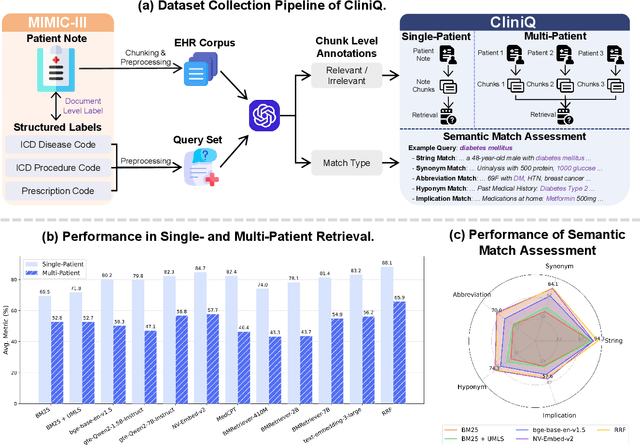
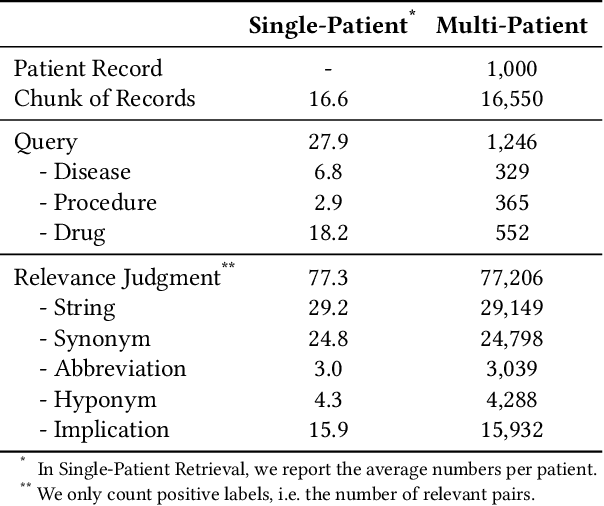
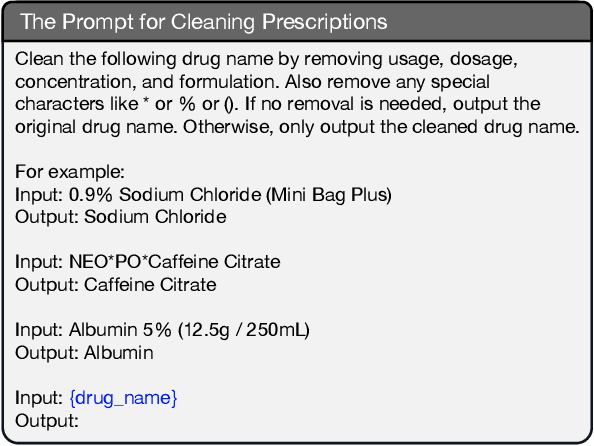
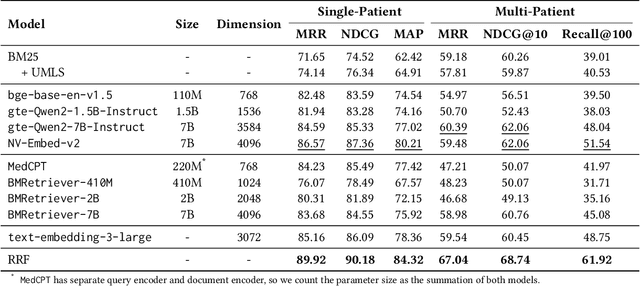
Entity retrieval plays a crucial role in the utilization of Electronic Health Records (EHRs) and is applied across a wide range of clinical practices. However, a comprehensive evaluation of this task is lacking due to the absence of a public benchmark. In this paper, we propose the development and release of a novel benchmark for evaluating entity retrieval in EHRs, with a particular focus on the semantic gap issue. Using discharge summaries from the MIMIC-III dataset, we incorporate ICD codes and prescription labels associated with the notes as queries, and annotate relevance judgments using GPT-4. In total, we use 1,000 patient notes, generate 1,246 queries, and provide over 77,000 relevance annotations. To offer the first assessment of the semantic gap, we introduce a novel classification system for relevance matches. Leveraging GPT-4, we categorize each relevant pair into one of five categories: string, synonym, abbreviation, hyponym, and implication. Using the proposed benchmark, we evaluate several retrieval methods, including BM25, query expansion, and state-of-the-art dense retrievers. Our findings show that BM25 provides a strong baseline but struggles with semantic matches. Query expansion significantly improves performance, though it slightly reduces string match capabilities. Dense retrievers outperform traditional methods, particularly for semantic matches, and general-domain dense retrievers often surpass those trained specifically in the biomedical domain.
GENIE: Generative Note Information Extraction model for structuring EHR data
Jan 30, 2025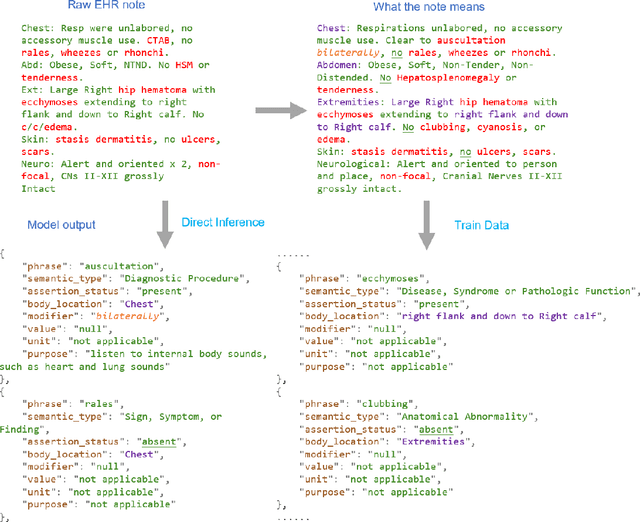
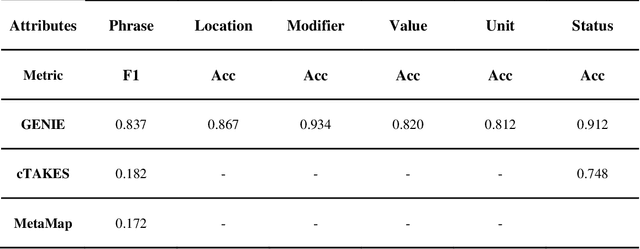
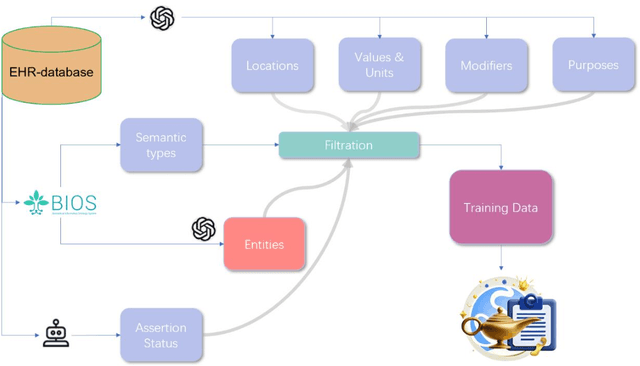
Electronic Health Records (EHRs) hold immense potential for advancing healthcare, offering rich, longitudinal data that combines structured information with valuable insights from unstructured clinical notes. However, the unstructured nature of clinical text poses significant challenges for secondary applications. Traditional methods for structuring EHR free-text data, such as rule-based systems and multi-stage pipelines, are often limited by their time-consuming configurations and inability to adapt across clinical notes from diverse healthcare settings. Few systems provide a comprehensive attribute extraction for terminologies. While giant large language models (LLMs) like GPT-4 and LLaMA 405B excel at structuring tasks, they are slow, costly, and impractical for large-scale use. To overcome these limitations, we introduce GENIE, a Generative Note Information Extraction system that leverages LLMs to streamline the structuring of unstructured clinical text into usable data with standardized format. GENIE processes entire paragraphs in a single pass, extracting entities, assertion statuses, locations, modifiers, values, and purposes with high accuracy. Its unified, end-to-end approach simplifies workflows, reduces errors, and eliminates the need for extensive manual intervention. Using a robust data preparation pipeline and fine-tuned small scale LLMs, GENIE achieves competitive performance across multiple information extraction tasks, outperforming traditional tools like cTAKES and MetaMap and can handle extra attributes to be extracted. GENIE strongly enhances real-world applicability and scalability in healthcare systems. By open-sourcing the model and test data, we aim to encourage collaboration and drive further advancements in EHR structurization.
Black-Box Segmentation of Electronic Medical Records
Sep 29, 2024


Electronic medical records (EMRs) contain the majority of patients' healthcare details. It is an abundant resource for developing an automatic healthcare system. Most of the natural language processing (NLP) studies on EMR processing, such as concept extraction, are adversely affected by the inaccurate segmentation of EMR sections. At the same time, not enough attention has been given to the accurate sectioning of EMRs. The information that may occur in section structures is unvalued. This work focuses on the segmentation of EMRs and proposes a black-box segmentation method using a simple sentence embedding model and neural network, along with a proper training method. To achieve universal adaptivity, we train our model on the dataset with different section headings formats. We compare several advanced deep learning-based NLP methods, and our method achieves the best segmentation accuracies (above 98%) on various test data with a proper training corpus.