 Add to Chrome
 Add to Firefox
 Add to Edge
LLM-Aligned Geographic Item Tokenization for Local-Life Recommendation
Nov 18, 2025
Recent advances in Large Language Models (LLMs) have enhanced text-based recommendation by enriching traditional ID-based methods with semantic generalization capabilities. Text-based methods typically encode item textual information via prompt design and generate discrete semantic IDs through item tokenization. However, in domain-specific tasks such as local-life services, simply injecting location information into prompts fails to capture fine-grained spatial characteristics and real-world distance awareness among items. To address this, we propose LGSID, an LLM-Aligned Geographic Item Tokenization Framework for Local-life Recommendation. This framework consists of two key components: (1) RL-based Geographic LLM Alignment, and (2) Hierarchical Geographic Item Tokenization. In the RL-based alignment module, we initially train a list-wise reward model to capture real-world spatial relationships among items. We then introduce a novel G-DPO algorithm that uses pre-trained reward model to inject generalized spatial knowledge and collaborative signals into LLMs while preserving their semantic understanding. Furthermore, we propose a hierarchical geographic item tokenization strategy, where primary tokens are derived from discrete spatial and content attributes, and residual tokens are refined using the aligned LLM's geographic representation vectors. Extensive experiments on real-world Kuaishou industry datasets show that LGSID consistently outperforms state-of-the-art discriminative and generative recommendation models. Ablation studies, visualizations, and case studies further validate its effectiveness.

A Plug-and-Play Spatially-Constrained Representation Enhancement Framework for Local-Life Recommendation
Nov 17, 2025Local-life recommendation have witnessed rapid growth, providing users with convenient access to daily essentials. However, this domain faces two key challenges: (1) spatial constraints, driven by the requirements of the local-life scenario, where items are usually shown only to users within a limited geographic area, indirectly reducing their exposure probability; and (2) long-tail sparsity, where few popular items dominate user interactions, while many high-quality long-tail items are largely overlooked due to imbalanced interaction opportunities. Existing methods typically adopt a user-centric perspective, such as modeling spatial user preferences or enhancing long-tail representations with collaborative filtering signals. However, we argue that an item-centric perspective is more suitable for this domain, focusing on enhancing long-tail items representation that align with the spatially-constrained characteristics of local lifestyle services. To tackle this issue, we propose ReST, a Plug-And-Play Spatially-Constrained Representation Enhancement Framework for Long-Tail Local-Life Recommendation. Specifically, we first introduce a Meta ID Warm-up Network, which initializes fundamental ID representations by injecting their basic attribute-level semantic information. Subsequently, we propose a novel Spatially-Constrained ID Representation Enhancement Network (SIDENet) based on contrastive learning, which incorporates two efficient strategies: a spatially-constrained hard sampling strategy and a dynamic representation alignment strategy. This design adaptively identifies weak ID representations based on their attribute-level information during training. It additionally enhances them by capturing latent item relationships within the spatially-constrained characteristics of local lifestyle services, while preserving compatibility with popular items.
OneLoc: Geo-Aware Generative Recommender Systems for Local Life Service
Aug 20, 2025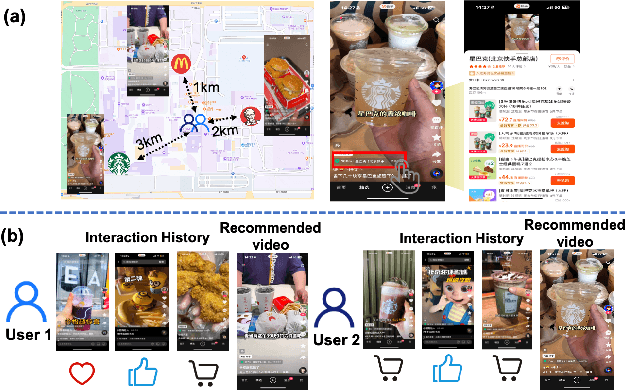
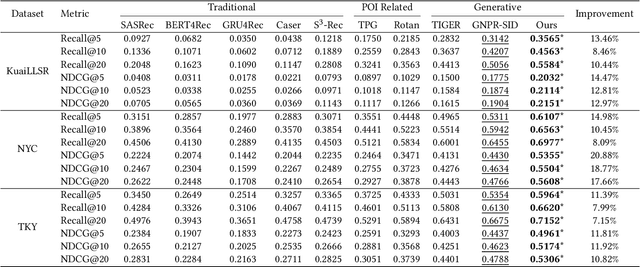
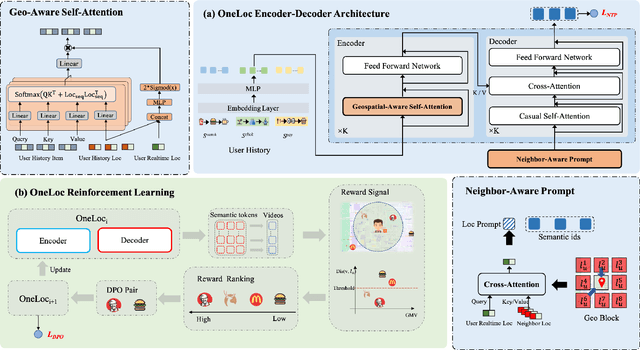
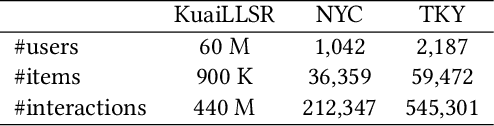
Local life service is a vital scenario in Kuaishou App, where video recommendation is intrinsically linked with store's location information. Thus, recommendation in our scenario is challenging because we should take into account user's interest and real-time location at the same time. In the face of such complex scenarios, end-to-end generative recommendation has emerged as a new paradigm, such as OneRec in the short video scenario, OneSug in the search scenario, and EGA in the advertising scenario. However, in local life service, an end-to-end generative recommendation model has not yet been developed as there are some key challenges to be solved. The first challenge is how to make full use of geographic information. The second challenge is how to balance multiple objectives, including user interests, the distance between user and stores, and some other business objectives. To address the challenges, we propose OneLoc. Specifically, we leverage geographic information from different perspectives: (1) geo-aware semantic ID incorporates both video and geographic information for tokenization, (2) geo-aware self-attention in the encoder leverages both video location similarity and user's real-time location, and (3) neighbor-aware prompt captures rich context information surrounding users for generation. To balance multiple objectives, we use reinforcement learning and propose two reward functions, i.e., geographic reward and GMV reward. With the above design, OneLoc achieves outstanding offline and online performance. In fact, OneLoc has been deployed in local life service of Kuaishou App. It serves 400 million active users daily, achieving 21.016% and 17.891% improvements in terms of gross merchandise value (GMV) and orders numbers.