 Add to Chrome
 Add to Firefox
 Add to Edge
RoboPoint: A Vision-Language Model for Spatial Affordance Prediction for Robotics
Jun 15, 2024
From rearranging objects on a table to putting groceries into shelves, robots must plan precise action points to perform tasks accurately and reliably. In spite of the recent adoption of vision language models (VLMs) to control robot behavior, VLMs struggle to precisely articulate robot actions using language. We introduce an automatic synthetic data generation pipeline that instruction-tunes VLMs to robotic domains and needs. Using the pipeline, we train RoboPoint, a VLM that predicts image keypoint affordances given language instructions. Compared to alternative approaches, our method requires no real-world data collection or human demonstration, making it much more scalable to diverse environments and viewpoints. In addition, RoboPoint is a general model that enables several downstream applications such as robot navigation, manipulation, and augmented reality (AR) assistance. Our experiments demonstrate that RoboPoint outperforms state-of-the-art VLMs (GPT-4o) and visual prompting techniques (PIVOT) by 21.8% in the accuracy of predicting spatial affordance and by 30.5% in the success rate of downstream tasks. Project website: https://robo-point.github.io.

RVT-2: Learning Precise Manipulation from Few Demonstrations
Jun 12, 2024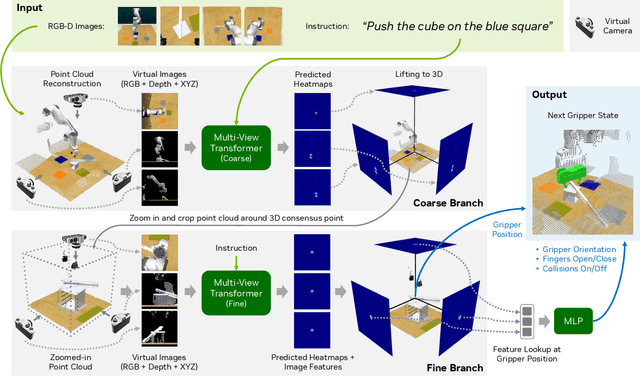
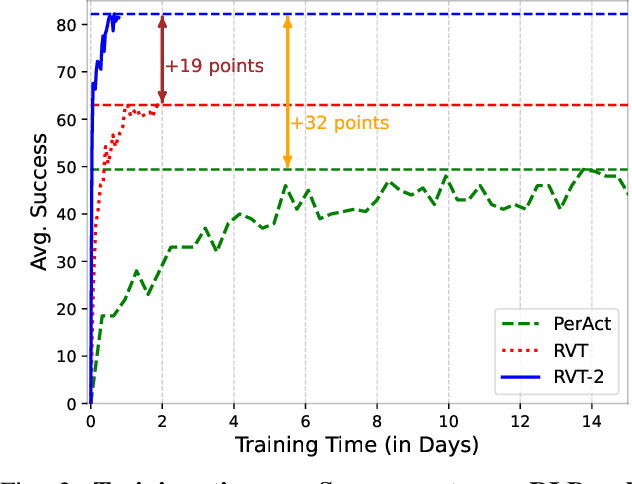
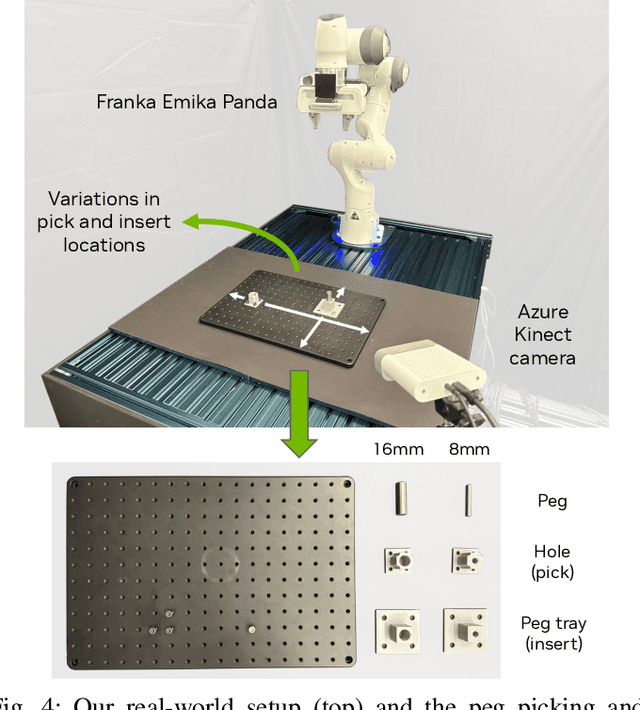
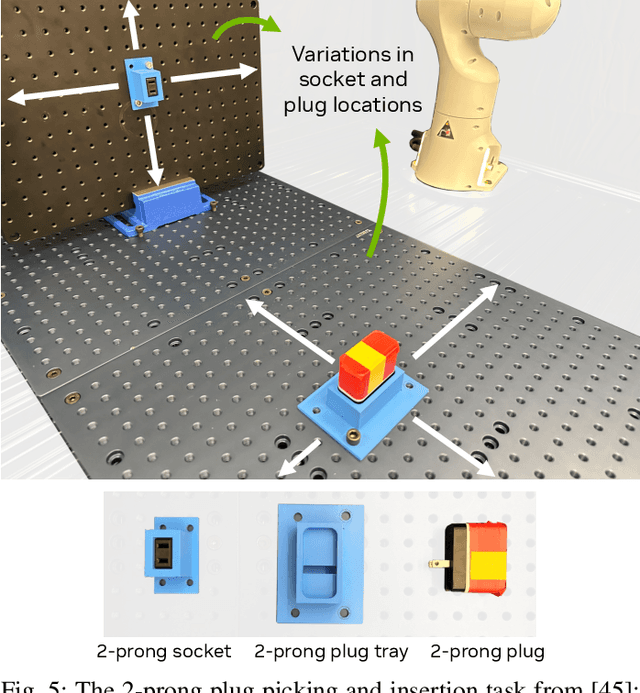
In this work, we study how to build a robotic system that can solve multiple 3D manipulation tasks given language instructions. To be useful in industrial and household domains, such a system should be capable of learning new tasks with few demonstrations and solving them precisely. Prior works, like PerAct and RVT, have studied this problem, however, they often struggle with tasks requiring high precision. We study how to make them more effective, precise, and fast. Using a combination of architectural and system-level improvements, we propose RVT-2, a multitask 3D manipulation model that is 6X faster in training and 2X faster in inference than its predecessor RVT. RVT-2 achieves a new state-of-the-art on RLBench, improving the success rate from 65% to 82%. RVT-2 is also effective in the real world, where it can learn tasks requiring high precision, like picking up and inserting plugs, with just 10 demonstrations. Visual results, code, and trained model are provided at: https://robotic-view-transformer-2.github.io/.
URDFormer: A Pipeline for Constructing Articulated Simulation Environments from Real-World Images
May 19, 2024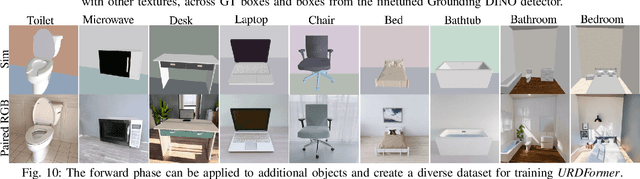



Constructing simulation scenes that are both visually and physically realistic is a problem of practical interest in domains ranging from robotics to computer vision. This problem has become even more relevant as researchers wielding large data-hungry learning methods seek new sources of training data for physical decision-making systems. However, building simulation models is often still done by hand. A graphic designer and a simulation engineer work with predefined assets to construct rich scenes with realistic dynamic and kinematic properties. While this may scale to small numbers of scenes, to achieve the generalization properties that are required for data-driven robotic control, we require a pipeline that is able to synthesize large numbers of realistic scenes, complete with 'natural' kinematic and dynamic structures. To attack this problem, we develop models for inferring structure and generating simulation scenes from natural images, allowing for scalable scene generation from web-scale datasets. To train these image-to-simulation models, we show how controllable text-to-image generative models can be used in generating paired training data that allows for modeling of the inverse problem, mapping from realistic images back to complete scene models. We show how this paradigm allows us to build large datasets of scenes in simulation with semantic and physical realism. We present an integrated end-to-end pipeline that generates simulation scenes complete with articulated kinematic and dynamic structures from real-world images and use these for training robotic control policies. We then robustly deploy in the real world for tasks like articulated object manipulation. In doing so, our work provides both a pipeline for large-scale generation of simulation environments and an integrated system for training robust robotic control policies in the resulting environments.
IntervenGen: Interventional Data Generation for Robust and Data-Efficient Robot Imitation Learning
May 02, 2024Imitation learning is a promising paradigm for training robot control policies, but these policies can suffer from distribution shift, where the conditions at evaluation time differ from those in the training data. A popular approach for increasing policy robustness to distribution shift is interactive imitation learning (i.e., DAgger and variants), where a human operator provides corrective interventions during policy rollouts. However, collecting a sufficient amount of interventions to cover the distribution of policy mistakes can be burdensome for human operators. We propose IntervenGen (I-Gen), a novel data generation system that can autonomously produce a large set of corrective interventions with rich coverage of the state space from a small number of human interventions. We apply I-Gen to 4 simulated environments and 1 physical environment with object pose estimation error and show that it can increase policy robustness by up to 39x with only 10 human interventions. Videos and more results are available at https://sites.google.com/view/intervengen2024.
ASID: Active Exploration for System Identification in Robotic Manipulation
Apr 18, 2024

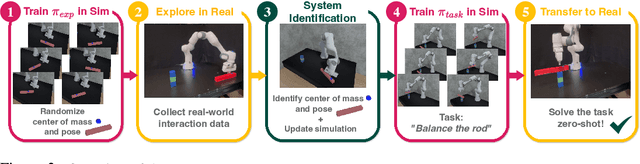

Model-free control strategies such as reinforcement learning have shown the ability to learn control strategies without requiring an accurate model or simulator of the world. While this is appealing due to the lack of modeling requirements, such methods can be sample inefficient, making them impractical in many real-world domains. On the other hand, model-based control techniques leveraging accurate simulators can circumvent these challenges and use a large amount of cheap simulation data to learn controllers that can effectively transfer to the real world. The challenge with such model-based techniques is the requirement for an extremely accurate simulation, requiring both the specification of appropriate simulation assets and physical parameters. This requires considerable human effort to design for every environment being considered. In this work, we propose a learning system that can leverage a small amount of real-world data to autonomously refine a simulation model and then plan an accurate control strategy that can be deployed in the real world. Our approach critically relies on utilizing an initial (possibly inaccurate) simulator to design effective exploration policies that, when deployed in the real world, collect high-quality data. We demonstrate the efficacy of this paradigm in identifying articulation, mass, and other physical parameters in several challenging robotic manipulation tasks, and illustrate that only a small amount of real-world data can allow for effective sim-to-real transfer. Project website at https://weirdlabuw.github.io/asid
AdaDemo: Data-Efficient Demonstration Expansion for Generalist Robotic Agent
Apr 11, 2024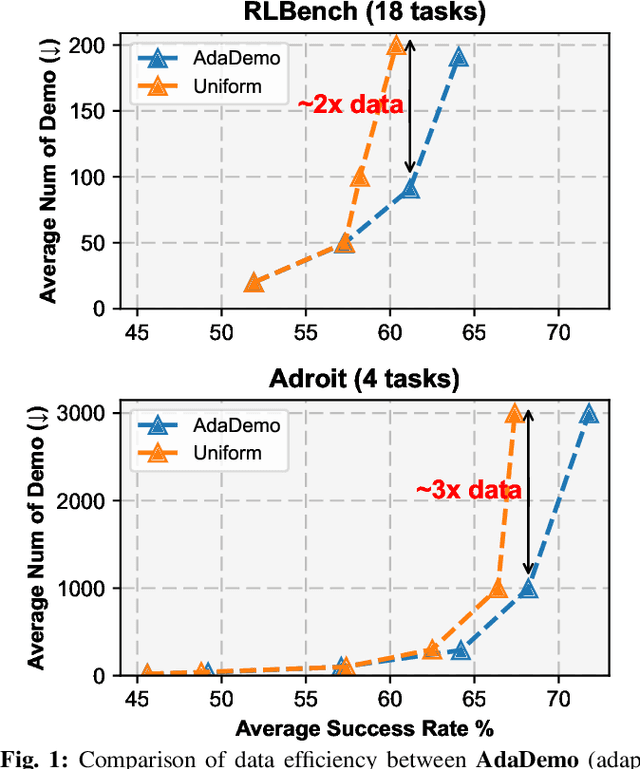
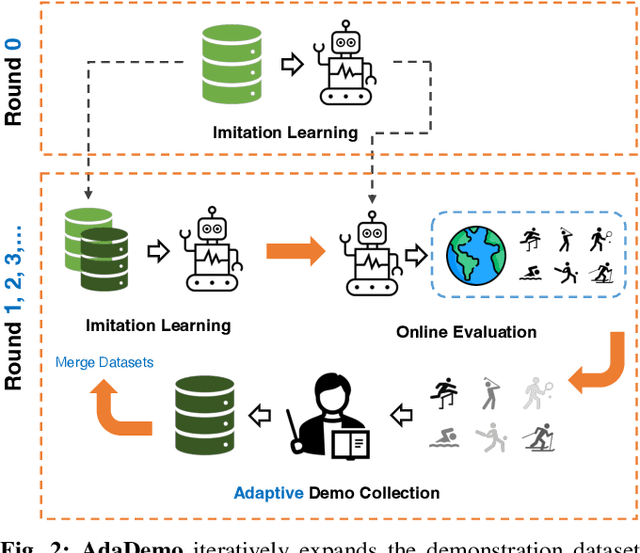
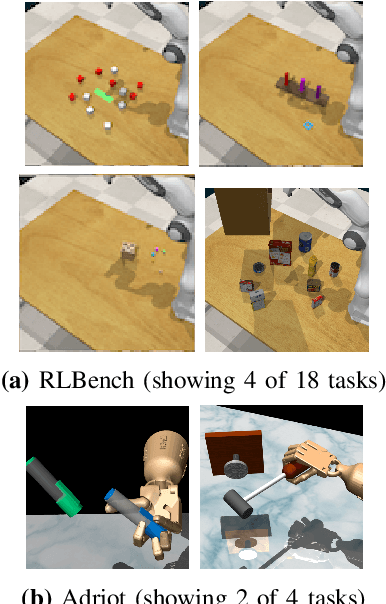
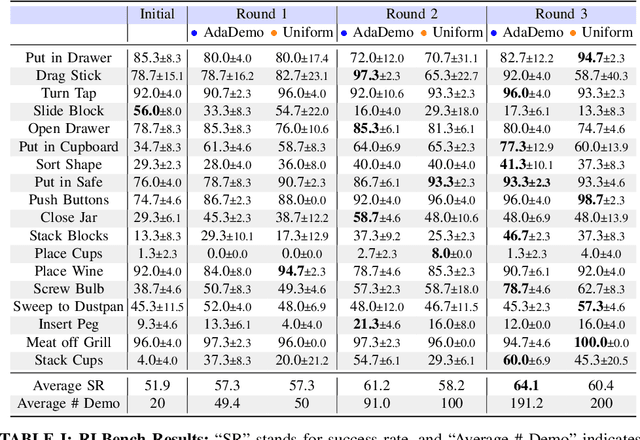
Encouraged by the remarkable achievements of language and vision foundation models, developing generalist robotic agents through imitation learning, using large demonstration datasets, has become a prominent area of interest in robot learning. The efficacy of imitation learning is heavily reliant on the quantity and quality of the demonstration datasets. In this study, we aim to scale up demonstrations in a data-efficient way to facilitate the learning of generalist robotic agents. We introduce AdaDemo (Adaptive Online Demonstration Expansion), a general framework designed to improve multi-task policy learning by actively and continually expanding the demonstration dataset. AdaDemo strategically collects new demonstrations to address the identified weakness in the existing policy, ensuring data efficiency is maximized. Through a comprehensive evaluation on a total of 22 tasks across two robotic manipulation benchmarks (RLBench and Adroit), we demonstrate AdaDemo's capability to progressively improve policy performance by guiding the generation of high-quality demonstration datasets in a data-efficient manner.
EVE: Enabling Anyone to Train Robot using Augmented Reality
Apr 09, 2024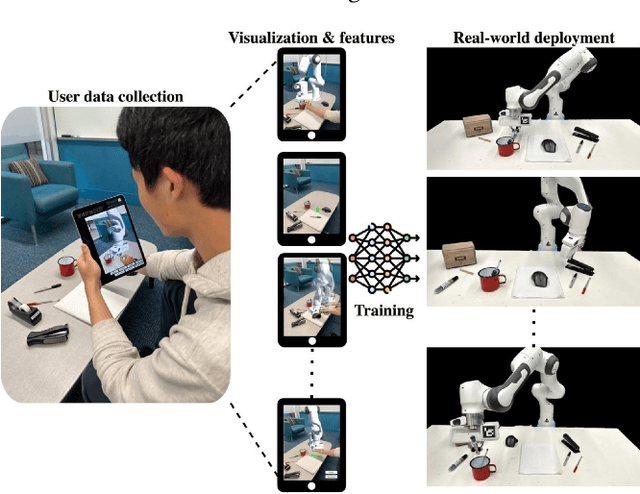

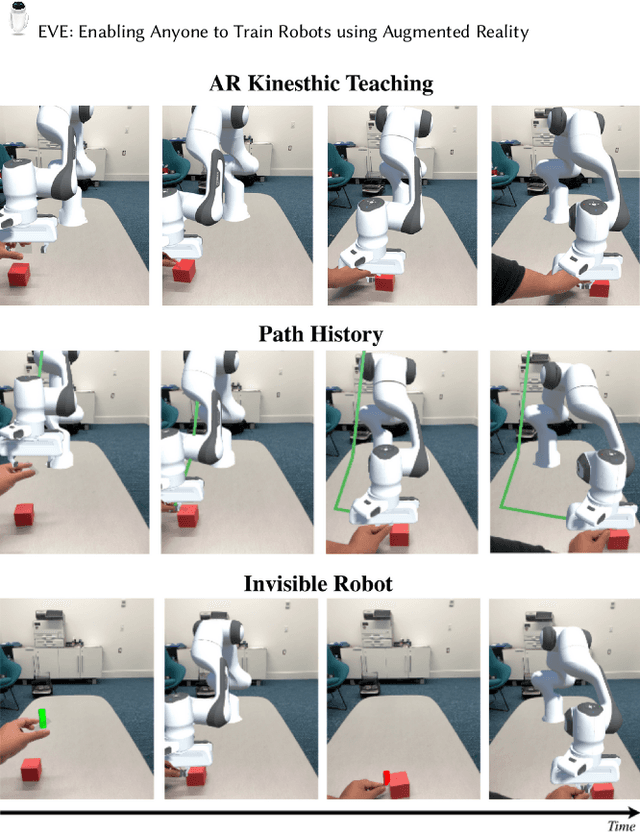

The increasing affordability of robot hardware is accelerating the integration of robots into everyday activities. However, training a robot to automate a task typically requires physical robots and expensive demonstration data from trained human annotators. Consequently, only those with access to physical robots produce demonstrations to train robots. To mitigate this issue, we introduce EVE, an iOS app that enables everyday users to train robots using intuitive augmented reality visualizations without needing a physical robot. With EVE, users can collect demonstrations by specifying waypoints with their hands, visually inspecting the environment for obstacles, modifying existing waypoints, and verifying collected trajectories. In a user study ($N=14$, $D=30$) consisting of three common tabletop tasks, EVE outperformed three state-of-the-art interfaces in success rate and was comparable to kinesthetic teaching-physically moving a real robot-in completion time, usability, motion intent communication, enjoyment, and preference ($mean_{p}=0.30$). We conclude by enumerating limitations and design considerations for future AR-based demonstration collection systems for robotics.
Scaling Population-Based Reinforcement Learning with GPU Accelerated Simulation
Apr 08, 2024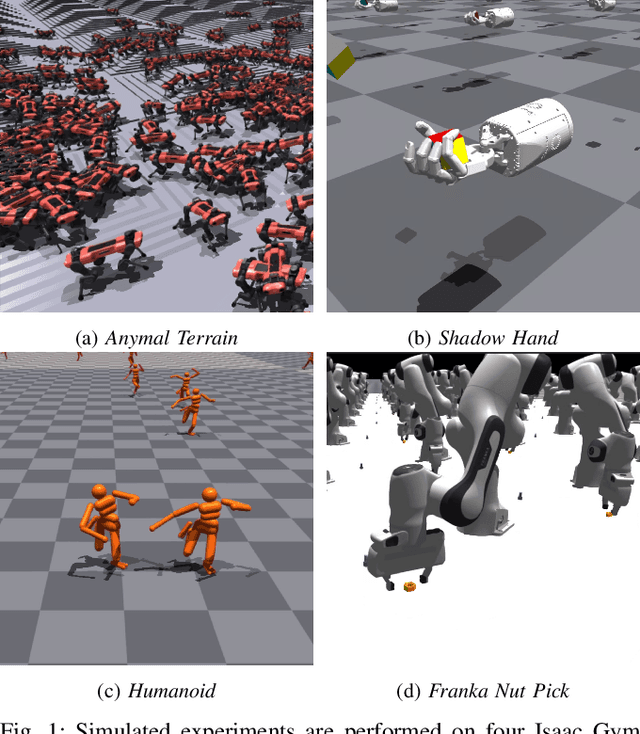
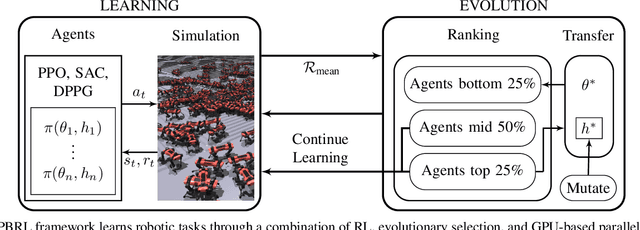
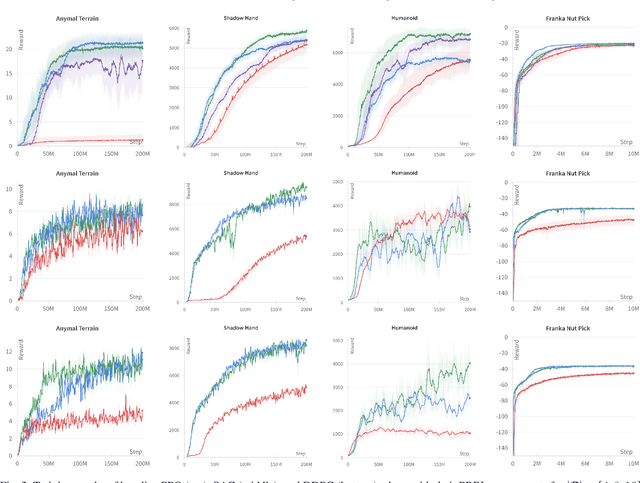
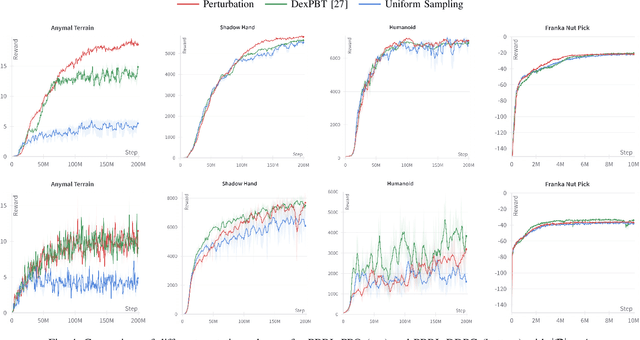
In recent years, deep reinforcement learning (RL) has shown its effectiveness in solving complex continuous control tasks like locomotion and dexterous manipulation. However, this comes at the cost of an enormous amount of experience required for training, exacerbated by the sensitivity of learning efficiency and the policy performance to hyperparameter selection, which often requires numerous trials of time-consuming experiments. This work introduces a Population-Based Reinforcement Learning (PBRL) approach that exploits a GPU-accelerated physics simulator to enhance the exploration capabilities of RL by concurrently training multiple policies in parallel. The PBRL framework is applied to three state-of-the-art RL algorithms -- PPO, SAC, and DDPG -- dynamically adjusting hyperparameters based on the performance of learning agents. The experiments are performed on four challenging tasks in Isaac Gym -- Anymal Terrain, Shadow Hand, Humanoid, Franka Nut Pick -- by analyzing the effect of population size and mutation mechanisms for hyperparameters. The results show that PBRL agents achieve superior performance, in terms of cumulative reward, compared to non-evolutionary baseline agents. The trained agents are finally deployed in the real world for a Franka Nut Pick task, demonstrating successful sim-to-real transfer. Code and videos of the learned policies are available on our project website.
Neural Implicit Representation for Building Digital Twins of Unknown Articulated Objects
Apr 01, 2024We address the problem of building digital twins of unknown articulated objects from two RGBD scans of the object at different articulation states. We decompose the problem into two stages, each addressing distinct aspects. Our method first reconstructs object-level shape at each state, then recovers the underlying articulation model including part segmentation and joint articulations that associate the two states. By explicitly modeling point-level correspondences and exploiting cues from images, 3D reconstructions, and kinematics, our method yields more accurate and stable results compared to prior work. It also handles more than one movable part and does not rely on any object shape or structure priors. Project page: https://github.com/NVlabs/DigitalTwinArt
THE COLOSSEUM: A Benchmark for Evaluating Generalization for Robotic Manipulation
Feb 13, 2024To realize effective large-scale, real-world robotic applications, we must evaluate how well our robot policies adapt to changes in environmental conditions. Unfortunately, a majority of studies evaluate robot performance in environments closely resembling or even identical to the training setup. We present THE COLOSSEUM, a novel simulation benchmark, with 20 diverse manipulation tasks, that enables systematical evaluation of models across 12 axes of environmental perturbations. These perturbations include changes in color, texture, and size of objects, table-tops, and backgrounds; we also vary lighting, distractors, and camera pose. Using THE COLOSSEUM, we compare 4 state-of-the-art manipulation models to reveal that their success rate degrades between 30-50% across these perturbation factors. When multiple perturbations are applied in unison, the success rate degrades $\geq$75%. We identify that changing the number of distractor objects, target object color, or lighting conditions are the perturbations that reduce model performance the most. To verify the ecological validity of our results, we show that our results in simulation are correlated ($\bar{R}^2 = 0.614$) to similar perturbations in real-world experiments. We open source code for others to use THE COLOSSEUM, and also release code to 3D print the objects used to replicate the real-world perturbations. Ultimately, we hope that THE COLOSSEUM will serve as a benchmark to identify modeling decisions that systematically improve generalization for manipulation. See https://robot-colosseum.github.io/ for more details.