 Add to Chrome
 Add to Firefox
 Add to Edge
Why Does Action Chunking Improve Behavioral Cloning Performance in Robotic Control?
Aug 03, 2026
Action chunking---predicting and executing multiple actions instead of a single action---has proven to be a critical component for learning effective robotic control policies. However, our precise understanding of why action chunking improves performance has remained limited. In this work we seek to close this gap. Through rigorous experimental evaluations in both simulated and real-world settings, we show that existing hypotheses for the success of action chunking---temporal consistency, horizon reduction, and representation learning---fail to explain the success of action chunking. Instead, we find that action chunking benefits from greater non-Markovian expressivity and reduced compounding error compared to Markovian policies, but, in many settings of interest, these effects can be fully captured by delayed policies, which at each step predict a single action based on the observation $k$ steps in the past. We then show that there exists an additional benefit of action chunking that we refer to as implicit ensembling. In particular, by learning a diversity of temporal relationships (that is, $a_t | o_t, a_t | o_{t-1}, \ldots$), action-chunked policies exhibit behavior matching that of a model ensemble, increasing their robustness and generalization ability over policies that only learn a single temporal relationship. Building on these insights, we show that in simulated and real-world robotic control settings, we can match the performance of action chunking without action chunking---by deploying an action chunking policy as an ensemble of policies with randomized delays. Furthermore, we propose a policy class that amplifies the benefits of action chunking by explicitly instantiating an ensemble, and which we show significantly improves over the performance of action chunking in many domains.

Adapting Generalist Robot Policies with Semantic Reinforcement Learning
Jun 30, 2026Generalist robot policies learn a diverse repertoire of behaviors from large-scale pretraining. In principle, this makes them excellent priors for downstream adaptation via reinforcement learning (RL). In practice, however, standard RL methods leveraging this prior optimize directly over robot actions, requiring the base policy's action distribution to be close to that of a performant policy from the start. This assumption breaks down for complex or long-horizon tasks that fall outside the pretraining distribution. Our key insight is that, for sufficiently expressive generalist policies, language prompts are an effective alternative space for learning to solve such tasks: modulating language inputs elicits skills already within the policy's repertoire, which can be composed to solve tasks beyond its zero-shot capabilities. We propose Semantic Action Reinforcement Learning (SARL), which learns to optimize this prompt space through online interaction, treating the generalist policy as a controllable skill prior. Importantly, leveraging pretrained skills rather than learning new ones from scratch yields structured, semantically meaningful exploration and highly efficient online improvement, and learning to modulate prompts through experience grounds them in induced real-world behaviors for robust task-solving. Across real-world settings and simulated benchmarks, we show SARL unlocks fundamentally new capabilities -- adapting VLA behavior to solve complex, long-horizon tasks -- and significantly outperforms existing approaches for improving robot behavior in deployment.
Learning Process Rewards via Success Visitation Matching for Efficient RL
Jun 22, 2026In many modern applications of reinforcement learning (RL), the natural reward for a task of interest is inherently sparse: a reward of 0 is given everywhere except when the task is completed, when a reward of +1 is given. Training a policy to maximize such a sparse reward requires solving a challenging credit assignment problem, leading to slow or ineffective RL improvement. We propose a simple approach to transform a sparse outcome reward into a dense process reward. Our approach relies on training a discriminator to distinguish between previous successful and unsuccessful episodes, and using this discriminator to incentivize the RL-learned policy to match the state-action visitations of successful episodes, while avoiding those of unsuccessful episodes. By incentivizing the policy to match the visitations over all states, not just those that correspond to task success, this reward provides dense feedback on whether progress is being made towards task completion, and, we show, provably achieves this without changing the optimal policy. Focusing on finetuning of robotic control policies, we demonstrate that our approach leads to significantly faster RL finetuning performance on both simulated and real-world manipulation tasks, as compared to simply maximizing the sparse outcome reward.
Improving Robotic Generalist Policies via Flow Reversal Steering
Jun 11, 2026Generalist policies can learn a wide range of skills from diverse robot datasets. In order to solve or improve on challenging news tasks, we need a way to infer and invoke the appropriate actions from the policy's rich behavioral prior, especially when directly commanding the policy fails. We focus on flow matching generalists and propose Flow Reversal Steering (FRS): a method that takes suboptimal but ``reasonable'' actions, finds their latent noises by passing them through the flow policy in reverse, and maps them to nearby generalist action modes. We evaluate FRS across many simulated and real-world manipulation settings. First, FRS can turn coarse semantic guidance from humans or vision-language models (VLMs) into corresponding good robot actions, improving zero-shot control. These gains can be distilled with behavioral cloning by training an auxiliary policy to output noises that the generalist maps to good actions -- showing up to 95% absolute task success rate boosts in under a minute of training. Finally, FRS enables policy improvement by bootstrapping reinforcement learning with semantic knowledge, improving on several tasks that standard RL fails to improve on.
RoboReward: General-Purpose Vision-Language Reward Models for Robotics
Jan 08, 2026A well-designed reward is critical for effective reinforcement learning-based policy improvement. In real-world robotics, obtaining such rewards typically requires either labor-intensive human labeling or brittle, handcrafted objectives. Vision-language models (VLMs) have shown promise as automatic reward models, yet their effectiveness on real robot tasks is poorly understood. In this work, we aim to close this gap by introducing (1) RoboReward, a robotics reward dataset and benchmark built on large-scale real-robot corpora from Open X-Embodiment (OXE) and RoboArena, and (2) vision-language reward models trained on this dataset (RoboReward 4B/8B). Because OXE is success-heavy and lacks failure examples, we propose a negative examples data augmentation pipeline that generates calibrated negative and near-misses via counterfactual relabeling of successful episodes and temporal clipping to create partial-progress outcomes from the same videos. Using this framework, we build a large training and evaluation dataset spanning diverse tasks and embodiments to test whether state-of-the-art VLMs can reliably provide rewards for robot learning. Our evaluation of open and proprietary VLMs finds that no model excels across tasks, highlighting substantial room for improvement. We then train general-purpose 4B- and 8B-parameter models that outperform much larger VLMs in assigning rewards for short-horizon robotic tasks. Finally, we deploy the 8B model in real-robot reinforcement learning and find that it improves policy learning over Gemini Robotics-ER 1.5 while narrowing the gap to RL training with human-provided rewards. We release the full dataset, trained reward models, and evaluation suite on our website to advance the development of general-purpose reward models in robotics: https://crfm.stanford.edu/helm/robo-reward-bench (project website).
Robust Finetuning of Vision-Language-Action Robot Policies via Parameter Merging
Dec 18, 2025Generalist robot policies, trained on large and diverse datasets, have demonstrated the ability to generalize across a wide spectrum of behaviors, enabling a single policy to act in varied real-world environments. However, they still fall short on new tasks not covered in the training data. When finetuned on limited demonstrations of a new task, these policies often overfit to the specific demonstrations--not only losing their prior abilities to solve a wide variety of generalist tasks but also failing to generalize within the new task itself. In this work, we aim to develop a method that preserves the generalization capabilities of the generalist policy during finetuning, allowing a single policy to robustly incorporate a new skill into its repertoire. Our goal is a single policy that both learns to generalize to variations of the new task and retains the broad competencies gained from pretraining. We show that this can be achieved through a simple yet effective strategy: interpolating the weights of a finetuned model with that of the pretrained model. We show, across extensive simulated and real-world experiments, that such model merging produces a single model that inherits the generalist abilities of the base model and learns to solve the new task robustly, outperforming both the pretrained and finetuned model on out-of-distribution variations of the new task. Moreover, we show that model merging performance scales with the amount of pretraining data, and enables continual acquisition of new skills in a lifelong learning setting, without sacrificing previously learned generalist abilities.
Posterior Behavioral Cloning: Pretraining BC Policies for Efficient RL Finetuning
Dec 18, 2025Standard practice across domains from robotics to language is to first pretrain a policy on a large-scale demonstration dataset, and then finetune this policy, typically with reinforcement learning (RL), in order to improve performance on deployment domains. This finetuning step has proved critical in achieving human or super-human performance, yet while much attention has been given to developing more effective finetuning algorithms, little attention has been given to ensuring the pretrained policy is an effective initialization for RL finetuning. In this work we seek to understand how the pretrained policy affects finetuning performance, and how to pretrain policies in order to ensure they are effective initializations for finetuning. We first show theoretically that standard behavioral cloning (BC) -- which trains a policy to directly match the actions played by the demonstrator -- can fail to ensure coverage over the demonstrator's actions, a minimal condition necessary for effective RL finetuning. We then show that if, instead of exactly fitting the observed demonstrations, we train a policy to model the posterior distribution of the demonstrator's behavior given the demonstration dataset, we do obtain a policy that ensures coverage over the demonstrator's actions, enabling more effective finetuning. Furthermore, this policy -- which we refer to as the posterior behavioral cloning (PostBC) policy -- achieves this while ensuring pretrained performance is no worse than that of the BC policy. We then show that PostBC is practically implementable with modern generative models in robotic control domains -- relying only on standard supervised learning -- and leads to significantly improved RL finetuning performance on both realistic robotic control benchmarks and real-world robotic manipulation tasks, as compared to standard behavioral cloning.
Active learning of neural population dynamics using two-photon holographic optogenetics
Dec 03, 2024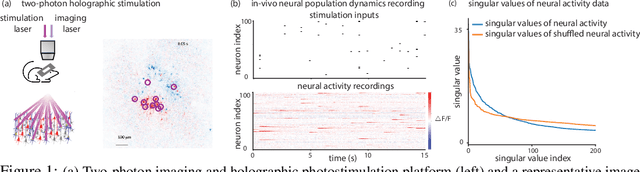
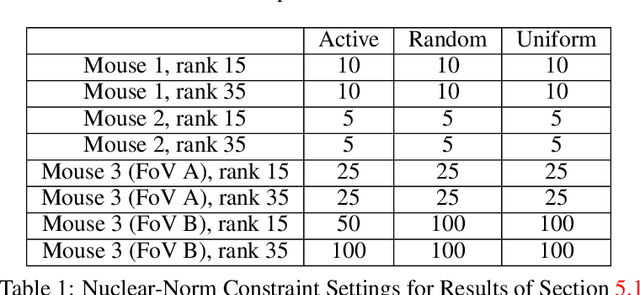
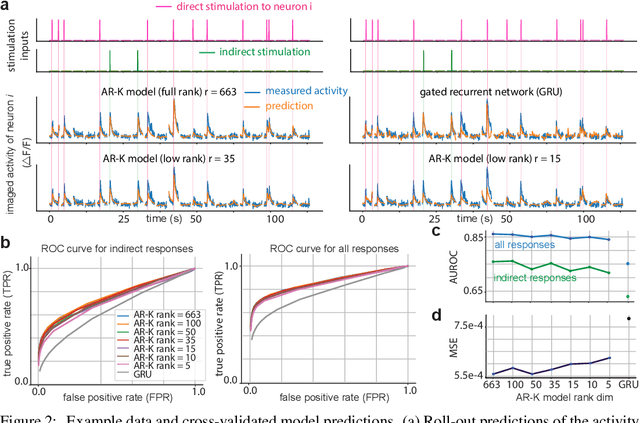
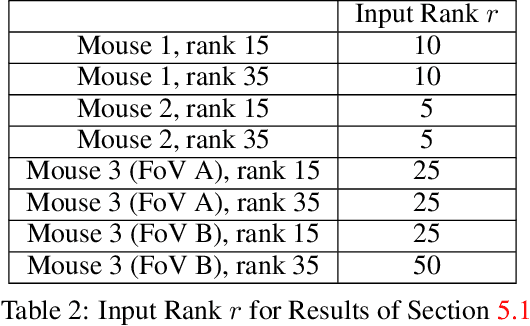
Recent advances in techniques for monitoring and perturbing neural populations have greatly enhanced our ability to study circuits in the brain. In particular, two-photon holographic optogenetics now enables precise photostimulation of experimenter-specified groups of individual neurons, while simultaneous two-photon calcium imaging enables the measurement of ongoing and induced activity across the neural population. Despite the enormous space of potential photostimulation patterns and the time-consuming nature of photostimulation experiments, very little algorithmic work has been done to determine the most effective photostimulation patterns for identifying the neural population dynamics. Here, we develop methods to efficiently select which neurons to stimulate such that the resulting neural responses will best inform a dynamical model of the neural population activity. Using neural population responses to photostimulation in mouse motor cortex, we demonstrate the efficacy of a low-rank linear dynamical systems model, and develop an active learning procedure which takes advantage of low-rank structure to determine informative photostimulation patterns. We demonstrate our approach on both real and synthetic data, obtaining in some cases as much as a two-fold reduction in the amount of data required to reach a given predictive power. Our active stimulation design method is based on a novel active learning procedure for low-rank regression, which may be of independent interest.
Overcoming the Sim-to-Real Gap: Leveraging Simulation to Learn to Explore for Real-World RL
Oct 26, 2024


In order to mitigate the sample complexity of real-world reinforcement learning, common practice is to first train a policy in a simulator where samples are cheap, and then deploy this policy in the real world, with the hope that it generalizes effectively. Such \emph{direct sim2real} transfer is not guaranteed to succeed, however, and in cases where it fails, it is unclear how to best utilize the simulator. In this work, we show that in many regimes, while direct sim2real transfer may fail, we can utilize the simulator to learn a set of \emph{exploratory} policies which enable efficient exploration in the real world. In particular, in the setting of low-rank MDPs, we show that coupling these exploratory policies with simple, practical approaches -- least-squares regression oracles and naive randomized exploration -- yields a polynomial sample complexity in the real world, an exponential improvement over direct sim2real transfer, or learning without access to a simulator. To the best of our knowledge, this is the first evidence that simulation transfer yields a provable gain in reinforcement learning in settings where direct sim2real transfer fails. We validate our theoretical results on several realistic robotic simulators and a real-world robotic sim2real task, demonstrating that transferring exploratory policies can yield substantial gains in practice as well.
Corruption-Robust Linear Bandits: Minimax Optimality and Gap-Dependent Misspecification
Oct 10, 2024
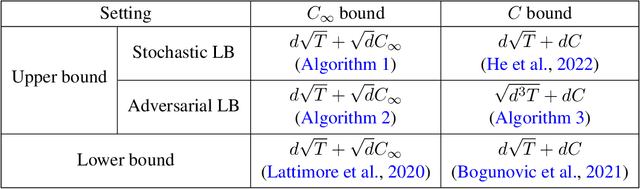
In linear bandits, how can a learner effectively learn when facing corrupted rewards? While significant work has explored this question, a holistic understanding across different adversarial models and corruption measures is lacking, as is a full characterization of the minimax regret bounds. In this work, we compare two types of corruptions commonly considered: strong corruption, where the corruption level depends on the action chosen by the learner, and weak corruption, where the corruption level does not depend on the action chosen by the learner. We provide a unified framework to analyze these corruptions. For stochastic linear bandits, we fully characterize the gap between the minimax regret under strong and weak corruptions. We also initiate the study of corrupted adversarial linear bandits, obtaining upper and lower bounds with matching dependencies on the corruption level. Next, we reveal a connection between corruption-robust learning and learning with gap-dependent mis-specification, a setting first studied by Liu et al. (2023a), where the misspecification level of an action or policy is proportional to its suboptimality. We present a general reduction that enables any corruption-robust algorithm to handle gap-dependent misspecification. This allows us to recover the results of Liu et al. (2023a) in a black-box manner and significantly generalize them to settings like linear MDPs, yielding the first results for gap-dependent misspecification in reinforcement learning. However, this general reduction does not attain the optimal rate for gap-dependent misspecification. Motivated by this, we develop a specialized algorithm that achieves optimal bounds for gap-dependent misspecification in linear bandits, thus answering an open question posed by Liu et al. (2023a).