 Add to Chrome
 Add to Firefox
 Add to Edge
Mind the Cap: Output-Budget Regimes Change the Measured Multilingual Reasoning Gap
Aug 04, 2026
Multilingual evaluations report accuracy at a single output-token cap, but languages need different numbers of tokens to express the same content, so the cap is a hidden experimental variable. We test whether the native-vs-translate gap on MGSM (German, Thai, Swahili) is a token-budget artifact for Qwen3-8B and Llama-3.1-8B-Instruct under four prompting strategies. The measured gap swings by up to 57 points across budgets, length normalization moves it by up to 38.9 points where the cap binds, and at tight caps normalization can reverse which strategy scores higher. We prospectively froze the sweep's three Qwen peaks and its near-zero value at 1024 and evaluated them on 540,000 independently hard-capped decodes: a second frozen family of six Holm-corrected tests rejects every null. The frozen test at $B^*=1024$ still fails to reject because native accuracy has already saturated there; above saturation, the residual difference is a strategy-performance gap, not an identified reasoning deficit. The same truncation channel prices a cost-ordered adaptation ladder: a cross-fitted Thai vocabulary extension closes 0.0 points of the gap at the frozen budget and 4.9 points where 19% of traces still truncate. A third frozen family varies only the announced budget at a fixed enforced cap; announcing 128 rather than 2048 tokens moves Thai native accuracy by 5.1 points, so accuracy is not a function of the enforced cap alone. A correct-emission timing identity computed from one long-cap run matches the three pre-specified MGSM peaks to 0.65 points and, in an exploratory Qwen-only analysis of three further benchmarks, tracks held-out items to 0.92 points, locating the peak exactly in five of seven cells. Treat the output cap as an independent variable and report accuracy across the budget regime, not at a single budget.

From Agent Failures to Text Policies: What Works and What Breaks
Jul 22, 2026TextGrad improves language-model systems by revising text from feedback. Its core thesis is that natural-language feedback can act as a gradient for optimizing text components without changing model weights. Applying it to agents is harder because feedback arrives only after a sequence of actions, making it difficult to identify which decision caused failure. We study this problem by separating the ability to follow a useful policy from the ability to learn that policy from experience. Our main finding is a clear gap between these two abilities. Human-written policies improve two frozen 7B agents on TextWorldExpress by 5.0 success points, showing that useful policy text exists. However, policies generated from agent trajectories do not reliably outperform fixed prompting, even with richer traces, counterfactual evidence, or iterative GEPA search. The main challenge for agent-level TextGrad is therefore not executing textual policy updates, but reliably generating and selecting them from experience.
Structured Feedback Improves Repair in an LLM Agent Loop
Jul 15, 2026LLM agents often retry after external validation rejects a candidate, but the interface between validation and the next model call remains underspecified. We introduce VeriHarness, a code-controlled agent loop in which models generate candidates while external validators control acceptance, budgets, and traces. We use it to compare raw diagnostics with feedback that identifies the failure location, observed value, and admissible alternatives. Across 50 paired TextWorld games under a four-call cap, feedback containing all three fields raises terminal success from 14/50 to 36/50 for Qwen2.5-Coder-14B (+44 percentage points) and from 8/50 to 29/50 for Llama-3.1-8B (+42 points). Ablations locate most of the gain in the admissible alternatives: feedback containing only the location and observed value remains near the raw diagnostic baseline. Presenting the complete repair information in prose instead of a keyed JSON record yields nearly the same success, providing no evidence that JSON syntax itself improves repair. The ordering persists across the tested call budgets and one sampled-decoding setting.
RoboLab: A High-Fidelity Simulation Benchmark for Analysis of Task Generalist Policies
Apr 10, 2026The pursuit of general-purpose robotics has yielded impressive foundation models, yet simulation-based benchmarking remains a bottleneck due to rapid performance saturation and a lack of true generalization testing. Existing benchmarks often exhibit significant domain overlap between training and evaluation, trivializing success rates and obscuring insights into robustness. We introduce RoboLab, a simulation benchmarking framework designed to address these challenges. Concretely, our framework is designed to answer two questions: (1) to what extent can we understand the performance of a real-world policy by analyzing its behavior in simulation, and (2) which external factors most strongly affect that behavior under controlled perturbations. First, RoboLab enables human-authored and LLM-enabled generation of scenes and tasks in a robot- and policy-agnostic manner within a physically realistic and photorealistic simulation. With this, we propose the RoboLab-120 benchmark, consisting of 120 tasks categorized into three competency axes: visual, procedural, relational competency, across three difficulty levels. Second, we introduce a systematic analysis of real-world policies that quantify both their performance and the sensitivity of their behavior to controlled perturbations, indicating that high-fidelity simulation can serve as a proxy for analyzing performance and its dependence on external factors. Evaluation with RoboLab exposes significant performance gap in current state-of-the-art models. By providing granular metrics and a scalable toolset, RoboLab offers a scalable framework for evaluating the true generalization capabilities of task-generalist robotic policies.
HAMSTER: Hierarchical Action Models For Open-World Robot Manipulation
Feb 08, 2025


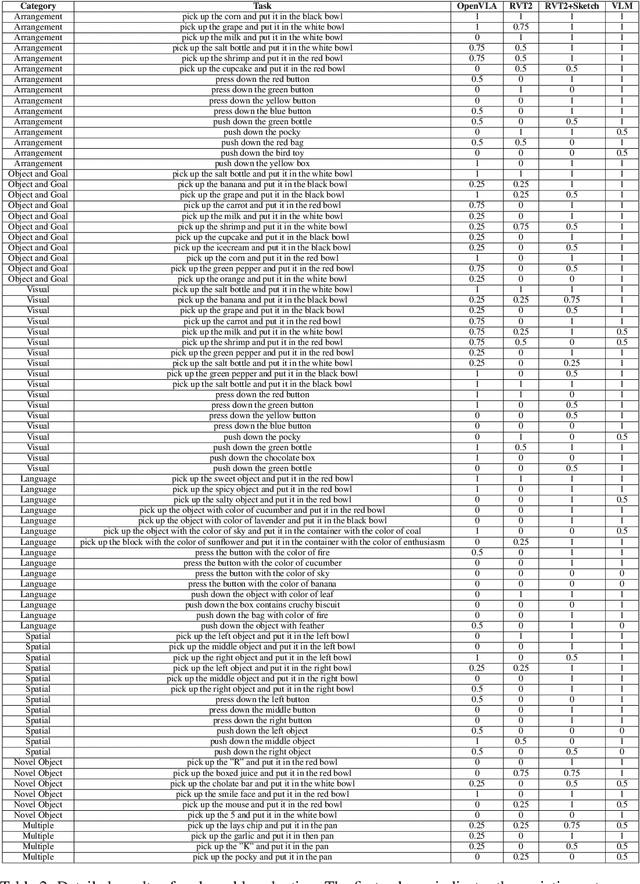
Large foundation models have shown strong open-world generalization to complex problems in vision and language, but similar levels of generalization have yet to be achieved in robotics. One fundamental challenge is the lack of robotic data, which are typically obtained through expensive on-robot operation. A promising remedy is to leverage cheaper, off-domain data such as action-free videos, hand-drawn sketches or simulation data. In this work, we posit that hierarchical vision-language-action (VLA) models can be more effective in utilizing off-domain data than standard monolithic VLA models that directly finetune vision-language models (VLMs) to predict actions. In particular, we study a class of hierarchical VLA models, where the high-level VLM is finetuned to produce a coarse 2D path indicating the desired robot end-effector trajectory given an RGB image and a task description. The intermediate 2D path prediction is then served as guidance to the low-level, 3D-aware control policy capable of precise manipulation. Doing so alleviates the high-level VLM from fine-grained action prediction, while reducing the low-level policy's burden on complex task-level reasoning. We show that, with the hierarchical design, the high-level VLM can transfer across significant domain gaps between the off-domain finetuning data and real-robot testing scenarios, including differences on embodiments, dynamics, visual appearances and task semantics, etc. In the real-robot experiments, we observe an average of 20% improvement in success rate across seven different axes of generalization over OpenVLA, representing a 50% relative gain. Visual results are provided at: https://hamster-robot.github.io/
Differentiable GPU-Parallelized Task and Motion Planning
Nov 18, 2024
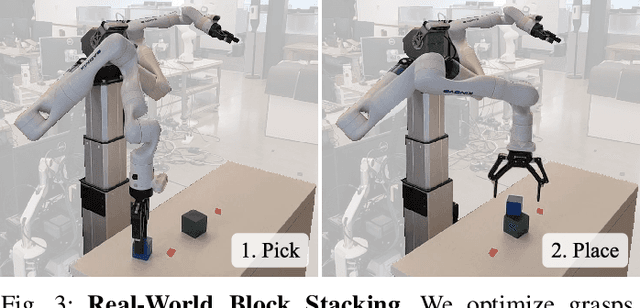
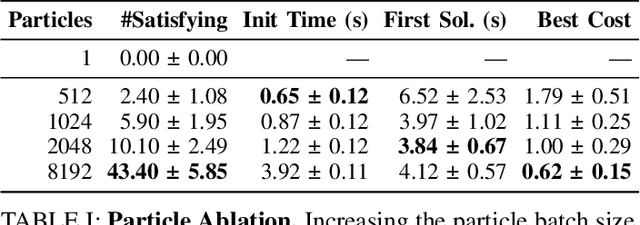
We present a differentiable optimization-based framework for Task and Motion Planning (TAMP) that is massively parallelizable on GPUs, enabling thousands of sampled seeds to be optimized simultaneously. Existing sampling-based approaches inherently disconnect the parameters by generating samples for each independently and combining them through composition and rejection, while optimization-based methods struggle with highly non-convex constraints and local optima. Our method treats TAMP constraint satisfaction as optimizing a batch of particles, each representing an assignment to a plan skeleton's continuous parameters. We represent the plan skeleton's constraints using differentiable cost functions, enabling us to compute the gradient of each particle and update it toward satisfying solutions. Our use of GPU parallelism better covers the parameter space through scale, increasing the likelihood of finding the global optima by exploring multiple basins through global sampling. We demonstrate that our algorithm can effectively solve a highly constrained Tetris packing problem using a Franka arm in simulation and deploy our planner on a real robot arm. Website: https://williamshen-nz.github.io/gpu-tamp
Discovering Robotic Interaction Modes with Discrete Representation Learning
Oct 26, 2024
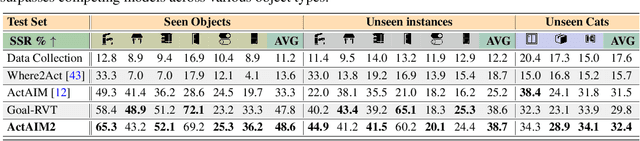

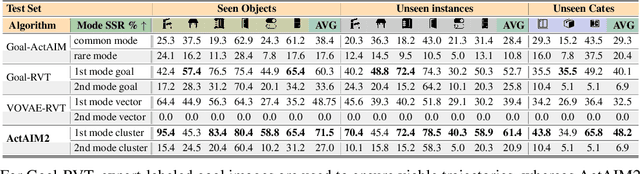
Human actions manipulating articulated objects, such as opening and closing a drawer, can be categorized into multiple modalities we define as interaction modes. Traditional robot learning approaches lack discrete representations of these modes, which are crucial for empirical sampling and grounding. In this paper, we present ActAIM2, which learns a discrete representation of robot manipulation interaction modes in a purely unsupervised fashion, without the use of expert labels or simulator-based privileged information. Utilizing novel data collection methods involving simulator rollouts, ActAIM2 consists of an interaction mode selector and a low-level action predictor. The selector generates discrete representations of potential interaction modes with self-supervision, while the predictor outputs corresponding action trajectories. Our method is validated through its success rate in manipulating articulated objects and its robustness in sampling meaningful actions from the discrete representation. Extensive experiments demonstrate ActAIM2's effectiveness in enhancing manipulability and generalizability over baselines and ablation studies. For videos and additional results, see our website: https://actaim2.github.io/.
3D-MVP: 3D Multiview Pretraining for Robotic Manipulation
Jun 26, 2024


Recent works have shown that visual pretraining on egocentric datasets using masked autoencoders (MAE) can improve generalization for downstream robotics tasks. However, these approaches pretrain only on 2D images, while many robotics applications require 3D scene understanding. In this work, we propose 3D-MVP, a novel approach for 3D multi-view pretraining using masked autoencoders. We leverage Robotic View Transformer (RVT), which uses a multi-view transformer to understand the 3D scene and predict gripper pose actions. We split RVT's multi-view transformer into visual encoder and action decoder, and pretrain its visual encoder using masked autoencoding on large-scale 3D datasets such as Objaverse. We evaluate 3D-MVP on a suite of virtual robot manipulation tasks and demonstrate improved performance over baselines. We also show promising results on a real robot platform with minimal finetuning. Our results suggest that 3D-aware pretraining is a promising approach to improve sample efficiency and generalization of vision-based robotic manipulation policies. We will release code and pretrained models for 3D-MVP to facilitate future research. Project site: https://jasonqsy.github.io/3DMVP
RVT-2: Learning Precise Manipulation from Few Demonstrations
Jun 12, 2024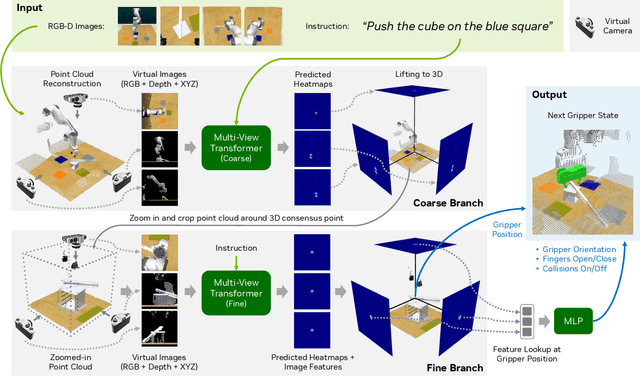
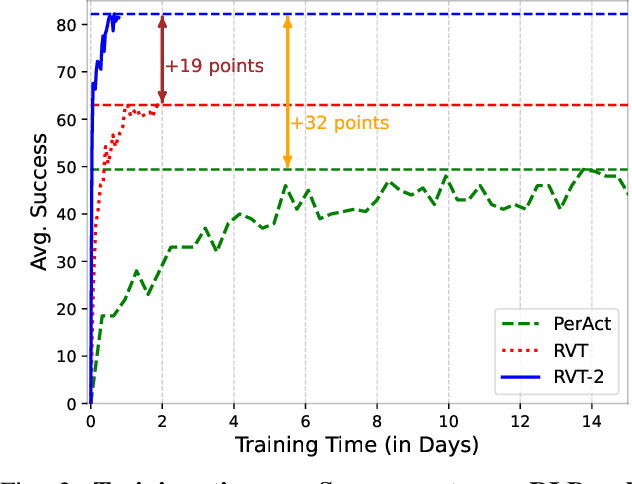
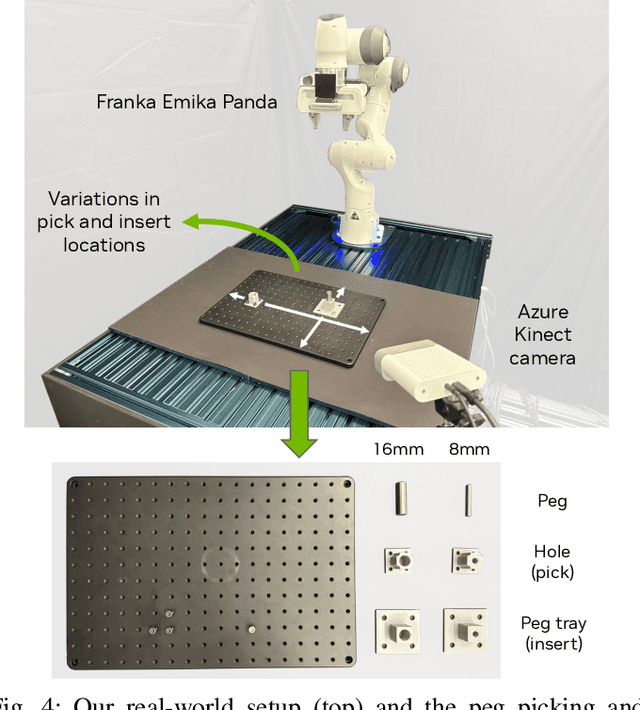
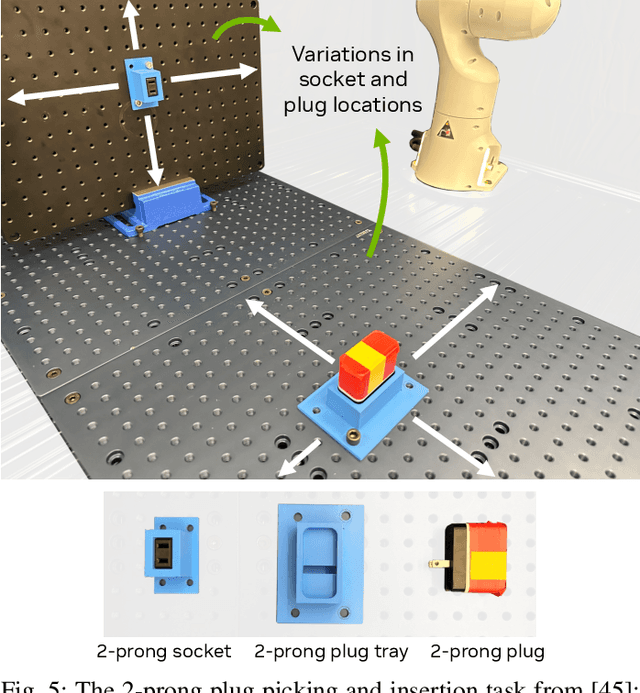
In this work, we study how to build a robotic system that can solve multiple 3D manipulation tasks given language instructions. To be useful in industrial and household domains, such a system should be capable of learning new tasks with few demonstrations and solving them precisely. Prior works, like PerAct and RVT, have studied this problem, however, they often struggle with tasks requiring high precision. We study how to make them more effective, precise, and fast. Using a combination of architectural and system-level improvements, we propose RVT-2, a multitask 3D manipulation model that is 6X faster in training and 2X faster in inference than its predecessor RVT. RVT-2 achieves a new state-of-the-art on RLBench, improving the success rate from 65% to 82%. RVT-2 is also effective in the real world, where it can learn tasks requiring high precision, like picking up and inserting plugs, with just 10 demonstrations. Visual results, code, and trained model are provided at: https://robotic-view-transformer-2.github.io/.
AdaDemo: Data-Efficient Demonstration Expansion for Generalist Robotic Agent
Apr 11, 2024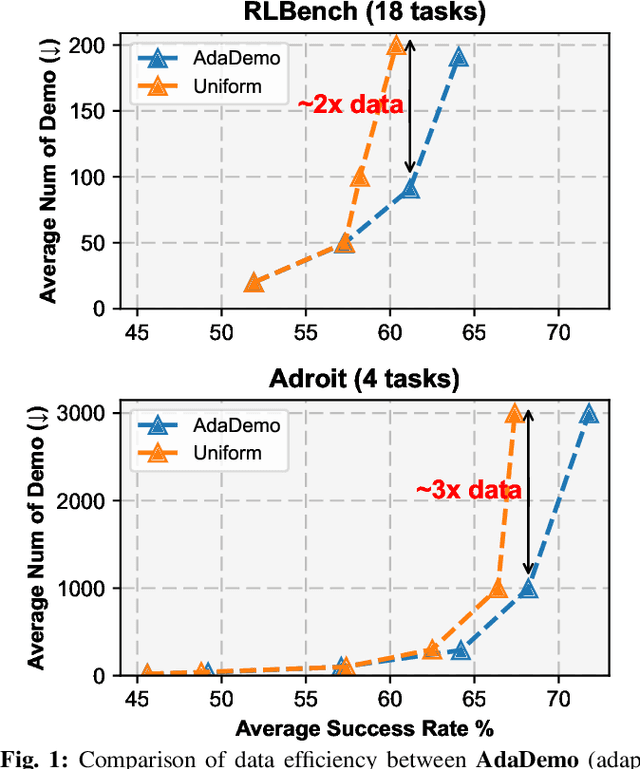
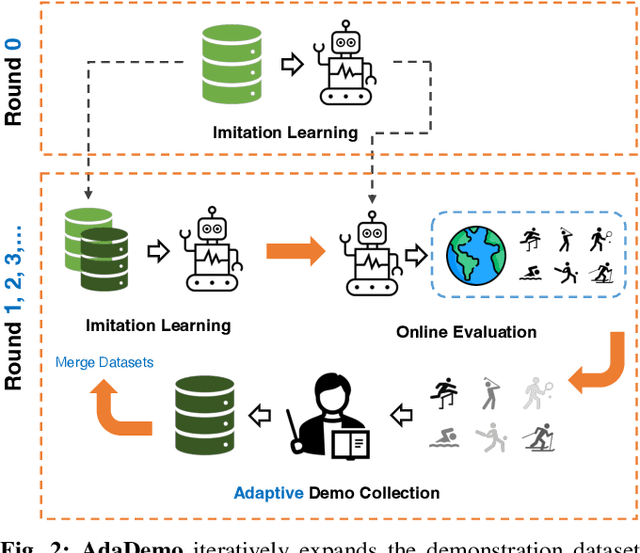
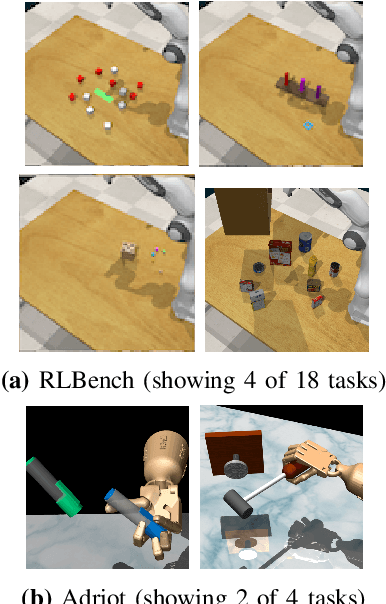
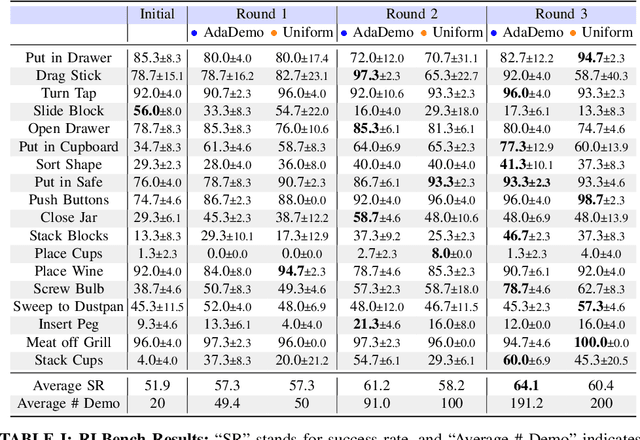
Encouraged by the remarkable achievements of language and vision foundation models, developing generalist robotic agents through imitation learning, using large demonstration datasets, has become a prominent area of interest in robot learning. The efficacy of imitation learning is heavily reliant on the quantity and quality of the demonstration datasets. In this study, we aim to scale up demonstrations in a data-efficient way to facilitate the learning of generalist robotic agents. We introduce AdaDemo (Adaptive Online Demonstration Expansion), a general framework designed to improve multi-task policy learning by actively and continually expanding the demonstration dataset. AdaDemo strategically collects new demonstrations to address the identified weakness in the existing policy, ensuring data efficiency is maximized. Through a comprehensive evaluation on a total of 22 tasks across two robotic manipulation benchmarks (RLBench and Adroit), we demonstrate AdaDemo's capability to progressively improve policy performance by guiding the generation of high-quality demonstration datasets in a data-efficient manner.