 Add to Chrome
 Add to Firefox
 Add to Edge
ASPIRE: Agentic /Skills Discovery for Robotics
Jun 30, 2026
Traditional robot programming is challenging: it requires orchestrating multimodal perception, managing physical contact dynamics, and handling diverse configurations and execution failures. We introduce ASPIRE (Agentic Skill Programming through Iterative Robot Exploration), a continual learning system that autonomously writes and refines robot control programs in a code-as-policy paradigm while compounding experience into a reusable skill library. ASPIRE discovers skills that persist across tasks, simulation and real-world settings, and embodiments. It operates in an open-ended loop with three components: (1) a closed-loop robot execution engine that exposes fine-grained multimodal traces, enabling autonomous failure diagnosis, repair synthesis, and validation; (2) a continually expanding skill library that distills validated fixes into reusable, transferable knowledge; and (3) evolutionary search that generates diverse task sequences and control programs to explore beyond single-trajectory refinement. ASPIRE surpasses prior methods by up to 77% on LIBERO-Pro manipulation under perturbation, 72% on Robosuite bimanual handover, and 32% on BEHAVIOR-1K long-horizon household tasks. Its accumulated library also enables zero-shot generalization to unseen long-horizon tasks: on LIBERO-Pro Long, ASPIRE achieves 31% success versus 4% for prior methods despite their use of test-time reasoning and retries. Finally, simulation-discovered skills provide initial evidence of sim-to-real transfer, substantially reducing real-robot programming effort across different embodiments and robot APIs.

Human2Any: Human-to-Robot Transfer via Constraint-Aware Compositional Planning
Jun 27, 2026Human videos are a scalable source of supervision for robot manipulation, as they are abundant and naturally capture rich object interactions. However, transferring human demonstrations to robots remains challenging due to embodiment mismatch, scene variation, and robot-specific feasibility constraints. We present Human2Any, a framework for learning reusable object-centric interaction priors from human videos without requiring real-world robot demonstrations in the target task contexts. Human2Any represents manipulation through object-object interaction motion, capturing task-relevant scene changes while abstracting away embodiment-specific details. It composes learned interaction priors with robot-side feasibility reasoning and motion planning, allowing the same human-derived knowledge to adapt to different embodiments, scene geometries, and task contexts. We validate Human2Any across diverse manipulation settings, including real-world experiments on a Franka tabletop setup and an RBY-1 humanoid mobile robot, demonstrating robust interaction-centric manipulation without real-world robot training data. Project website: https://human2any.github.io/.
SimFoundry: Modular and Automated Scene Generation for Policy Learning and Evaluation
Jun 26, 2026Training and evaluating robot policies in the real world is costly and difficult to scale. We introduce SimFoundry, a modular and automated system for zero-shot real-to-sim scene construction from a video. SimFoundry generates sim-ready digital twins and supports object, scene, and task editing, enabling the automated generation of diverse digital cousins: affordance-preserving variations of reconstructed real-world scenes. Policies trained on SimFoundry data transfer zero-shot to challenging real tasks involving multi-step manipulation, articulated object interaction, and bimanual interaction, and its digital cousins (variations of the original scene, objects, and tasks) facilitate generalization to new real-world conditions. Across 7 manipulation tasks and 5 policy architectures, SimFoundry simulation evaluations strongly predict real-world performance, with mean Pearson correlation 0.911 and mean maximum ranking violation 0.018. When evaluating sim-trained policies zero-shot in the real world, policies trained with object, scene, and task cousins in simulation show average task success rate improvements of 17%, 21%, and 40%, respectively. Additional details at https://research.nvidia.com/labs/gear/simfoundry/ .
GRAFT: Graph-Based Affordance Transfer via Part Correspondence
Jun 23, 2026Generalizing robotic manipulation to unseen objects remains challenging, as learning-based approaches require many demonstrations and fail in few-shot settings. Prior work transfers affordances through semantic retrieval, but semantics alone neglect geometric similarity, which is critical for manipulation. We propose GRAFT, a geometry-aware correspondence framework for zero-shot manipulation transfer using only one demonstration per object. Objects are represented as part-based graphs, where part-level descriptors support global instance retrieval and part correspondence, and vertex-level descriptors enable fine-grained contact point matching. For an unseen object, our method first retrieves the most functionally and geometrically similar instance from the demonstration buffer with aligned functional parts, and finally propagates the contact points through point-wise correspondence.
HumanoidMimicGen: Data Generation for Loco-Manipulation via Whole-Body Planning
May 26, 2026Imitation learning is a promising approach for training humanoid robots to both walk and manipulate, but it requires a large number of demonstrations, which are time-intensive and difficult to collect via teleoperation. Existing data-generation algorithms can automatically synthesize demonstrations for manipulators, but they are ineffective on humanoids because their high-dimensional composite action spaces involve arms, legs, and torsos. We present HumanoidMimicGen, a method for generating humanoid legged loco-manipulation data. Our method adapts contact-rich whole-body skills from a handful of source demonstrations to new states, generalizing across changes in object pose. By interleaving these single- and dual-arm skills with whole-body locomotion and manipulation planning, the method generates stable, collision-free data across diverse scenes and layouts. To evaluate our approach, we introduce a new simulated loco-manipulation benchmark containing nine diverse tasks that test humanoid loco-manipulation capabilities. There, we demonstrate that HumanoidMimicGen automatically generates large datasets for imitation learning and enables a systematic study of how data generation and policy learning decisions impact model performance. We show that whole-body visuomotor policies co-trained with data generated by HumanoidMimicGen outperform those trained only on real-world data by 20%.
COBALT: Crowdsourcing Robot Learning via Cloud-Based Teleoperation with Smartphones
May 20, 2026The scarcity of large-scale, high-quality demonstration data remains a bottleneck in scaling imitation learning for robotic manipulation. We present COBALT, a teleoperation platform designed to democratize robot learning at scale both in simulation and in the real world. By leveraging vectorized environments, our scalable, load-balanced infrastructure supports concurrent teleoperation by multiple users on a single GPU, yielding a significant reduction in teleoperation cost. Operators can connect from nearly anywhere on Earth using commonly available devices, including single or dual smartphones, VR headsets, 3D mice, and keyboards. An inmemory data cache and efficient video streaming keep control and rendering synchronous, sustaining dozens of concurrent users at 20 Hz with sub-100 ms end-to-end latency for up to 8 concurrent users per GPU. We also demonstrate stable operation supporting 256 simulated clients across 8 GPUs, underscoring the system's ability to scale across hardware and within individual servers. We perform a comprehensive user study showing that phone-based teleoperation performs comparably to or better than specialized hardware, enabling faster, more ergonomic data collection. To ensure data quality, COBALT logs a suite of real-time metrics to automatically filter suboptimal demonstrations. We further demonstrate that a structured user training curriculum significantly improves data collection quality. Guided by insights from our user study, we crowdsource the collection of a large-scale, high-quality pilot dataset with 7500+ demonstrations (50+ hours) collected with smartphones across nine countries over five days. We validate the dataset's quality by training state-of-the-art imitation learning algorithms. Please visit https://cobalt-teleop.github.io/ for more details.
SoftMimicGen: A Data Generation System for Scalable Robot Learning in Deformable Object Manipulation
Mar 26, 2026Large-scale robot datasets have facilitated the learning of a wide range of robot manipulation skills, but these datasets remain difficult to collect and scale further, owing to the intractable amount of human time, effort, and cost required. Simulation and synthetic data generation have proven to be an effective alternative to fuel this need for data, especially with the advent of recent work showing that such synthetic datasets can dramatically reduce real-world data requirements and facilitate generalization to novel scenarios unseen in real-world demonstrations. However, this paradigm has been limited to rigid-body tasks, which are easy to simulate. Deformable object manipulation encompasses a large portion of real-world manipulation and remains a crucial gap to address towards increasing adoption of the synthetic simulation data paradigm. In this paper, we introduce SoftMimicGen, an automated data generation pipeline for deformable object manipulation tasks. We introduce a suite of high-fidelity simulation environments that encompasses a wide range of deformable objects (stuffed animal, rope, tissue, towel) and manipulation behaviors (high-precision threading, dynamic whipping, folding, pick-and-place), across four robot embodiments: a single-arm manipulator, bimanual arms, a humanoid, and a surgical robot. We apply SoftMimicGen to generate datasets across the task suite, train high-performing policies from the data, and systematically analyze the data generation system. Project website: \href{https://softmimicgen.github.io}{softmimicgen.github.io}.
Point Bridge: 3D Representations for Cross Domain Policy Learning
Jan 24, 2026Robot foundation models are beginning to deliver on the promise of generalist robotic agents, yet progress remains constrained by the scarcity of large-scale real-world manipulation datasets. Simulation and synthetic data generation offer a scalable alternative, but their usefulness is limited by the visual domain gap between simulation and reality. In this work, we present Point Bridge, a framework that leverages unified, domain-agnostic point-based representations to unlock synthetic datasets for zero-shot sim-to-real policy transfer, without explicit visual or object-level alignment. Point Bridge combines automated point-based representation extraction via Vision-Language Models (VLMs), transformer-based policy learning, and efficient inference-time pipelines to train capable real-world manipulation agents using only synthetic data. With additional co-training on small sets of real demonstrations, Point Bridge further improves performance, substantially outperforming prior vision-based sim-and-real co-training methods. It achieves up to 44% gains in zero-shot sim-to-real transfer and up to 66% with limited real data across both single-task and multitask settings. Videos of the robot are best viewed at: https://pointbridge3d.github.io/
ReinforceGen: Hybrid Skill Policies with Automated Data Generation and Reinforcement Learning
Dec 18, 2025Long-horizon manipulation has been a long-standing challenge in the robotics community. We propose ReinforceGen, a system that combines task decomposition, data generation, imitation learning, and motion planning to form an initial solution, and improves each component through reinforcement-learning-based fine-tuning. ReinforceGen first segments the task into multiple localized skills, which are connected through motion planning. The skills and motion planning targets are trained with imitation learning on a dataset generated from 10 human demonstrations, and then fine-tuned through online adaptation and reinforcement learning. When benchmarked on the Robosuite dataset, ReinforceGen reaches 80% success rate on all tasks with visuomotor controls in the highest reset range setting. Additional ablation studies show that our fine-tuning approaches contributes to an 89% average performance increase. More results and videos available in https://reinforcegen.github.io/
Isaac Lab: A GPU-Accelerated Simulation Framework for Multi-Modal Robot Learning
Nov 06, 2025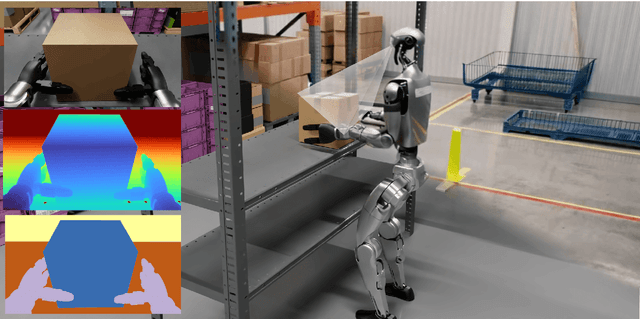
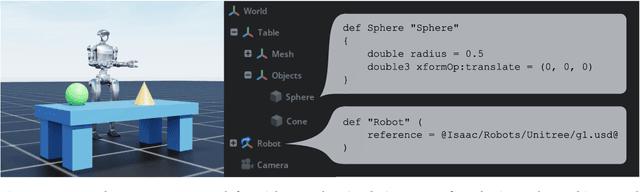
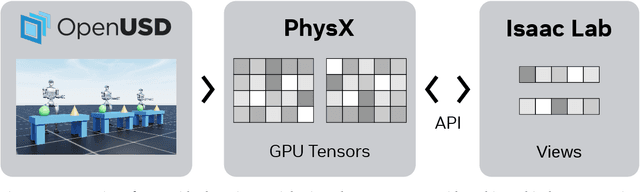
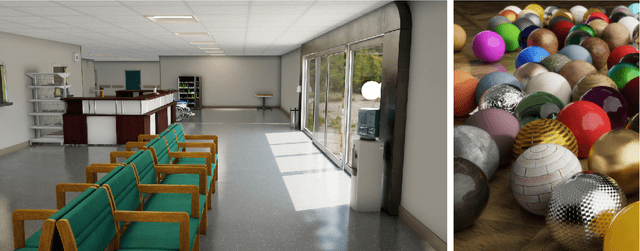
We present Isaac Lab, the natural successor to Isaac Gym, which extends the paradigm of GPU-native robotics simulation into the era of large-scale multi-modal learning. Isaac Lab combines high-fidelity GPU parallel physics, photorealistic rendering, and a modular, composable architecture for designing environments and training robot policies. Beyond physics and rendering, the framework integrates actuator models, multi-frequency sensor simulation, data collection pipelines, and domain randomization tools, unifying best practices for reinforcement and imitation learning at scale within a single extensible platform. We highlight its application to a diverse set of challenges, including whole-body control, cross-embodiment mobility, contact-rich and dexterous manipulation, and the integration of human demonstrations for skill acquisition. Finally, we discuss upcoming integration with the differentiable, GPU-accelerated Newton physics engine, which promises new opportunities for scalable, data-efficient, and gradient-based approaches to robot learning. We believe Isaac Lab's combination of advanced simulation capabilities, rich sensing, and data-center scale execution will help unlock the next generation of breakthroughs in robotics research.