 Add to Chrome
 Add to Firefox
 Add to Edge
EmoStyle: Affective Conditioning of Style-Specialist Experts for Emotional Image Generation
Jul 11, 2026
Emotion-aware artistic image generation requires an image to match the input prompt, follow the specified artistic style, and convey the target emotion. In this challenge, the main difficulty is that the visual and affective attributes available in the training data are not explicitly provided at test time. Without these attributes, the generator has to decide not only what to depict, but also how the target emotion should be expressed through color, lighting, brushwork, composition, line, and layout. This creates a control gap between the available test prompt and the fine-grained conditions needed for emotion-aware artistic generation. To bridge this gap, we propose EmoStyle, a Z-Image-based framework that converts the input prompt into a structured generation state. An LLM reasoner first predicts affective cues (valence-arousal, dominant emotion, and therapeutic-effect labels) and an aspect-ratio decision. Instead of using these predictions only as additional prompt text, we encode the affective fields into an affective condition vector and inject it into the denoising blocks through AdaLN-style modulation. This allows the inferred control variables to directly guide the generation of intermediate features. Since emotional expression is also style-dependent, we further train a dedicated LoRA adapter for each artistic style bucket and select the corresponding expert during inference, enabling the same affective cues to be rendered with bucket-specific priors for color, texture, brushwork, and composition. Finally, a lightweight VLM-guided candidate selection step ranks the generated images based on prompt alignment, style consistency, emotional expression, and visual quality. In Track 1 of the AffectiveArt Challenge 2026, our USTC\_PI\_LAB\_TEAM submission achieved first place.

SILO: Simulation-in-the-Loop Sim-to-Real Transfer for Multi-Stage Cable Routing
Jul 06, 2026Linear-deformable manipulation remains challenging due to the complex deformations of objects such as cables and ropes. Prior data-driven approaches, particularly imitation learning, have shown some promise in narrowly defined settings but typically require thousands of demonstrations for specific tasks and cable types, limiting scalability and generalization. We introduce a sim-to-real reinforcement learning (RL) framework for multi-stage cable routing that leverages GPU-parallelized simulation to approximate linear deformable behaviors. Training across thousands of parallel simulations enables the learned policies to generalize across diverse cable geometries and deformation patterns. To bridge the sim-to-real gap, we propose a novel deployment strategy that combines a Simulation In the LOop (SILO) execution framework, localized RL policies, and robust cable state estimation. On real-world cable routing tasks, our approach achieves higher success rates and 2x reduction in cycle times compared to prior state-of-the-art learning methods. To our knowledge, this is the first successful sim-to-real transfer of RL policies for multi-stage cable routing. Videos and additional visualizations are available at https://silo-cable-routing.github.io/
RobotPan: A 360$^\circ$ Surround-View Robotic Vision System for Embodied Perception
Apr 15, 2026Surround-view perception is increasingly important for robotic navigation and loco-manipulation, especially in human-in-the-loop settings such as teleoperation, data collection, and emergency takeover. However, current robotic visual interfaces are often limited to narrow forward-facing views, or, when multiple on-board cameras are available, require cumbersome manual switching that interrupts the operator's workflow. Both configurations suffer from motion-induced jitter that causes simulator sickness in head-mounted displays. We introduce a surround-view robotic vision system that combines six cameras with LiDAR to provide full 360$^\circ$ visual coverage, while meeting the geometric and real-time constraints of embodied deployment. We further present \textsc{RobotPan}, a feed-forward framework that predicts \emph{metric-scaled} and \emph{compact} 3D Gaussians from calibrated sparse-view inputs for real-time rendering, reconstruction, and streaming. \textsc{RobotPan} lifts multi-view features into a unified spherical coordinate representation and decodes Gaussians using hierarchical spherical voxel priors, allocating fine resolution near the robot and coarser resolution at larger radii to reduce computational redundancy without sacrificing fidelity. To support long sequences, our online fusion updates dynamic content while preventing unbounded growth in static regions by selectively updating appearance. Finally, we release a multi-sensor dataset tailored to 360$^\circ$ novel view synthesis and metric 3D reconstruction for robotics, covering navigation, manipulation, and locomotion on real platforms. Experiments show that \textsc{RobotPan} achieves competitive quality against prior feed-forward reconstruction and view-synthesis methods while producing substantially fewer Gaussians, enabling practical real-time embodied deployment. Project website: https://robotpan.github.io/
Heracles: Bridging Precise Tracking and Generative Synthesis for General Humanoid Control
Mar 31, 2026Achieving general-purpose humanoid control requires a delicate balance between the precise execution of commanded motions and the flexible, anthropomorphic adaptability needed to recover from unpredictable environmental perturbations. Current general controllers predominantly formulate motion control as a rigid reference-tracking problem. While effective in nominal conditions, these trackers often exhibit brittle, non-anthropomorphic failure modes under severe disturbances, lacking the generative adaptability inherent to human motor control. To overcome this limitation, we propose Heracles, a novel state-conditioned diffusion middleware that bridges precise motion tracking and generative synthesis. Rather than relying on rigid tracking paradigms or complex explicit mode-switching, Heracles operates as an intermediary layer between high-level reference motions and low-level physics trackers. By conditioning on the robot's real-time state, the diffusion model implicitly adapts its behavior: it approximates an identity map when the state closely aligns with the reference, preserving zero-shot tracking fidelity. Conversely, when encountering significant state deviations, it seamlessly transitions into a generative synthesizer to produce natural, anthropomorphic recovery trajectories. Our framework demonstrates that integrating generative priors into the control loop not only significantly enhances robustness against extreme perturbations but also elevates humanoid control from a rigid tracking paradigm to an open-ended, generative general-purpose architecture.
SPARR: Simulation-based Policies with Asymmetric Real-world Residuals for Assembly
Feb 26, 2026Robotic assembly presents a long-standing challenge due to its requirement for precise, contact-rich manipulation. While simulation-based learning has enabled the development of robust assembly policies, their performance often degrades when deployed in real-world settings due to the sim-to-real gap. Conversely, real-world reinforcement learning (RL) methods avoid the sim-to-real gap, but rely heavily on human supervision and lack generalization ability to environmental changes. In this work, we propose a hybrid approach that combines a simulation-trained base policy with a real-world residual policy to efficiently adapt to real-world variations. The base policy, trained in simulation using low-level state observations and dense rewards, provides strong priors for initial behavior. The residual policy, learned in the real world using visual observations and sparse rewards, compensates for discrepancies in dynamics and sensor noise. Extensive real-world experiments demonstrate that our method, SPARR, achieves near-perfect success rates across diverse two-part assembly tasks. Compared to the state-of-the-art zero-shot sim-to-real methods, SPARR improves success rates by 38.4% while reducing cycle time by 29.7%. Moreover, SPARR requires no human expertise, in contrast to the state-of-the-art real-world RL approaches that depend heavily on human supervision.
MeshMimic: Geometry-Aware Humanoid Motion Learning through 3D Scene Reconstruction
Feb 17, 2026Humanoid motion control has witnessed significant breakthroughs in recent years, with deep reinforcement learning (RL) emerging as a primary catalyst for achieving complex, human-like behaviors. However, the high dimensionality and intricate dynamics of humanoid robots make manual motion design impractical, leading to a heavy reliance on expensive motion capture (MoCap) data. These datasets are not only costly to acquire but also frequently lack the necessary geometric context of the surrounding physical environment. Consequently, existing motion synthesis frameworks often suffer from a decoupling of motion and scene, resulting in physical inconsistencies such as contact slippage or mesh penetration during terrain-aware tasks. In this work, we present MeshMimic, an innovative framework that bridges 3D scene reconstruction and embodied intelligence to enable humanoid robots to learn coupled "motion-terrain" interactions directly from video. By leveraging state-of-the-art 3D vision models, our framework precisely segments and reconstructs both human trajectories and the underlying 3D geometry of terrains and objects. We introduce an optimization algorithm based on kinematic consistency to extract high-quality motion data from noisy visual reconstructions, alongside a contact-invariant retargeting method that transfers human-environment interaction features to the humanoid agent. Experimental results demonstrate that MeshMimic achieves robust, highly dynamic performance across diverse and challenging terrains. Our approach proves that a low-cost pipeline utilizing only consumer-grade monocular sensors can facilitate the training of complex physical interactions, offering a scalable path toward the autonomous evolution of humanoid robots in unstructured environments.
EmoVerse: A MLLMs-Driven Emotion Representation Dataset for Interpretable Visual Emotion Analysis
Nov 16, 2025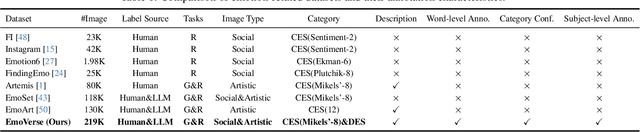
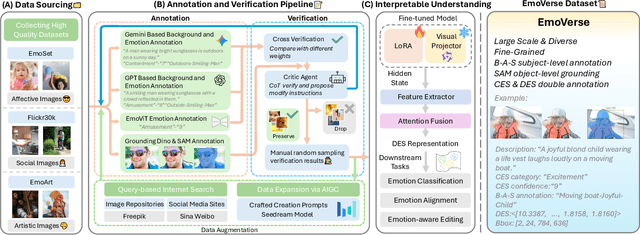
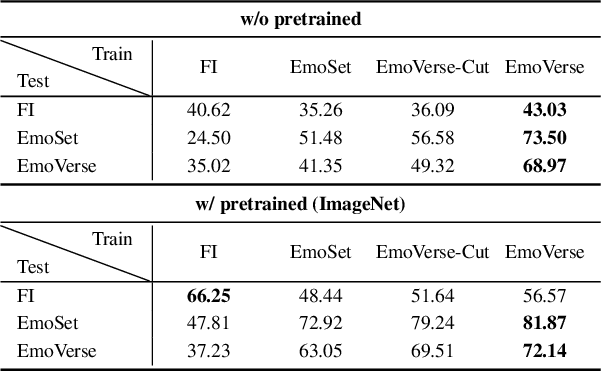
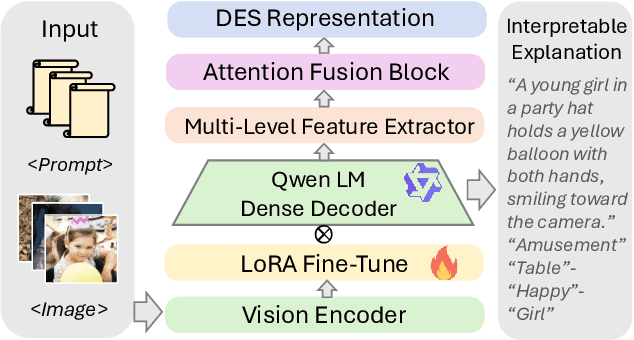
Visual Emotion Analysis (VEA) aims to bridge the affective gap between visual content and human emotional responses. Despite its promise, progress in this field remains limited by the lack of open-source and interpretable datasets. Most existing studies assign a single discrete emotion label to an entire image, offering limited insight into how visual elements contribute to emotion. In this work, we introduce EmoVerse, a large-scale open-source dataset that enables interpretable visual emotion analysis through multi-layered, knowledge-graph-inspired annotations. By decomposing emotions into Background-Attribute-Subject (B-A-S) triplets and grounding each element to visual regions, EmoVerse provides word-level and subject-level emotional reasoning. With over 219k images, the dataset further includes dual annotations in Categorical Emotion States (CES) and Dimensional Emotion Space (DES), facilitating unified discrete and continuous emotion representation. A novel multi-stage pipeline ensures high annotation reliability with minimal human effort. Finally, we introduce an interpretable model that maps visual cues into DES representations and provides detailed attribution explanations. Together, the dataset, pipeline, and model form a comprehensive foundation for advancing explainable high-level emotion understanding.
Isaac Lab: A GPU-Accelerated Simulation Framework for Multi-Modal Robot Learning
Nov 06, 2025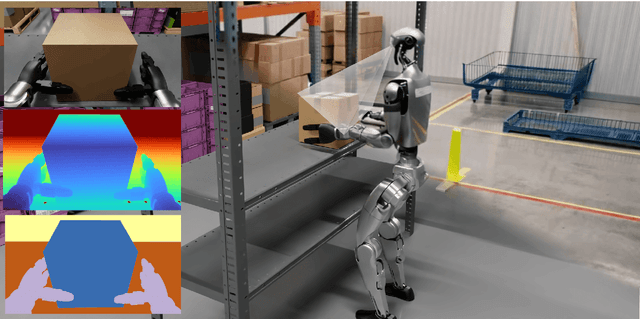
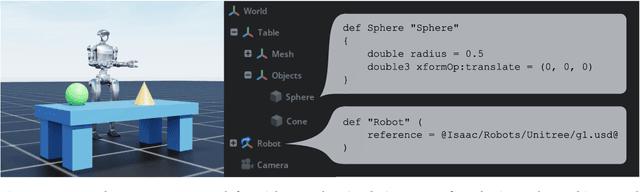
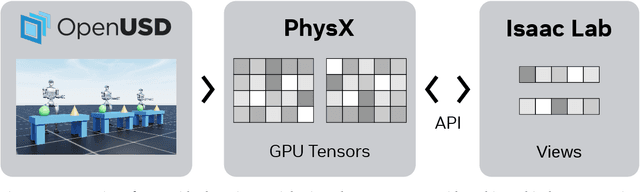
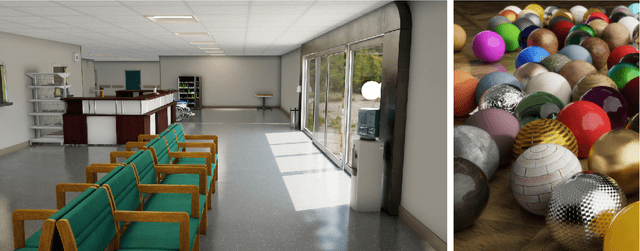
We present Isaac Lab, the natural successor to Isaac Gym, which extends the paradigm of GPU-native robotics simulation into the era of large-scale multi-modal learning. Isaac Lab combines high-fidelity GPU parallel physics, photorealistic rendering, and a modular, composable architecture for designing environments and training robot policies. Beyond physics and rendering, the framework integrates actuator models, multi-frequency sensor simulation, data collection pipelines, and domain randomization tools, unifying best practices for reinforcement and imitation learning at scale within a single extensible platform. We highlight its application to a diverse set of challenges, including whole-body control, cross-embodiment mobility, contact-rich and dexterous manipulation, and the integration of human demonstrations for skill acquisition. Finally, we discuss upcoming integration with the differentiable, GPU-accelerated Newton physics engine, which promises new opportunities for scalable, data-efficient, and gradient-based approaches to robot learning. We believe Isaac Lab's combination of advanced simulation capabilities, rich sensing, and data-center scale execution will help unlock the next generation of breakthroughs in robotics research.
DPL: Depth-only Perceptive Humanoid Locomotion via Realistic Depth Synthesis and Cross-Attention Terrain Reconstruction
Oct 08, 2025Recent advancements in legged robot perceptive locomotion have shown promising progress. However, terrain-aware humanoid locomotion remains largely constrained to two paradigms: depth image-based end-to-end learning and elevation map-based methods. The former suffers from limited training efficiency and a significant sim-to-real gap in depth perception, while the latter depends heavily on multiple vision sensors and localization systems, resulting in latency and reduced robustness. To overcome these challenges, we propose a novel framework that tightly integrates three key components: (1) Terrain-Aware Locomotion Policy with a Blind Backbone, which leverages pre-trained elevation map-based perception to guide reinforcement learning with minimal visual input; (2) Multi-Modality Cross-Attention Transformer, which reconstructs structured terrain representations from noisy depth images; (3) Realistic Depth Images Synthetic Method, which employs self-occlusion-aware ray casting and noise-aware modeling to synthesize realistic depth observations, achieving over 30\% reduction in terrain reconstruction error. This combination enables efficient policy training with limited data and hardware resources, while preserving critical terrain features essential for generalization. We validate our framework on a full-sized humanoid robot, demonstrating agile and adaptive locomotion across diverse and challenging terrains.
Humanoid Occupancy: Enabling A Generalized Multimodal Occupancy Perception System on Humanoid Robots
Jul 27, 2025Humanoid robot technology is advancing rapidly, with manufacturers introducing diverse heterogeneous visual perception modules tailored to specific scenarios. Among various perception paradigms, occupancy-based representation has become widely recognized as particularly suitable for humanoid robots, as it provides both rich semantic and 3D geometric information essential for comprehensive environmental understanding. In this work, we present Humanoid Occupancy, a generalized multimodal occupancy perception system that integrates hardware and software components, data acquisition devices, and a dedicated annotation pipeline. Our framework employs advanced multi-modal fusion techniques to generate grid-based occupancy outputs encoding both occupancy status and semantic labels, thereby enabling holistic environmental understanding for downstream tasks such as task planning and navigation. To address the unique challenges of humanoid robots, we overcome issues such as kinematic interference and occlusion, and establish an effective sensor layout strategy. Furthermore, we have developed the first panoramic occupancy dataset specifically for humanoid robots, offering a valuable benchmark and resource for future research and development in this domain. The network architecture incorporates multi-modal feature fusion and temporal information integration to ensure robust perception. Overall, Humanoid Occupancy delivers effective environmental perception for humanoid robots and establishes a technical foundation for standardizing universal visual modules, paving the way for the widespread deployment of humanoid robots in complex real-world scenarios.