 Add to Chrome
 Add to Firefox
 Add to Edge
Research on Image Recognition Technology Based on Multimodal Deep Learning
May 06, 2024
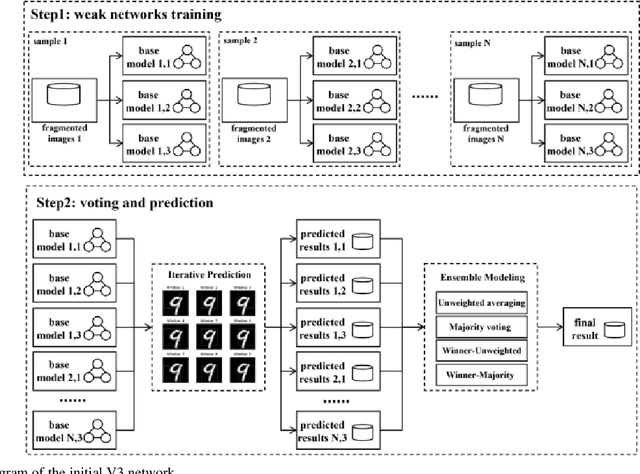
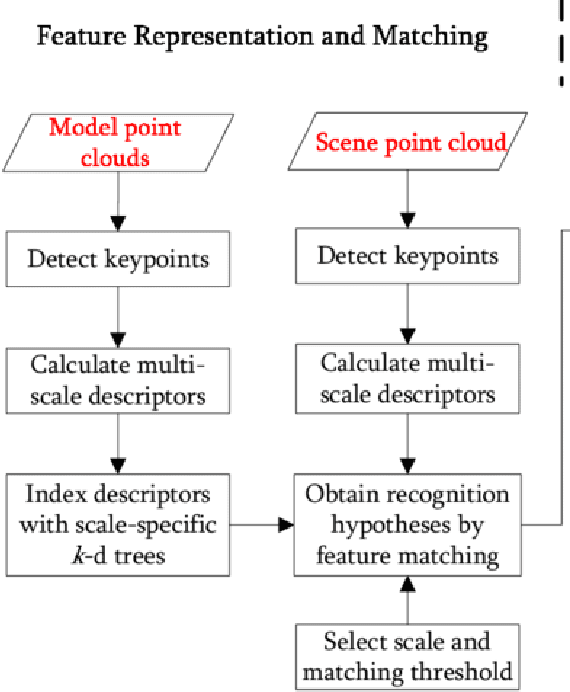
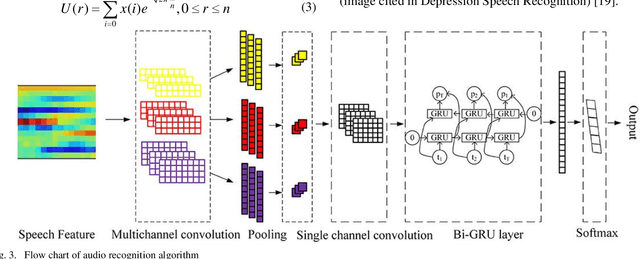
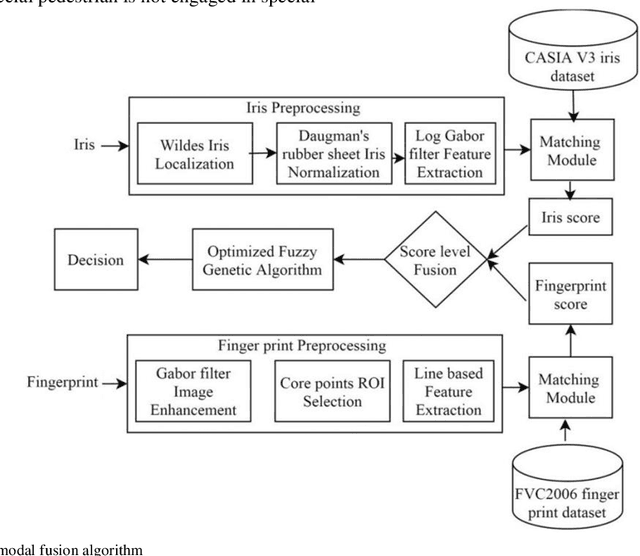
This project investigates the human multi-modal behavior identification algorithm utilizing deep neural networks. According to the characteristics of different modal information, different deep neural networks are used to adapt to different modal video information. Through the integration of various deep neural networks, the algorithm successfully identifies behaviors across multiple modalities. In this project, multiple cameras developed by Microsoft Kinect were used to collect corresponding bone point data based on acquiring conventional images. In this way, the motion features in the image can be extracted. Ultimately, the behavioral characteristics discerned through both approaches are synthesized to facilitate the precise identification and categorization of behaviors. The performance of the suggested algorithm was evaluated using the MSR3D data set. The findings from these experiments indicate that the accuracy in recognizing behaviors remains consistently high, suggesting that the algorithm is reliable in various scenarios. Additionally, the tests demonstrate that the algorithm substantially enhances the accuracy of detecting pedestrian behaviors in video footage.

Adaptive speed planning for Unmanned Vehicle Based on Deep Reinforcement Learning
Apr 26, 2024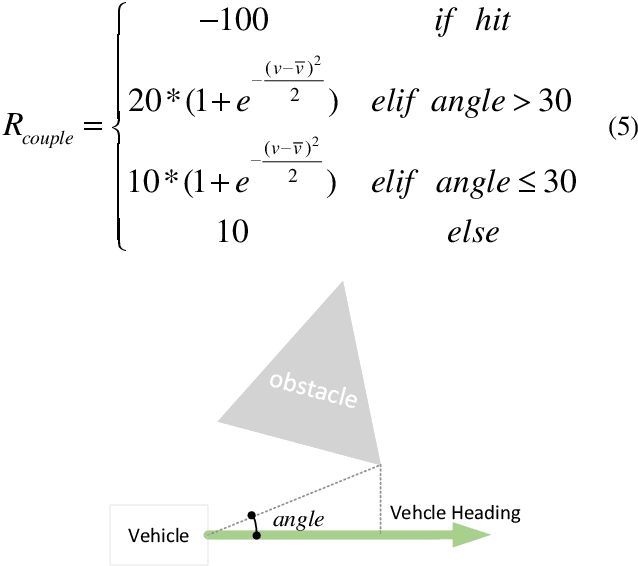
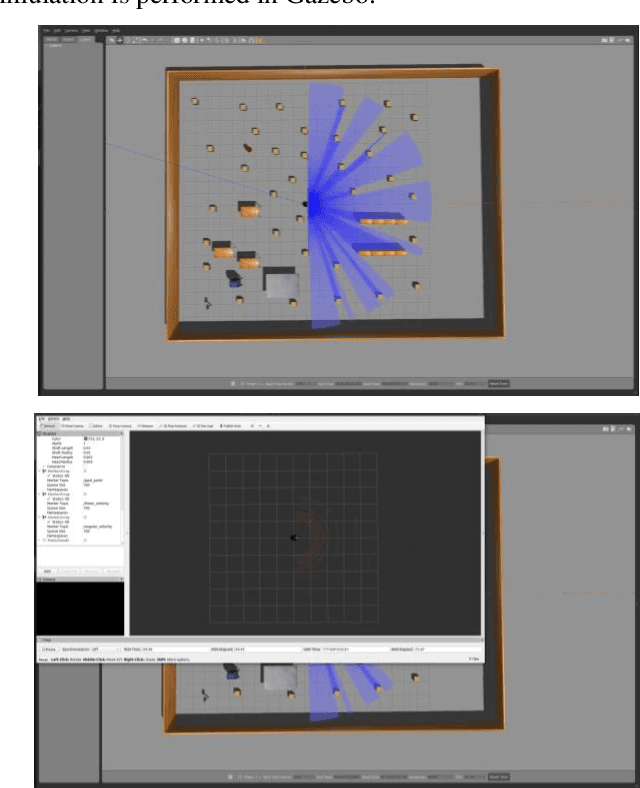
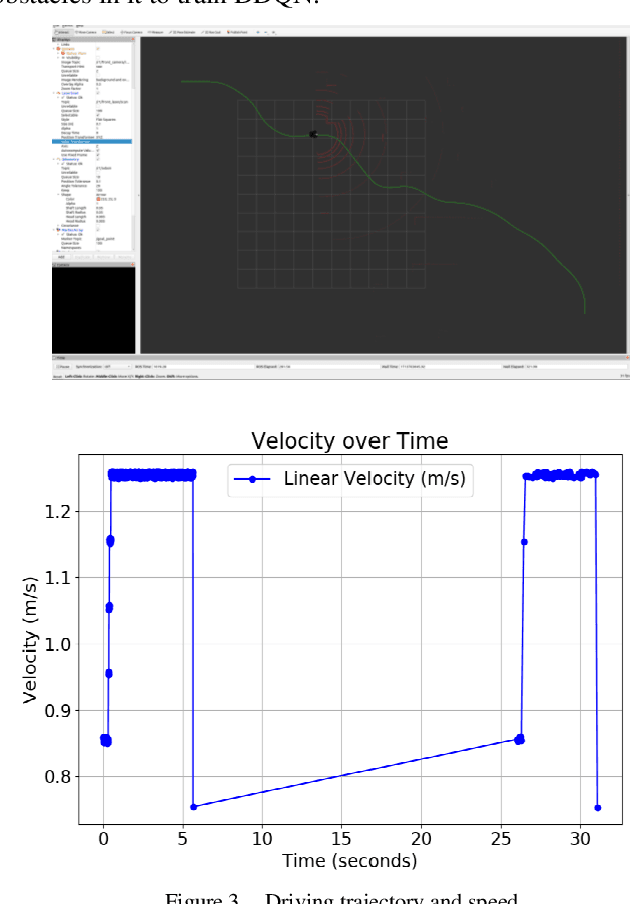
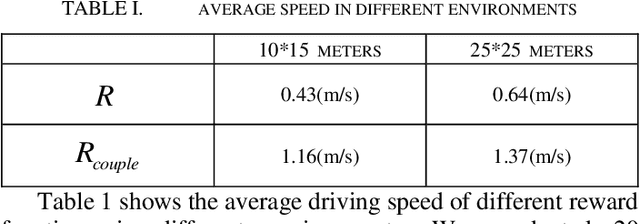
In order to solve the problem of frequent deceleration of unmanned vehicles when approaching obstacles, this article uses a Deep Q-Network (DQN) and its extension, the Double Deep Q-Network (DDQN), to develop a local navigation system that adapts to obstacles while maintaining optimal speed planning. By integrating improved reward functions and obstacle angle determination methods, the system demonstrates significant enhancements in maneuvering capabilities without frequent decelerations. Experiments conducted in simulated environments with varying obstacle densities confirm the effectiveness of the proposed method in achieving more stable and efficient path planning.
Localization Through Particle Filter Powered Neural Network Estimated Monocular Camera Poses
Apr 26, 2024The reduced cost and computational and calibration requirements of monocular cameras make them ideal positioning sensors for mobile robots, albeit at the expense of any meaningful depth measurement. Solutions proposed by some scholars to this localization problem involve fusing pose estimates from convolutional neural networks (CNNs) with pose estimates from geometric constraints on motion to generate accurate predictions of robot trajectories. However, the distribution of attitude estimation based on CNN is not uniform, resulting in certain translation problems in the prediction of robot trajectories. This paper proposes improving these CNN-based pose estimates by propagating a SE(3) uniform distribution driven by a particle filter. The particles utilize the same motion model used by the CNN, while updating their weights using CNN-based estimates. The results show that while the rotational component of pose estimation does not consistently improve relative to CNN-based estimation, the translational component is significantly more accurate. This factor combined with the superior smoothness of the filtered trajectories shows that the use of particle filters significantly improves the performance of CNN-based localization algorithms.
An Image is Worth 1/2 Tokens After Layer 2: Plug-and-Play Inference Acceleration for Large Vision-Language Models
Mar 11, 2024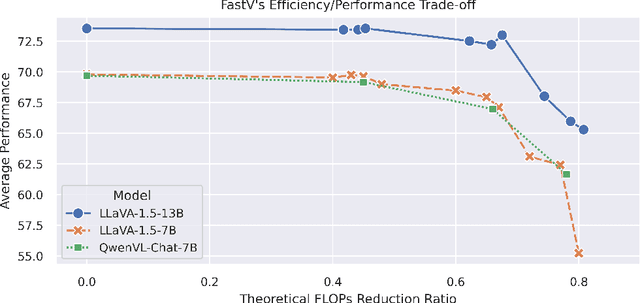
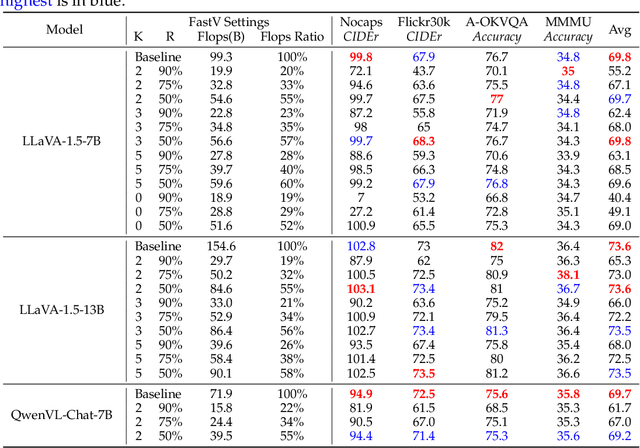
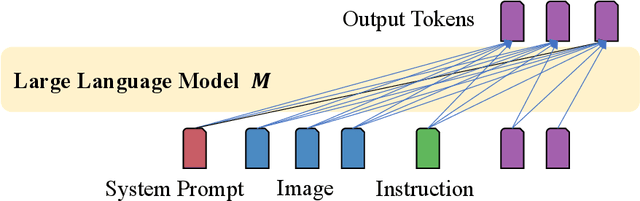

In this study, we identify the inefficient attention phenomena in Large Vision-Language Models (LVLMs), notably within prominent models like LLaVA-1.5, QwenVL-Chat and Video-LLaVA. We find out that the attention computation over visual tokens is of extreme inefficiency in the deep layers of popular LVLMs, suggesting a need for a sparser approach compared to textual data handling. To this end, we introduce FastV, a versatile plug-and-play method designed to optimize computational efficiency by learning adaptive attention patterns in early layers and pruning visual tokens in subsequent ones. Our evaluations demonstrate FastV's ability to dramatically reduce computational costs (e.g., a 45 reduction in FLOPs for LLaVA-1.5-13B) without sacrificing performance in a wide range of image and video understanding tasks. The computational efficiency and performance trade-off of FastV are highly customizable and pareto-efficient. It can compress the FLOPs of a 13B-parameter model to achieve a lower budget than that of a 7B-parameter model, while still maintaining superior performance. We believe FastV has practical values for deployment of LVLMs in edge devices and commercial models. Code is released at https://github.com/pkunlp-icler/FastV.
Training-Free Long-Context Scaling of Large Language Models
Feb 27, 2024The ability of Large Language Models (LLMs) to process and generate coherent text is markedly weakened when the number of input tokens exceeds their pretraining length. Given the expensive overhead of finetuning large-scale models with longer sequences, we propose Dual Chunk Attention (DCA), which enables Llama2 70B to support context windows of more than 100k tokens without continual training. By decomposing the attention computation for long sequences into chunk-based modules, DCA manages to effectively capture the relative positional information of tokens within the same chunk (Intra-Chunk) and across distinct chunks (Inter-Chunk), as well as integrates seamlessly with Flash Attention. In addition to its impressive extrapolation capability, DCA achieves performance on practical long-context tasks that is comparable to or even better than that of finetuned models. When compared with proprietary models, our training-free 70B model attains 94% of the performance of gpt-3.5-16k, indicating it is a viable open-source alternative. All code and data used in this work are released at \url{https://github.com/HKUNLP/ChunkLlama}.
AIR-Bench: Benchmarking Large Audio-Language Models via Generative Comprehension
Feb 12, 2024
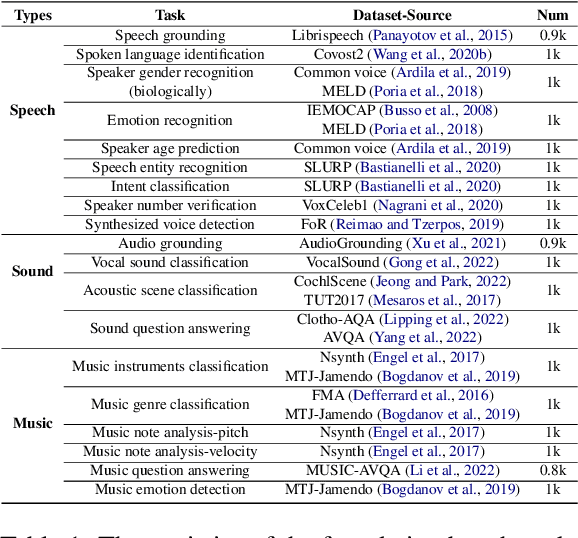
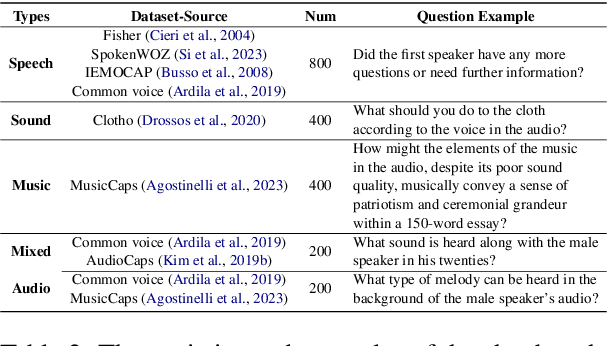
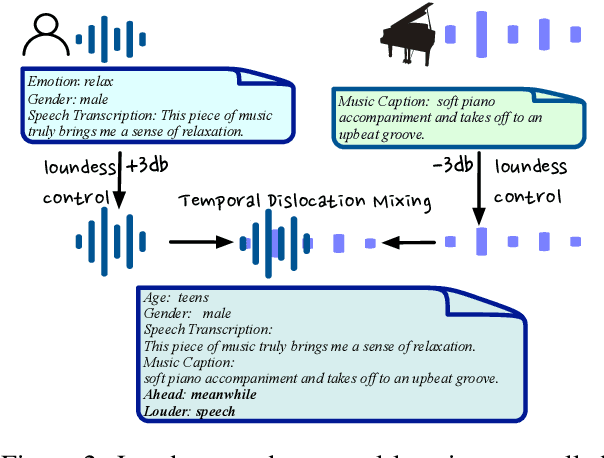
Recently, instruction-following audio-language models have received broad attention for human-audio interaction. However, the absence of benchmarks capable of evaluating audio-centric interaction capabilities has impeded advancements in this field. Previous models primarily focus on assessing different fundamental tasks, such as Automatic Speech Recognition (ASR), and lack an assessment of the open-ended generative capabilities centered around audio. Thus, it is challenging to track the progression in the Large Audio-Language Models (LALMs) domain and to provide guidance for future improvement. In this paper, we introduce AIR-Bench (\textbf{A}udio \textbf{I}nst\textbf{R}uction \textbf{Bench}mark), the first benchmark designed to evaluate the ability of LALMs to understand various types of audio signals (including human speech, natural sounds, and music), and furthermore, to interact with humans in the textual format. AIR-Bench encompasses two dimensions: \textit{foundation} and \textit{chat} benchmarks. The former consists of 19 tasks with approximately 19k single-choice questions, intending to inspect the basic single-task ability of LALMs. The latter one contains 2k instances of open-ended question-and-answer data, directly assessing the comprehension of the model on complex audio and its capacity to follow instructions. Both benchmarks require the model to generate hypotheses directly. We design a unified framework that leverages advanced language models, such as GPT-4, to evaluate the scores of generated hypotheses given the meta-information of the audio. Experimental results demonstrate a high level of consistency between GPT-4-based evaluation and human evaluation. By revealing the limitations of existing LALMs through evaluation results, AIR-Bench can provide insights into the direction of future research.
Sketch and Refine: Towards Fast and Accurate Lane Detection
Jan 26, 2024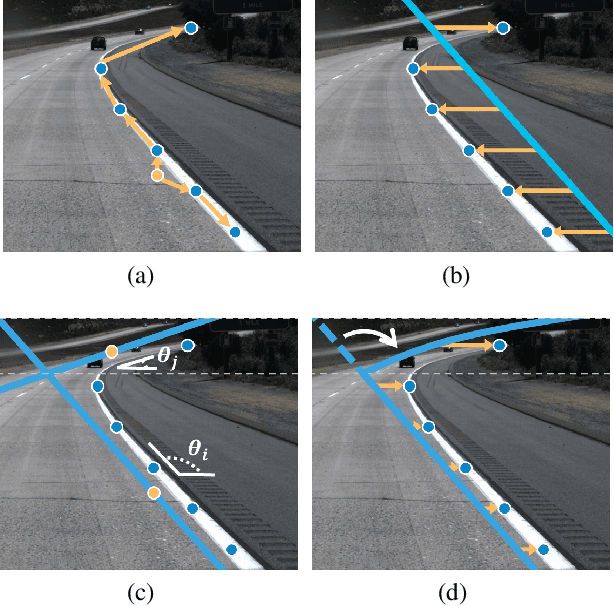
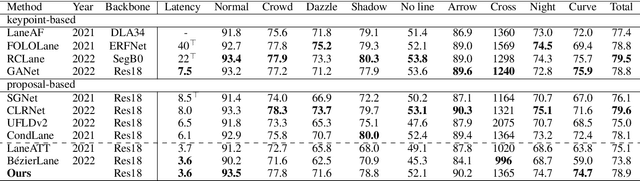
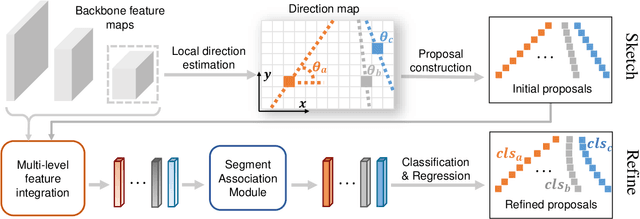
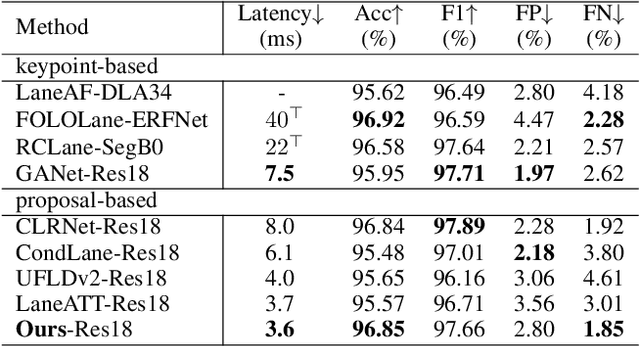
Lane detection is to determine the precise location and shape of lanes on the road. Despite efforts made by current methods, it remains a challenging task due to the complexity of real-world scenarios. Existing approaches, whether proposal-based or keypoint-based, suffer from depicting lanes effectively and efficiently. Proposal-based methods detect lanes by distinguishing and regressing a collection of proposals in a streamlined top-down way, yet lack sufficient flexibility in lane representation. Keypoint-based methods, on the other hand, construct lanes flexibly from local descriptors, which typically entail complicated post-processing. In this paper, we present a "Sketch-and-Refine" paradigm that utilizes the merits of both keypoint-based and proposal-based methods. The motivation is that local directions of lanes are semantically simple and clear. At the "Sketch" stage, local directions of keypoints can be easily estimated by fast convolutional layers. Then we can build a set of lane proposals accordingly with moderate accuracy. At the "Refine" stage, we further optimize these proposals via a novel Lane Segment Association Module (LSAM), which allows adaptive lane segment adjustment. Last but not least, we propose multi-level feature integration to enrich lane feature representations more efficiently. Based on the proposed "Sketch and Refine" paradigm, we propose a fast yet effective lane detector dubbed "SRLane". Experiments show that our SRLane can run at a fast speed (i.e., 278 FPS) while yielding an F1 score of 78.9\%. The source code is available at: https://github.com/passerer/SRLane.
Large Language Models are Superpositions of All Characters: Attaining Arbitrary Role-play via Self-Alignment
Jan 23, 2024Considerable efforts have been invested in augmenting the role-playing proficiency of open-source large language models (LLMs) by emulating proprietary counterparts. Nevertheless, we posit that LLMs inherently harbor role-play capabilities, owing to the extensive knowledge of characters and potential dialogues ingrained in their vast training corpora. Thus, in this study, we introduce Ditto, a self-alignment method for role-play. Ditto capitalizes on character knowledge, encouraging an instruction-following LLM to simulate role-play dialogues as a variant of reading comprehension. This method creates a role-play training set comprising 4,000 characters, surpassing the scale of currently available datasets by tenfold regarding the number of roles. Subsequently, we fine-tune the LLM using this self-generated dataset to augment its role-playing capabilities. Upon evaluating our meticulously constructed and reproducible role-play benchmark and the roleplay subset of MT-Bench, Ditto, in various parameter scales, consistently maintains a consistent role identity and provides accurate role-specific knowledge in multi-turn role-play conversations. Notably, it outperforms all open-source role-play baselines, showcasing performance levels comparable to advanced proprietary chatbots. Furthermore, we present the first comprehensive cross-supervision alignment experiment in the role-play domain, revealing that the intrinsic capabilities of LLMs confine the knowledge within role-play. Meanwhile, the role-play styles can be easily acquired with the guidance of smaller models. We open-source related resources at https://github.com/OFA-Sys/Ditto.
Controllable 3D Face Generation with Conditional Style Code Diffusion
Jan 11, 2024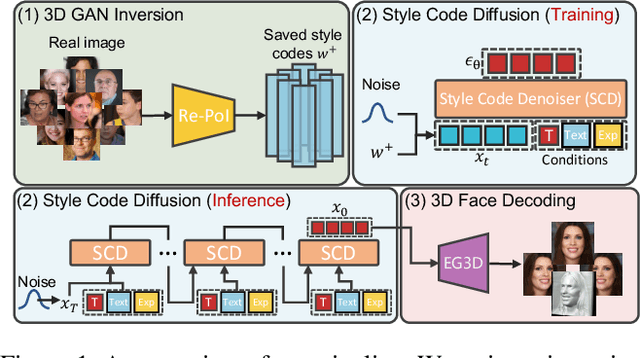
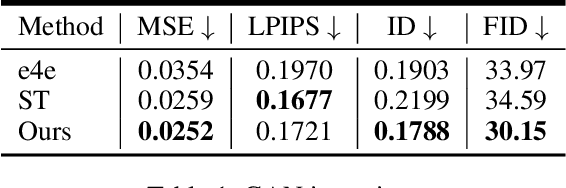
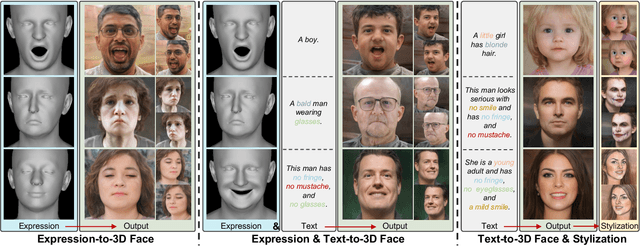
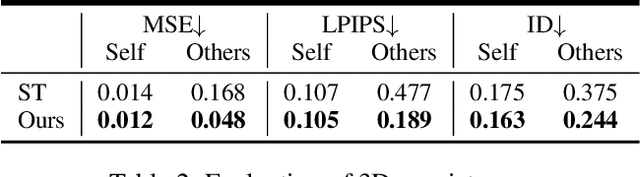
Generating photorealistic 3D faces from given conditions is a challenging task. Existing methods often rely on time-consuming one-by-one optimization approaches, which are not efficient for modeling the same distribution content, e.g., faces. Additionally, an ideal controllable 3D face generation model should consider both facial attributes and expressions. Thus we propose a novel approach called TEx-Face(TExt & Expression-to-Face) that addresses these challenges by dividing the task into three components, i.e., 3D GAN Inversion, Conditional Style Code Diffusion, and 3D Face Decoding. For 3D GAN inversion, we introduce two methods which aim to enhance the representation of style codes and alleviate 3D inconsistencies. Furthermore, we design a style code denoiser to incorporate multiple conditions into the style code and propose a data augmentation strategy to address the issue of insufficient paired visual-language data. Extensive experiments conducted on FFHQ, CelebA-HQ, and CelebA-Dialog demonstrate the promising performance of our TEx-Face in achieving the efficient and controllable generation of photorealistic 3D faces. The code will be available at https://github.com/sxl142/TEx-Face.
MultiGPrompt for Multi-Task Pre-Training and Prompting on Graphs
Nov 28, 2023Graphs can inherently model interconnected objects on the Web, thereby facilitating a series of Web applications, such as web analyzing and content recommendation. Recently, Graph Neural Networks (GNNs) have emerged as a mainstream technique for graph representation learning. However, their efficacy within an end-to-end supervised framework is significantly tied to the availabilityof task-specific labels. To mitigate labeling costs and enhance robustness in few-shot settings, pre-training on self-supervised tasks has emerged as a promising method, while prompting has been proposed to further narrow the objective gap between pretext and downstream tasks. Although there has been some initial exploration of prompt-based learning on graphs, they primarily leverage a single pretext task, resulting in a limited subset of general knowledge that could be learned from the pre-training data. Hence, in this paper, we propose MultiGPrompt, a novel multi-task pre-training and prompting framework to exploit multiple pretext tasks for more comprehensive pre-trained knowledge. First, in pre-training, we design a set of pretext tokens to synergize multiple pretext tasks. Second, we propose a dual-prompt mechanism consisting of composed and open prompts to leverage task-specific and global pre-training knowledge, to guide downstream tasks in few-shot settings. Finally, we conduct extensive experiments on six public datasets to evaluate and analyze MultiGPrompt.