 Add to Chrome
 Add to Firefox
 Add to Edge
An Event-Oriented Diffusion-Refinement Method for Sparse Events Completion
Jan 06, 2024
Event cameras or dynamic vision sensors (DVS) record asynchronous response to brightness changes instead of conventional intensity frames, and feature ultra-high sensitivity at low bandwidth. The new mechanism demonstrates great advantages in challenging scenarios with fast motion and large dynamic range. However, the recorded events might be highly sparse due to either limited hardware bandwidth or extreme photon starvation in harsh environments. To unlock the full potential of event cameras, we propose an inventive event sequence completion approach conforming to the unique characteristics of event data in both the processing stage and the output form. Specifically, we treat event streams as 3D event clouds in the spatiotemporal domain, develop a diffusion-based generative model to generate dense clouds in a coarse-to-fine manner, and recover exact timestamps to maintain the temporal resolution of raw data successfully. To validate the effectiveness of our method comprehensively, we perform extensive experiments on three widely used public datasets with different spatial resolutions, and additionally collect a novel event dataset covering diverse scenarios with highly dynamic motions and under harsh illumination. Besides generating high-quality dense events, our method can benefit downstream applications such as object classification and intensity frame reconstruction.

MobileVLM : A Fast, Strong and Open Vision Language Assistant for Mobile Devices
Dec 30, 2023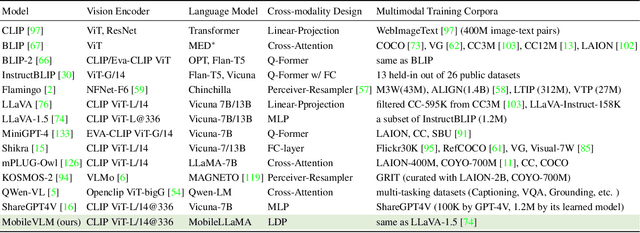
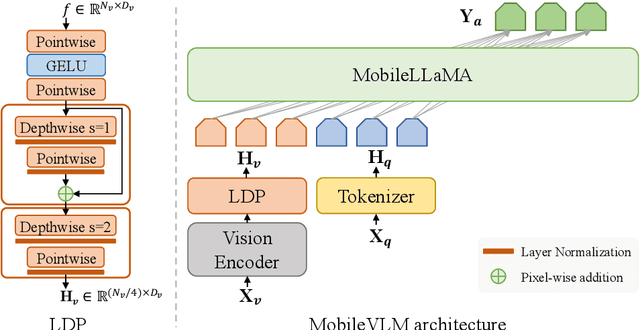
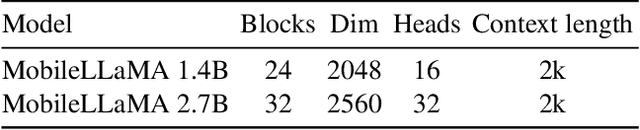
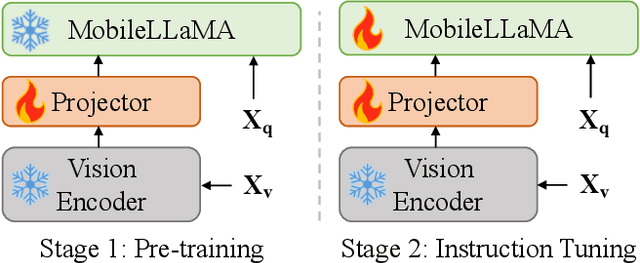
We present MobileVLM, a competent multimodal vision language model (MMVLM) targeted to run on mobile devices. It is an amalgamation of a myriad of architectural designs and techniques that are mobile-oriented, which comprises a set of language models at the scale of 1.4B and 2.7B parameters, trained from scratch, a multimodal vision model that is pre-trained in the CLIP fashion, cross-modality interaction via an efficient projector. We evaluate MobileVLM on several typical VLM benchmarks. Our models demonstrate on par performance compared with a few much larger models. More importantly, we measure the inference speed on both a Qualcomm Snapdragon 888 CPU and an NVIDIA Jeston Orin GPU, and we obtain state-of-the-art performance of 21.5 tokens and 65.3 tokens per second, respectively. Our code will be made available at: https://github.com/Meituan-AutoML/MobileVLM.
Rethinking of Feature Interaction for Multi-task Learning on Dense Prediction
Dec 21, 2023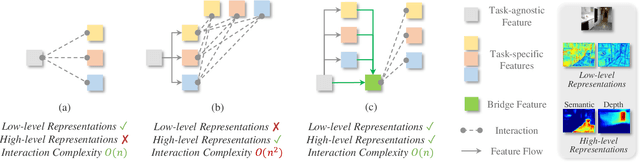


Existing works generally adopt the encoder-decoder structure for Multi-task Dense Prediction, where the encoder extracts the task-generic features, and multiple decoders generate task-specific features for predictions. We observe that low-level representations with rich details and high-level representations with abundant task information are not both involved in the multi-task interaction process. Additionally, low-quality and low-efficiency issues also exist in current multi-task learning architectures. In this work, we propose to learn a comprehensive intermediate feature globally from both task-generic and task-specific features, we reveal an important fact that this intermediate feature, namely the bridge feature, is a good solution to the above issues. Based on this, we propose a novel Bridge-Feature-Centirc Interaction (BRFI) method. A Bridge Feature Extractor (BFE) is designed for the generation of strong bridge features and Task Pattern Propagation (TPP) is applied to ensure high-quality task interaction participants. Then a Task-Feature Refiner (TFR) is developed to refine final task predictions with the well-learned knowledge from the bridge features. Extensive experiments are conducted on NYUD-v2 and PASCAL Context benchmarks, and the superior performance shows the proposed architecture is effective and powerful in promoting different dense prediction tasks simultaneously.
Towards Knowledge-driven Autonomous Driving
Dec 12, 2023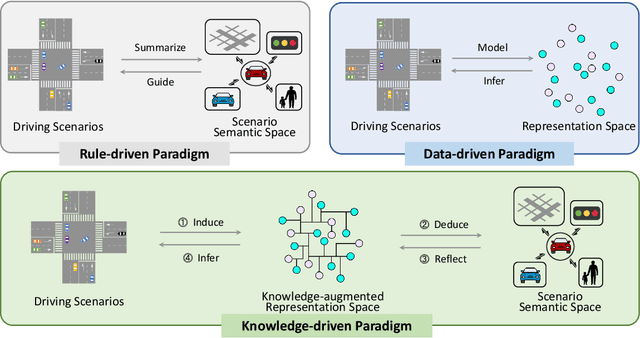
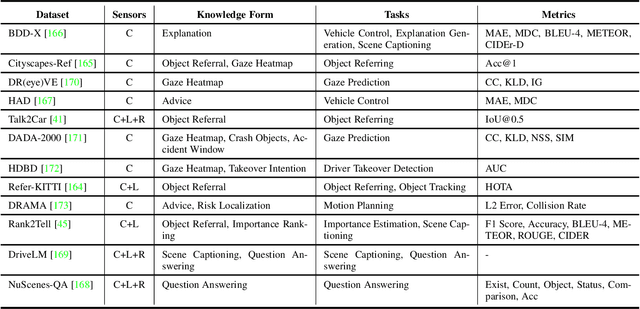
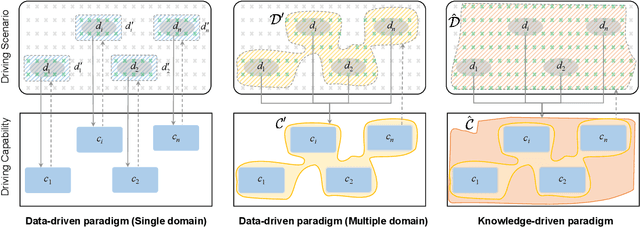
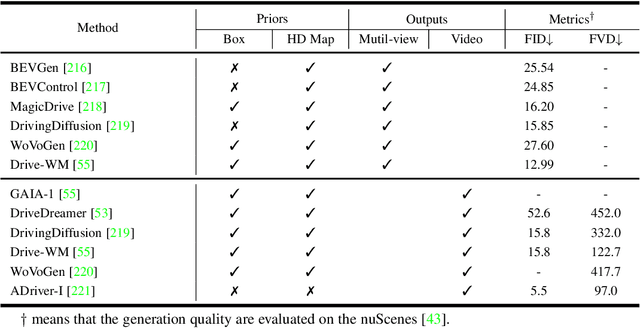
This paper explores the emerging knowledge-driven autonomous driving technologies. Our investigation highlights the limitations of current autonomous driving systems, in particular their sensitivity to data bias, difficulty in handling long-tail scenarios, and lack of interpretability. Conversely, knowledge-driven methods with the abilities of cognition, generalization and life-long learning emerge as a promising way to overcome these challenges. This paper delves into the essence of knowledge-driven autonomous driving and examines its core components: dataset \& benchmark, environment, and driver agent. By leveraging large language models, world models, neural rendering, and other advanced artificial intelligence techniques, these components collectively contribute to a more holistic, adaptive, and intelligent autonomous driving system. The paper systematically organizes and reviews previous research efforts in this area, and provides insights and guidance for future research and practical applications of autonomous driving. We will continually share the latest updates on cutting-edge developments in knowledge-driven autonomous driving along with the relevant valuable open-source resources at: \url{https://github.com/PJLab-ADG/awesome-knowledge-driven-AD}.
Transferring CLIP's Knowledge into Zero-Shot Point Cloud Semantic Segmentation
Dec 12, 2023
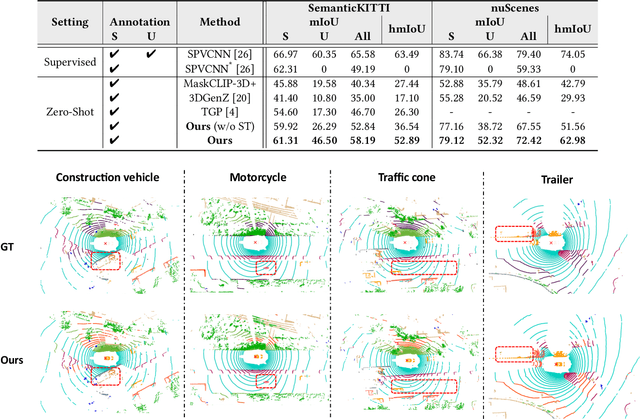

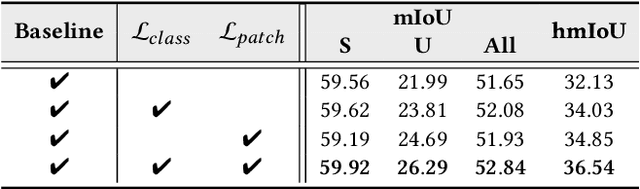
Traditional 3D segmentation methods can only recognize a fixed range of classes that appear in the training set, which limits their application in real-world scenarios due to the lack of generalization ability. Large-scale visual-language pre-trained models, such as CLIP, have shown their generalization ability in the zero-shot 2D vision tasks, but are still unable to be applied to 3D semantic segmentation directly. In this work, we focus on zero-shot point cloud semantic segmentation and propose a simple yet effective baseline to transfer the visual-linguistic knowledge implied in CLIP to point cloud encoder at both feature and output levels. Both feature-level and output-level alignments are conducted between 2D and 3D encoders for effective knowledge transfer. Concretely, a Multi-granularity Cross-modal Feature Alignment (MCFA) module is proposed to align 2D and 3D features from global semantic and local position perspectives for feature-level alignment. For the output level, per-pixel pseudo labels of unseen classes are extracted using the pre-trained CLIP model as supervision for the 3D segmentation model to mimic the behavior of the CLIP image encoder. Extensive experiments are conducted on two popular benchmarks of point cloud segmentation. Our method outperforms significantly previous state-of-the-art methods under zero-shot setting (+29.2% mIoU on SemanticKITTI and 31.8% mIoU on nuScenes), and further achieves promising results in the annotation-free point cloud semantic segmentation setting, showing its great potential for label-efficient learning.
Lenna: Language Enhanced Reasoning Detection Assistant
Dec 05, 2023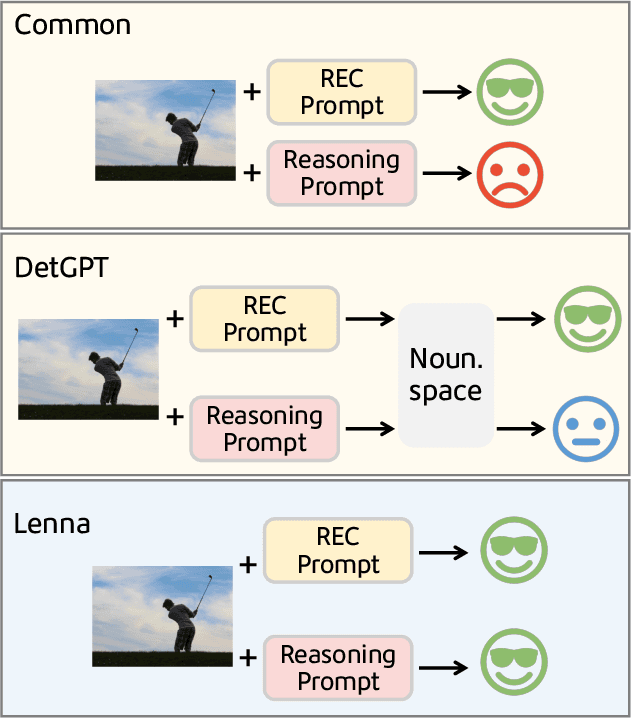
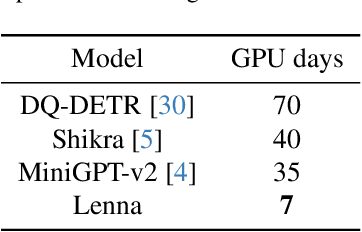
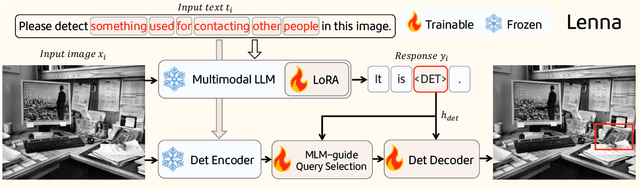
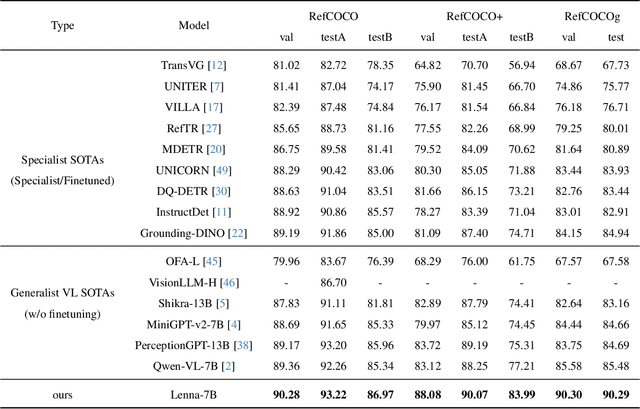
With the fast-paced development of multimodal large language models (MLLMs), we can now converse with AI systems in natural languages to understand images. However, the reasoning power and world knowledge embedded in the large language models have been much less investigated and exploited for image perception tasks. In this paper, we propose Lenna, a language-enhanced reasoning detection assistant, which utilizes the robust multimodal feature representation of MLLMs, while preserving location information for detection. This is achieved by incorporating an additional <DET> token in the MLLM vocabulary that is free of explicit semantic context but serves as a prompt for the detector to identify the corresponding position. To evaluate the reasoning capability of Lenna, we construct a ReasonDet dataset to measure its performance on reasoning-based detection. Remarkably, Lenna demonstrates outstanding performance on ReasonDet and comes with significantly low training costs. It also incurs minimal transferring overhead when extended to other tasks. Our code and model will be available at https://git.io/Lenna.
Masked Autoencoders Are Robust Neural Architecture Search Learners
Nov 20, 2023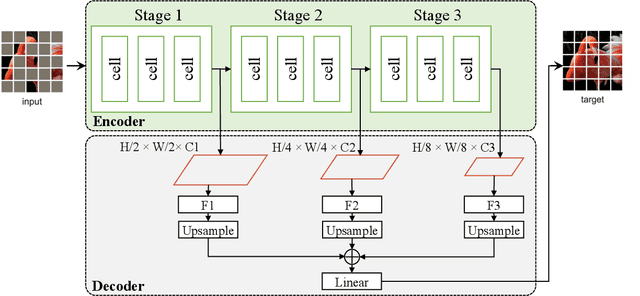
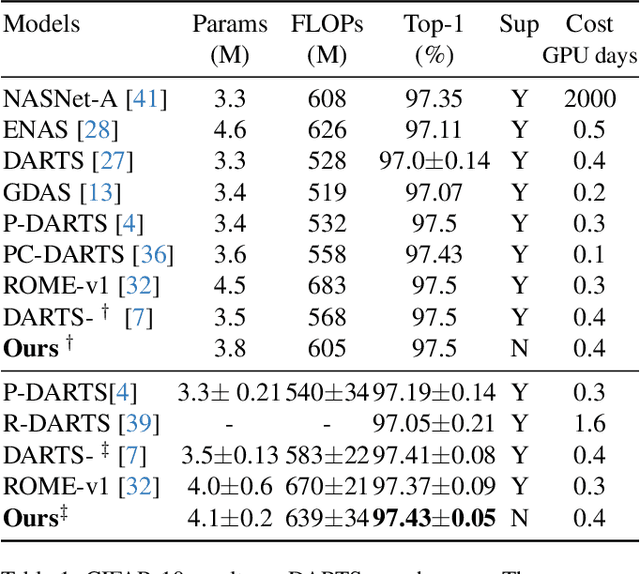

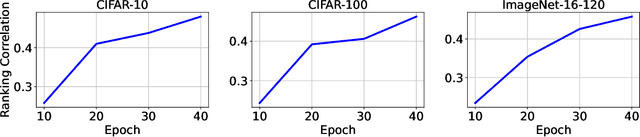
Neural Architecture Search (NAS) currently relies heavily on labeled data, which is both expensive and time-consuming to acquire. In this paper, we propose a novel NAS framework based on Masked Autoencoders (MAE) that eliminates the need for labeled data during the search process. By replacing the supervised learning objective with an image reconstruction task, our approach enables the robust discovery of network architectures without compromising performance and generalization ability. Additionally, we address the problem of performance collapse encountered in the widely-used Differentiable Architecture Search (DARTS) method in the unsupervised paradigm by introducing a multi-scale decoder. Through extensive experiments conducted on various search spaces and datasets, we demonstrate the effectiveness and robustness of the proposed method, providing empirical evidence of its superiority over baseline approaches.
A Speed Odyssey for Deployable Quantization of LLMs
Nov 16, 2023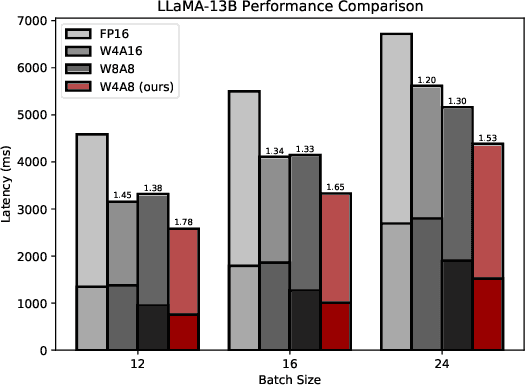
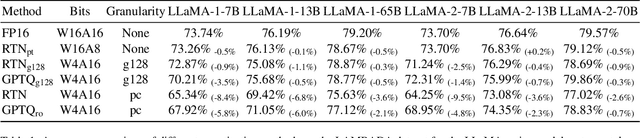
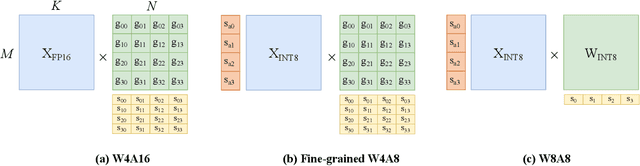
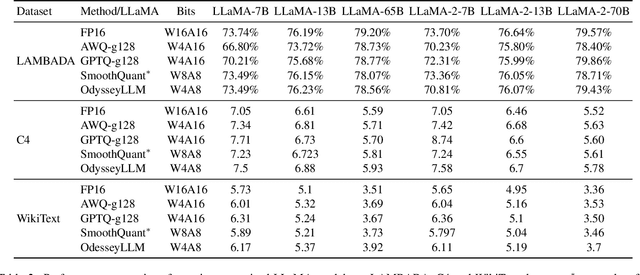
The large language model era urges faster and less costly inference. Prior model compression works on LLMs tend to undertake a software-centric approach primarily focused on the simulated quantization performance. By neglecting the feasibility of deployment, these approaches are typically disabled in real practice. They used to drastically push down the quantization bit range for a reduced computation which might not be supported by the mainstream hardware, or involve sophisticated algorithms that introduce extra computation or memory access overhead. We argue that pursuing a hardware-centric approach in the construction of quantization algorithms is crucial. In this regard, we are driven to build our compression method on top of hardware awareness, eliminating impractical algorithm choices while maximizing the benefit of hardware acceleration. Our method, OdysseyLLM, comes with a novel W4A8 kernel implementation called FastGEMM and a combined recipe of quantization strategies. Extensive experiments manifest the superiority of our W4A8 method which brings the actual speed boosting up to \textbf{4$\times$} compared to Hugging Face FP16 inference and \textbf{2.23$\times$} vs. the state-of-the-art inference engine TensorRT-LLM in FP16, and \textbf{1.45$\times$} vs. TensorRT-LLM in INT8, yet without substantially harming the performance.
MultiSPANS: A Multi-range Spatial-Temporal Transformer Network for Traffic Forecast via Structural Entropy Optimization
Nov 06, 2023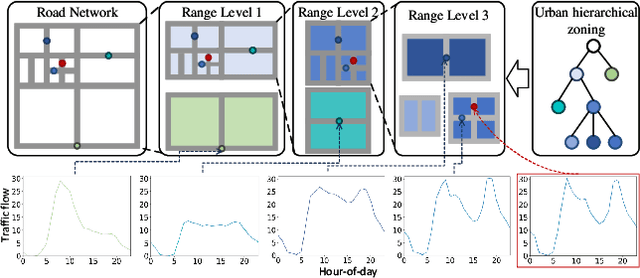
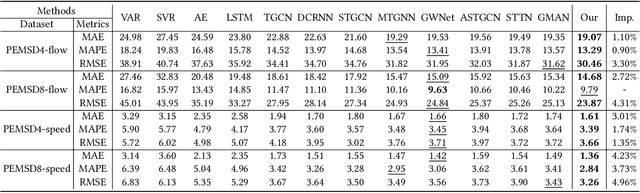
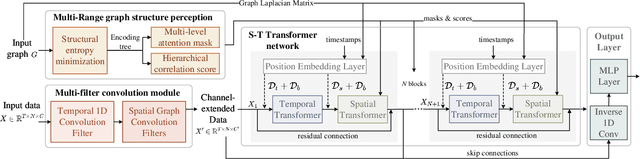
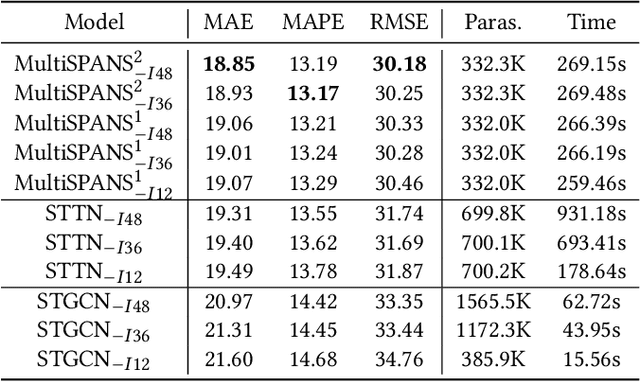
Traffic forecasting is a complex multivariate time-series regression task of paramount importance for traffic management and planning. However, existing approaches often struggle to model complex multi-range dependencies using local spatiotemporal features and road network hierarchical knowledge. To address this, we propose MultiSPANS. First, considering that an individual recording point cannot reflect critical spatiotemporal local patterns, we design multi-filter convolution modules for generating informative ST-token embeddings to facilitate attention computation. Then, based on ST-token and spatial-temporal position encoding, we employ the Transformers to capture long-range temporal and spatial dependencies. Furthermore, we introduce structural entropy theory to optimize the spatial attention mechanism. Specifically, The structural entropy minimization algorithm is used to generate optimal road network hierarchies, i.e., encoding trees. Based on this, we propose a relative structural entropy-based position encoding and a multi-head attention masking scheme based on multi-layer encoding trees. Extensive experiments demonstrate the superiority of the presented framework over several state-of-the-art methods in real-world traffic datasets, and the longer historical windows are effectively utilized. The code is available at https://github.com/SELGroup/MultiSPANS.
A Transformer-Based Model With Self-Distillation for Multimodal Emotion Recognition in Conversations
Oct 31, 2023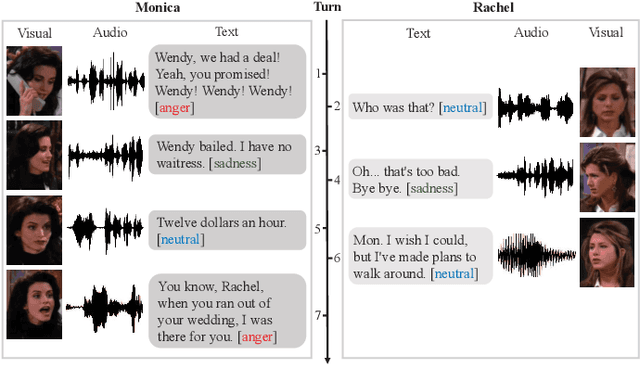
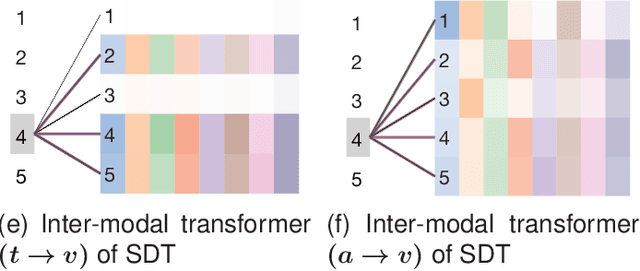
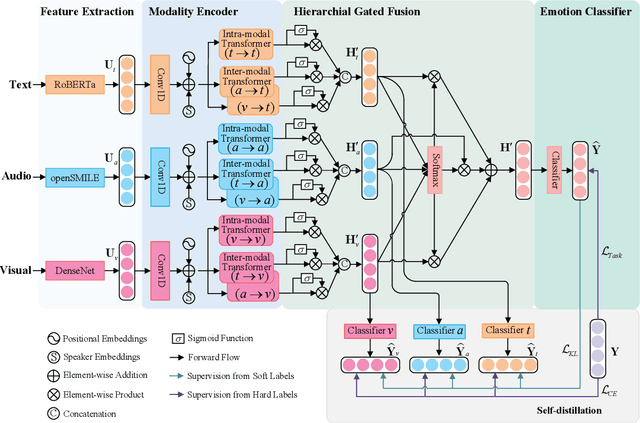
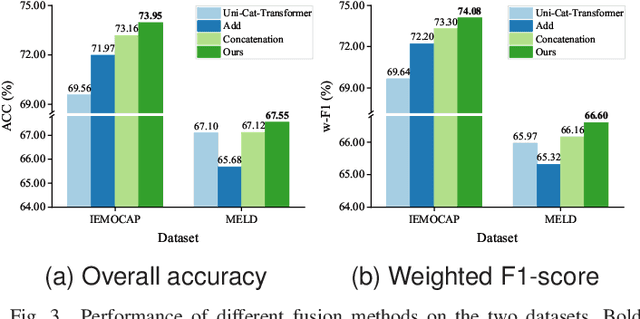
Emotion recognition in conversations (ERC), the task of recognizing the emotion of each utterance in a conversation, is crucial for building empathetic machines. Existing studies focus mainly on capturing context- and speaker-sensitive dependencies on the textual modality but ignore the significance of multimodal information. Different from emotion recognition in textual conversations, capturing intra- and inter-modal interactions between utterances, learning weights between different modalities, and enhancing modal representations play important roles in multimodal ERC. In this paper, we propose a transformer-based model with self-distillation (SDT) for the task. The transformer-based model captures intra- and inter-modal interactions by utilizing intra- and inter-modal transformers, and learns weights between modalities dynamically by designing a hierarchical gated fusion strategy. Furthermore, to learn more expressive modal representations, we treat soft labels of the proposed model as extra training supervision. Specifically, we introduce self-distillation to transfer knowledge of hard and soft labels from the proposed model to each modality. Experiments on IEMOCAP and MELD datasets demonstrate that SDT outperforms previous state-of-the-art baselines.
* 13 pages, 10 figures. Accepted by IEEE Transactions on Multimedia (TMM)