 Add to Chrome
 Add to Firefox
 Add to Edge
InternLM-XComposer2.5-OmniLive: A Comprehensive Multimodal System for Long-term Streaming Video and Audio Interactions
Dec 12, 2024
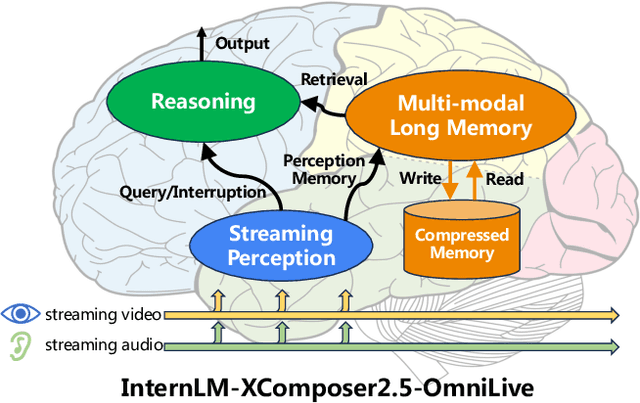


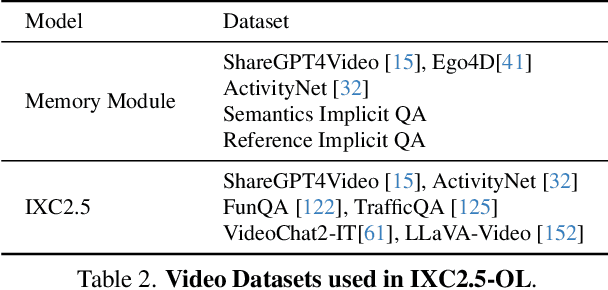
Creating AI systems that can interact with environments over long periods, similar to human cognition, has been a longstanding research goal. Recent advancements in multimodal large language models (MLLMs) have made significant strides in open-world understanding. However, the challenge of continuous and simultaneous streaming perception, memory, and reasoning remains largely unexplored. Current MLLMs are constrained by their sequence-to-sequence architecture, which limits their ability to process inputs and generate responses simultaneously, akin to being unable to think while perceiving. Furthermore, relying on long contexts to store historical data is impractical for long-term interactions, as retaining all information becomes costly and inefficient. Therefore, rather than relying on a single foundation model to perform all functions, this project draws inspiration from the concept of the Specialized Generalist AI and introduces disentangled streaming perception, reasoning, and memory mechanisms, enabling real-time interaction with streaming video and audio input. The proposed framework InternLM-XComposer2.5-OmniLive (IXC2.5-OL) consists of three key modules: (1) Streaming Perception Module: Processes multimodal information in real-time, storing key details in memory and triggering reasoning in response to user queries. (2) Multi-modal Long Memory Module: Integrates short-term and long-term memory, compressing short-term memories into long-term ones for efficient retrieval and improved accuracy. (3) Reasoning Module: Responds to queries and executes reasoning tasks, coordinating with the perception and memory modules. This project simulates human-like cognition, enabling multimodal large language models to provide continuous and adaptive service over time.

OmniDocBench: Benchmarking Diverse PDF Document Parsing with Comprehensive Annotations
Dec 10, 2024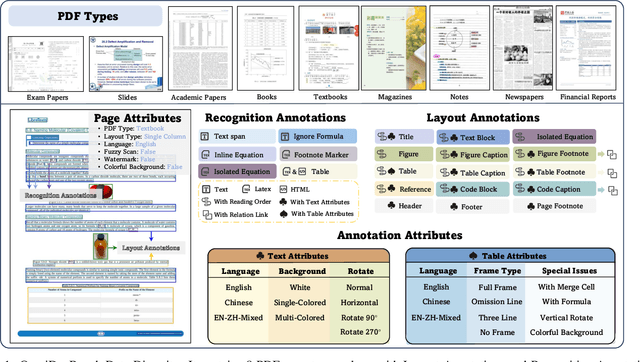

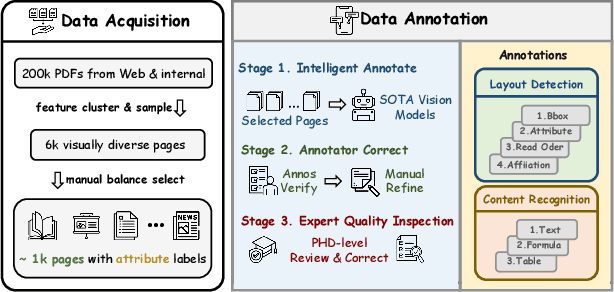
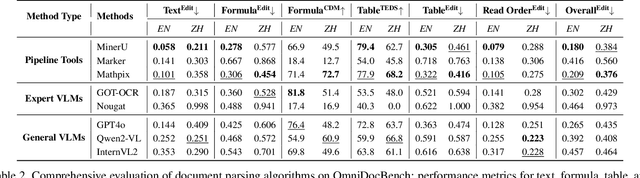
Document content extraction is crucial in computer vision, especially for meeting the high-quality data needs of large language models (LLMs) and retrieval-augmented generation (RAG) technologies. However, current document parsing methods suffer from significant limitations in terms of diversity and comprehensive evaluation. To address these challenges, we introduce OmniDocBench, a novel multi-source benchmark designed to advance automated document content extraction. OmniDocBench includes a meticulously curated and annotated high-quality evaluation dataset comprising nine diverse document types, such as academic papers, textbooks, slides, among others. Our benchmark provides a flexible and comprehensive evaluation framework with 19 layout category labels and 14 attribute labels, enabling multi-level assessments across entire datasets, individual modules, or specific data types. Using OmniDocBench, we perform an exhaustive comparative analysis of existing modular pipelines and multimodal end-to-end methods, highlighting their limitations in handling document diversity and ensuring fair evaluation. OmniDocBench establishes a robust, diverse, and fair evaluation standard for the document content extraction field, offering crucial insights for future advancements and fostering the development of document parsing technologies. The codes and dataset is available in https://github.com/opendatalab/OmniDocBench.
Chimera: Improving Generalist Model with Domain-Specific Experts
Dec 08, 2024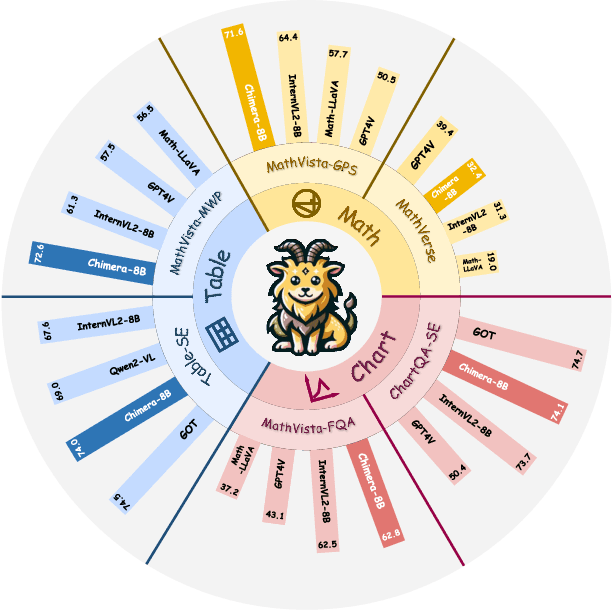
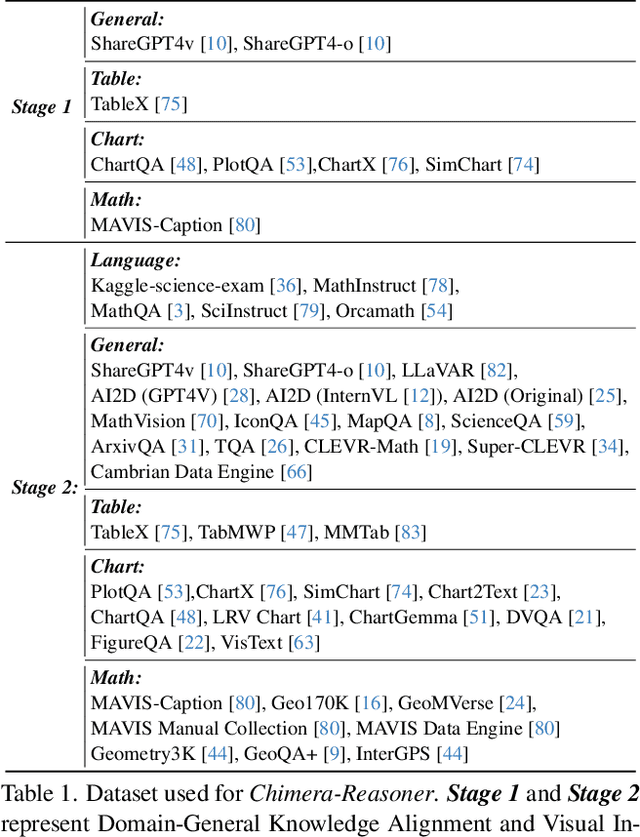
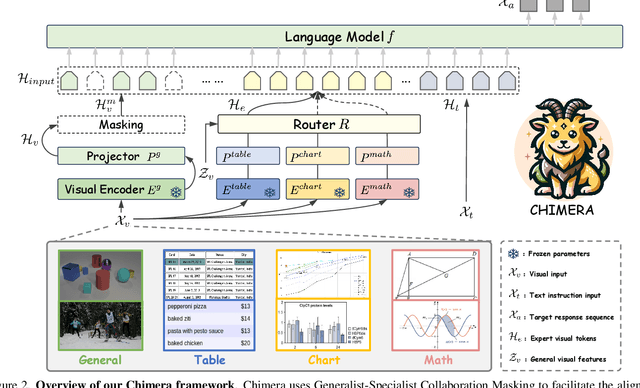
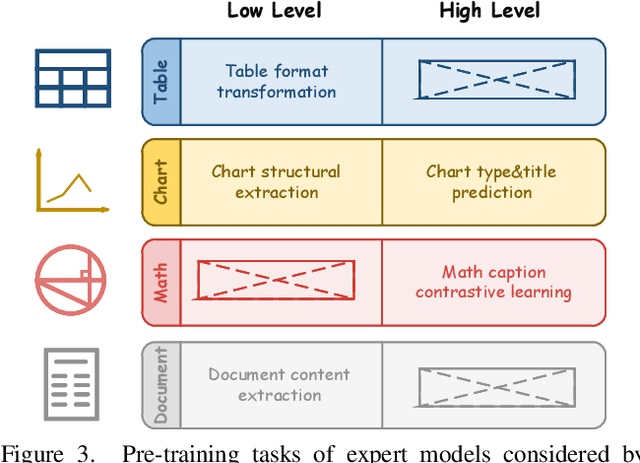
Recent advancements in Large Multi-modal Models (LMMs) underscore the importance of scaling by increasing image-text paired data, achieving impressive performance on general tasks. Despite their effectiveness in broad applications, generalist models are primarily trained on web-scale datasets dominated by natural images, resulting in the sacrifice of specialized capabilities for domain-specific tasks that require extensive domain prior knowledge. Moreover, directly integrating expert models tailored for specific domains is challenging due to the representational gap and imbalanced optimization between the generalist model and experts. To address these challenges, we introduce Chimera, a scalable and low-cost multi-modal pipeline designed to boost the ability of existing LMMs with domain-specific experts. Specifically, we design a progressive training strategy to integrate features from expert models into the input of a generalist LMM. To address the imbalanced optimization caused by the well-aligned general visual encoder, we introduce a novel Generalist-Specialist Collaboration Masking (GSCM) mechanism. This results in a versatile model that excels across the chart, table, math, and document domains, achieving state-of-the-art performance on multi-modal reasoning and visual content extraction tasks, both of which are challenging tasks for assessing existing LMMs.
OCR Hinders RAG: Evaluating the Cascading Impact of OCR on Retrieval-Augmented Generation
Dec 03, 2024Retrieval-augmented Generation (RAG) enhances Large Language Models (LLMs) by integrating external knowledge to reduce hallucinations and incorporate up-to-date information without retraining. As an essential part of RAG, external knowledge bases are commonly built by extracting structured data from unstructured PDF documents using Optical Character Recognition (OCR). However, given the imperfect prediction of OCR and the inherent non-uniform representation of structured data, knowledge bases inevitably contain various OCR noises. In this paper, we introduce OHRBench, the first benchmark for understanding the cascading impact of OCR on RAG systems. OHRBench includes 350 carefully selected unstructured PDF documents from six real-world RAG application domains, along with Q&As derived from multimodal elements in documents, challenging existing OCR solutions used for RAG To better understand OCR's impact on RAG systems, we identify two primary types of OCR noise: Semantic Noise and Formatting Noise and apply perturbation to generate a set of structured data with varying degrees of each OCR noise. Using OHRBench, we first conduct a comprehensive evaluation of current OCR solutions and reveal that none is competent for constructing high-quality knowledge bases for RAG systems. We then systematically evaluate the impact of these two noise types and demonstrate the vulnerability of RAG systems. Furthermore, we discuss the potential of employing Vision-Language Models (VLMs) without OCR in RAG systems. Code: https://github.com/opendatalab/OHR-Bench
Seq2Time: Sequential Knowledge Transfer for Video LLM Temporal Grounding
Nov 25, 2024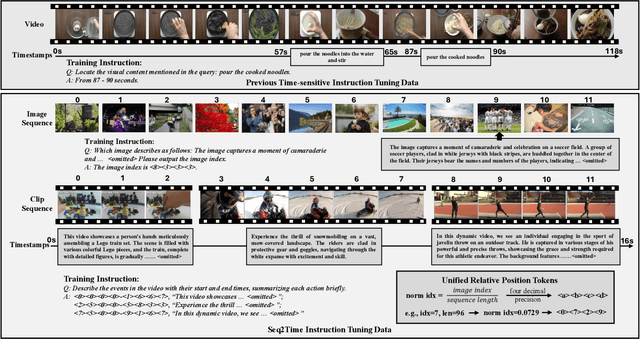
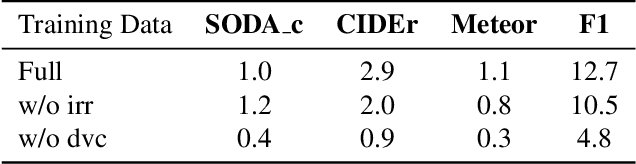
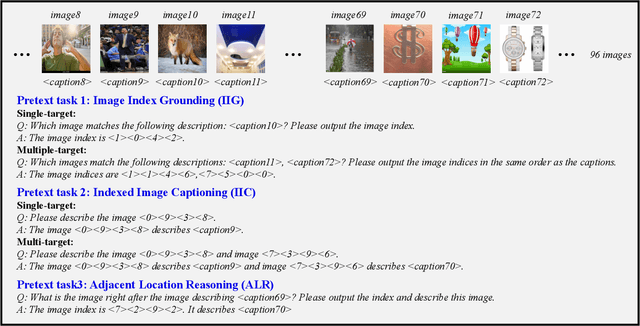
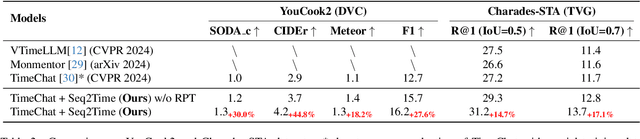
Temporal awareness is essential for video large language models (LLMs) to understand and reason about events within long videos, enabling applications like dense video captioning and temporal video grounding in a unified system. However, the scarcity of long videos with detailed captions and precise temporal annotations limits their temporal awareness. In this paper, we propose Seq2Time, a data-oriented training paradigm that leverages sequences of images and short video clips to enhance temporal awareness in long videos. By converting sequence positions into temporal annotations, we transform large-scale image and clip captioning datasets into sequences that mimic the temporal structure of long videos, enabling self-supervised training with abundant time-sensitive data. To enable sequence-to-time knowledge transfer, we introduce a novel time representation that unifies positional information across image sequences, clip sequences, and long videos. Experiments demonstrate the effectiveness of our method, achieving a 27.6% improvement in F1 score and 44.8% in CIDEr on the YouCook2 benchmark and a 14.7% increase in recall on the Charades-STA benchmark compared to the baseline.
Document Parsing Unveiled: Techniques, Challenges, and Prospects for Structured Information Extraction
Oct 29, 2024
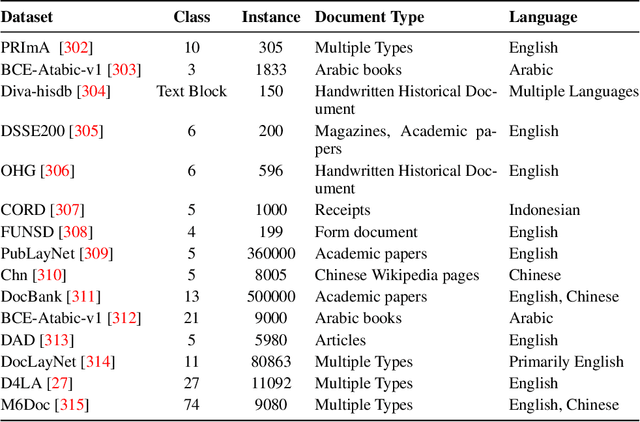

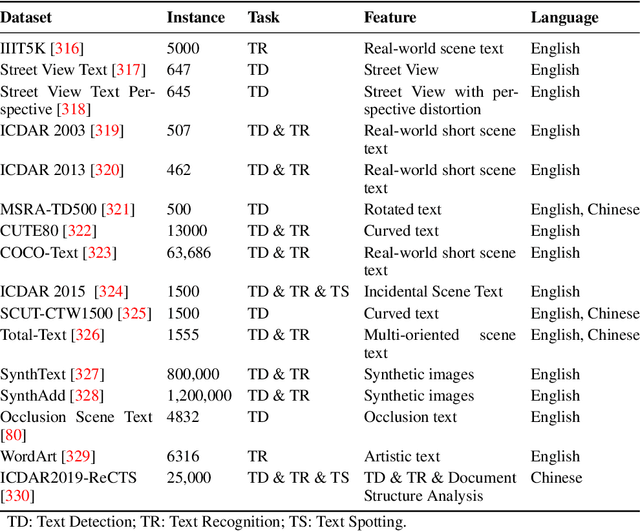
Document parsing is essential for converting unstructured and semi-structured documents-such as contracts, academic papers, and invoices-into structured, machine-readable data. Document parsing extract reliable structured data from unstructured inputs, providing huge convenience for numerous applications. Especially with recent achievements in Large Language Models, document parsing plays an indispensable role in both knowledge base construction and training data generation. This survey presents a comprehensive review of the current state of document parsing, covering key methodologies, from modular pipeline systems to end-to-end models driven by large vision-language models. Core components such as layout detection, content extraction (including text, tables, and mathematical expressions), and multi-modal data integration are examined in detail. Additionally, this paper discusses the challenges faced by modular document parsing systems and vision-language models in handling complex layouts, integrating multiple modules, and recognizing high-density text. It emphasizes the importance of developing larger and more diverse datasets and outlines future research directions.
HoPE: A Novel Positional Encoding Without Long-Term Decay for Enhanced Context Awareness and Extrapolation
Oct 28, 2024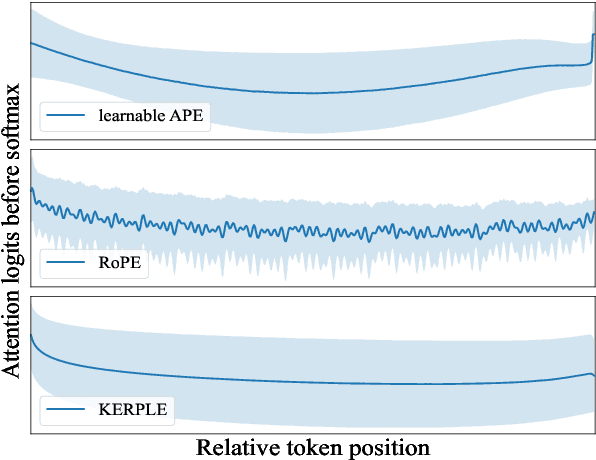

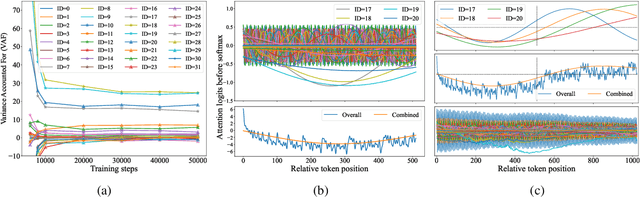

Many positional encodings (PEs) are designed to exhibit long-term decay, based on an entrenched and long-standing inductive opinion: tokens farther away from the current position carry less relevant information. We argue that long-term decay is outdated in the era of LLMs, as LLMs are now applied to tasks demanding precise retrieval of in-context information from arbitrary positions. Firstly, we present empirical analyses on various PEs, demonstrating that models inherently learn attention with only a local-decay pattern while forming a U-shape pattern globally, contradicting the principle of long-term decay. Furthermore, we conduct a detailed analysis of rotary position encoding (RoPE, a prevalent relative positional encoding in LLMs), and found that the U-shape attention is caused by some learned components, which are also the key factor limiting RoPE's expressiveness and extrapolation.Inspired by these insights, we propose High-frequency rotary Position Encoding (HoPE). HoPE replaces the specific components in RoPE with position-independent ones, retaining only high-frequency signals, which also breaks the principle of long-term decay in theory. HoPE achieves two major advantages: (1) Without constraints imposed by long-term decay, contradictory factors that limit spontaneous attention optimization and model extrapolation performance are removed. (2) Components representing positions and semantics are are optimized. These enhances model's context awareness and extrapolation, as validated by extensive experiments.
DiP-GO: A Diffusion Pruner via Few-step Gradient Optimization
Oct 22, 2024
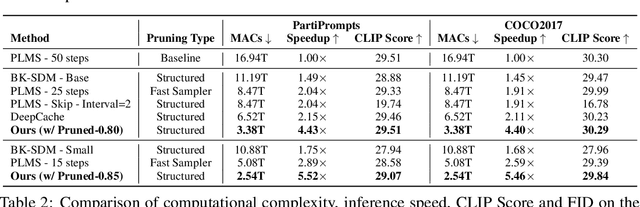

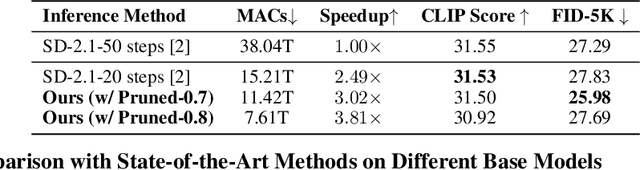
Diffusion models have achieved remarkable progress in the field of image generation due to their outstanding capabilities. However, these models require substantial computing resources because of the multi-step denoising process during inference. While traditional pruning methods have been employed to optimize these models, the retraining process necessitates large-scale training datasets and extensive computational costs to maintain generalization ability, making it neither convenient nor efficient. Recent studies attempt to utilize the similarity of features across adjacent denoising stages to reduce computational costs through simple and static strategies. However, these strategies cannot fully harness the potential of the similar feature patterns across adjacent timesteps. In this work, we propose a novel pruning method that derives an efficient diffusion model via a more intelligent and differentiable pruner. At the core of our approach is casting the model pruning process into a SubNet search process. Specifically, we first introduce a SuperNet based on standard diffusion via adding some backup connections built upon the similar features. We then construct a plugin pruner network and design optimization losses to identify redundant computation. Finally, our method can identify an optimal SubNet through few-step gradient optimization and a simple post-processing procedure. We conduct extensive experiments on various diffusion models including Stable Diffusion series and DiTs. Our DiP-GO approach achieves 4.4 x speedup for SD-1.5 without any loss of accuracy, significantly outperforming the previous state-of-the-art methods.
SiamSeg: Self-Training with Contrastive Learning for Unsupervised Domain Adaptation in Remote Sensing
Oct 17, 2024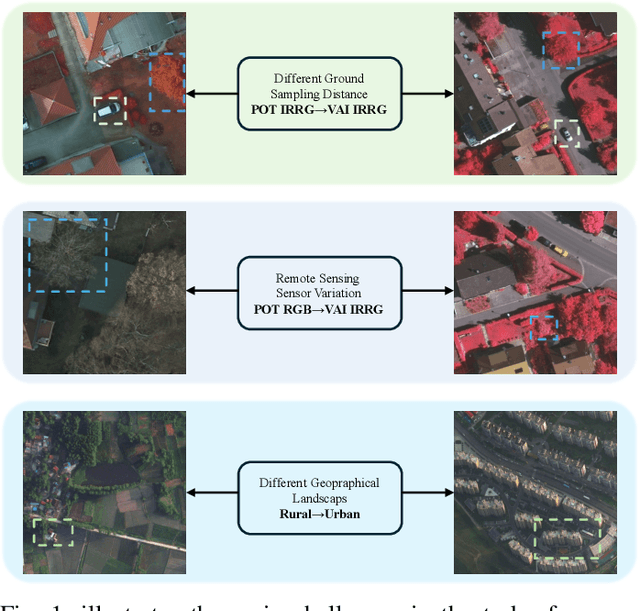
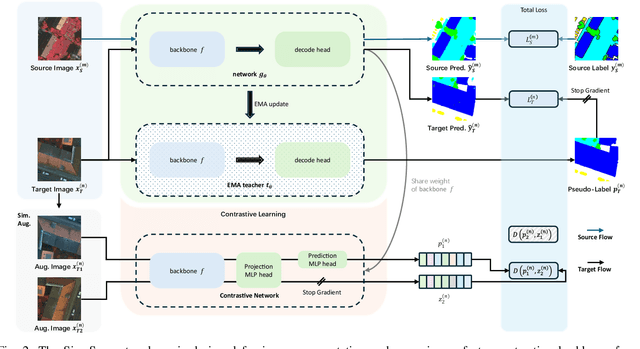
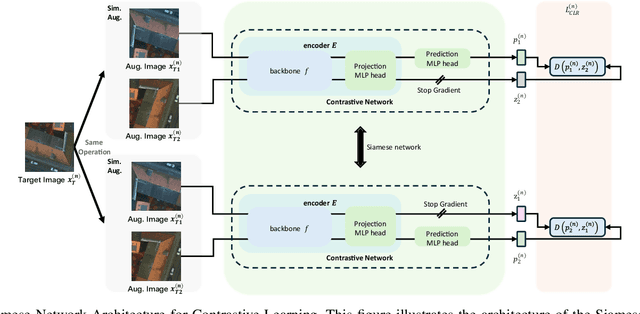
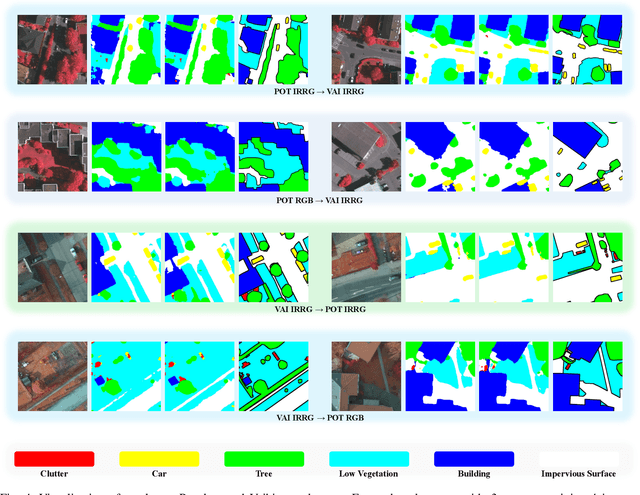
Semantic segmentation of remote sensing (RS) images is a challenging task with significant potential across various applications. Deep learning, especially supervised learning with large-scale labeled datasets, has greatly advanced this field. However, acquiring high-quality labeled data is expensive and time-consuming. Moreover, variations in ground sampling distance (GSD), imaging equipment, and geographic diversity contribute to domain shifts between datasets, which pose significant challenges to models trained solely on source domain data, leading to poor cross-domain performance. Domain shift is well-known for undermining a model's generalization ability in the target domain. To address this, unsupervised domain adaptation (UDA) has emerged as a promising solution, enabling models to learn from unlabeled target domain data while training on labeled source domain data. Recent advancements, particularly in self-supervised learning via pseudo-label generation, have shown potential in mitigating domain discrepancies. Strategies combining source and target domain images with their true and pseudo labels for self-supervised training have been effective in addressing domain bias. Despite progress in computer vision, the application of pseudo-labeling methods to RS image segmentation remains underexplored.
Order-aware Interactive Segmentation
Oct 17, 2024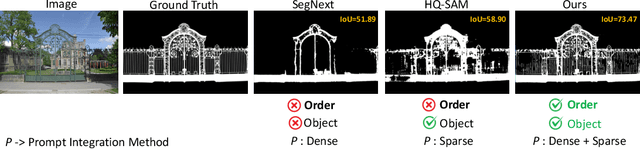
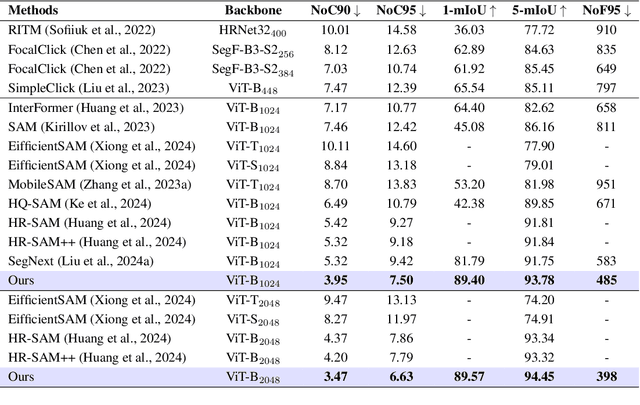
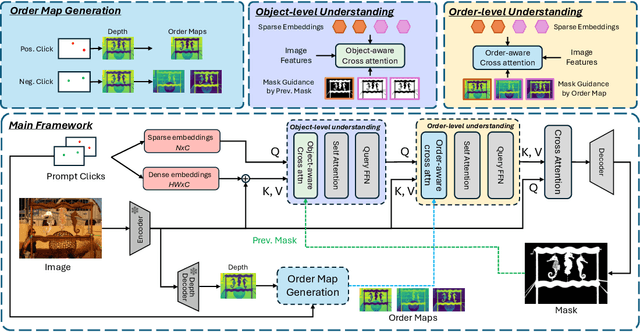

Interactive segmentation aims to accurately segment target objects with minimal user interactions. However, current methods often fail to accurately separate target objects from the background, due to a limited understanding of order, the relative depth between objects in a scene. To address this issue, we propose OIS: order-aware interactive segmentation, where we explicitly encode the relative depth between objects into order maps. We introduce a novel order-aware attention, where the order maps seamlessly guide the user interactions (in the form of clicks) to attend to the image features. We further present an object-aware attention module to incorporate a strong object-level understanding to better differentiate objects with similar order. Our approach allows both dense and sparse integration of user clicks, enhancing both accuracy and efficiency as compared to prior works. Experimental results demonstrate that OIS achieves state-of-the-art performance, improving mIoU after one click by 7.61 on the HQSeg44K dataset and 1.32 on the DAVIS dataset as compared to the previous state-of-the-art SegNext, while also doubling inference speed compared to current leading methods. The project page is https://ukaukaaaa.github.io/projects/OIS/index.html