 Add to Chrome
 Add to Firefox
 Add to Edge
PEAK: Precise and Persistent Concept Erasure via k-Sparse Autoencoders
Aug 11, 2026
Erasing concepts from large-scale text-to-image (T2I) diffusion models has become increasingly crucial due to the growing concerns over copyright infringement, privacy violations, and offensive content. Existing approaches struggle to achieve both precise and persistent concept erasure: inaccurate localization of concept-related representations may cause unintended semantic interference, while incomplete removal of the underlying concept knowledge allows adversarial recovery. To address this dilemma, we propose PEAK, a \textbf{\textit{precise}} and \textbf{\textit{persistent}} concept erasure framework via k-Sparse Autoencoders (kSAEs). PEAK first trains a kSAE on internal activations of the diffusion denoising network to decompose dense representations into interpretable sparse features. By contrasting sparse activations induced by target and non-target prompts, PEAK identifies a compact set of target-specific features according to both activation strength and frequency. These localized features are then used for parameter optimization, where PEAK selectively suppresses target-related activations while preserving complementary non-target ones towards the original model. This feature-guided optimization embeds concept erasure directly into diffusion parameters, eliminating the need for additional inference-time intervention and facilitating effective persistence against adversarial attacks. Extensive experiments demonstrate that PEAK achieves effective and robust concept erasure. On the I2P benchmark, PEAK reduces NudeNet detections from 582 to 6, lowers the average attack success rate (ASR) from 96.52\% to 5.63\%, and preserves general generation quality on MS-COCO with a near-zero KID. Our code and models are available at: https://github.com/manmanTAT/PEAK

OmniDocBench: Benchmarking Diverse PDF Document Parsing with Comprehensive Annotations
Dec 10, 2024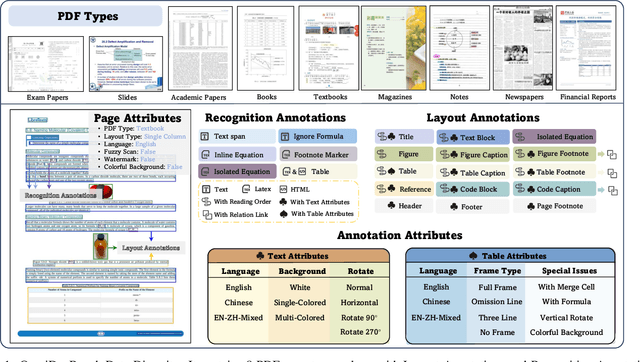

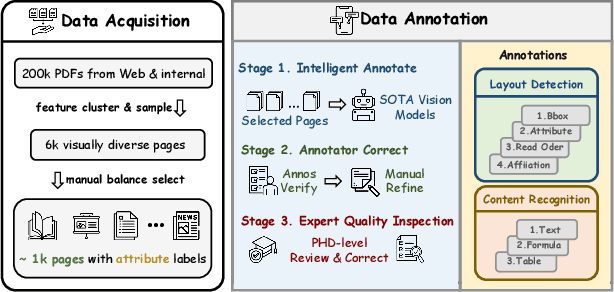
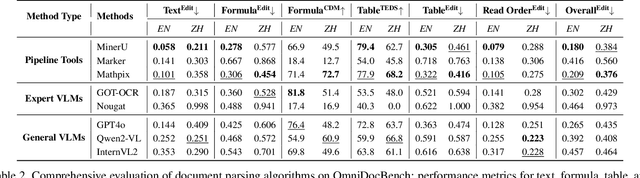
Document content extraction is crucial in computer vision, especially for meeting the high-quality data needs of large language models (LLMs) and retrieval-augmented generation (RAG) technologies. However, current document parsing methods suffer from significant limitations in terms of diversity and comprehensive evaluation. To address these challenges, we introduce OmniDocBench, a novel multi-source benchmark designed to advance automated document content extraction. OmniDocBench includes a meticulously curated and annotated high-quality evaluation dataset comprising nine diverse document types, such as academic papers, textbooks, slides, among others. Our benchmark provides a flexible and comprehensive evaluation framework with 19 layout category labels and 14 attribute labels, enabling multi-level assessments across entire datasets, individual modules, or specific data types. Using OmniDocBench, we perform an exhaustive comparative analysis of existing modular pipelines and multimodal end-to-end methods, highlighting their limitations in handling document diversity and ensuring fair evaluation. OmniDocBench establishes a robust, diverse, and fair evaluation standard for the document content extraction field, offering crucial insights for future advancements and fostering the development of document parsing technologies. The codes and dataset is available in https://github.com/opendatalab/OmniDocBench.