 Add to Chrome
 Add to Firefox
 Add to Edge
XClipGS: Exact Half-Space Clipping for Medical Volume Gaussian Splatting
Aug 07, 2026
Gaussian-splatting proxies enable interactive rendering of volumetric medical scans, but a clipping plane exposes anatomy not constrained by external-view training and intersects primitives that conventional splatting can only keep or drop whole. We present XClipGS (eXact Clipping), which treats these as two separate problems: the render-time clip operator and supervision of the hidden interior. Under the local affine model used by EWA splatting, the ray integral of a half-space-restricted Gaussian factorizes exactly into its ordinary 2D footprint and a conditional Gaussian CDF whose argument is affine in pixel coordinates. The resulting closed-form per-pixel operator introduces no learned clipping parameters or auxiliary network and remains differentiable with respect to the primitive and plane. We use multi-distance reference views with varied clipping-plane axes and offsets to supervise the interior through the same operator. We also introduce a paired clipped/unclipped cut-face protocol with difference-referenced cut error (CDE) and culled-side leakage (Leak), because global image metrics dilute errors near the plane. On eight CT and MRI volumes with plane offsets not used for training, XClipGS attains the highest PSNR on every volume (33.56 versus 32.34 dB for ClipGS) while rendering at over 650 FPS, far above real time, versus 278 FPS. On voxel-axis cut-face views, it raises average band SSIM from 0.809 to 0.860 and leaks roughly 40 times less. Without retraining, it also achieves the best average across all four metrics on arbitrary-normal planes; on a fixed interior, it matches RaRa's face fidelity with about 16 times less leakage. Project page: https://gaozhongpai.github.io/XClipGS/

Point Tracking in Surgery--The 2025 Surgical Tattoos in Infrared Challenge (STIRC2025)
Jul 14, 2026Point tracking in surgery is crucial to enable applications in downstream tasks such as segmentation, 3D reconstruction, virtual tissue landmarking, autonomous probe-based scanning, and subtask autonomy. This paper introduces the 2025 iteration of a point tracking challenge to address this, wherein participants submit their algorithms for quantification. Their algorithms are evaluated using a dataset named surgical tattoos in infrared (STIR), with the challenge named the STIR Challenge 2025 (STIRC2025). The STIR Challenge 2025 comprises two quantitative components: accuracy and efficiency. The accuracy component tests the accuracy of algorithms on in vivo and ex vivo sequences. The efficiency component tests algorithm inference latency. The challenge was conducted as a part of MICCAI EndoVis 2025, and seven teams participated in this challenge. In this paper we summarize the challenge results and participant methods. The challenge dataset is available at: https://zenodo.org/records/20191078, and the code for baseline models and metrics calculation is available here: https://github.com/athaddius/STIRMetrics
S$^3$POT: Contrast-Driven Face Occlusion Segmentation via Self-Supervised Prompt Learning
Jan 31, 2026Existing face parsing methods usually misclassify occlusions as facial components. This is because occlusion is a high-level concept, it does not refer to a concrete category of object. Thus, constructing a real-world face dataset covering all categories of occlusion object is almost impossible and accurate mask annotation is labor-intensive. To deal with the problems, we present S$^3$POT, a contrast-driven framework synergizing face generation with self-supervised spatial prompting, to achieve occlusion segmentation. The framework is inspired by the insights: 1) Modern face generators' ability to realistically reconstruct occluded regions, creating an image that preserve facial geometry while eliminating occlusion, and 2) Foundation segmentation models' (e.g., SAM) capacity to extract precise mask when provided with appropriate prompts. In particular, S$^3$POT consists of three modules: Reference Generation (RF), Feature enhancement (FE), and Prompt Selection (PS). First, a reference image is produced by RF using structural guidance from parsed mask. Second, FE performs contrast of tokens between raw and reference images to obtain an initial prompt, then modifies image features with the prompt by cross-attention. Third, based on the enhanced features, PS constructs a set of positive and negative prompts and screens them with a self-attention network for a mask decoder. The network is learned under the guidance of three novel and complementary objective functions without occlusion ground truth mask involved. Extensive experiments on a dedicatedly collected dataset demonstrate S$^3$POT's superior performance and the effectiveness of each module.
In defense of the two-stage framework for open-set domain adaptive semantic segmentation
Jan 04, 2026Open-Set Domain Adaptation for Semantic Segmentation (OSDA-SS) presents a significant challenge, as it requires both domain adaptation for known classes and the distinction of unknowns. Existing methods attempt to address both tasks within a single unified stage. We question this design, as the annotation imbalance between known and unknown classes often leads to negative transfer of known classes and underfitting for unknowns. To overcome these issues, we propose SATS, a Separating-then-Adapting Training Strategy, which addresses OSDA-SS through two sequential steps: known/unknown separation and unknown-aware domain adaptation. By providing the model with more accurate and well-aligned unknown classes, our method ensures a balanced learning of discriminative features for both known and unknown classes, steering the model toward discovering truly unknown objects. Additionally, we present hard unknown exploration, an innovative data augmentation method that exposes the model to more challenging unknowns, strengthening its ability to capture more comprehensive understanding of target unknowns. We evaluate our method on public OSDA-SS benchmarks. Experimental results demonstrate that our method achieves a substantial advancement, with a +3.85% H-Score improvement for GTA5-to-Cityscapes and +18.64% for SYNTHIA-to-Cityscapes, outperforming previous state-of-the-art methods.
Consistent Instance Field for Dynamic Scene Understanding
Dec 16, 2025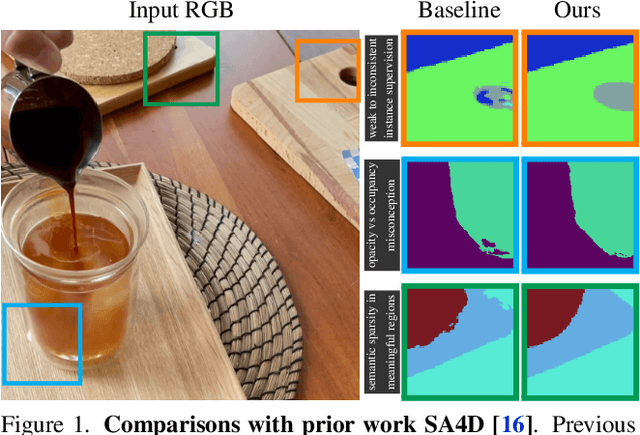
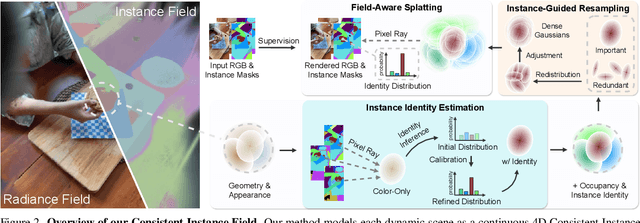
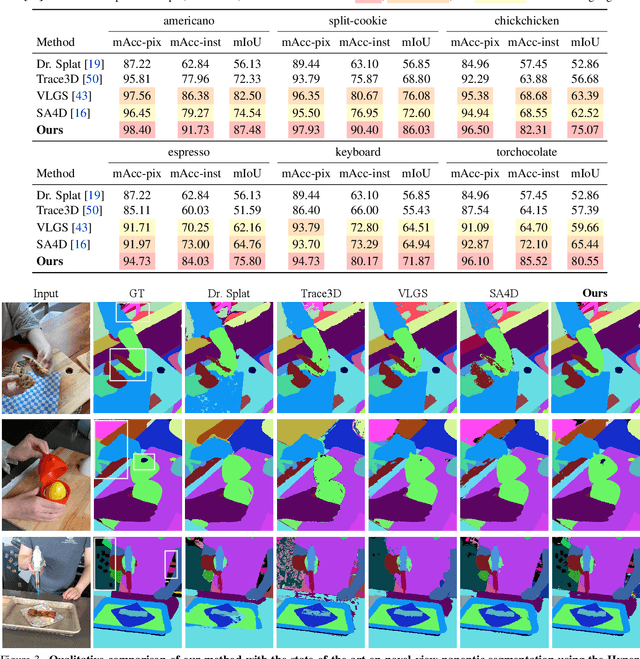
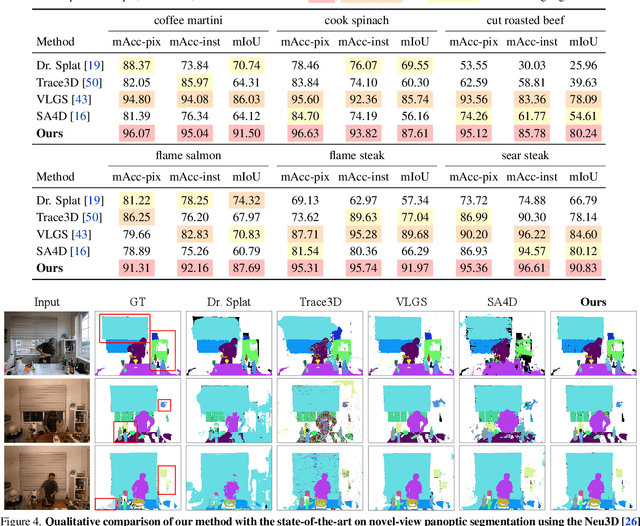
We introduce Consistent Instance Field, a continuous and probabilistic spatio-temporal representation for dynamic scene understanding. Unlike prior methods that rely on discrete tracking or view-dependent features, our approach disentangles visibility from persistent object identity by modeling each space-time point with an occupancy probability and a conditional instance distribution. To realize this, we introduce a novel instance-embedded representation based on deformable 3D Gaussians, which jointly encode radiance and semantic information and are learned directly from input RGB images and instance masks through differentiable rasterization. Furthermore, we introduce new mechanisms to calibrate per-Gaussian identities and resample Gaussians toward semantically active regions, ensuring consistent instance representations across space and time. Experiments on HyperNeRF and Neu3D datasets demonstrate that our method significantly outperforms state-of-the-art methods on novel-view panoptic segmentation and open-vocabulary 4D querying tasks.
From Particles to Fields: Reframing Photon Mapping with Continuous Gaussian Photon Fields
Dec 13, 2025Accurately modeling light transport is essential for realistic image synthesis. Photon mapping provides physically grounded estimates of complex global illumination effects such as caustics and specular-diffuse interactions, yet its per-view radiance estimation remains computationally inefficient when rendering multiple views of the same scene. The inefficiency arises from independent photon tracing and stochastic kernel estimation at each viewpoint, leading to inevitable redundant computation. To accelerate multi-view rendering, we reformulate photon mapping as a continuous and reusable radiance function. Specifically, we introduce the Gaussian Photon Field (GPF), a learnable representation that encodes photon distributions as anisotropic 3D Gaussian primitives parameterized by position, rotation, scale, and spectrum. GPF is initialized from physically traced photons in the first SPPM iteration and optimized using multi-view supervision of final radiance, distilling photon-based light transport into a continuous field. Once trained, the field enables differentiable radiance evaluation along camera rays without repeated photon tracing or iterative refinement. Extensive experiments on scenes with complex light transport, such as caustics and specular-diffuse interactions, demonstrate that GPF attains photon-level accuracy while reducing computation by orders of magnitude, unifying the physical rigor of photon-based rendering with the efficiency of neural scene representations.
Render-FM: A Foundation Model for Real-time Photorealistic Volumetric Rendering
May 22, 2025Volumetric rendering of Computed Tomography (CT) scans is crucial for visualizing complex 3D anatomical structures in medical imaging. Current high-fidelity approaches, especially neural rendering techniques, require time-consuming per-scene optimization, limiting clinical applicability due to computational demands and poor generalizability. We propose Render-FM, a novel foundation model for direct, real-time volumetric rendering of CT scans. Render-FM employs an encoder-decoder architecture that directly regresses 6D Gaussian Splatting (6DGS) parameters from CT volumes, eliminating per-scan optimization through large-scale pre-training on diverse medical data. By integrating robust feature extraction with the expressive power of 6DGS, our approach efficiently generates high-quality, real-time interactive 3D visualizations across diverse clinical CT data. Experiments demonstrate that Render-FM achieves visual fidelity comparable or superior to specialized per-scan methods while drastically reducing preparation time from nearly an hour to seconds for a single inference step. This advancement enables seamless integration into real-time surgical planning and diagnostic workflows. The project page is: https://gaozhongpai.github.io/renderfm/.
PolypSegTrack: Unified Foundation Model for Colonoscopy Video Analysis
Mar 31, 2025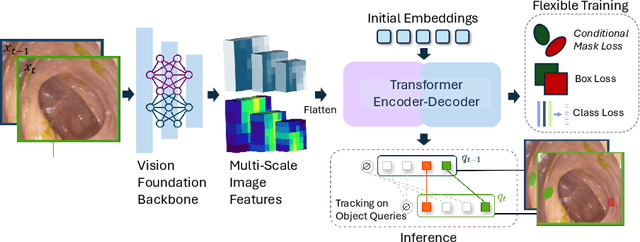
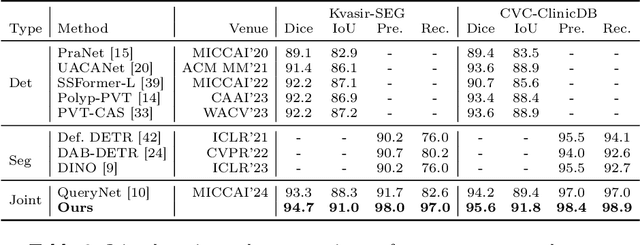
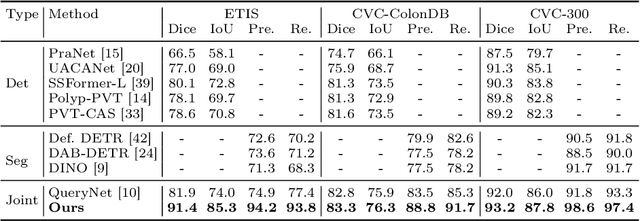
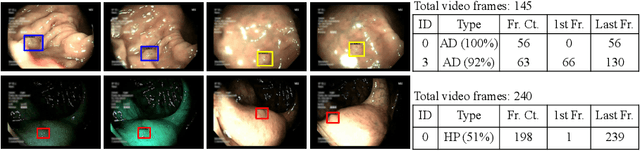
Early detection, accurate segmentation, classification and tracking of polyps during colonoscopy are critical for preventing colorectal cancer. Many existing deep-learning-based methods for analyzing colonoscopic videos either require task-specific fine-tuning, lack tracking capabilities, or rely on domain-specific pre-training. In this paper, we introduce \textit{PolypSegTrack}, a novel foundation model that jointly addresses polyp detection, segmentation, classification and unsupervised tracking in colonoscopic videos. Our approach leverages a novel conditional mask loss, enabling flexible training across datasets with either pixel-level segmentation masks or bounding box annotations, allowing us to bypass task-specific fine-tuning. Our unsupervised tracking module reliably associates polyp instances across frames using object queries, without relying on any heuristics. We leverage a robust vision foundation model backbone that is pre-trained unsupervisedly on natural images, thereby removing the need for domain-specific pre-training. Extensive experiments on multiple polyp benchmarks demonstrate that our method significantly outperforms existing state-of-the-art approaches in detection, segmentation, classification, and tracking.
CHROME: Clothed Human Reconstruction with Occlusion-Resilience and Multiview-Consistency from a Single Image
Mar 19, 2025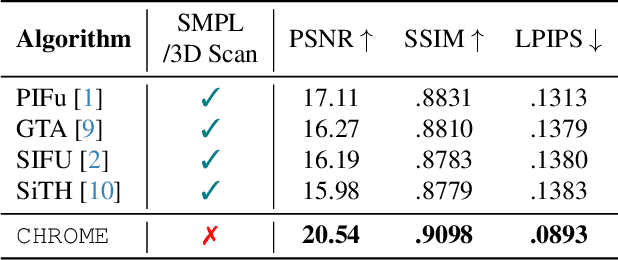
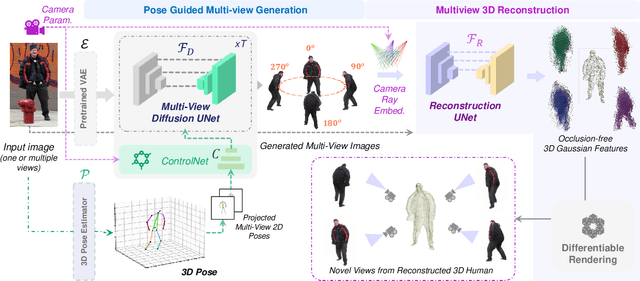
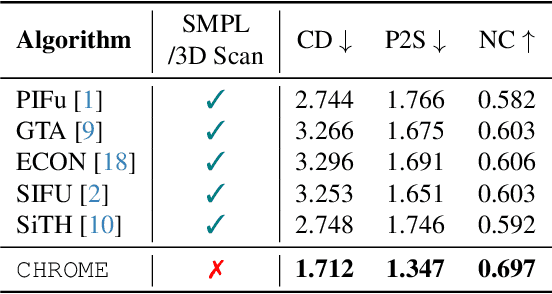
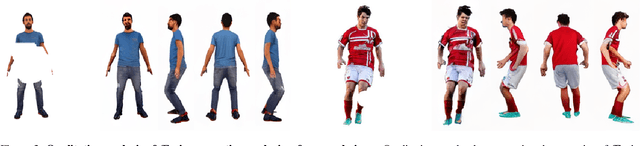
Reconstructing clothed humans from a single image is a fundamental task in computer vision with wide-ranging applications. Although existing monocular clothed human reconstruction solutions have shown promising results, they often rely on the assumption that the human subject is in an occlusion-free environment. Thus, when encountering in-the-wild occluded images, these algorithms produce multiview inconsistent and fragmented reconstructions. Additionally, most algorithms for monocular 3D human reconstruction leverage geometric priors such as SMPL annotations for training and inference, which are extremely challenging to acquire in real-world applications. To address these limitations, we propose CHROME: Clothed Human Reconstruction with Occlusion-Resilience and Multiview-ConsistEncy from a Single Image, a novel pipeline designed to reconstruct occlusion-resilient 3D humans with multiview consistency from a single occluded image, without requiring either ground-truth geometric prior annotations or 3D supervision. Specifically, CHROME leverages a multiview diffusion model to first synthesize occlusion-free human images from the occluded input, compatible with off-the-shelf pose control to explicitly enforce cross-view consistency during synthesis. A 3D reconstruction model is then trained to predict a set of 3D Gaussians conditioned on both the occluded input and synthesized views, aligning cross-view details to produce a cohesive and accurate 3D representation. CHROME achieves significant improvements in terms of both novel view synthesis (upto 3 db PSNR) and geometric reconstruction under challenging conditions.
7DGS: Unified Spatial-Temporal-Angular Gaussian Splatting
Mar 11, 2025Real-time rendering of dynamic scenes with view-dependent effects remains a fundamental challenge in computer graphics. While recent advances in Gaussian Splatting have shown promising results separately handling dynamic scenes (4DGS) and view-dependent effects (6DGS), no existing method unifies these capabilities while maintaining real-time performance. We present 7D Gaussian Splatting (7DGS), a unified framework representing scene elements as seven-dimensional Gaussians spanning position (3D), time (1D), and viewing direction (3D). Our key contribution is an efficient conditional slicing mechanism that transforms 7D Gaussians into view- and time-conditioned 3D Gaussians, maintaining compatibility with existing 3D Gaussian Splatting pipelines while enabling joint optimization. Experiments demonstrate that 7DGS outperforms prior methods by up to 7.36 dB in PSNR while achieving real-time rendering (401 FPS) on challenging dynamic scenes with complex view-dependent effects. The project page is: https://gaozhongpai.github.io/7dgs/.