 Add to Chrome
 Add to Firefox
 Add to Edge
OmniMapBench: Benchmarking Visual-Centric Reasoning on Diverse Map Documents
Jul 10, 2026
Recent advancements in LVLMs necessitate robust benchmarks for complex, visually grounded reasoning. A critical limitation is identified in many document understanding benchmarks: visual content is often reducible to text, enabling high performance without genuine visual grounding. To address this limitation, OmniMapBench is introduced to foster visual-centric reasoning for map documents. The benchmark comprises 2,096 manually annotated question-answer pairs across 1,603 map documents from nine categories. It is designed to probe a hierarchy of skills, ranging from perception to multi-step visual reasoning. To quantify benchmark properties, a simple yet effective benchmark-level metric is proposed: the Visual Dependency Index (VDI), defined as the accuracy drop when images are replaced with question-agnostic descriptions. OmniMapBench exhibits higher VDI than established benchmarks, which quantitatively validates its focus on irreducible visual reasoning. Comprehensive evaluations of 25 leading LVLMs are conducted on OmniMapBench. A significant performance gap is observed, with the top-performing model achieving only 75.03\% accuracy. This result underscores the challenges posed by OmniMapBench to current LVLMs. This work aims to catalyze progress in visual-centric reasoning for document understanding of LVLMs. The dataset and code are publicly available at https://github.com/SIGMME/OmniMapBench.

MindEdit-Bench: Benchmarking Object-Level Counterfactual Spatial Reasoning in VLMs from In-the-Wild Photos
Jul 01, 2026Benchmarks for vision-language models (VLMs) mostly test observational spatial reasoning: models describe relations already visible in the input. Existing what-if tasks typically vary the observer while keeping the scene fixed. Can VLMs instead predict the consequences of hypothetically moving or rotating an object? We introduce MindEdit-Bench, a benchmark of six spatial reasoning tasks built from three-photo smartphone triplets of newly captured indoor scenes via an automatic in-the-wild 3D scene-graph extraction pipeline. Four tasks probe perception and perspective transformation over observed structure; two new tasks, L4 (spatial editing) and L5 (cross-view visibility editing), probe object-level counterfactual reasoning, where correct answers are absent from all input images. Each question provides 8-24 structured answer choices, enabling answer-letter-level diagnosis of spatial and fallback errors. The benchmark covers 120 private indoor scenes not drawn from public datasets, reducing public-data pretraining-overlap risk. Across 15 VLMs on 1,003 human-verified questions, task-wise mean VLM accuracy is only 8%-31%, versus 81%-97% human majority-vote accuracy. The pooled human--best-VLM gap is 53 pp, with at least 39 pp on every task. The structured answer space further reveals non-uniform failures, including weaker camera-depth-axis inference and fallback behavior on difficult visibility-editing cases.
Dr. DocBench: A Comprehensive Benchmark for Expert-Level and Difficult Document Parsing
May 31, 2026Document parsing and recognition are fundamental capabilities for vision-language models (VLMs) and document processing systems. However, existing Optical Character Recognition (OCR) and document parsing benchmarks are increasingly limited in coverage and difficulty: many focus on common document genres or uniformly sampled pages where modern parsers already perform strongly, while offering limited annotation for expert-domain structures such as chemical formula, music notation, complex tables, and cross-page layouts. We introduce Dr. DocBench, a difficulty-aware benchmark for expert-level document parsing. Built from a large-scale multilingual book corpus, Dr. DocBench spans 52 BISAC subject domains and selects challenging documents through parser-failure-based sampling, targeting cases where multiple state-of-the-art systems struggle. It contains 4,514 annotated pages from long documents averaging around 100 pages, with 65k high-quality page- and block-level annotations for layout, reading order, hierarchical relations, and domain-specific visual contents. Evaluations of pipeline-based parsers and general-purpose VLMs show that strong performance on existing benchmarks does not transfer to our expert-level document parsing. Our analysis reveals substantial failures across subjects, content types, and structural attributes, highlighting Dr. DocBench as a comprehensive testbed for diagnosing and advancing document intelligence.
ChartNet: A Million-Scale, High-Quality Multimodal Dataset for Robust Chart Understanding
Mar 28, 2026Understanding charts requires models to jointly reason over geometric visual patterns, structured numerical data, and natural language -- a capability where current vision-language models (VLMs) remain limited. We introduce ChartNet, a high-quality, million-scale multimodal dataset designed to advance chart interpretation and reasoning. ChartNet leverages a novel code-guided synthesis pipeline to generate 1.5 million diverse chart samples spanning 24 chart types and 6 plotting libraries. Each sample consists of five aligned components: plotting code, rendered chart image, data table, natural language summary, and question-answering with reasoning, providing fine-grained cross-modal alignment. To capture the full spectrum of chart comprehension, ChartNet additionally includes specialized subsets encompassing human annotated data, real-world data, safety, and grounding. Moreover, a rigorous quality-filtering pipeline ensures visual fidelity, semantic accuracy, and diversity across chart representations. Fine-tuning on ChartNet consistently improves results across benchmarks, demonstrating its utility as large-scale supervision for multimodal models. As the largest open-source dataset of its kind, ChartNet aims to support the development of foundation models with robust and generalizable capabilities for data visualization understanding. The dataset is publicly available at https://huggingface.co/datasets/ibm-granite/ChartNet
Learning Only with Images: Visual Reinforcement Learning with Reasoning, Rendering, and Visual Feedback
Jul 28, 2025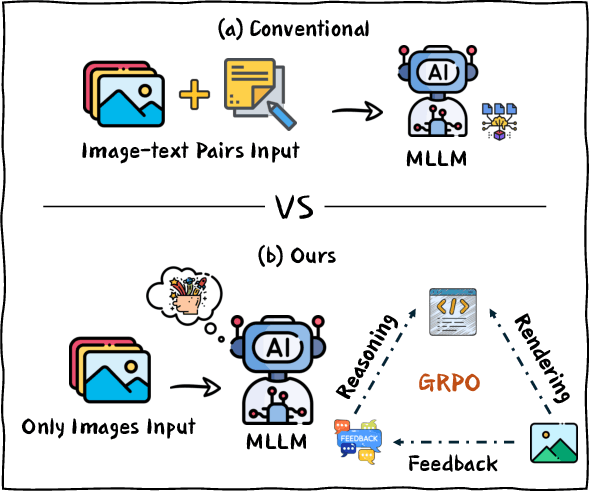
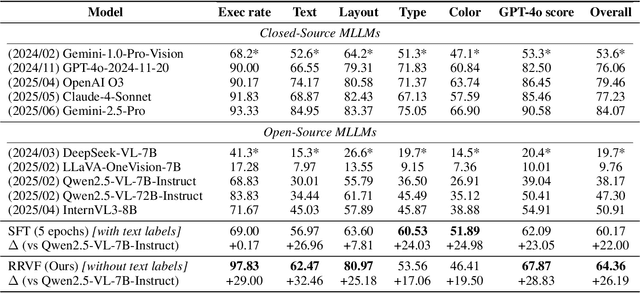
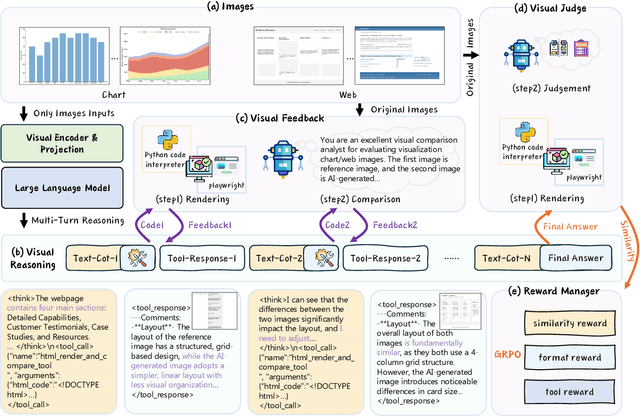
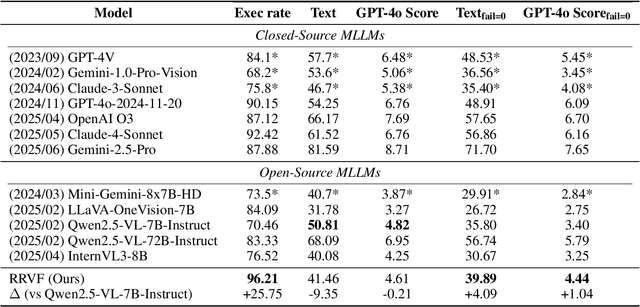
Multimodal Large Language Models (MLLMs) have exhibited impressive performance across various visual tasks. Subsequent investigations into enhancing their visual reasoning abilities have significantly expanded their performance envelope. However, a critical bottleneck in the advancement of MLLMs toward deep visual reasoning is their heavy reliance on curated image-text supervision. To solve this problem, we introduce a novel framework termed ``Reasoning-Rendering-Visual-Feedback'' (RRVF), which enables MLLMs to learn complex visual reasoning from only raw images. This framework builds on the ``Asymmetry of Verification'' principle to train MLLMs, i.e., verifying the rendered output against a source image is easier than generating it. We demonstrate that this relative ease provides an ideal reward signal for optimization via Reinforcement Learning (RL) training, reducing the reliance on the image-text supervision. Guided by the above principle, RRVF implements a closed-loop iterative process encompassing reasoning, rendering, and visual feedback components, enabling the model to perform self-correction through multi-turn interactions and tool invocation, while this pipeline can be optimized by the GRPO algorithm in an end-to-end manner. Extensive experiments on image-to-code generation for data charts and web interfaces show that RRVF substantially outperforms existing open-source MLLMs and surpasses supervised fine-tuning baselines. Our findings demonstrate that systems driven by purely visual feedback present a viable path toward more robust and generalizable reasoning models without requiring explicit supervision. Code will be available at https://github.com/L-O-I/RRVF.
What Matters in LLM-generated Data: Diversity and Its Effect on Model Fine-Tuning
Jun 24, 2025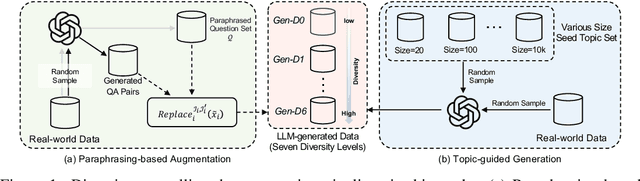

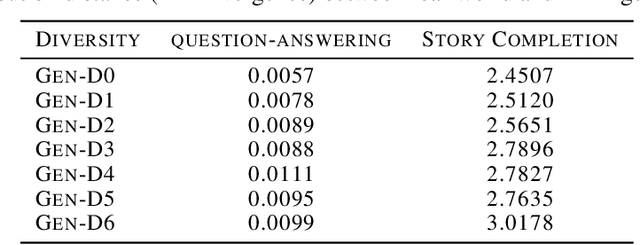
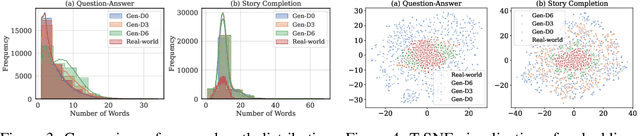
With the remarkable generative capabilities of large language models (LLMs), using LLM-generated data to train downstream models has emerged as a promising approach to mitigate data scarcity in specific domains and reduce time-consuming annotations. However, recent studies have highlighted a critical issue: iterative training on self-generated data results in model collapse, where model performance degrades over time. Despite extensive research on the implications of LLM-generated data, these works often neglect the importance of data diversity, a key factor in data quality. In this work, we aim to understand the implications of the diversity of LLM-generated data on downstream model performance. Specifically, we explore how varying levels of diversity in LLM-generated data affect downstream model performance. Additionally, we investigate the performance of models trained on data that mixes different proportions of LLM-generated data, which we refer to as synthetic data. Our experimental results show that, with minimal distribution shift, moderately diverse LLM-generated data can enhance model performance in scenarios with insufficient labeled data, whereas highly diverse generated data has a negative impact. We hope our empirical findings will offer valuable guidance for future studies on LLMs as data generators.
Objaverse++: Curated 3D Object Dataset with Quality Annotations
Apr 09, 2025This paper presents Objaverse++, a curated subset of Objaverse enhanced with detailed attribute annotations by human experts. Recent advances in 3D content generation have been driven by large-scale datasets such as Objaverse, which contains over 800,000 3D objects collected from the Internet. Although Objaverse represents the largest available 3D asset collection, its utility is limited by the predominance of low-quality models. To address this limitation, we manually annotate 10,000 3D objects with detailed attributes, including aesthetic quality scores, texture color classifications, multi-object composition flags, transparency characteristics, etc. Then, we trained a neural network capable of annotating the tags for the rest of the Objaverse dataset. Through experiments and a user study on generation results, we demonstrate that models pre-trained on our quality-focused subset achieve better performance than those trained on the larger dataset of Objaverse in image-to-3D generation tasks. In addition, by comparing multiple subsets of training data filtered by our tags, our results show that the higher the data quality, the faster the training loss converges. These findings suggest that careful curation and rich annotation can compensate for the raw dataset size, potentially offering a more efficient path to develop 3D generative models. We release our enhanced dataset of approximately 500,000 curated 3D models to facilitate further research on various downstream tasks in 3D computer vision. In the near future, we aim to extend our annotations to cover the entire Objaverse dataset.
COIG-P: A High-Quality and Large-Scale Chinese Preference Dataset for Alignment with Human Values
Apr 07, 2025Aligning large language models (LLMs) with human preferences has achieved remarkable success. However, existing Chinese preference datasets are limited by small scale, narrow domain coverage, and lack of rigorous data validation. Additionally, the reliance on human annotators for instruction and response labeling significantly constrains the scalability of human preference datasets. To address these challenges, we design an LLM-based Chinese preference dataset annotation pipeline with no human intervention. Specifically, we crawled and carefully filtered 92k high-quality Chinese queries and employed 15 mainstream LLMs to generate and score chosen-rejected response pairs. Based on it, we introduce COIG-P (Chinese Open Instruction Generalist - Preference), a high-quality, large-scale Chinese preference dataset, comprises 1,009k Chinese preference pairs spanning 6 diverse domains: Chat, Code, Math, Logic, Novel, and Role. Building upon COIG-P, to reduce the overhead of using LLMs for scoring, we trained a 8B-sized Chinese Reward Model (CRM) and meticulously constructed a Chinese Reward Benchmark (CRBench). Evaluation results based on AlignBench \citep{liu2024alignbenchbenchmarkingchinesealignment} show that that COIG-P significantly outperforms other Chinese preference datasets, and it brings significant performance improvements ranging from 2% to 12% for the Qwen2/2.5 and Infinity-Instruct-3M-0625 model series, respectively. The results on CRBench demonstrate that our CRM has a strong and robust scoring ability. We apply it to filter chosen-rejected response pairs in a test split of COIG-P, and our experiments show that it is comparable to GPT-4o in identifying low-quality samples while maintaining efficiency and cost-effectiveness. Our codes and data are released in https://github.com/multimodal-art-projection/COIG-P.
SuperGPQA: Scaling LLM Evaluation across 285 Graduate Disciplines
Feb 20, 2025Large language models (LLMs) have demonstrated remarkable proficiency in mainstream academic disciplines such as mathematics, physics, and computer science. However, human knowledge encompasses over 200 specialized disciplines, far exceeding the scope of existing benchmarks. The capabilities of LLMs in many of these specialized fields-particularly in light industry, agriculture, and service-oriented disciplines-remain inadequately evaluated. To address this gap, we present SuperGPQA, a comprehensive benchmark that evaluates graduate-level knowledge and reasoning capabilities across 285 disciplines. Our benchmark employs a novel Human-LLM collaborative filtering mechanism to eliminate trivial or ambiguous questions through iterative refinement based on both LLM responses and expert feedback. Our experimental results reveal significant room for improvement in the performance of current state-of-the-art LLMs across diverse knowledge domains (e.g., the reasoning-focused model DeepSeek-R1 achieved the highest accuracy of 61.82% on SuperGPQA), highlighting the considerable gap between current model capabilities and artificial general intelligence. Additionally, we present comprehensive insights from our management of a large-scale annotation process, involving over 80 expert annotators and an interactive Human-LLM collaborative system, offering valuable methodological guidance for future research initiatives of comparable scope.
Sailor2: Sailing in South-East Asia with Inclusive Multilingual LLMs
Feb 18, 2025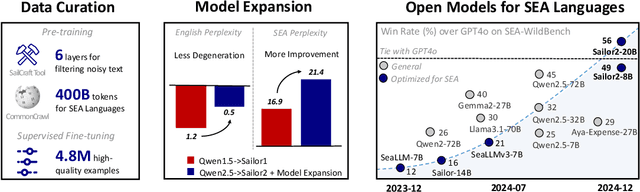
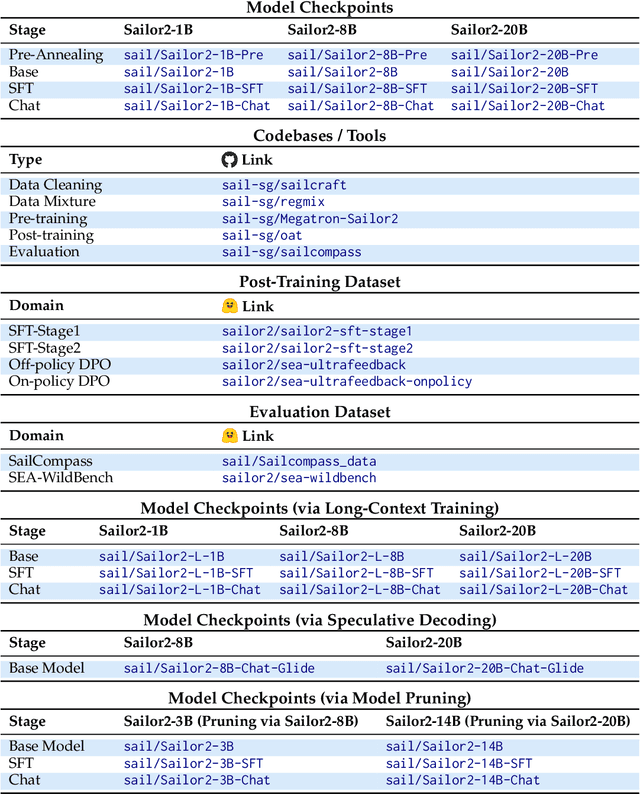
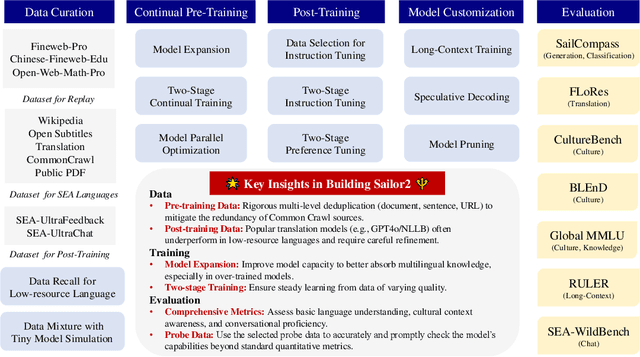
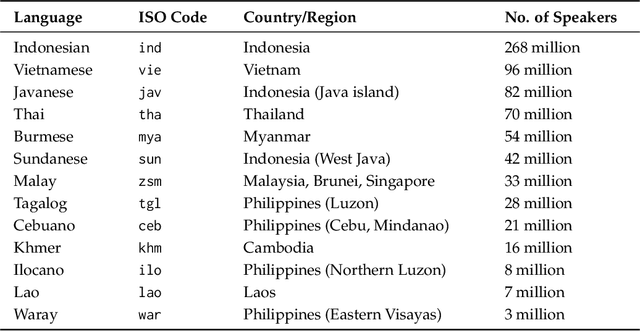
Sailor2 is a family of cutting-edge multilingual language models for South-East Asian (SEA) languages, available in 1B, 8B, and 20B sizes to suit diverse applications. Building on Qwen2.5, Sailor2 undergoes continuous pre-training on 500B tokens (400B SEA-specific and 100B replay tokens) to support 13 SEA languages while retaining proficiency in Chinese and English. Sailor2-20B model achieves a 50-50 win rate against GPT-4o across SEA languages. We also deliver a comprehensive cookbook on how to develop the multilingual model in an efficient manner, including five key aspects: data curation, pre-training, post-training, model customization and evaluation. We hope that Sailor2 model (Apache 2.0 license) will drive language development in the SEA region, and Sailor2 cookbook will inspire researchers to build more inclusive LLMs for other under-served languages.