 Add to Chrome
 Add to Firefox
 Add to Edge
Weakly Supervised Action Localization
Papers and Code
Exploring the Temporal Consistency for Point-Level Weakly-Supervised Temporal Action Localization
Feb 05, 2026
Point-supervised Temporal Action Localization (PTAL) adopts a lightly frame-annotated paradigm (\textit{i.e.}, labeling only a single frame per action instance) to train a model to effectively locate action instances within untrimmed videos. Most existing approaches design the task head of models with only a point-supervised snippet-level classification, without explicit modeling of understanding temporal relationships among frames of an action. However, understanding the temporal relationships of frames is crucial because it can help a model understand how an action is defined and therefore benefits localizing the full frames of an action. To this end, in this paper, we design a multi-task learning framework that fully utilizes point supervision to boost the model's temporal understanding capability for action localization. Specifically, we design three self-supervised temporal understanding tasks: (i) Action Completion, (ii) Action Order Understanding, and (iii) Action Regularity Understanding. These tasks help a model understand the temporal consistency of actions across videos. To the best of our knowledge, this is the first attempt to explicitly explore temporal consistency for point supervision action localization. Extensive experimental results on four benchmark datasets demonstrate the effectiveness of the proposed method compared to several state-of-the-art approaches.

WS-IMUBench: Can Weakly Supervised Methods from Audio, Image, and Video Be Adapted for IMU-based Temporal Action Localization?
Feb 02, 2026IMU-based Human Activity Recognition (HAR) has enabled a wide range of ubiquitous computing applications, yet its dominant clip classification paradigm cannot capture the rich temporal structure of real-world behaviors. This motivates a shift toward IMU Temporal Action Localization (IMU-TAL), which predicts both action categories and their start/end times in continuous streams. However, current progress is strongly bottlenecked by the need for dense, frame-level boundary annotations, which are costly and difficult to scale. To address this bottleneck, we introduce WS-IMUBench, a systematic benchmark study of weakly supervised IMU-TAL (WS-IMU-TAL) under only sequence-level labels. Rather than proposing a new localization algorithm, we evaluate how well established weakly supervised localization paradigms from audio, image, and video transfer to IMU-TAL under only sequence-level labels. We benchmark seven representative weakly supervised methods on seven public IMU datasets, resulting in over 3,540 model training runs and 7,080 inference evaluations. Guided by three research questions on transferability, effectiveness, and insights, our findings show that (i) transfer is modality-dependent, with temporal-domain methods generally more stable than image-derived proposal-based approaches; (ii) weak supervision can be competitive on favorable datasets (e.g., with longer actions and higher-dimensional sensing); and (iii) dominant failure modes arise from short actions, temporal ambiguity, and proposal quality. Finally, we outline concrete directions for advancing WS-IMU-TAL (e.g., IMU-specific proposal generation, boundary-aware objectives, and stronger temporal reasoning). Beyond individual results, WS-IMUBench establishes a reproducible benchmarking template, datasets, protocols, and analyses, to accelerate community-wide progress toward scalable WS-IMU-TAL.
Live or Lie: Action-Aware Capsule Multiple Instance Learning for Risk Assessment in Live Streaming Platforms
Feb 03, 2026Live streaming has become a cornerstone of today's internet, enabling massive real-time social interactions. However, it faces severe risks arising from sparse, coordinated malicious behaviors among multiple participants, which are often concealed within normal activities and challenging to detect timely and accurately. In this work, we provide a pioneering study on risk assessment in live streaming rooms, characterized by weak supervision where only room-level labels are available. We formulate the task as a Multiple Instance Learning (MIL) problem, treating each room as a bag and defining structured user-timeslot capsules as instances. These capsules represent subsequences of user actions within specific time windows, encapsulating localized behavioral patterns. Based on this formulation, we propose AC-MIL, an Action-aware Capsule MIL framework that models both individual behaviors and group-level coordination patterns. AC-MIL captures multi-granular semantics and behavioral cues through a serial and parallel architecture that jointly encodes temporal dynamics and cross-user dependencies. These signals are integrated for robust room-level risk prediction, while also offering interpretable evidence at the behavior segment level. Extensive experiments on large-scale industrial datasets from Douyin demonstrate that AC-MIL significantly outperforms MIL and sequential baselines, establishing new state-of-the-art performance in room-level risk assessment for live streaming. Moreover, AC-MIL provides capsule-level interpretability, enabling identification of risky behavior segments as actionable evidence for intervention. The project page is available at: https://qiaoyran.github.io/AC-MIL/.
PEAfowl: Perception-Enhanced Multi-View Vision-Language-Action for Bimanual Manipulation
Jan 25, 2026Bimanual manipulation in cluttered scenes requires policies that remain stable under occlusions, viewpoint and scene variations. Existing vision-language-action models often fail to generalize because (i) multi-view features are fused via view-agnostic token concatenation, yielding weak 3D-consistent spatial understanding, and (ii) language is injected as global conditioning, resulting in coarse instruction grounding. In this paper, we introduce PEAfowl, a perception-enhanced multi-view VLA policy for bimanual manipulation. For spatial reasoning, PEAfowl predicts per-token depth distributions, performs differentiable 3D lifting, and aggregates local cross-view neighbors to form geometrically grounded, cross-view consistent representations. For instruction grounding, we propose to replace global conditioning with a Perceiver-style text-aware readout over frozen CLIP visual features, enabling iterative evidence accumulation. To overcome noisy and incomplete commodity depth without adding inference overhead, we apply training-only depth distillation from a pretrained depth teacher to supervise the depth-distribution head, providing perception front-end with geometry-aware priors. On RoboTwin 2.0 under domain-randomized setting, PEAfowl improves the strongest baseline by 23.0 pp in success rate, and real-robot experiments further demonstrate reliable sim-to-real transfer and consistent improvements from depth distillation. Project website: https://peafowlvla.github.io/.
Advancing Adaptive Multi-Stage Video Anomaly Reasoning: A Benchmark Dataset and Method
Jan 15, 2026Recent progress in reasoning capabilities of Multimodal Large Language Models(MLLMs) has highlighted their potential for performing complex video understanding tasks. However, in the domain of Video Anomaly Detection and Understanding (VAD&U), existing MLLM-based methods are largely limited to anomaly localization or post-hoc description, lacking explicit reasoning processes, risk awareness, and decision-oriented interpretation. To address this gap, we define a new task termed Video Anomaly Reasoning (VAR), which elevates video anomaly analysis from descriptive understanding to structured, multi-stage reasoning. VAR explicitly requires models to perform progressive reasoning over anomalous events before answering anomaly-related questions, encompassing visual perception, causal interpretation, and risk-aware decision making. To support this task, we present a new dataset with 8,641 videos, where each video is annotated with diverse question types corresponding to different reasoning depths, totaling more than 50,000 samples, making it one of the largest datasets for video anomaly. The annotations are based on a structured Perception-Cognition-Action Chain-of-Thought (PerCoAct-CoT), which formalizes domain-specific reasoning priors for video anomaly understanding. This design enables systematic evaluation of multi-stage and adaptive anomaly reasoning. In addition, we propose Anomaly-Aware Group Relative Policy Optimization to further enhance reasoning reliability under weak supervision. Building upon the proposed task and dataset, we develop an end-to-end MLLM-based VAR model termed Vad-R1-Plus, which supports adaptive hierarchical reasoning and risk-aware decision making. Extensive experiments demonstrate that the proposed benchmark and method effectively advance the reasoning capabilities of MLLMs on VAR tasks, outperforming both open-source and proprietary baselines.
Agentic Retoucher for Text-To-Image Generation
Jan 08, 2026Text-to-image (T2I) diffusion models such as SDXL and FLUX have achieved impressive photorealism, yet small-scale distortions remain pervasive in limbs, face, text and so on. Existing refinement approaches either perform costly iterative re-generation or rely on vision-language models (VLMs) with weak spatial grounding, leading to semantic drift and unreliable local edits. To close this gap, we propose Agentic Retoucher, a hierarchical decision-driven framework that reformulates post-generation correction as a human-like perception-reasoning-action loop. Specifically, we design (1) a perception agent that learns contextual saliency for fine-grained distortion localization under text-image consistency cues, (2) a reasoning agent that performs human-aligned inferential diagnosis via progressive preference alignment, and (3) an action agent that adaptively plans localized inpainting guided by user preference. This design integrates perceptual evidence, linguistic reasoning, and controllable correction into a unified, self-corrective decision process. To enable fine-grained supervision and quantitative evaluation, we further construct GenBlemish-27K, a dataset of 6K T2I images with 27K annotated artifact regions across 12 categories. Extensive experiments demonstrate that Agentic Retoucher consistently outperforms state-of-the-art methods in perceptual quality, distortion localization and human preference alignment, establishing a new paradigm for self-corrective and perceptually reliable T2I generation.
Attack-Aware Deepfake Detection under Counter-Forensic Manipulations
Dec 26, 2025This work presents an attack-aware deepfake and image-forensics detector designed for robustness, well-calibrated probabilities, and transparent evidence under realistic deployment conditions. The method combines red-team training with randomized test-time defense in a two-stream architecture, where one stream encodes semantic content using a pretrained backbone and the other extracts forensic residuals, fused via a lightweight residual adapter for classification, while a shallow Feature Pyramid Network style head produces tamper heatmaps under weak supervision. Red-team training applies worst-of-K counter-forensics per batch, including JPEG realign and recompress, resampling warps, denoise-to-regrain operations, seam smoothing, small color and gamma shifts, and social-app transcodes, while test-time defense injects low-cost jitters such as resize and crop phase changes, mild gamma variation, and JPEG phase shifts with aggregated predictions. Heatmaps are guided to concentrate within face regions using face-box masks without strict pixel-level annotations. Evaluation on existing benchmarks, including standard deepfake datasets and a surveillance-style split with low light and heavy compression, reports clean and attacked performance, AUC, worst-case accuracy, reliability, abstention quality, and weak-localization scores. Results demonstrate near-perfect ranking across attacks, low calibration error, minimal abstention risk, and controlled degradation under regrain, establishing a modular, data-efficient, and practically deployable baseline for attack-aware detection with calibrated probabilities and actionable heatmaps.
DoGCLR: Dominance-Game Contrastive Learning Network for Skeleton-Based Action Recognition
Nov 19, 2025Existing self-supervised contrastive learning methods for skeleton-based action recognition often process all skeleton regions uniformly, and adopt a first-in-first-out (FIFO) queue to store negative samples, which leads to motion information loss and non-optimal negative sample selection. To address these challenges, this paper proposes Dominance-Game Contrastive Learning network for skeleton-based action Recognition (DoGCLR), a self-supervised framework based on game theory. DoGCLR models the construction of positive and negative samples as a dynamic Dominance Game, where both sample types interact to reach an equilibrium that balances semantic preservation and discriminative strength. Specifically, a spatio-temporal dual weight localization mechanism identifies key motion regions and guides region-wise augmentations to enhance motion diversity while maintaining semantics. In parallel, an entropy-driven dominance strategy manages the memory bank by retaining high entropy (hard) negatives and replacing low-entropy (weak) ones, ensuring consistent exposure to informative contrastive signals. Extensive experiments are conducted on NTU RGB+D and PKU-MMD datasets. On NTU RGB+D 60 X-Sub/X-View, DoGCLR achieves 81.1%/89.4% accuracy, and on NTU RGB+D 120 X-Sub/X-Set, DoGCLR achieves 71.2%/75.5% accuracy, surpassing state-of-the-art methods by 0.1%, 2.7%, 1.1%, and 2.3%, respectively. On PKU-MMD Part I/Part II, DoGCLR performs comparably to the state-of-the-art methods and achieves a 1.9% higher accuracy on Part II, highlighting its strong robustness on more challenging scenarios.
UTAL-GNN: Unsupervised Temporal Action Localization using Graph Neural Networks
Aug 27, 2025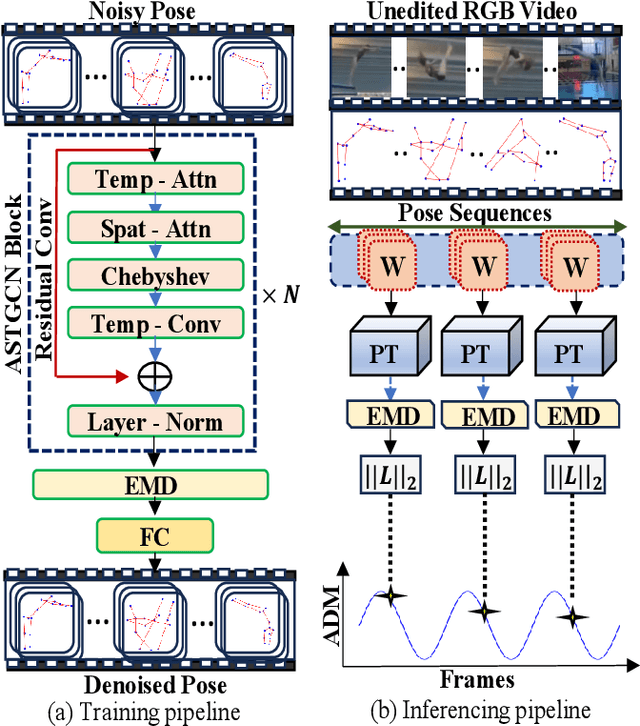
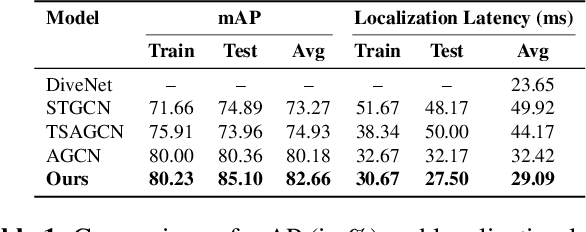

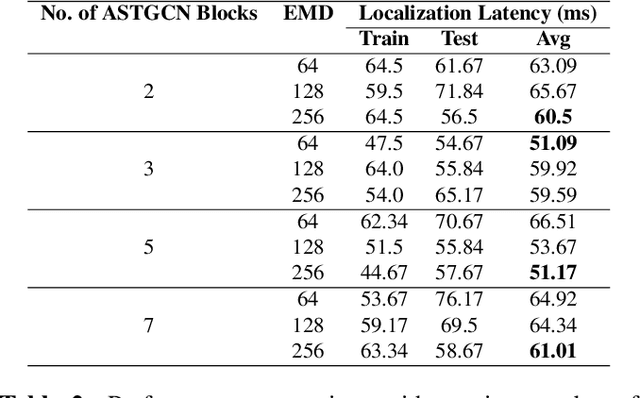
Fine-grained action localization in untrimmed sports videos presents a significant challenge due to rapid and subtle motion transitions over short durations. Existing supervised and weakly supervised solutions often rely on extensive annotated datasets and high-capacity models, making them computationally intensive and less adaptable to real-world scenarios. In this work, we introduce a lightweight and unsupervised skeleton-based action localization pipeline that leverages spatio-temporal graph neural representations. Our approach pre-trains an Attention-based Spatio-Temporal Graph Convolutional Network (ASTGCN) on a pose-sequence denoising task with blockwise partitions, enabling it to learn intrinsic motion dynamics without any manual labeling. At inference, we define a novel Action Dynamics Metric (ADM), computed directly from low-dimensional ASTGCN embeddings, which detects motion boundaries by identifying inflection points in its curvature profile. Our method achieves a mean Average Precision (mAP) of 82.66% and average localization latency of 29.09 ms on the DSV Diving dataset, matching state-of-the-art supervised performance while maintaining computational efficiency. Furthermore, it generalizes robustly to unseen, in-the-wild diving footage without retraining, demonstrating its practical applicability for lightweight, real-time action analysis systems in embedded or dynamic environments.
TRKT: Weakly Supervised Dynamic Scene Graph Generation with Temporal-enhanced Relation-aware Knowledge Transferring
Aug 07, 2025Dynamic Scene Graph Generation (DSGG) aims to create a scene graph for each video frame by detecting objects and predicting their relationships. Weakly Supervised DSGG (WS-DSGG) reduces annotation workload by using an unlocalized scene graph from a single frame per video for training. Existing WS-DSGG methods depend on an off-the-shelf external object detector to generate pseudo labels for subsequent DSGG training. However, detectors trained on static, object-centric images struggle in dynamic, relation-aware scenarios required for DSGG, leading to inaccurate localization and low-confidence proposals. To address the challenges posed by external object detectors in WS-DSGG, we propose a Temporal-enhanced Relation-aware Knowledge Transferring (TRKT) method, which leverages knowledge to enhance detection in relation-aware dynamic scenarios. TRKT is built on two key components:(1)Relation-aware knowledge mining: we first employ object and relation class decoders that generate category-specific attention maps to highlight both object regions and interactive areas. Then we propose an Inter-frame Attention Augmentation strategy that exploits optical flow for neighboring frames to enhance the attention maps, making them motion-aware and robust to motion blur. This step yields relation- and motion-aware knowledge mining for WS-DSGG. (2) we introduce a Dual-stream Fusion Module that integrates category-specific attention maps into external detections to refine object localization and boost confidence scores for object proposals. Extensive experiments demonstrate that TRKT achieves state-of-the-art performance on Action Genome dataset. Our code is avaliable at https://github.com/XZPKU/TRKT.git.