 Add to Chrome
 Add to Firefox
 Add to Edge
City Sentinel: A Unified AI-Based Smart Surveillance Framework for Real-Time Multi-Threat Detection Using Deep Learning
Aug 09, 2026
Rapid urbanization has increased the need for surveillance systems that can monitor multiple public safety risks at the same time. Traditional systems often use separate solutions for facial recognition, vehicle identification, fire detection, and behavioral analysis, resulting in fragmented infrastructure and multiple interfaces for operators to manage. This paper presents City Sentinel, a unified AI-based surveillance framework that integrates six detection capabilities into one scalable platform: facial recognition, automatic number plate recognition (ANPR), fire and smoke detection, weapon and knife detection, violence detection, and road accident detection. The system combines a Next.js operator dashboard, FastAPI backend, cloud-based PostgreSQL event storage, InsightFace and YOLOv8 vision models, and EasyOCR for plate recognition. Camera streams are processed through dedicated inference workers using RTSP. On a workstation equipped with an NVIDIA RTX 3060 GPU, the system achieves a median end-to-end latency of 743 ms and supports four concurrent RTSP streams within a two-second latency limit. It achieves a 91.2% face-match rate, 85.7% plate-reading accuracy, and mAP@0.5 scores of 0.846 to 0.889 across the fire, knife, and weapon detection modules. In user-acceptance testing, operators could enroll a new identity in under one minute and identify a flagged person from live footage in an average of 12 seconds. The results demonstrate that a modular, open-source, multi-model architecture can provide broad surveillance coverage, cloud-based auditability, and flexibility for adding new detection capabilities while maintaining practical real-time performance.

Mining Subscenario Refactoring Opportunities in Behaviour-Driven Software Test Suites: ML Classifiers and LLM-Judge Baselines
May 14, 2026Context. Behaviour-Driven Development (BDD) software test suites accumulate duplicated step subsequences. Three published refactoring patterns are available (within-file Background, within-repo reusable-scenario invocation, cross-organisational shared higher-level step), but no prior work automates which recurring subsequences are worth extracting or which mechanism applies. Objective. Rank recurring step subsequences ("slices") by refactoring suitability (extraction-worthy), pre-map each to one of the three patterns, and quantify prevalence across the public BDD ecosystem. Method. Every contiguous L-step window (L in [2, 18]) in a 339-repository / 276-upstream-owner Gherkin corpus is keyed by paraphrase-robust cluster identifiers and counted under three scopes. Sentence-BERT (SBERT) / Uniform Manifold Approximation and Projection (UMAP) / Hierarchical Density-Based Clustering (HDBSCAN) recovers paraphrase-equivalent slices. Three authors label a stratified 200-slice pool against a written rubric. An eXtreme Gradient Boosting (XGBoost) extraction-worthy classifier trained under 5-fold cross-validation is compared with a tuned rule baseline and two open-weight Large Language Model (LLM) judges. Results. The miner produces 5,382,249 slices collapsing to 692,020 recurring patterns. Three-author Fleiss' kappa = 0.56 (extraction-worthy) and 0.79 (mechanism). The classifier reaches out-of-fold F1 = 0.891 (95% CI [0.852, 0.927]), outperforming both the rule baseline (F1 = 0.836, p = 0.017) and the better LLM judge (F1 = 0.728, p < 1e-4). 75.0%, 59.5%, and 11.7% of scenarios carry a within-file Background, within-repo reusable-scenario, or cross-organisational shared-step candidate. Conclusion. Paraphrase-robust subscenario discovery yields a corpus-wide census of BDD refactoring opportunities; pipeline, classifier predictions, labelled pool, and rubric are released under Apache-2.0.
Finding Duplicates in 1.1M BDD Steps: cukereuse, a Paraphrase-Robust Static Detector for Cucumber and Gherkin
Apr 22, 2026Behaviour-Driven Development (BDD) suites accumulate step-text duplication whose maintenance cost is established in prior work. Existing detection techniques require running the tests (Binamungu et al., 2018-2023) or are confined to a single organisation (Irshad et al., 2020-2022), leaving a gap: a purely static, paraphrase-robust, step-level detector usable on any repository. We fill the gap with cukereuse, an open-source Python CLI combining exact hashing, Levenshtein ratio, and sentence-transformer embeddings in a layered pipeline, released alongside an empirical corpus of 347 public GitHub repositories, 23,667 parsed .feature files, and 1,113,616 Gherkin steps. The step-weighted exact-duplicate rate is 80.2 %; the median-repository rate is 58.6 % (Spearman rho = 0.51 with size). The top hybrid cluster groups 20.7k occurrences across 2.2k files. Against 1,020 pairs manually labelled by the three authors under a released rubric (inter-annotator Fleiss' kappa = 0.84 on a 60-pair overlap), we report precision, recall, and F1 with bootstrap 95 % CIs under two protocols: the primary rubric and a score-free second-pass relabelling. The strongest honest pair-level number is near-exact at F1 = 0.822 on score-free labels; the primary-rubric semantic F1 = 0.906 is inflated by a stratification artefact that pins recall at 1.000. Lexical baselines (SourcererCC-style, NiCad-style) reach primary F1 = 0.761 and 0.799. The paper also presents a CDN-structured critique of Gherkin (Cognitive Dimensions of Notations); eight of fourteen dimensions are rated problematic or unsupported. The tool, corpus, labelled pairs, rubric, and pipeline are released under permissive licences.
SwinTF3D: A Lightweight Multimodal Fusion Approach for Text-Guided 3D Medical Image Segmentation
Dec 28, 2025The recent integration of artificial intelligence into medical imaging has driven remarkable advances in automated organ segmentation. However, most existing 3D segmentation frameworks rely exclusively on visual learning from large annotated datasets restricting their adaptability to new domains and clinical tasks. The lack of semantic understanding in these models makes them ineffective in addressing flexible, user-defined segmentation objectives. To overcome these limitations, we propose SwinTF3D, a lightweight multimodal fusion approach that unifies visual and linguistic representations for text-guided 3D medical image segmentation. The model employs a transformer-based visual encoder to extract volumetric features and integrates them with a compact text encoder via an efficient fusion mechanism. This design allows the system to understand natural-language prompts and correctly align semantic cues with their corresponding spatial structures in medical volumes, while producing accurate, context-aware segmentation results with low computational overhead. Extensive experiments on the BTCV dataset demonstrate that SwinTF3D achieves competitive Dice and IoU scores across multiple organs, despite its compact architecture. The model generalizes well to unseen data and offers significant efficiency gains compared to conventional transformer-based segmentation networks. Bridging visual perception with linguistic understanding, SwinTF3D establishes a practical and interpretable paradigm for interactive, text-driven 3D medical image segmentation, opening perspectives for more adaptive and resource-efficient solutions in clinical imaging.
Attack-Aware Deepfake Detection under Counter-Forensic Manipulations
Dec 26, 2025This work presents an attack-aware deepfake and image-forensics detector designed for robustness, well-calibrated probabilities, and transparent evidence under realistic deployment conditions. The method combines red-team training with randomized test-time defense in a two-stream architecture, where one stream encodes semantic content using a pretrained backbone and the other extracts forensic residuals, fused via a lightweight residual adapter for classification, while a shallow Feature Pyramid Network style head produces tamper heatmaps under weak supervision. Red-team training applies worst-of-K counter-forensics per batch, including JPEG realign and recompress, resampling warps, denoise-to-regrain operations, seam smoothing, small color and gamma shifts, and social-app transcodes, while test-time defense injects low-cost jitters such as resize and crop phase changes, mild gamma variation, and JPEG phase shifts with aggregated predictions. Heatmaps are guided to concentrate within face regions using face-box masks without strict pixel-level annotations. Evaluation on existing benchmarks, including standard deepfake datasets and a surveillance-style split with low light and heavy compression, reports clean and attacked performance, AUC, worst-case accuracy, reliability, abstention quality, and weak-localization scores. Results demonstrate near-perfect ranking across attacks, low calibration error, minimal abstention risk, and controlled degradation under regrain, establishing a modular, data-efficient, and practically deployable baseline for attack-aware detection with calibrated probabilities and actionable heatmaps.
Clinical Decision Support System for Unani Medicine Practitioners
Oct 24, 2023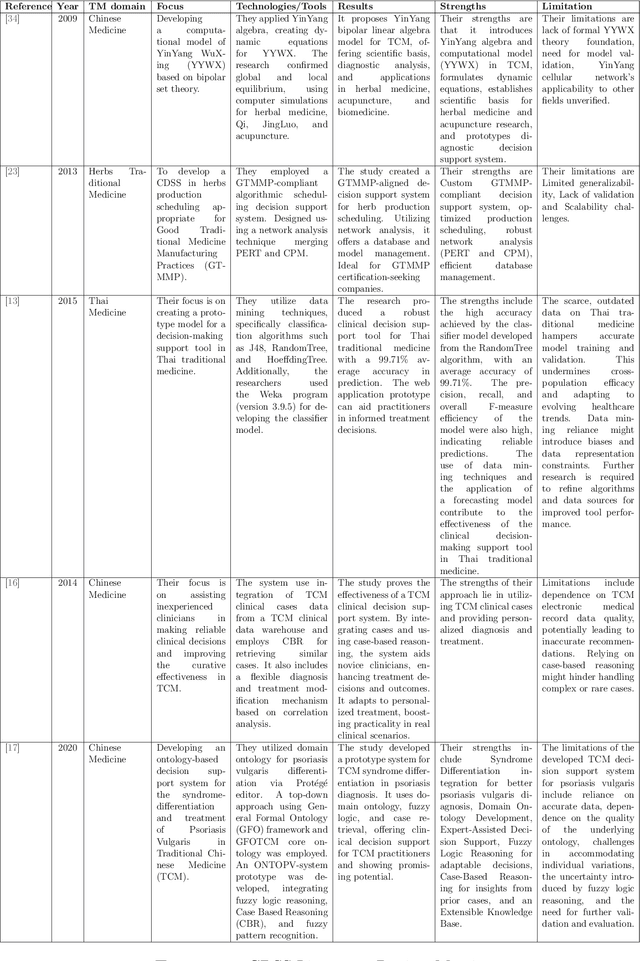
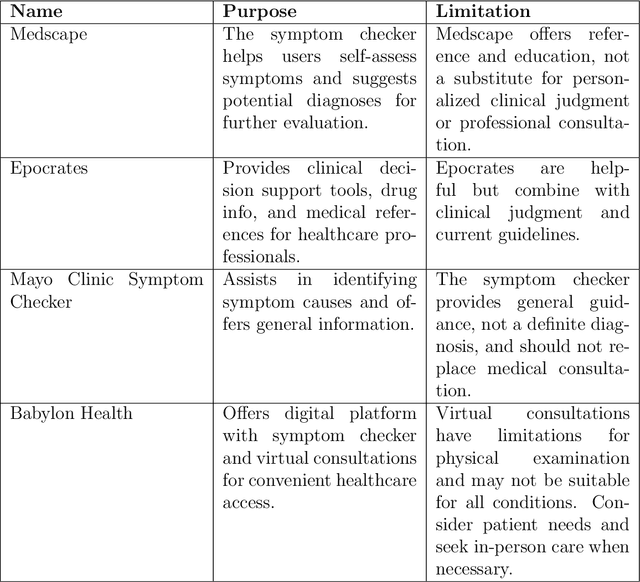
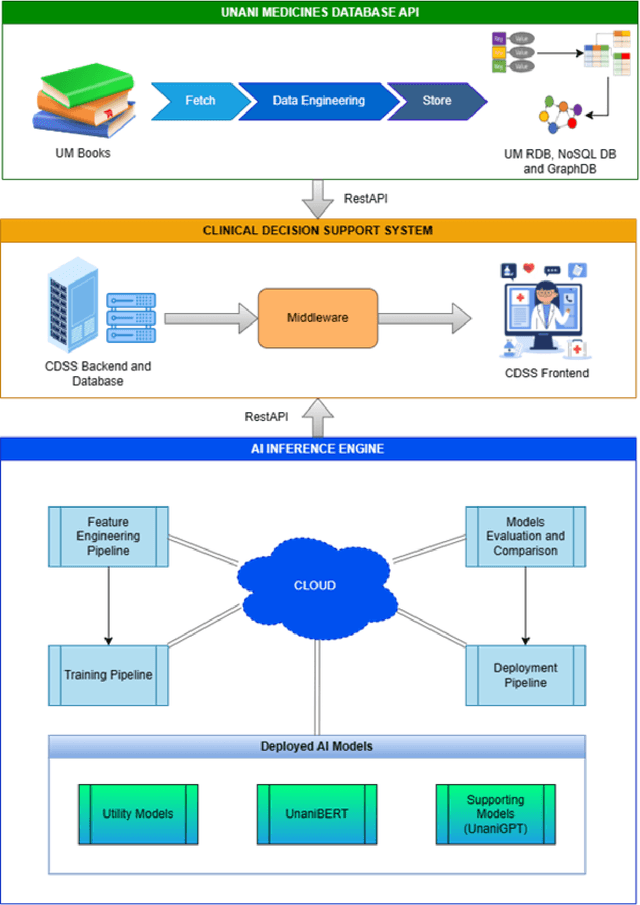
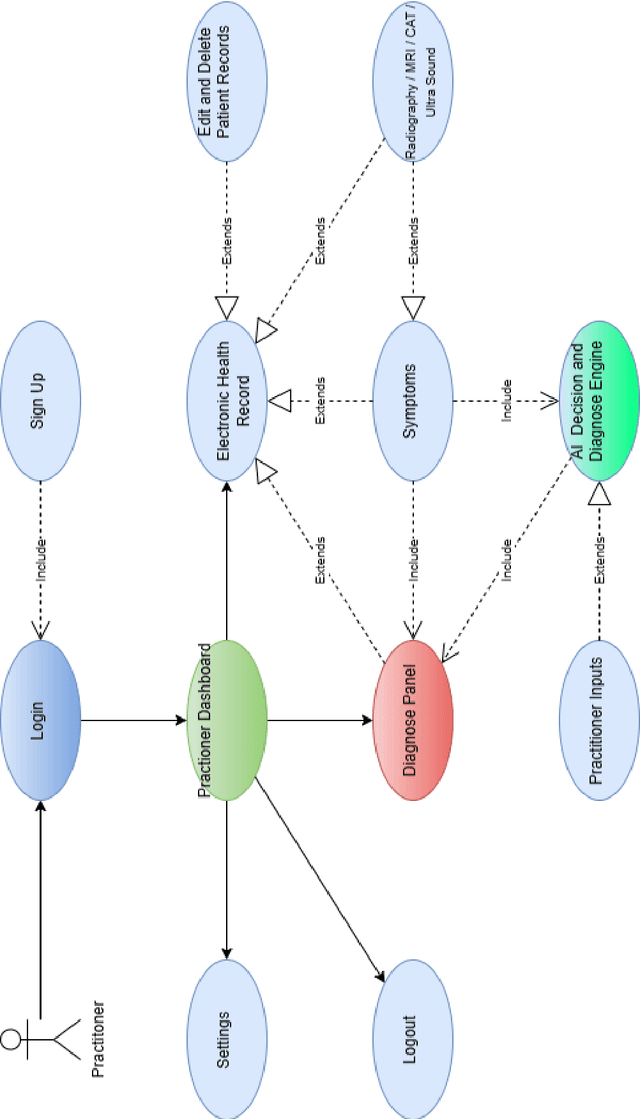
Like other fields of Traditional Medicines, Unani Medicines have been found as an effective medical practice for ages. It is still widely used in the subcontinent, particularly in Pakistan and India. However, Unani Medicines Practitioners are lacking modern IT applications in their everyday clinical practices. An Online Clinical Decision Support System may address this challenge to assist apprentice Unani Medicines practitioners in their diagnostic processes. The proposed system provides a web-based interface to enter the patient's symptoms, which are then automatically analyzed by our system to generate a list of probable diseases. The system allows practitioners to choose the most likely disease and inform patients about the associated treatment options remotely. The system consists of three modules: an Online Clinical Decision Support System, an Artificial Intelligence Inference Engine, and a comprehensive Unani Medicines Database. The system employs advanced AI techniques such as Decision Trees, Deep Learning, and Natural Language Processing. For system development, the project team used a technology stack that includes React, FastAPI, and MySQL. Data and functionality of the application is exposed using APIs for integration and extension with similar domain applications. The novelty of the project is that it addresses the challenge of diagnosing diseases accurately and efficiently in the context of Unani Medicines principles. By leveraging the power of technology, the proposed Clinical Decision Support System has the potential to ease access to healthcare services and information, reduce cost, boost practitioner and patient satisfaction, improve speed and accuracy of the diagnostic process, and provide effective treatments remotely. The application will be useful for Unani Medicines Practitioners, Patients, Government Drug Regulators, Software Developers, and Medical Researchers.