 Add to Chrome
 Add to Firefox
 Add to Edge
Rule-Compliant Visual Spatial Planning for Multimodal Large Language Models
Aug 20, 2026
Multimodal large language models (MLLMs) combine linguistic reasoning with visual perception, yet their ability to perform visual spatial planning under explicit or previously unseen rule constraints remains underexplored. This setting requires models to jointly understand spatial layouts, interpret natural-language rules, and plan valid actions accordingly. To address this gap, we introduce RuleMaze, a controllable benchmark in which MLLMs must navigate mazes while obeying natural-language rules of varying complexity. RuleMaze isolates rule-compliant spatial planning by requiring accurate perception, rule interpretation, and constrained action planning. To enable scalable and systematic rule construction, we propose Language-Logic-Function Hybridization, which automatically generates natural-language rules and translates them into logical representations and executable validators, eliminating manual rule engineering. To improve rule following and generalization, we introduce Disentangled Multimodal Planning (DMP), which separates perception, execution, and rule verification through interpretable reasoning primitives. By disentangling these components, DMP facilitates systematic generalization to more complex and previously unseen rules, while providing transparent intermediate planning traces. Experiments demonstrate that DMP substantially improves rule compliance and planning success compared to end-to-end textual planning baselines. Overall, RuleMaze establishes a principled benchmark for studying grounded and interpretable rule-based spatial planning in MLLMs. Code is available at https://github.com/oceanflowlab/RuleMaze.

Unleashing Multimodal Large Language Models for Training-free HOI Detection in the Wild
Jul 15, 2026Human-object interaction detection (HOID) has traditionally been formulated as a supervised detection problem over predefined interaction categories. While such paradigms achieve strong performance on closed-set benchmarks, they fundamentally entangle interaction understanding with dataset-specific supervision, limiting their ability to generalize to open-world and compositional scenarios. Recent HOI detectors attempt to leverage MLLMs through prompting strategies to transfer interaction-specific knowledge. However, such prompt-based approaches primarily focus on extracting discriminative representations from pretrained models, while underexploring their inherent multimodal reasoning capabilities. As a result, they struggle to provide informative contextual reasoning for ambiguous and open-world interaction scenarios. In this work, we present AgentHOI, a training-free, agentic framework that transfers the generalist multimodal reasoning capabilities of foundation models to HOI detection in the wild. Instead of learning interaction classifiers, AgentHOI modularly orchestrates complementary vision foundation modules to perform open-ended semantic reasoning and spatial grounding in a coordinated manner. To address the challenges of incomplete interaction discovery and ambiguous localization in complex scenes, we introduce two key mechanisms: (1) Context-aware Multi-round Reasoning, which progressively refines interaction hypotheses to ensure exhaustive and compositional HOI discovery, and (2) Multifaceted Interaction Localization, which enhances grounding precision by generating instance-specific descriptions that integrate semantic, spatial, and appearance cues. Extensive experiments demonstrate that AgentHOI achieves superior performance over state-of-the-art supervised and weakly supervised methods in real-world settings, despite requiring no HOID data for training.
TRKT: Weakly Supervised Dynamic Scene Graph Generation with Temporal-enhanced Relation-aware Knowledge Transferring
Aug 07, 2025Dynamic Scene Graph Generation (DSGG) aims to create a scene graph for each video frame by detecting objects and predicting their relationships. Weakly Supervised DSGG (WS-DSGG) reduces annotation workload by using an unlocalized scene graph from a single frame per video for training. Existing WS-DSGG methods depend on an off-the-shelf external object detector to generate pseudo labels for subsequent DSGG training. However, detectors trained on static, object-centric images struggle in dynamic, relation-aware scenarios required for DSGG, leading to inaccurate localization and low-confidence proposals. To address the challenges posed by external object detectors in WS-DSGG, we propose a Temporal-enhanced Relation-aware Knowledge Transferring (TRKT) method, which leverages knowledge to enhance detection in relation-aware dynamic scenarios. TRKT is built on two key components:(1)Relation-aware knowledge mining: we first employ object and relation class decoders that generate category-specific attention maps to highlight both object regions and interactive areas. Then we propose an Inter-frame Attention Augmentation strategy that exploits optical flow for neighboring frames to enhance the attention maps, making them motion-aware and robust to motion blur. This step yields relation- and motion-aware knowledge mining for WS-DSGG. (2) we introduce a Dual-stream Fusion Module that integrates category-specific attention maps into external detections to refine object localization and boost confidence scores for object proposals. Extensive experiments demonstrate that TRKT achieves state-of-the-art performance on Action Genome dataset. Our code is avaliable at https://github.com/XZPKU/TRKT.git.
Exploring Conditional Multi-Modal Prompts for Zero-shot HOI Detection
Aug 05, 2024Zero-shot Human-Object Interaction (HOI) detection has emerged as a frontier topic due to its capability to detect HOIs beyond a predefined set of categories. This task entails not only identifying the interactiveness of human-object pairs and localizing them but also recognizing both seen and unseen interaction categories. In this paper, we introduce a novel framework for zero-shot HOI detection using Conditional Multi-Modal Prompts, namely CMMP. This approach enhances the generalization of large foundation models, such as CLIP, when fine-tuned for HOI detection. Unlike traditional prompt-learning methods, we propose learning decoupled vision and language prompts for interactiveness-aware visual feature extraction and generalizable interaction classification, respectively. Specifically, we integrate prior knowledge of different granularity into conditional vision prompts, including an input-conditioned instance prior and a global spatial pattern prior. The former encourages the image encoder to treat instances belonging to seen or potentially unseen HOI concepts equally while the latter provides representative plausible spatial configuration of the human and object under interaction. Besides, we employ language-aware prompt learning with a consistency constraint to preserve the knowledge of the large foundation model to enable better generalization in the text branch. Extensive experiments demonstrate the efficacy of our detector with conditional multi-modal prompts, outperforming previous state-of-the-art on unseen classes of various zero-shot settings. The code and models are available at \url{https://github.com/ltttpku/CMMP}.
Exploring the Potential of Large Foundation Models for Open-Vocabulary HOI Detection
Apr 10, 2024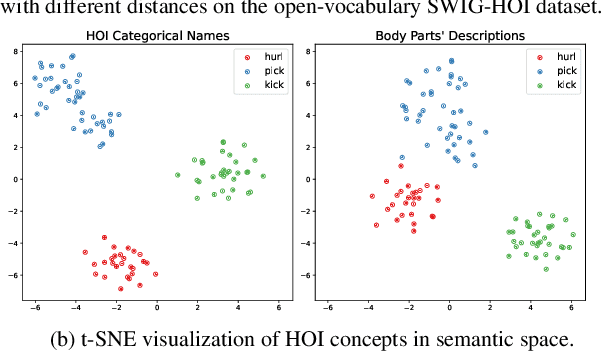
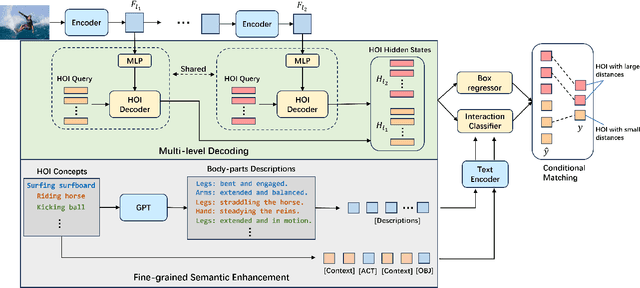
Open-vocabulary human-object interaction (HOI) detection, which is concerned with the problem of detecting novel HOIs guided by natural language, is crucial for understanding human-centric scenes. However, prior zero-shot HOI detectors often employ the same levels of feature maps to model HOIs with varying distances, leading to suboptimal performance in scenes containing human-object pairs with a wide range of distances. In addition, these detectors primarily rely on category names and overlook the rich contextual information that language can provide, which is essential for capturing open vocabulary concepts that are typically rare and not well-represented by category names alone. In this paper, we introduce a novel end-to-end open vocabulary HOI detection framework with conditional multi-level decoding and fine-grained semantic enhancement (CMD-SE), harnessing the potential of Visual-Language Models (VLMs). Specifically, we propose to model human-object pairs with different distances with different levels of feature maps by incorporating a soft constraint during the bipartite matching process. Furthermore, by leveraging large language models (LLMs) such as GPT models, we exploit their extensive world knowledge to generate descriptions of human body part states for various interactions. Then we integrate the generalizable and fine-grained semantics of human body parts to improve interaction recognition. Experimental results on two datasets, SWIG-HOI and HICO-DET, demonstrate that our proposed method achieves state-of-the-art results in open vocabulary HOI detection. The code and models are available at https://github.com/ltttpku/CMD-SE-release.
Efficient Adaptive Human-Object Interaction Detection with Concept-guided Memory
Sep 07, 2023Human Object Interaction (HOI) detection aims to localize and infer the relationships between a human and an object. Arguably, training supervised models for this task from scratch presents challenges due to the performance drop over rare classes and the high computational cost and time required to handle long-tailed distributions of HOIs in complex HOI scenes in realistic settings. This observation motivates us to design an HOI detector that can be trained even with long-tailed labeled data and can leverage existing knowledge from pre-trained models. Inspired by the powerful generalization ability of the large Vision-Language Models (VLM) on classification and retrieval tasks, we propose an efficient Adaptive HOI Detector with Concept-guided Memory (ADA-CM). ADA-CM has two operating modes. The first mode makes it tunable without learning new parameters in a training-free paradigm. Its second mode incorporates an instance-aware adapter mechanism that can further efficiently boost performance if updating a lightweight set of parameters can be afforded. Our proposed method achieves competitive results with state-of-the-art on the HICO-DET and V-COCO datasets with much less training time. Code can be found at https://github.com/ltttpku/ADA-CM.
EgoTaskQA: Understanding Human Tasks in Egocentric Videos
Oct 08, 2022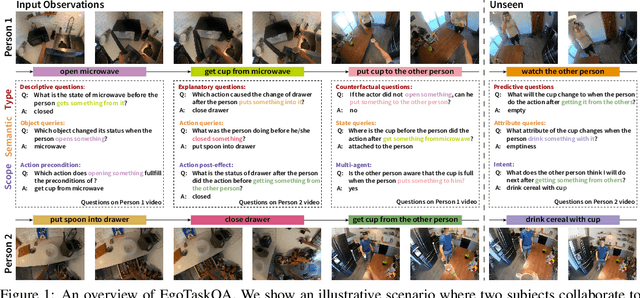
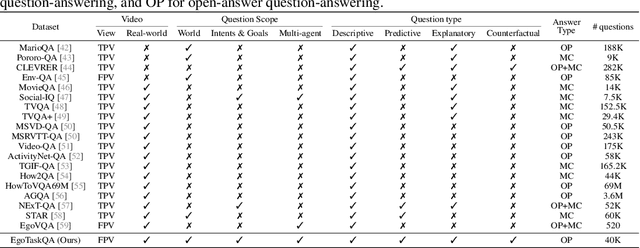
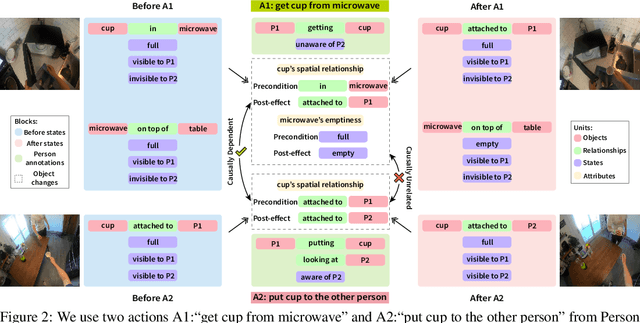
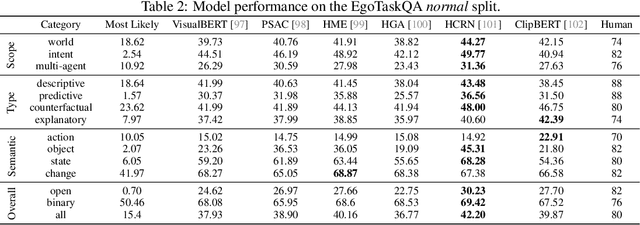
Understanding human tasks through video observations is an essential capability of intelligent agents. The challenges of such capability lie in the difficulty of generating a detailed understanding of situated actions, their effects on object states (i.e., state changes), and their causal dependencies. These challenges are further aggravated by the natural parallelism from multi-tasking and partial observations in multi-agent collaboration. Most prior works leverage action localization or future prediction as an indirect metric for evaluating such task understanding from videos. To make a direct evaluation, we introduce the EgoTaskQA benchmark that provides a single home for the crucial dimensions of task understanding through question-answering on real-world egocentric videos. We meticulously design questions that target the understanding of (1) action dependencies and effects, (2) intents and goals, and (3) agents' beliefs about others. These questions are divided into four types, including descriptive (what status?), predictive (what will?), explanatory (what caused?), and counterfactual (what if?) to provide diagnostic analyses on spatial, temporal, and causal understandings of goal-oriented tasks. We evaluate state-of-the-art video reasoning models on our benchmark and show their significant gaps between humans in understanding complex goal-oriented egocentric videos. We hope this effort will drive the vision community to move onward with goal-oriented video understanding and reasoning.
Team PKU-WICT-MIPL PIC Makeup Temporal Video Grounding Challenge 2022 Technical Report
Jul 06, 2022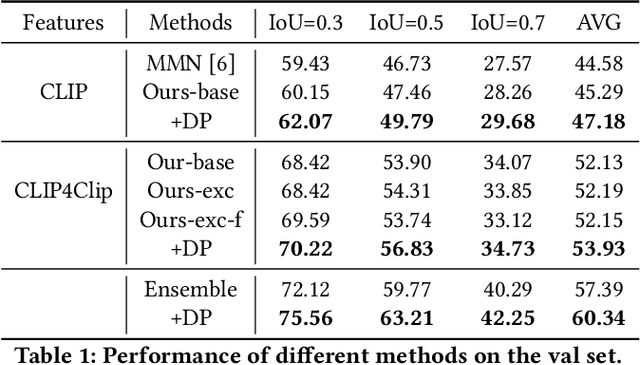

In this technical report, we briefly introduce the solutions of our team `PKU-WICT-MIPL' for the PIC Makeup Temporal Video Grounding (MTVG) Challenge in ACM-MM 2022. Given an untrimmed makeup video and a step query, the MTVG aims to localize a temporal moment of the target makeup step in the video. To tackle this task, we propose a phrase relationship mining framework to exploit the temporal localization relationship relevant to the fine-grained phrase and the whole sentence. Besides, we propose to constrain the localization results of different step sentence queries to not overlap with each other through a dynamic programming algorithm. The experimental results demonstrate the effectiveness of our method. Our final submission ranked 2nd on the leaderboard, with only a 0.55\% gap from the first.
Visual cryptography in single-pixel imaging
Nov 12, 2019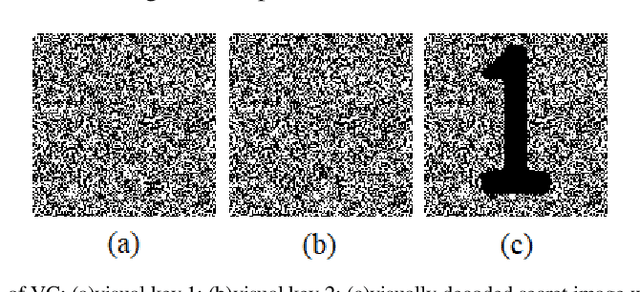
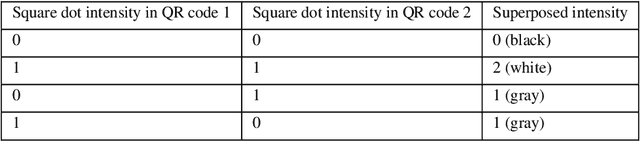
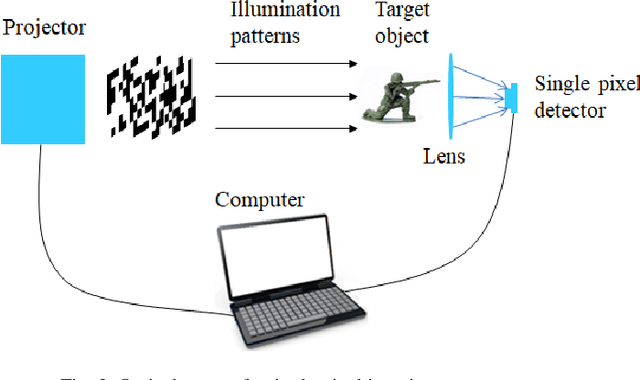
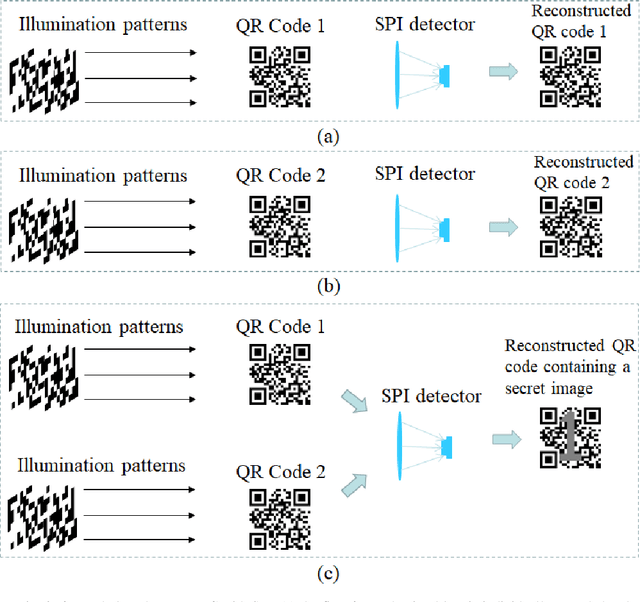
Two novel visual cryptography (VC) schemes are proposed by combining VC with single-pixel imaging (SPI) for the first time. It is pointed out that the overlapping of visual key images in VC is similar to the superposition of pixel intensities by a single-pixel detector in SPI. In the first scheme, QR-code VC is designed by using opaque sheets instead of transparent sheets. The secret image can be recovered when identical illumination patterns are projected onto multiple visual key images and a single detector is used to record the total light intensities. In the second scheme, the secret image is shared by multiple illumination pattern sequences and it can be recovered when the visual key patterns are projected onto identical items. The application of VC can be extended to more diversified scenarios by our proposed schemes.
Does deep learning always outperform simple linear regression in optical imaging?
Oct 31, 2019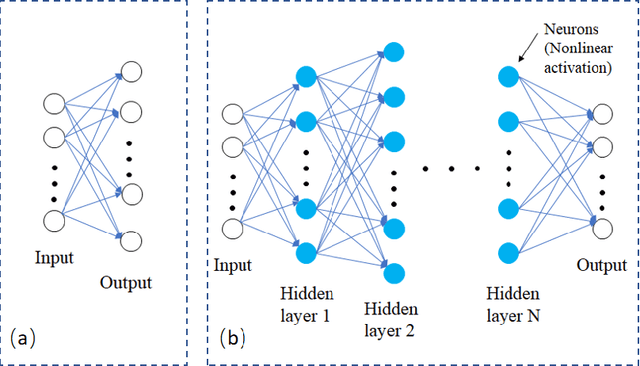
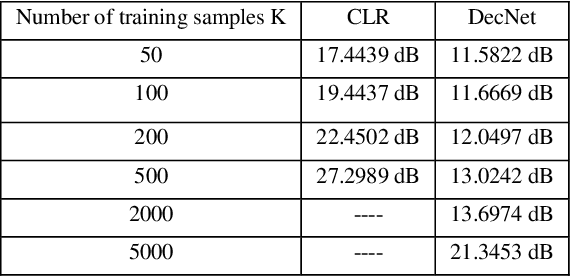
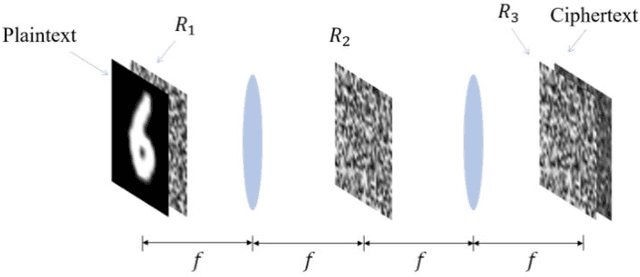
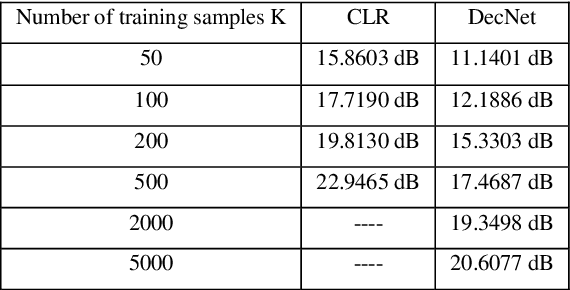
Deep learning has been extensively applied in many optical imaging applications in recent years. Despite the success, the limitations and drawbacks of deep learning in optical imaging have been seldom investigated. In this work, we show that conventional linear-regression-based methods can outperform the previously proposed deep learning approaches for two black-box optical imaging problems in some extent. Deep learning demonstrates its weakness especially when the number of training samples is small. The advantages and disadvantages of linear-regression-based methods and deep learning are analyzed and compared. Since many optical systems are essentially linear, a deep learning network containing many nonlinearity functions sometimes may not be the most suitable option.