 Add to Chrome
 Add to Firefox
 Add to Edge
PEAfowl: Perception-Enhanced Multi-View Vision-Language-Action for Bimanual Manipulation
Jan 25, 2026
Bimanual manipulation in cluttered scenes requires policies that remain stable under occlusions, viewpoint and scene variations. Existing vision-language-action models often fail to generalize because (i) multi-view features are fused via view-agnostic token concatenation, yielding weak 3D-consistent spatial understanding, and (ii) language is injected as global conditioning, resulting in coarse instruction grounding. In this paper, we introduce PEAfowl, a perception-enhanced multi-view VLA policy for bimanual manipulation. For spatial reasoning, PEAfowl predicts per-token depth distributions, performs differentiable 3D lifting, and aggregates local cross-view neighbors to form geometrically grounded, cross-view consistent representations. For instruction grounding, we propose to replace global conditioning with a Perceiver-style text-aware readout over frozen CLIP visual features, enabling iterative evidence accumulation. To overcome noisy and incomplete commodity depth without adding inference overhead, we apply training-only depth distillation from a pretrained depth teacher to supervise the depth-distribution head, providing perception front-end with geometry-aware priors. On RoboTwin 2.0 under domain-randomized setting, PEAfowl improves the strongest baseline by 23.0 pp in success rate, and real-robot experiments further demonstrate reliable sim-to-real transfer and consistent improvements from depth distillation. Project website: https://peafowlvla.github.io/.

MISCGrasp: Leveraging Multiple Integrated Scales and Contrastive Learning for Enhanced Volumetric Grasping
Jul 03, 2025Robotic grasping faces challenges in adapting to objects with varying shapes and sizes. In this paper, we introduce MISCGrasp, a volumetric grasping method that integrates multi-scale feature extraction with contrastive feature enhancement for self-adaptive grasping. We propose a query-based interaction between high-level and low-level features through the Insight Transformer, while the Empower Transformer selectively attends to the highest-level features, which synergistically strikes a balance between focusing on fine geometric details and overall geometric structures. Furthermore, MISCGrasp utilizes multi-scale contrastive learning to exploit similarities among positive grasp samples, ensuring consistency across multi-scale features. Extensive experiments in both simulated and real-world environments demonstrate that MISCGrasp outperforms baseline and variant methods in tabletop decluttering tasks. More details are available at https://miscgrasp.github.io/.
NeuGrasp: Generalizable Neural Surface Reconstruction with Background Priors for Material-Agnostic Object Grasp Detection
Mar 05, 2025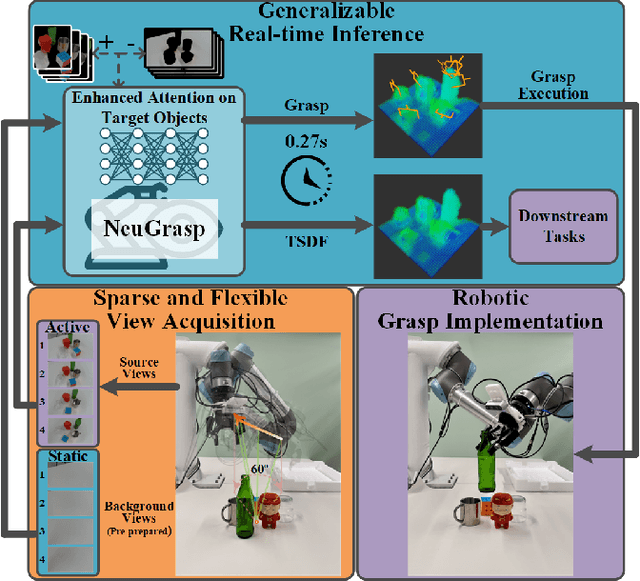
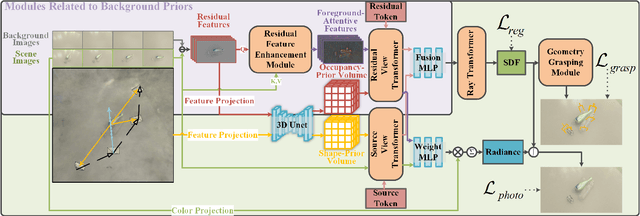
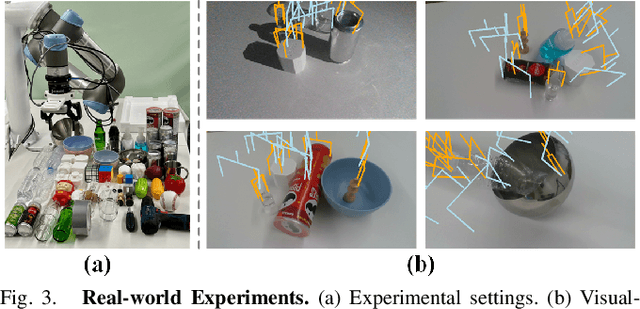
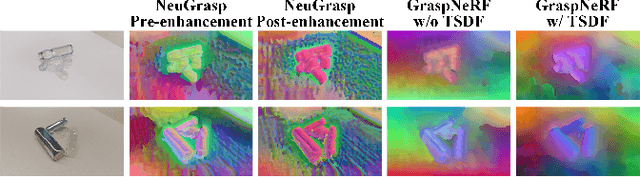
Robotic grasping in scenes with transparent and specular objects presents great challenges for methods relying on accurate depth information. In this paper, we introduce NeuGrasp, a neural surface reconstruction method that leverages background priors for material-agnostic grasp detection. NeuGrasp integrates transformers and global prior volumes to aggregate multi-view features with spatial encoding, enabling robust surface reconstruction in narrow and sparse viewing conditions. By focusing on foreground objects through residual feature enhancement and refining spatial perception with an occupancy-prior volume, NeuGrasp excels in handling objects with transparent and specular surfaces. Extensive experiments in both simulated and real-world scenarios show that NeuGrasp outperforms state-of-the-art methods in grasping while maintaining comparable reconstruction quality. More details are available at https://neugrasp.github.io/.