 Add to Chrome
 Add to Firefox
 Add to Edge
An Empirical Study of Training Pixel-Space Text-to-Image Diffusion Models
Aug 17, 2026
This paper investigates an increasingly important topic in generative modeling: pixel-space diffusion models. Although numerous studies have explored this topic, most focus on small-scale or class-conditional settings. Consequently, a practical recipe for training pixel-space models that rival or exceed well-established latent-space counterparts remains elusive. Through a comprehensive empirical study, we first observe that direct large-scale pre-training in pixel space converges substantially more slowly than in latent space. This observation motivates a latent-to-pixel strategy that acquires generative priors efficiently in latent space and transitions to pixel space during post-training. We then systematically investigate the key design choices governing this transition, including weight initialization, data composition, prediction target, decoder architecture, and noise schedule, and identify a practical recipe that makes the resulting pixel-space models match or outperform their latent-space counterparts while delivering 3.18 to 4.75 times end-to-end inference speedups. We hope that our findings provide useful empirical insights and practical guidelines for future research on pixel-space generation.

SynVAR: Synergizing Spatial and Semantic Alignment in Visual Autoregressive Model
Aug 08, 2026VAR has gained widespread popularity due to its next-scale prediction paradigm. However, it faces substantial performance bottlenecks when handling complex scenes with multiple objects and attributes. Existing diffusion-based enhancement methods fail to adequately address the unique challenge of cross-scale error propagation and accumulation in VAR. To this end, we propose SynVAR, the first training-free enhancement framework specifically tailored for the VAR paradigm, which introduces a spatial-semantic collaborative control strategy to effectively suppress propagation error and improve generation quality. SynVAR comprises three key components: (1) Global guidance to ensure reasonable spatial structure in the early stages, (2) Receptive field constraints to mitigate early-stage semantic confusion, (3) High-frequency compensation to recover fine-grained details. Extensive quantitative and qualitative experiments demonstrate the significant improvements in the ability of SynVAR to enhance the VAR's capability for complex scene modeling.
Convex-Hull-Neighborhood Smooth Dual Generalization: Controlling Local Correction Propagation in Offline RL
Aug 04, 2026Offline reinforcement learning (offline RL) can benefit from nearby out-of-distribution (OOD) actions, but estimation errors at these actions may be amplified by bootstrapping. Existing regularization and local-generalization methods control either the admissible OOD region or the influence of generalized targets, often through separate mechanisms. We propose Convex Hull Neighborhood Smooth Dual Generalization (CSDG), which expresses the Bellman backup as an in-sample value target plus a CHN-local correction. This formulation makes the generalized contribution explicit and separates it from the in-sample reference path. The correction is obtained by smoothing in-sample-oriented and OOD-oriented candidates sampled at different perturbation radii. A mixture coefficient lambda scales its contribution to each backup, while the recursive discount remains gamma. Under boundedness and fixed perturbation kernels, we derive an exact one-step correction identity, a time-varying iterate bound, and a fixed-point bound that depends only on the branch discrepancy at the fixed point. We further characterize the implicit policies induced by the idealized operators and give a conditional non-degradation criterion. The practical algorithm approximates these quantities using asymmetric bounded noise and expectile regression, without exact support classification or an additional pessimistic OOD penalty. Experiments on Gym-MuJoCo and AntMaze show strong aggregate performance and stable value estimation. Code is available at: https://github.com/YOUNG-fnxm/CSDG
RoMeRL: Balancing Feedback Coverage and the Memory-Reward Trap in Self-Evolving Agent Memory via Reduced-Order Utility States
Aug 03, 2026Learning-based memory systems for self-evolving LLM agents face two tightly coupled challenges. First, trajectory-indexed utilities grow with the interaction history, thereby dispersing limited feedback over an ever-expanding state space. Second, because trajectory-level rewards are jointly assigned to co-retrieved memories, irrelevant experiences may receive misleading utility updates and consequently enter the memory-reward trap. To address these challenges, we introduce Reduced-Order Memory Reinforcement Learning (RoMeRL), which represents the growing trajectory-indexed utility space using a fixed-dimensional per-task memory state factorized by outcome polarity and memory dynamics. RoMeRL incorporates new experiences through a fixed set of semantic coordinates whose contents are updated or replaced over time, thereby concentrating feedback over a bounded utility support. Theoretically, we show that this reduced-order parameterization increases the average feedback received by each utility coordinate and characterize the steady-state occupancy of erroneous coordinates under a generic coordinate-transition model. Empirically, across ALFWorld and LifelongAgentBench, RoMeRL improves task performance, reduces the Cold-Q ratio by 80.0%, increases feedback density by approximately 6.0 times, reduces the maintained memory size by 84.4%, and cuts LLM calls by 21.1%. These results show that reduced-order utility states support efficient self-evolving agent memory while limiting persistent reward contamination. Code is available at: https://github.com/YOUNG-fnxm/RoMeRL
JAVEDIT: Joint Audio-Visual Instruction-Guided Video Editing with Agentic Data Curation
Jun 02, 2026While instruction-based video editing has seen significant progress, joint audio-visual editing remains constrained by the absence of dedicated datasets and benchmarks. To bridge this gap, we present JAVEdit-100k, the first large-scale, high-quality dataset tailored for instruction-guided joint audio-visual editing. Focusing on human-centric videos, JAVEdit-100k comprises approximately 100K editing triplets spanning five distinct categories, including subject editing and speech editing. This dataset is rigorously constructed via four meticulously designed generation pipelines, seamlessly paired with an agent-in-the-loop quality control mechanism. Furthermore, to address the lack of standardized evaluation within the field, we introduce JAVEditBench, a comprehensive benchmark featuring curated source videos and human-aligned instructions across all editing categories. Finally, we propose JAVEdit, a pioneering baseline model for instruction-guided joint audio-visual editing. Experiments show that \model\ outperforms all baselines on five of six evaluation metrics.
PixVerve: Advancing Native UHR Image Generation to 100MP with a Large-Scale High-Quality Dataset
May 19, 2026Text-to-Image (T2I) models have recently seen notable progress around 1K and 2K resolution. With the extreme desire for better visual experience and the rapid development of imaging technology, the demand for Ultra-High-Resolution (UHR) image generation has grown significantly. However, UHR image generation poses great challenges due to the scarcity and complexity of high-resolution content. In this paper, we first introduce PixVerve-95K, a high-quality, open-source UHR T2I dataset curated with a carefully designed data pipeline, which contains 95K images across diverse scenarios (each image has a minimum pixel-count of 100M) and seven-dimensional annotations. Based on our large-scale image-text dataset, we take a pioneering step to extend various T2I foundation models to native 100MP generation with three training schemes. Finally, leveraging both conventional metrics and multimodal large language model-based assessments, our proposed PixVerve-Bench benchmark establishes a comprehensive evaluation protocol for UHR images encompassing visual quality and semantic alignment. Extensive experimental results on our benchmark and the constructive exploration of training strategies collaboratively provide valuable insights for future breakthroughs.
L2P: Unlocking Latent Potential for Pixel Generation
May 12, 2026Pixel diffusion models have recently regained attention for visual generation. However, training advanced pixel-space models from scratch demands prohibitive computational and data resources. To address this, we propose the Latent-to-Pixel (L2P) transfer paradigm, an efficient framework that directly harnesses the rich knowledge of pre-trained LDMs to build powerful pixel-space models. Specifically, L2P discards the VAE in favor of large-patch tokenization and freezes the source LDM's intermediate layers, exclusively training shallow layers to learn the latent-to-pixel transformation. By utilizing LDM-generated synthetic images as the sole training corpus, L2P fits an already smooth data manifold, enabling rapid convergence with zero real-data collection. This strategy allows L2P to seamlessly migrate massive latent priors to the pixel space using only 8 GPUs. Furthermore, eliminating the VAE memory bottleneck unlocks native 4K ultra-high resolution generation. Extensive experiments across mainstream LDM architectures show that L2P incurs negligible training overhead, yet performs on par with the source LDM on DPG-Bench and reaches 93% performance on GenEval.
TextCrafter: Accurately Rendering Multiple Texts in Complex Visual Scenes
Apr 01, 2025This paper explores the task of Complex Visual Text Generation (CVTG), which centers on generating intricate textual content distributed across diverse regions within visual images. In CVTG, image generation models often rendering distorted and blurred visual text or missing some visual text. To tackle these challenges, we propose TextCrafter, a novel multi-visual text rendering method. TextCrafter employs a progressive strategy to decompose complex visual text into distinct components while ensuring robust alignment between textual content and its visual carrier. Additionally, it incorporates a token focus enhancement mechanism to amplify the prominence of visual text during the generation process. TextCrafter effectively addresses key challenges in CVTG tasks, such as text confusion, omissions, and blurriness. Moreover, we present a new benchmark dataset, CVTG-2K, tailored to rigorously evaluate the performance of generative models on CVTG tasks. Extensive experiments demonstrate that our method surpasses state-of-the-art approaches.
Region-Aware Text-to-Image Generation via Hard Binding and Soft Refinement
Nov 15, 2024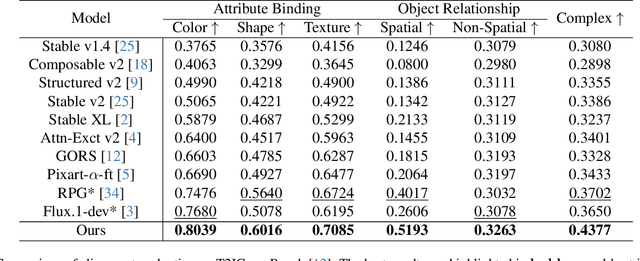
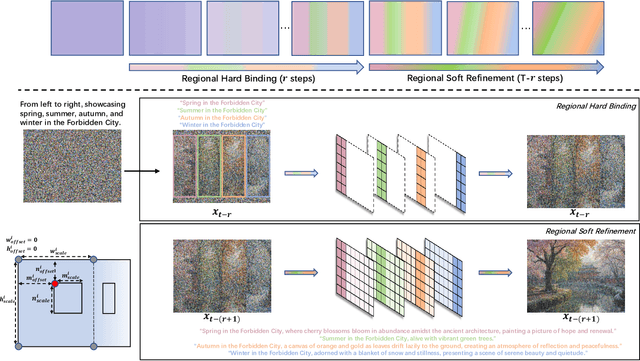
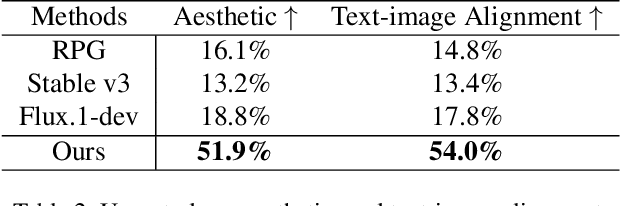
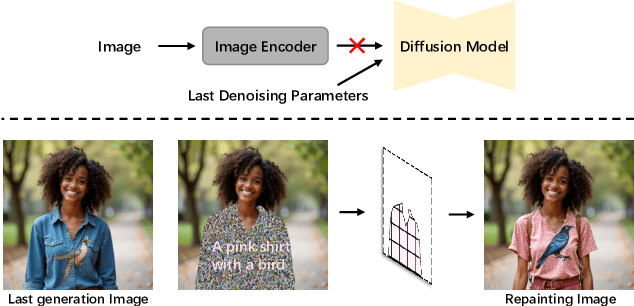
Regional prompting, or compositional generation, which enables fine-grained spatial control, has gained increasing attention for its practicality in real-world applications. However, previous methods either introduce additional trainable modules, thus only applicable to specific models, or manipulate on score maps within cross-attention layers using attention masks, resulting in limited control strength when the number of regions increases. To handle these limitations, we present RAG, a Regional-Aware text-to-image Generation method conditioned on regional descriptions for precise layout composition. RAG decouple the multi-region generation into two sub-tasks, the construction of individual region (Regional Hard Binding) that ensures the regional prompt is properly executed, and the overall detail refinement (Regional Soft Refinement) over regions that dismiss the visual boundaries and enhance adjacent interactions. Furthermore, RAG novelly makes repainting feasible, where users can modify specific unsatisfied regions in the last generation while keeping all other regions unchanged, without relying on additional inpainting models. Our approach is tuning-free and applicable to other frameworks as an enhancement to the prompt following property. Quantitative and qualitative experiments demonstrate that RAG achieves superior performance over attribute binding and object relationship than previous tuning-free methods.
Adaptive Guidance Learning for Camouflaged Object Detection
May 07, 2024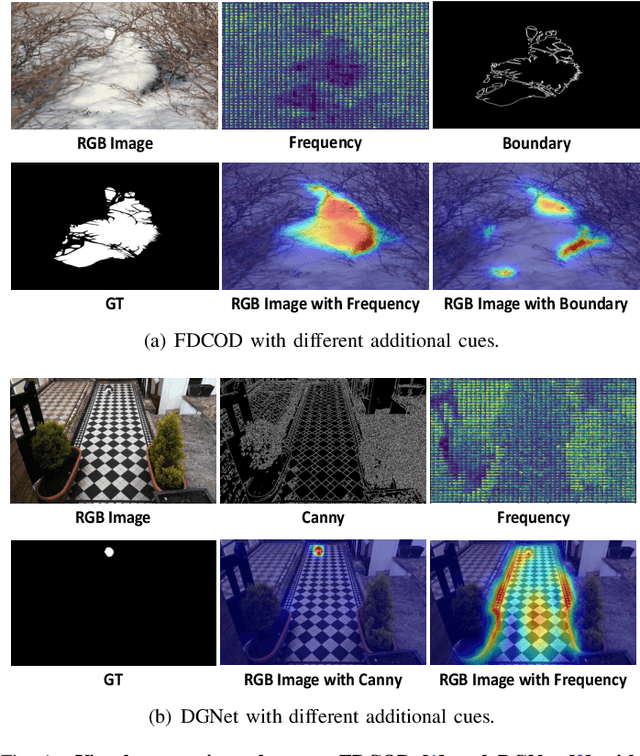
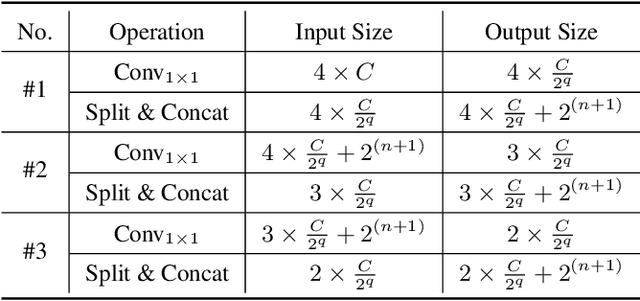
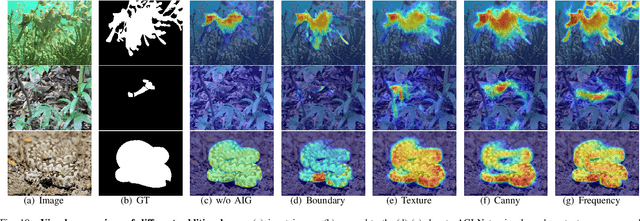
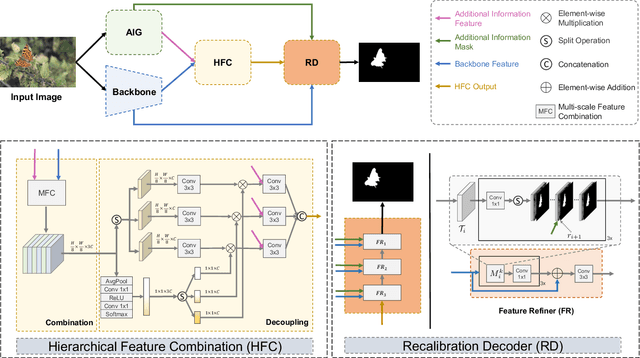
Camouflaged object detection (COD) aims to segment objects visually embedded in their surroundings, which is a very challenging task due to the high similarity between the objects and the background. To address it, most methods often incorporate additional information (e.g., boundary, texture, and frequency clues) to guide feature learning for better detecting camouflaged objects from the background. Although progress has been made, these methods are basically individually tailored to specific auxiliary cues, thus lacking adaptability and not consistently achieving high segmentation performance. To this end, this paper proposes an adaptive guidance learning network, dubbed \textit{AGLNet}, which is a unified end-to-end learnable model for exploring and adapting different additional cues in CNN models to guide accurate camouflaged feature learning. Specifically, we first design a straightforward additional information generation (AIG) module to learn additional camouflaged object cues, which can be adapted for the exploration of effective camouflaged features. Then we present a hierarchical feature combination (HFC) module to deeply integrate additional cues and image features to guide camouflaged feature learning in a multi-level fusion manner.Followed by a recalibration decoder (RD), different features are further aggregated and refined for accurate object prediction. Extensive experiments on three widely used COD benchmark datasets demonstrate that the proposed method achieves significant performance improvements under different additional cues, and outperforms the recent 20 state-of-the-art methods by a large margin. Our code will be made publicly available at: \textcolor{blue}{{https://github.com/ZNan-Chen/AGLNet}}.