 Add to Chrome
 Add to Firefox
 Add to Edge
InstructVVT: Instruction-Driven Video Virtual Try-On without Auxiliary Spatial Priors
Aug 14, 2026
Video virtual try-on is a highly constrained editing task requiring the precise replacement of a target person's clothing while strictly preserving the original video's spatial structure and temporal dynamics. Existing methods heavily rely on auxiliary handcrafted spatial priors (e.g., masks, poses) for editing control. However, these priors are prone to failure in unconstrained real-world videos and often compress rich visual context into incomplete structural signals. Furthermore, standard reconstruction objectives fail to fully capture try-on-specific human preferences. To address these challenges, we propose InstructVVT, an instruction-driven and reference-guided video virtual try-on framework based on a Diffusion Transformer (DiT) that operates without inference-time spatial priors. Our core insight is to recover fine-grained control directly from the input triplet (source video, reference garment, and instruction) via a dual-level reference conditioning scheme. Specifically, an MLLM infers semantic edit tokens for target disambiguation and structural preservation, while a lightweight conditioning pathway explicitly injects fine-grained visual garment details. Finally, we design a try-on-specific reward and utilize the DiffusionNFT algorithm to align the model with human preferences. Extensive experiments on ViViD-S and TripVVT-Bench demonstrate that InstructVVT outperforms state-of-the-art open-source methods in garment fidelity, structural preservation, and temporal consistency, despite requiring fewer inference-time controls.

EgoMonth: A Month-Level Egocentric Video Benchmark for Long-Term Spatiotemporal Memory
Aug 13, 2026Recent advances in Multimodal Large Language Models (MLLMs) have led to substantial progress in video understanding, accompanied by a growing number of long video benchmarks. However, existing benchmarks rely predominantly on web-sourced videos that lack inter-clip spatiotemporal continuity, making it difficult to assess whether models can maintain consistent memory across days or weeks of real-world experience. We introduce EgoMonth, the first month-level egocentric video understanding benchmark. EgoMonth comprises over 300 hours of first-person daily-life recordings from 20 participants spanning 20 to 120 days, paired with 1,443 human-crafted multiple-choice question-answer pairs. We design a cognitively grounded 14-task evaluation framework organized into three hierarchical cognitive levels: Schema Consolidation, Episodic Indexing, and Cascading Reasoning. Evaluation of state-of-the-art open-source and closed-source MLLMs reveals that even the best-performing model, Gemini 2.5 Pro, achieves only 71.8% macro-average accuracy, remaining 22.4 percentage points below the corrected human baseline of 94.2%. Several models perform near or below the 25% chance level on tasks such as Route Reasoning, Cross-view Spatial Reasoning, and Direction Judgement, while even the strongest closed-source model remains substantially below human performance. These results indicate that current MLLMs function as lossy summarizers rather than faithful memorizers, highlighting the need for architectures with genuine long-term spatiotemporal memory.
SynVAR: Synergizing Spatial and Semantic Alignment in Visual Autoregressive Model
Aug 08, 2026VAR has gained widespread popularity due to its next-scale prediction paradigm. However, it faces substantial performance bottlenecks when handling complex scenes with multiple objects and attributes. Existing diffusion-based enhancement methods fail to adequately address the unique challenge of cross-scale error propagation and accumulation in VAR. To this end, we propose SynVAR, the first training-free enhancement framework specifically tailored for the VAR paradigm, which introduces a spatial-semantic collaborative control strategy to effectively suppress propagation error and improve generation quality. SynVAR comprises three key components: (1) Global guidance to ensure reasonable spatial structure in the early stages, (2) Receptive field constraints to mitigate early-stage semantic confusion, (3) High-frequency compensation to recover fine-grained details. Extensive quantitative and qualitative experiments demonstrate the significant improvements in the ability of SynVAR to enhance the VAR's capability for complex scene modeling.
SimInsert: Seamless Video Object Insertion via Regional Sparse Attention Fusion
May 22, 2026Video object insertion requires ensuring spatio-temporal coherence and interactive realism, extending far beyond simple content placement. However, current approaches are often hindered by a reliance on explicit motion engineering or resource-intensive retraining, restricting their flexibility and generalization. To bridge this gap, we present \textit{SimInsert}, a training-free paradigm that efficiently decouples the task into intuitive single-frame editing and semantic motion description. By harnessing the robust generative priors of image-to-video diffusion models, SimInsert propagates edits temporally, strictly preserving background invariance while enabling plausible, text-driven interactions between the inserted object and the dynamic environment. Our approach hinges on non-invasive guidance mechanisms that enforce structural consistency, facilitate seamless boundary fusion, and counteract the fidelity drift that typically accumulates during the denoising trajectory. Extensive quantitative experiments validate our efficacy: SimInsert surpasses state-of-the-art methods with an 18.8\% gain in PSNR, 20.1\% in SSIM, and a 44.1\% decrease in LPIPS, offering a streamlined solution for high-fidelity video editing.
PhysLayer: Language-Guided Layered Animation with Depth-Aware Physics
Apr 26, 2026Existing image-to-video generation methods often produce physically implausible motions and lack precise control over object dynamics. While prior approaches have incorporated physics simulators, they remain confined to 2D planar motions and fail to capture depth-aware spatial interactions. We introduce PhysLayer, a novel framework enabling language-guided, depth-aware layered animation of static images. PhysLayer consists of three key components: First, a language-guided scene understanding module that utilizes vision foundation models to decompose scenes into depth-based layers by analyzing object composition, material properties, and physical parameters. Second, a depth-aware layered physics simulation that extends 2D rigid-body dynamics with depth motion and perspective-consistent scaling, enabling more realistic object interactions without requiring full 3D reconstruction. Third, a physics-guided video synthesis module that integrates simulated trajectories with scene-aware relighting for temporally coherent results. Experimental results demonstrate improvements in CLIP-Similarity (+2.2\%), FID score (+9.3\%), and Motion-FID (+3\%), with human evaluation showing enhanced physical plausibility (+24\%) and text-video alignment (+35\%). Our approach provides a practical balance between physical realism and computational efficiency for controllable image animation.
PhysCodeBench: Benchmarking Physics-Aware Symbolic Simulation of 3D Scenes via Self-Corrective Multi-Agent Refinement
Apr 26, 2026Physics-aware symbolic simulation of 3D scenes is critical for robotics, embodied AI, and scientific computing, requiring models to understand natural language descriptions of physical phenomena and translate them into executable simulation environments. While large language models (LLMs) excel at general code generation, they struggle with the semantic gap between physical descriptions and simulation implementation. We introduce PhysCodeBench, the first comprehensive benchmark for evaluating physics-aware symbolic simulation, comprising 700 manually-crafted diverse samples across mechanics, fluid dynamics, and soft-body physics with expert annotations. Our evaluation framework measures both code executability and physical accuracy through automated and visual assessment. Building on this, we propose a Self-Corrective Multi-Agent Refinement Framework (SMRF) with three specialized agents (simulation generator, error corrector, and simulation refiner) that collaborate iteratively with domain-specific validation to produce physically accurate simulations. SMRF achieves 67.7 points overall performance compared to 36.3 points for the best baseline among evaluated SOTA models, representing a 31.4-point improvement. Our analysis demonstrates that error correction is critical for accurate physics-aware symbolic simulation and that specialized multi-agent approaches significantly outperform single-agent methods across the tested physical domains.
FreeControl: Efficient, Training-Free Structural Control via One-Step Attention Extraction
Nov 07, 2025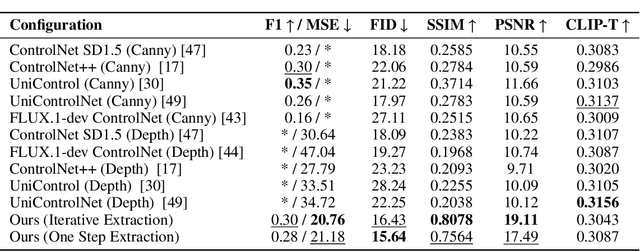
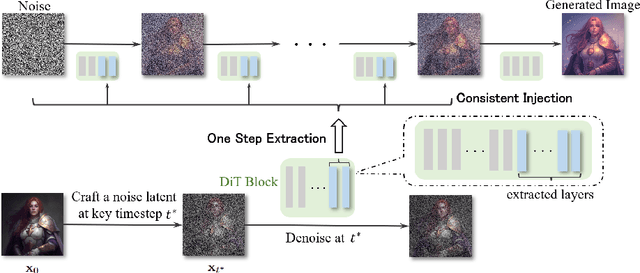
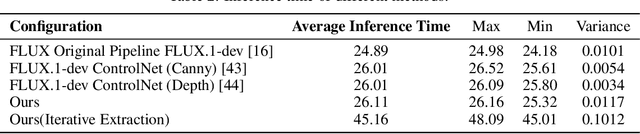
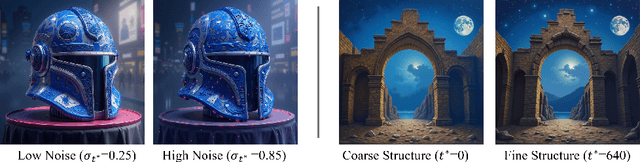
Controlling the spatial and semantic structure of diffusion-generated images remains a challenge. Existing methods like ControlNet rely on handcrafted condition maps and retraining, limiting flexibility and generalization. Inversion-based approaches offer stronger alignment but incur high inference cost due to dual-path denoising. We present FreeControl, a training-free framework for semantic structural control in diffusion models. Unlike prior methods that extract attention across multiple timesteps, FreeControl performs one-step attention extraction from a single, optimally chosen key timestep and reuses it throughout denoising. This enables efficient structural guidance without inversion or retraining. To further improve quality and stability, we introduce Latent-Condition Decoupling (LCD): a principled separation of the key timestep and the noised latent used in attention extraction. LCD provides finer control over attention quality and eliminates structural artifacts. FreeControl also supports compositional control via reference images assembled from multiple sources - enabling intuitive scene layout design and stronger prompt alignment. FreeControl introduces a new paradigm for test-time control, enabling structurally and semantically aligned, visually coherent generation directly from raw images, with the flexibility for intuitive compositional design and compatibility with modern diffusion models at approximately 5 percent additional cost.
OmniStyle: Filtering High Quality Style Transfer Data at Scale
May 20, 2025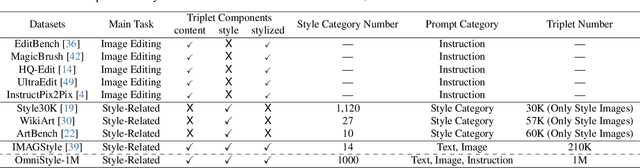
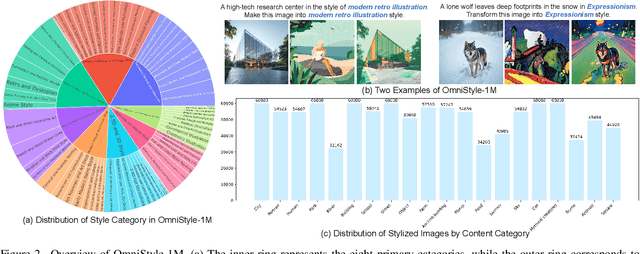
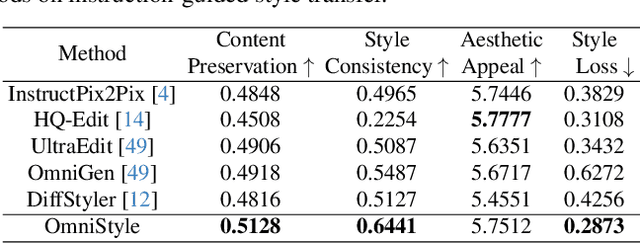
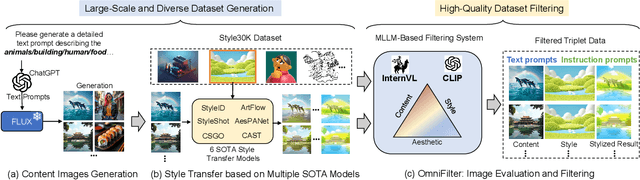
In this paper, we introduce OmniStyle-1M, a large-scale paired style transfer dataset comprising over one million content-style-stylized image triplets across 1,000 diverse style categories, each enhanced with textual descriptions and instruction prompts. We show that OmniStyle-1M can not only enable efficient and scalable of style transfer models through supervised training but also facilitate precise control over target stylization. Especially, to ensure the quality of the dataset, we introduce OmniFilter, a comprehensive style transfer quality assessment framework, which filters high-quality triplets based on content preservation, style consistency, and aesthetic appeal. Building upon this foundation, we propose OmniStyle, a framework based on the Diffusion Transformer (DiT) architecture designed for high-quality and efficient style transfer. This framework supports both instruction-guided and image-guided style transfer, generating high resolution outputs with exceptional detail. Extensive qualitative and quantitative evaluations demonstrate OmniStyle's superior performance compared to existing approaches, highlighting its efficiency and versatility. OmniStyle-1M and its accompanying methodologies provide a significant contribution to advancing high-quality style transfer, offering a valuable resource for the research community.
From Zero to Detail: Deconstructing Ultra-High-Definition Image Restoration from Progressive Spectral Perspective
Mar 17, 2025Ultra-high-definition (UHD) image restoration faces significant challenges due to its high resolution, complex content, and intricate details. To cope with these challenges, we analyze the restoration process in depth through a progressive spectral perspective, and deconstruct the complex UHD restoration problem into three progressive stages: zero-frequency enhancement, low-frequency restoration, and high-frequency refinement. Building on this insight, we propose a novel framework, ERR, which comprises three collaborative sub-networks: the zero-frequency enhancer (ZFE), the low-frequency restorer (LFR), and the high-frequency refiner (HFR). Specifically, the ZFE integrates global priors to learn global mapping, while the LFR restores low-frequency information, emphasizing reconstruction of coarse-grained content. Finally, the HFR employs our designed frequency-windowed kolmogorov-arnold networks (FW-KAN) to refine textures and details, producing high-quality image restoration. Our approach significantly outperforms previous UHD methods across various tasks, with extensive ablation studies validating the effectiveness of each component. The code is available at \href{https://github.com/NJU-PCALab/ERR}{here}.
Inversion-Free Video Style Transfer with Trajectory Reset Attention Control and Content-Style Bridging
Mar 10, 2025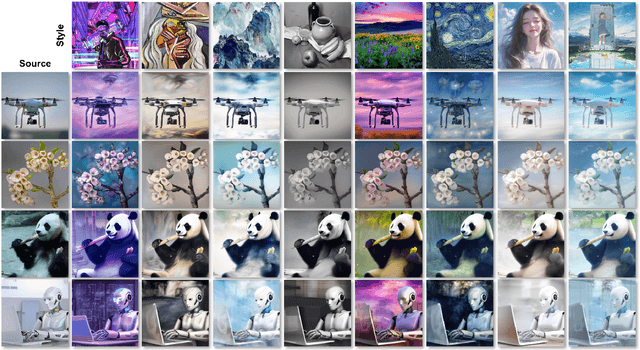

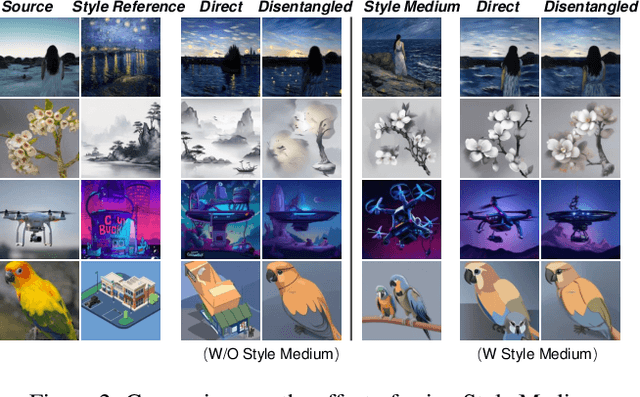
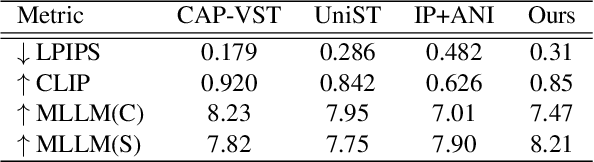
Video style transfer aims to alter the style of a video while preserving its content. Previous methods often struggle with content leakage and style misalignment, particularly when using image-driven approaches that aim to transfer precise styles. In this work, we introduce Trajectory Reset Attention Control (TRAC), a novel method that allows for high-quality style transfer while preserving content integrity. TRAC operates by resetting the denoising trajectory and enforcing attention control, thus enhancing content consistency while significantly reducing the computational costs against inversion-based methods. Additionally, a concept termed Style Medium is introduced to bridge the gap between content and style, enabling a more precise and harmonious transfer of stylistic elements. Building upon these concepts, we present a tuning-free framework that offers a stable, flexible, and efficient solution for both image and video style transfer. Experimental results demonstrate that our proposed framework accommodates a wide range of stylized outputs, from precise content preservation to the production of visually striking results with vibrant and expressive styles.