 Add to Chrome
 Add to Firefox
 Add to Edge
An Empirical Study of Training Pixel-Space Text-to-Image Diffusion Models
Aug 17, 2026
This paper investigates an increasingly important topic in generative modeling: pixel-space diffusion models. Although numerous studies have explored this topic, most focus on small-scale or class-conditional settings. Consequently, a practical recipe for training pixel-space models that rival or exceed well-established latent-space counterparts remains elusive. Through a comprehensive empirical study, we first observe that direct large-scale pre-training in pixel space converges substantially more slowly than in latent space. This observation motivates a latent-to-pixel strategy that acquires generative priors efficiently in latent space and transitions to pixel space during post-training. We then systematically investigate the key design choices governing this transition, including weight initialization, data composition, prediction target, decoder architecture, and noise schedule, and identify a practical recipe that makes the resulting pixel-space models match or outperform their latent-space counterparts while delivering 3.18 to 4.75 times end-to-end inference speedups. We hope that our findings provide useful empirical insights and practical guidelines for future research on pixel-space generation.

Learning Explicit Physical Parameter Control and Benchmarking for Video Generation
Jul 21, 2026Recent advances in image-to-video generation have improved visual realism, making physically grounded and controllable dynamics an important step toward future world simulation. Current models often generate plausible motion, but it is not reliably governed by explicit physical causes, and instance-level constraints can leak or become entangled in multi-object interactions. We attribute this gap to two missing pieces: large-scale, fine-grained physical parameterization, and model designs that correctly bind physical attributes to instances and emphasize dynamics over appearance. To bridge this gap, we introduce PhyParam-Dataset, an interaction-centric collection of 130K physically simulated videos with dense physical parameterization, including force vectors, object material properties, and environmental constants across five representative rigid-body motion types. Built on this data, we present PhyParam, a physics-guided image-to-video diffusion model that conditions on object-level forces, masses, friction, restitution, and scene-level gravity via a lightweight physical-attention routing mechanism, and further improves motion learning with semantic-structural feature-space supervision. We also establish PhyParam-Bench, a benchmark for physical-law consistency in image-to-video generation, with a multi-level protocol evaluating temporal dynamics, spatial stability, and semantic--physical alignment. Experiments show that PhyParam improves physical consistency while maintaining high visual fidelity, advancing explicit rigid-body physical-parameter control for image-to-video generation. We will publicly release the dataset, benchmark, and code to support future research.
Beyond Scalar Rewards by Internalizing Reasoning into Score Distributions
Jun 08, 2026Reward models are central to text-to-image post-training, but visual preference is subjective and better represented as a distribution over rubric scores than as a deterministic scalar. Existing scalar, score-token, and pairwise reward models over-compress uncertainty and fine-grained score differences, while reasoning-based generative rewards provide stronger judgments but are costly to deploy and difficult to use as direct optimization signals. We propose Z-Reward, a teacher-student reward modeling framework that decouples reasoning-heavy judgment from efficient reward deployment. The teacher is a large VLM that uses reasoning to infer rubric-aligned score distributions, and is trained with Group-wise Direct Score Optimization (GDSO), which combines policy-gradient rewards from distribution expectations with direct pointwise and pairwise supervision on score distributions and score gaps. The student is trained with Reasoning-Internalized Score Distillation (RISD), which transfers the teacher's reasoning-conditioned score distribution into a compact VLM without requiring explicit reasoning chains at inference time. On our internally annotated evaluation set, the 27B GDSO teacher reaches 89.6% human preference accuracy, outperforming SFT, RewardDance, and GRPO, while the 9B RISD student reaches 88.6%, outperforming the OPD baseline and closely matching the larger teacher. We further show that Z-Reward can serve as a differentiable reward signal for text-to-image optimization, yielding a 41.3% net human-preference improvement over the SFT baseline.
Extending One-Step Image Generation from Class Labels to Text via Discriminative Text Representation
Apr 20, 2026Few-step generation has been a long-standing goal, with recent one-step generation methods exemplified by MeanFlow achieving remarkable results. Existing research on MeanFlow primarily focuses on class-to-image generation. However, an intuitive yet unexplored direction is to extend the condition from fixed class labels to flexible text inputs, enabling richer content creation. Compared to the limited class labels, text conditions pose greater challenges to the model's understanding capability, necessitating the effective integration of powerful text encoders into the MeanFlow framework. Surprisingly, although incorporating text conditions appears straightforward, we find that integrating powerful LLM-based text encoders using conventional training strategies results in unsatisfactory performance. To uncover the underlying cause, we conduct detailed analyses and reveal that, due to the extremely limited number of refinement steps in the MeanFlow generation, such as only one step, the text feature representations are required to possess sufficiently high discriminability. This also explains why discrete and easily distinguishable class features perform well within the MeanFlow framework. Guided by these insights, we leverage a powerful LLM-based text encoder validated to possess the required semantic properties and adapt the MeanFlow generation process to this framework, resulting in efficient text-conditioned synthesis for the first time. Furthermore, we validate our approach on the widely used diffusion model, demonstrating significant generation performance improvements. We hope this work provides a general and practical reference for future research on text-conditioned MeanFlow generation. The code is available at https://github.com/AMAP-ML/EMF.
MAR-GRPO: Stabilized GRPO for AR-diffusion Hybrid Image Generation
Apr 08, 2026Reinforcement learning (RL) has been successfully applied to autoregressive (AR) and diffusion models. However, extending RL to hybrid AR-diffusion frameworks remains challenging due to interleaved inference and noisy log-probability estimation. In this work, we study masked autoregressive models (MAR) and show that the diffusion head plays a critical role in training dynamics, often introducing noisy gradients that lead to instability and early performance saturation. To address this issue, we propose a stabilized RL framework for MAR. We introduce multi-trajectory expectation (MTE), which estimates the optimization direction by averaging over multiple diffusion trajectories, thereby reducing diffusion-induced gradient noise. To avoid over-smoothing, we further estimate token-wise uncertainty from multiple trajectories and apply multi-trajectory optimization only to the top-k% uncertain tokens. In addition, we introduce a consistency-aware token selection strategy that filters out AR tokens that are less aligned with the final generated content. Extensive experiments across multiple benchmarks demonstrate that our method consistently improves visual quality, training stability, and spatial structure understanding over baseline GRPO and pre-RL models. Code is available at: https://github.com/AMAP-ML/mar-grpo.
ConceptWeaver: Weaving Disentangled Concepts with Flow
Mar 30, 2026Pre-trained flow-based models excel at synthesizing complex scenes yet lack a direct mechanism for disentangling and customizing their underlying concepts from one-shot real-world sources. To demystify this process, we first introduce a novel differential probing technique to isolate and analyze the influence of individual concept tokens on the velocity field over time. This investigation yields a critical insight: the generative process is not monolithic but unfolds in three distinct stages. An initial \textbf{Blueprint Stage} establishes low-frequency structure, followed by a pivotal \textbf{Instantiation Stage} where content concepts emerge with peak intensity and become naturally disentangled, creating an optimal window for manipulation. A final concept-insensitive refinement stage then synthesizes fine-grained details. Guided by this discovery, we propose \textbf{ConceptWeaver}, a framework for one-shot concept disentanglement. ConceptWeaver learns concept-specific semantic offsets from a single reference image using a stage-aware optimization strategy that aligns with the three-stage framework. These learned offsets are then deployed during inference via our novel ConceptWeaver Guidance (CWG) mechanism, which strategically injects them at the appropriate generative stage. Extensive experiments validate that ConceptWeaver enables high-fidelity, compositional synthesis and editing, demonstrating that understanding and leveraging the intrinsic, staged nature of flow models is key to unlocking precise, multi-granularity content manipulation.
Ranking-aware Reinforcement Learning for Ordinal Ranking
Jan 28, 2026Ordinal regression and ranking are challenging due to inherent ordinal dependencies that conventional methods struggle to model. We propose Ranking-Aware Reinforcement Learning (RARL), a novel RL framework that explicitly learns these relationships. At its core, RARL features a unified objective that synergistically integrates regression and Learning-to-Rank (L2R), enabling mutual improvement between the two tasks. This is driven by a ranking-aware verifiable reward that jointly assesses regression precision and ranking accuracy, facilitating direct model updates via policy optimization. To further enhance training, we introduce Response Mutation Operations (RMO), which inject controlled noise to improve exploration and prevent stagnation at saddle points. The effectiveness of RARL is validated through extensive experiments on three distinct benchmarks.
Taming Hallucinations: Boosting MLLMs' Video Understanding via Counterfactual Video Generation
Dec 30, 2025Multimodal Large Language Models (MLLMs) have made remarkable progress in video understanding. However, they suffer from a critical vulnerability: an over-reliance on language priors, which can lead to visual ungrounded hallucinations, especially when processing counterfactual videos that defy common sense. This limitation, stemming from the intrinsic data imbalance between text and video, is challenging to address due to the substantial cost of collecting and annotating counterfactual data. To address this, we introduce DualityForge, a novel counterfactual data synthesis framework that employs controllable, diffusion-based video editing to transform real-world videos into counterfactual scenarios. By embedding structured contextual information into the video editing and QA generation processes, the framework automatically produces high-quality QA pairs together with original-edited video pairs for contrastive training. Based on this, we build DualityVidQA, a large-scale video dataset designed to reduce MLLM hallucinations. In addition, to fully exploit the contrastive nature of our paired data, we propose Duality-Normalized Advantage Training (DNA-Train), a two-stage SFT-RL training regime where the RL phase applies pair-wise $\ell_1$ advantage normalization, thereby enabling a more stable and efficient policy optimization. Experiments on DualityVidQA-Test demonstrate that our method substantially reduces model hallucinations on counterfactual videos, yielding a relative improvement of 24.0% over the Qwen2.5-VL-7B baseline. Moreover, our approach achieves significant gains across both hallucination and general-purpose benchmarks, indicating strong generalization capability. We will open-source our dataset and code.
Omni-Effects: Unified and Spatially-Controllable Visual Effects Generation
Aug 12, 2025Visual effects (VFX) are essential visual enhancements fundamental to modern cinematic production. Although video generation models offer cost-efficient solutions for VFX production, current methods are constrained by per-effect LoRA training, which limits generation to single effects. This fundamental limitation impedes applications that require spatially controllable composite effects, i.e., the concurrent generation of multiple effects at designated locations. However, integrating diverse effects into a unified framework faces major challenges: interference from effect variations and spatial uncontrollability during multi-VFX joint training. To tackle these challenges, we propose Omni-Effects, a first unified framework capable of generating prompt-guided effects and spatially controllable composite effects. The core of our framework comprises two key innovations: (1) LoRA-based Mixture of Experts (LoRA-MoE), which employs a group of expert LoRAs, integrating diverse effects within a unified model while effectively mitigating cross-task interference. (2) Spatial-Aware Prompt (SAP) incorporates spatial mask information into the text token, enabling precise spatial control. Furthermore, we introduce an Independent-Information Flow (IIF) module integrated within the SAP, isolating the control signals corresponding to individual effects to prevent any unwanted blending. To facilitate this research, we construct a comprehensive VFX dataset Omni-VFX via a novel data collection pipeline combining image editing and First-Last Frame-to-Video (FLF2V) synthesis, and introduce a dedicated VFX evaluation framework for validating model performance. Extensive experiments demonstrate that Omni-Effects achieves precise spatial control and diverse effect generation, enabling users to specify both the category and location of desired effects.
VMBench: A Benchmark for Perception-Aligned Video Motion Generation
Mar 13, 2025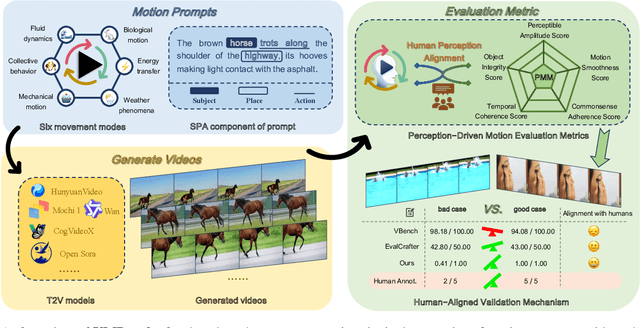
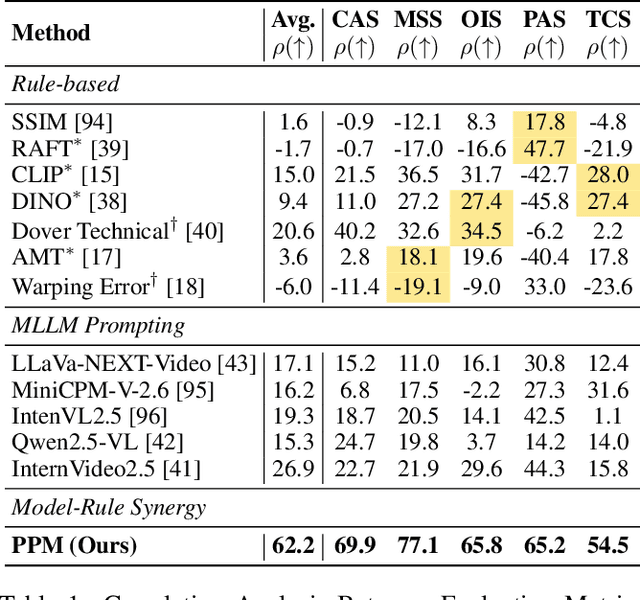
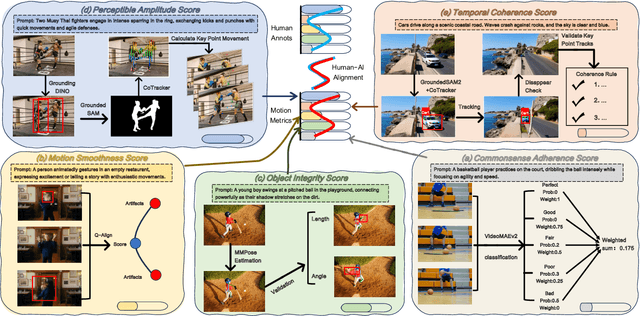
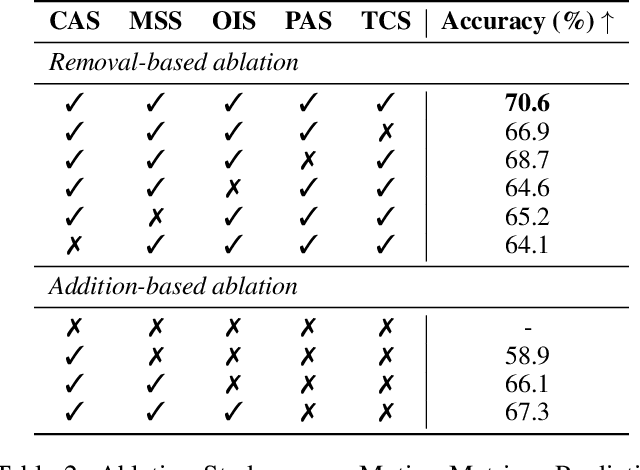
Video generation has advanced rapidly, improving evaluation methods, yet assessing video's motion remains a major challenge. Specifically, there are two key issues: 1) current motion metrics do not fully align with human perceptions; 2) the existing motion prompts are limited. Based on these findings, we introduce VMBench--a comprehensive Video Motion Benchmark that has perception-aligned motion metrics and features the most diverse types of motion. VMBench has several appealing properties: 1) Perception-Driven Motion Evaluation Metrics, we identify five dimensions based on human perception in motion video assessment and develop fine-grained evaluation metrics, providing deeper insights into models' strengths and weaknesses in motion quality. 2) Meta-Guided Motion Prompt Generation, a structured method that extracts meta-information, generates diverse motion prompts with LLMs, and refines them through human-AI validation, resulting in a multi-level prompt library covering six key dynamic scene dimensions. 3) Human-Aligned Validation Mechanism, we provide human preference annotations to validate our benchmarks, with our metrics achieving an average 35.3% improvement in Spearman's correlation over baseline methods. This is the first time that the quality of motion in videos has been evaluated from the perspective of human perception alignment. Additionally, we will soon release VMBench at https://github.com/GD-AIGC/VMBench, setting a new standard for evaluating and advancing motion generation models.