 Add to Chrome
 Add to Firefox
 Add to Edge
An Empirical Study of Training Pixel-Space Text-to-Image Diffusion Models
Aug 17, 2026
This paper investigates an increasingly important topic in generative modeling: pixel-space diffusion models. Although numerous studies have explored this topic, most focus on small-scale or class-conditional settings. Consequently, a practical recipe for training pixel-space models that rival or exceed well-established latent-space counterparts remains elusive. Through a comprehensive empirical study, we first observe that direct large-scale pre-training in pixel space converges substantially more slowly than in latent space. This observation motivates a latent-to-pixel strategy that acquires generative priors efficiently in latent space and transitions to pixel space during post-training. We then systematically investigate the key design choices governing this transition, including weight initialization, data composition, prediction target, decoder architecture, and noise schedule, and identify a practical recipe that makes the resulting pixel-space models match or outperform their latent-space counterparts while delivering 3.18 to 4.75 times end-to-end inference speedups. We hope that our findings provide useful empirical insights and practical guidelines for future research on pixel-space generation.

D-OPSD: On-Policy Self-Distillation for Continuously Tuning Step-Distilled Diffusion Models
May 06, 2026The landscape of high-performance image generation models is currently shifting from the inefficient multi-step ones to the efficient few-step counterparts (e.g, Z-Image-Turbo and FLUX.2-klein). However, these models present significant challenges for directly continuous supervised fine-tuning. For example, applying the commonly used fine-tuning technique would compromises their inherent few-step inference capability. To address this, we propose D-OPSD, a novel training paradigm for step-distilled diffusion models that enables on-policy learning during supervised fine-tuning. We first find that the modern diffusion model where the LLM/VLM serves as the encoder can inherit its encoder's in-context capabilities. This enables us to make the training as an on-policy self-distillation process. Specifically, during training, we make the model acts as both the teacher and the student with different contexts, where the student is conditioned only on the text feature, while the teacher is conditioned on the multimodal feature of both the text prompt and the target image. Training minimizes the two predicted distributions over the student's own roll-outs. By optimized on the model's own trajectory and under it's own supervision, D-OPSD enables the model to learn new concept, style, etc. without sacrificing the original few-step capacity.
Group Editing : Edit Multiple Images in One Go
Mar 25, 2026In this paper, we tackle the problem of performing consistent and unified modifications across a set of related images. This task is particularly challenging because these images may vary significantly in pose, viewpoint, and spatial layout. Achieving coherent edits requires establishing reliable correspondences across the images, so that modifications can be applied accurately to semantically aligned regions. To address this, we propose GroupEditing, a novel framework that builds both explicit and implicit relationships among images within a group. On the explicit side, we extract geometric correspondences using VGGT, which provides spatial alignment based on visual features. On the implicit side, we reformulate the image group as a pseudo-video and leverage the temporal coherence priors learned by pre-trained video models to capture latent relationships. To effectively fuse these two types of correspondences, we inject the explicit geometric cues from VGGT into the video model through a novel fusion mechanism. To support large-scale training, we construct GroupEditData, a new dataset containing high-quality masks and detailed captions for numerous image groups. Furthermore, to ensure identity preservation during editing, we introduce an alignment-enhanced RoPE module, which improves the model's ability to maintain consistent appearance across multiple images. Finally, we present GroupEditBench, a dedicated benchmark designed to evaluate the effectiveness of group-level image editing. Extensive experiments demonstrate that GroupEditing significantly outperforms existing methods in terms of visual quality, cross-view consistency, and semantic alignment.
Unified Video Editing with Temporal Reasoner
Dec 08, 2025Existing video editing methods face a critical trade-off: expert models offer precision but rely on task-specific priors like masks, hindering unification; conversely, unified temporal in-context learning models are mask-free but lack explicit spatial cues, leading to weak instruction-to-region mapping and imprecise localization. To resolve this conflict, we propose VideoCoF, a novel Chain-of-Frames approach inspired by Chain-of-Thought reasoning. VideoCoF enforces a ``see, reason, then edit" procedure by compelling the video diffusion model to first predict reasoning tokens (edit-region latents) before generating the target video tokens. This explicit reasoning step removes the need for user-provided masks while achieving precise instruction-to-region alignment and fine-grained video editing. Furthermore, we introduce a RoPE alignment strategy that leverages these reasoning tokens to ensure motion alignment and enable length extrapolation beyond the training duration. We demonstrate that with a minimal data cost of only 50k video pairs, VideoCoF achieves state-of-the-art performance on VideoCoF-Bench, validating the efficiency and effectiveness of our approach. Our code, weight, data are available at https://github.com/knightyxp/VideoCoF.
VideoGrain: Modulating Space-Time Attention for Multi-grained Video Editing
Feb 24, 2025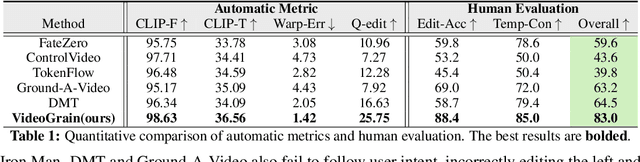
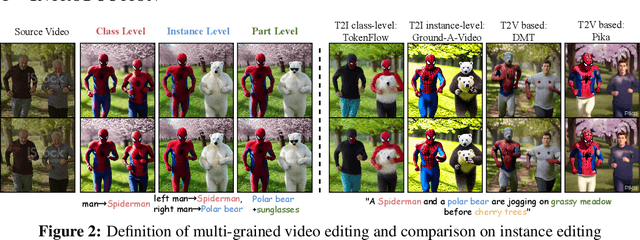
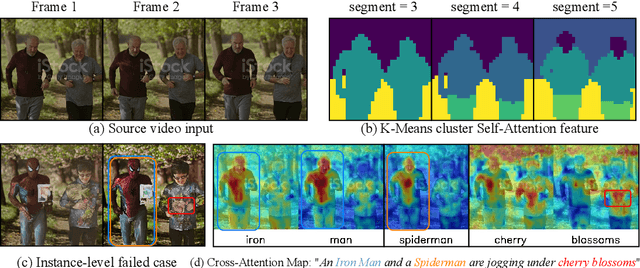

Recent advancements in diffusion models have significantly improved video generation and editing capabilities. However, multi-grained video editing, which encompasses class-level, instance-level, and part-level modifications, remains a formidable challenge. The major difficulties in multi-grained editing include semantic misalignment of text-to-region control and feature coupling within the diffusion model. To address these difficulties, we present VideoGrain, a zero-shot approach that modulates space-time (cross- and self-) attention mechanisms to achieve fine-grained control over video content. We enhance text-to-region control by amplifying each local prompt's attention to its corresponding spatial-disentangled region while minimizing interactions with irrelevant areas in cross-attention. Additionally, we improve feature separation by increasing intra-region awareness and reducing inter-region interference in self-attention. Extensive experiments demonstrate our method achieves state-of-the-art performance in real-world scenarios. Our code, data, and demos are available at https://knightyxp.github.io/VideoGrain_project_page/
EVA: Zero-shot Accurate Attributes and Multi-Object Video Editing
Mar 24, 2024Current diffusion-based video editing primarily focuses on local editing (\textit{e.g.,} object/background editing) or global style editing by utilizing various dense correspondences. However, these methods often fail to accurately edit the foreground and background simultaneously while preserving the original layout. We find that the crux of the issue stems from the imprecise distribution of attention weights across designated regions, including inaccurate text-to-attribute control and attention leakage. To tackle this issue, we introduce EVA, a \textbf{zero-shot} and \textbf{multi-attribute} video editing framework tailored for human-centric videos with complex motions. We incorporate a Spatial-Temporal Layout-Guided Attention mechanism that leverages the intrinsic positive and negative correspondences of cross-frame diffusion features. To avoid attention leakage, we utilize these correspondences to boost the attention scores of tokens within the same attribute across all video frames while limiting interactions between tokens of different attributes in the self-attention layer. For precise text-to-attribute manipulation, we use discrete text embeddings focused on specific layout areas within the cross-attention layer. Benefiting from the precise attention weight distribution, EVA can be easily generalized to multi-object editing scenarios and achieves accurate identity mapping. Extensive experiments demonstrate EVA achieves state-of-the-art results in real-world scenarios. Full results are provided at https://knightyxp.github.io/EVA/
DGL: Dynamic Global-Local Prompt Tuning for Text-Video Retrieval
Jan 19, 2024Text-video retrieval is a critical multi-modal task to find the most relevant video for a text query. Although pretrained models like CLIP have demonstrated impressive potential in this area, the rising cost of fully finetuning these models due to increasing model size continues to pose a problem. To address this challenge, prompt tuning has emerged as an alternative. However, existing works still face two problems when adapting pretrained image-text models to downstream video-text tasks: (1) The visual encoder could only encode frame-level features and failed to extract global-level general video information. (2) Equipping the visual and text encoder with separated prompts failed to mitigate the visual-text modality gap. To this end, we propose DGL, a cross-modal Dynamic prompt tuning method with Global-Local video attention. In contrast to previous prompt tuning methods, we employ the shared latent space to generate local-level text and frame prompts that encourage inter-modal interaction. Furthermore, we propose modeling video in a global-local attention mechanism to capture global video information from the perspective of prompt tuning. Extensive experiments reveal that when only 0.67% parameters are tuned, our cross-modal prompt tuning strategy DGL outperforms or is comparable to fully finetuning methods on MSR-VTT, VATEX, LSMDC, and ActivityNet datasets. Code will be available at https://github.com/knightyxp/DGL