 Add to Chrome
 Add to Firefox
 Add to Edge
JAVEDIT: Joint Audio-Visual Instruction-Guided Video Editing with Agentic Data Curation
Jun 02, 2026
While instruction-based video editing has seen significant progress, joint audio-visual editing remains constrained by the absence of dedicated datasets and benchmarks. To bridge this gap, we present JAVEdit-100k, the first large-scale, high-quality dataset tailored for instruction-guided joint audio-visual editing. Focusing on human-centric videos, JAVEdit-100k comprises approximately 100K editing triplets spanning five distinct categories, including subject editing and speech editing. This dataset is rigorously constructed via four meticulously designed generation pipelines, seamlessly paired with an agent-in-the-loop quality control mechanism. Furthermore, to address the lack of standardized evaluation within the field, we introduce JAVEditBench, a comprehensive benchmark featuring curated source videos and human-aligned instructions across all editing categories. Finally, we propose JAVEdit, a pioneering baseline model for instruction-guided joint audio-visual editing. Experiments show that \model\ outperforms all baselines on five of six evaluation metrics.

FlyMirage: A Fully Automated Generation Pipeline for Diverse and Scalable UAV Flight Data via Generative World Model
May 19, 2026In the field of Vision-Language Navigation (VLN), aerial datasets remain limited in their ability to combine scale, diversity, and realism, often relying on either costly real-world scenes or visually limited simulations. To address these challenges, we introduce FlyMirage, a highly scalable and fully automated data generation pipeline for aerial VLN. Our approach leverages large language models (LLM) as an environment designer to promote scene diversity, paired with a generative world model that instantiates these designs into high-fidelity 3D Gaussian Splatting (3DGS) scenes. To substantially reduce human labor and ensure the feasibility of flight data, FlyMirage automates scene exploration and semantic information acquisition, and further integrates a dynamically feasible planner for uncrewed aerial vehicle (UAV) trajectory generation. Utilizing this toolchain, we generate a large-scale, diverse, and photorealistic aerial VLN dataset, with dynamically feasible flying trajectories, designed to support the development of next-generation embodied navigation models.
NavDreamer: Video Models as Zero-Shot 3D Navigators
Feb 10, 2026Previous Vision-Language-Action models face critical limitations in navigation: scarce, diverse data from labor-intensive collection and static representations that fail to capture temporal dynamics and physical laws. We propose NavDreamer, a video-based framework for 3D navigation that leverages generative video models as a universal interface between language instructions and navigation trajectories. Our main hypothesis is that video's ability to encode spatiotemporal information and physical dynamics, combined with internet-scale availability, enables strong zero-shot generalization in navigation. To mitigate the stochasticity of generative predictions, we introduce a sampling-based optimization method that utilizes a VLM for trajectory scoring and selection. An inverse dynamics model is employed to decode executable waypoints from generated video plans for navigation. To systematically evaluate this paradigm in several video model backbones, we introduce a comprehensive benchmark covering object navigation, precise navigation, spatial grounding, language control, and scene reasoning. Extensive experiments demonstrate robust generalization across novel objects and unseen environments, with ablation studies revealing that navigation's high-level decision-making nature makes it particularly suited for video-based planning.
FFP-300K: Scaling First-Frame Propagation for Generalizable Video Editing
Jan 06, 2026First-Frame Propagation (FFP) offers a promising paradigm for controllable video editing, but existing methods are hampered by a reliance on cumbersome run-time guidance. We identify the root cause of this limitation as the inadequacy of current training datasets, which are often too short, low-resolution, and lack the task diversity required to teach robust temporal priors. To address this foundational data gap, we first introduce FFP-300K, a new large-scale dataset comprising 300K high-fidelity video pairs at 720p resolution and 81 frames in length, constructed via a principled two-track pipeline for diverse local and global edits. Building on this dataset, we propose a novel framework designed for true guidance-free FFP that resolves the critical tension between maintaining first-frame appearance and preserving source video motion. Architecturally, we introduce Adaptive Spatio-Temporal RoPE (AST-RoPE), which dynamically remaps positional encodings to disentangle appearance and motion references. At the objective level, we employ a self-distillation strategy where an identity propagation task acts as a powerful regularizer, ensuring long-term temporal stability and preventing semantic drift. Comprehensive experiments on the EditVerseBench benchmark demonstrate that our method significantly outperforming existing academic and commercial models by receiving about 0.2 PickScore and 0.3 VLM score improvement against these competitors.
Flying in Clutter on Monocular RGB by Learning in 3D Radiance Fields with Domain Adaptation
Dec 19, 2025Modern autonomous navigation systems predominantly rely on lidar and depth cameras. However, a fundamental question remains: Can flying robots navigate in clutter using solely monocular RGB images? Given the prohibitive costs of real-world data collection, learning policies in simulation offers a promising path. Yet, deploying such policies directly in the physical world is hindered by the significant sim-to-real perception gap. Thus, we propose a framework that couples the photorealism of 3D Gaussian Splatting (3DGS) environments with Adversarial Domain Adaptation. By training in high-fidelity simulation while explicitly minimizing feature discrepancy, our method ensures the policy relies on domain-invariant cues. Experimental results demonstrate that our policy achieves robust zero-shot transfer to the physical world, enabling safe and agile flight in unstructured environments with varying illumination.
A 28nm 0.22 μJ/token memory-compute-intensity-aware CNN-Transformer accelerator with hybrid-attention-based layer-fusion and cascaded pruning for semanticsegmentation
Dec 19, 2025This work presents a 28nm 13.93mm2 CNN-Transformer accelerator for semantic segmentation, achieving 3.86-to-10.91x energy reduction over previous designs. It features a hybrid attention unit, layer-fusion scheduler, and cascaded feature-map pruner, with peak energy efficiency of 52.90TOPS/W (INT8).
* 3 pages,7 pages, 2025 IEEE International Solid-State Circuits Conference (ISSCC)
Reactive Aerobatic Flight via Reinforcement Learning
May 30, 2025Quadrotors have demonstrated remarkable versatility, yet their full aerobatic potential remains largely untapped due to inherent underactuation and the complexity of aggressive maneuvers. Traditional approaches, separating trajectory optimization and tracking control, suffer from tracking inaccuracies, computational latency, and sensitivity to initial conditions, limiting their effectiveness in dynamic, high-agility scenarios. Inspired by recent breakthroughs in data-driven methods, we propose a reinforcement learning-based framework that directly maps drone states and aerobatic intentions to control commands, eliminating modular separation to enable quadrotors to perform end-to-end policy optimization for extreme aerobatic maneuvers. To ensure efficient and stable training, we introduce an automated curriculum learning strategy that dynamically adjusts aerobatic task difficulty. Enabled by domain randomization for robust zero-shot sim-to-real transfer, our approach is validated in demanding real-world experiments, including the first demonstration of a drone autonomously performing continuous inverted flight while reactively navigating a moving gate, showcasing unprecedented agility.
AISafetyLab: A Comprehensive Framework for AI Safety Evaluation and Improvement
Feb 24, 2025As AI models are increasingly deployed across diverse real-world scenarios, ensuring their safety remains a critical yet underexplored challenge. While substantial efforts have been made to evaluate and enhance AI safety, the lack of a standardized framework and comprehensive toolkit poses significant obstacles to systematic research and practical adoption. To bridge this gap, we introduce AISafetyLab, a unified framework and toolkit that integrates representative attack, defense, and evaluation methodologies for AI safety. AISafetyLab features an intuitive interface that enables developers to seamlessly apply various techniques while maintaining a well-structured and extensible codebase for future advancements. Additionally, we conduct empirical studies on Vicuna, analyzing different attack and defense strategies to provide valuable insights into their comparative effectiveness. To facilitate ongoing research and development in AI safety, AISafetyLab is publicly available at https://github.com/thu-coai/AISafetyLab, and we are committed to its continuous maintenance and improvement.
SnapGen: Taming High-Resolution Text-to-Image Models for Mobile Devices with Efficient Architectures and Training
Dec 12, 2024Existing text-to-image (T2I) diffusion models face several limitations, including large model sizes, slow runtime, and low-quality generation on mobile devices. This paper aims to address all of these challenges by developing an extremely small and fast T2I model that generates high-resolution and high-quality images on mobile platforms. We propose several techniques to achieve this goal. First, we systematically examine the design choices of the network architecture to reduce model parameters and latency, while ensuring high-quality generation. Second, to further improve generation quality, we employ cross-architecture knowledge distillation from a much larger model, using a multi-level approach to guide the training of our model from scratch. Third, we enable a few-step generation by integrating adversarial guidance with knowledge distillation. For the first time, our model SnapGen, demonstrates the generation of 1024x1024 px images on a mobile device around 1.4 seconds. On ImageNet-1K, our model, with only 372M parameters, achieves an FID of 2.06 for 256x256 px generation. On T2I benchmarks (i.e., GenEval and DPG-Bench), our model with merely 379M parameters, surpasses large-scale models with billions of parameters at a significantly smaller size (e.g., 7x smaller than SDXL, 14x smaller than IF-XL).
SynthVLM: High-Efficiency and High-Quality Synthetic Data for Vision Language Models
Aug 01, 2024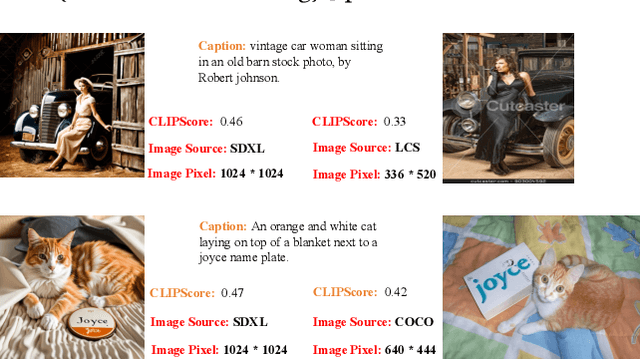


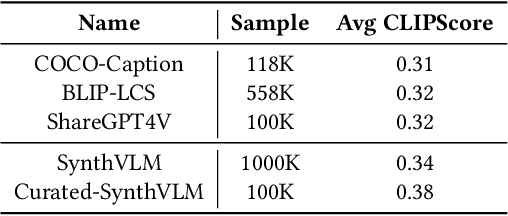
Recently, with the rise of web images, managing and understanding large-scale image datasets has become increasingly important. Vision Large Language Models (VLLMs) have recently emerged due to their robust vision-understanding capabilities. However, training these models requires vast amounts of data, posing challenges to efficiency, effectiveness, data quality, and privacy. In this paper, we introduce SynthVLM, a novel data synthesis pipeline for VLLMs. Unlike existing methods that generate captions from images, SynthVLM employs advanced diffusion models and high-quality captions to automatically generate and select high-resolution images from captions, creating precisely aligned image-text pairs. Leveraging these pairs, we achieve state-of-the-art (SoTA) performance on various vision question answering tasks, maintaining high alignment quality and preserving advanced language abilities. Moreover, SynthVLM surpasses traditional GPT-4 Vision-based caption generation methods in performance while significantly reducing computational overhead. Crucially, our method's reliance on purely generated data ensures the preservation of privacy, achieving SoTA performance with just 100k data points (only 18% of the official dataset size).