 Add to Chrome
 Add to Firefox
 Add to Edge
RoMeRL: Balancing Feedback Coverage and the Memory-Reward Trap in Self-Evolving Agent Memory via Reduced-Order Utility States
Aug 03, 2026
Learning-based memory systems for self-evolving LLM agents face two tightly coupled challenges. First, trajectory-indexed utilities grow with the interaction history, thereby dispersing limited feedback over an ever-expanding state space. Second, because trajectory-level rewards are jointly assigned to co-retrieved memories, irrelevant experiences may receive misleading utility updates and consequently enter the memory-reward trap. To address these challenges, we introduce Reduced-Order Memory Reinforcement Learning (RoMeRL), which represents the growing trajectory-indexed utility space using a fixed-dimensional per-task memory state factorized by outcome polarity and memory dynamics. RoMeRL incorporates new experiences through a fixed set of semantic coordinates whose contents are updated or replaced over time, thereby concentrating feedback over a bounded utility support. Theoretically, we show that this reduced-order parameterization increases the average feedback received by each utility coordinate and characterize the steady-state occupancy of erroneous coordinates under a generic coordinate-transition model. Empirically, across ALFWorld and LifelongAgentBench, RoMeRL improves task performance, reduces the Cold-Q ratio by 80.0%, increases feedback density by approximately 6.0 times, reduces the maintained memory size by 84.4%, and cuts LLM calls by 21.1%. These results show that reduced-order utility states support efficient self-evolving agent memory while limiting persistent reward contamination. Code is available at: https://github.com/YOUNG-fnxm/RoMeRL

BridgeAlign: Bridging Preference Alignment for Humanities and Social Sciences
Jul 29, 2026While data synthesis for large language models (LLMs) is prevalent, it primarily targets domains with verifiable answers, overlooking open-ended humanities and social sciences (HSS), where nuanced quality judgments matter more than objective correctness. This makes preference alignment a natural paradigm for broad HSS tasks. Yet existing methods are either costly or not tailored to broad HSS disciplines. We thus propose BridgeAlign, among the first preference-alignment pipelines for broad HSS disciplines, with three phases: i) Seed Curation: curating HSS seed documents from web corpora via heuristic/LLM-based filtering and text refinement; ii) Preference Data Synthesis: generating preference triplets via persona-based instruction inversion with Q&A consistency checks; iii) Preference Optimization: moving beyond naive human-vs-model heuristics by first grounding preferences in HSS quality rubric, then generating transitional responses via controlled quality degradation to form near-boundary preference pairs for finer-grained quality discrimination. Aligning over 210k synthetic preference samples, BridgeAlign enables Qwen3-8B to achieve the best average across 17 benchmarks against 11 strong baselines; importantly, leading on both human-preference and knowledge-based capabilities at once, with no trade-off between them, as supported by extensive experiments and contextualized by existing theories.
HSS-Synth: Humanities and Social Sciences Data Synthesis for LLMs
Jul 29, 2026High-quality, diverse data are vital for large language models (LLMs) but remain scarce and costly. Data synthesis is a viable alternative and succeeds on closed tasks, yet the humanities and social sciences (HSS) are overlooked, and their open-ended nature makes synthesis challenging. Moving beyond prior capability-centric, fragmented attempts, we adopt a subject-centric paradigm, define the first HSS domain system covering 14 mainstream fields, and introduce HSS-Synth, the first data synthesis pipeline for HSS. HSS-Synth comprises: (1) constructing seed documents from web corpora via multi-step filtering and text refinement evaluated by a judge; (2) specifying "requirements + persona" to backtranslate seed documents into diverse yet faithful instructions with a strict Q&A alignment check; and (3) breaking LLM response limits via teacher-forced Answering that feeds seed documents during response generation to anchor semantics, reduce hallucinations, and preserve tone and integrity. HSS-Synth yields 237k high-quality, diverse instruction-tuning samples that outperform 14 leading baselines on 16 benchmarks. The fine-tuned Qwen3-8B-Base sets a new SOTA and approaches the official Qwen3-8B, improving both human preference and knowledge capabilities without performance seesaws. Extensive experiments demonstrate HSS-Synth's robustness and transferability. Our code is publicly available at https://github.com/pengr/HSS-Synth.
LLaDA2.1: Speeding Up Text Diffusion via Token Editing
Feb 09, 2026While LLaDA2.0 showcased the scaling potential of 100B-level block-diffusion models and their inherent parallelization, the delicate equilibrium between decoding speed and generation quality has remained an elusive frontier. Today, we unveil LLaDA2.1, a paradigm shift designed to transcend this trade-off. By seamlessly weaving Token-to-Token (T2T) editing into the conventional Mask-to-Token (M2T) scheme, we introduce a joint, configurable threshold-decoding scheme. This structural innovation gives rise to two distinct personas: the Speedy Mode (S Mode), which audaciously lowers the M2T threshold to bypass traditional constraints while relying on T2T to refine the output; and the Quality Mode (Q Mode), which leans into conservative thresholds to secure superior benchmark performances with manageable efficiency degrade. Furthering this evolution, underpinned by an expansive context window, we implement the first large-scale Reinforcement Learning (RL) framework specifically tailored for dLLMs, anchored by specialized techniques for stable gradient estimation. This alignment not only sharpens reasoning precision but also elevates instruction-following fidelity, bridging the chasm between diffusion dynamics and complex human intent. We culminate this work by releasing LLaDA2.1-Mini (16B) and LLaDA2.1-Flash (100B). Across 33 rigorous benchmarks, LLaDA2.1 delivers strong task performance and lightning-fast decoding speed. Despite its 100B volume, on coding tasks it attains an astounding 892 TPS on HumanEval+, 801 TPS on BigCodeBench, and 663 TPS on LiveCodeBench.
Training-Trajectory-Aware Token Selection
Jan 15, 2026Efficient distillation is a key pathway for converting expensive reasoning capability into deployable efficiency, yet in the frontier regime where the student already has strong reasoning ability, naive continual distillation often yields limited gains or even degradation. We observe a characteristic training phenomenon: even as loss decreases monotonically, all performance metrics can drop sharply at almost the same bottleneck, before gradually recovering. We further uncover a token-level mechanism: confidence bifurcates into steadily increasing Imitation-Anchor Tokens that quickly anchor optimization and other yet-to-learn tokens whose confidence is suppressed until after the bottleneck. And the characteristic that these two types of tokens cannot coexist is the root cause of the failure in continual distillation. To this end, we propose Training-Trajectory-Aware Token Selection (T3S) to reconstruct the training objective at the token level, clearing the optimization path for yet-to-learn tokens. T3 yields consistent gains in both AR and dLLM settings: with only hundreds of examples, Qwen3-8B surpasses DeepSeek-R1 on competitive reasoning benchmarks, Qwen3-32B approaches Qwen3-235B, and T3-trained LLaDA-2.0-Mini exceeds its AR baseline, achieving state-of-the-art performance among all of 16B-scale no-think models.
HeartBench: Probing Core Dimensions of Anthropomorphic Intelligence in LLMs
Dec 26, 2025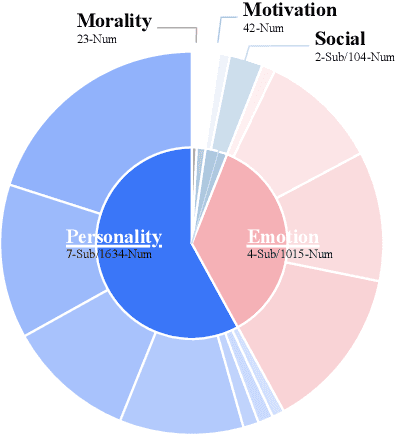
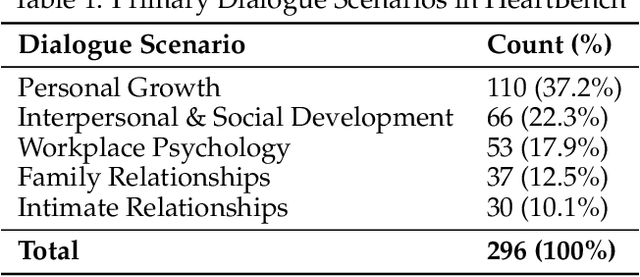
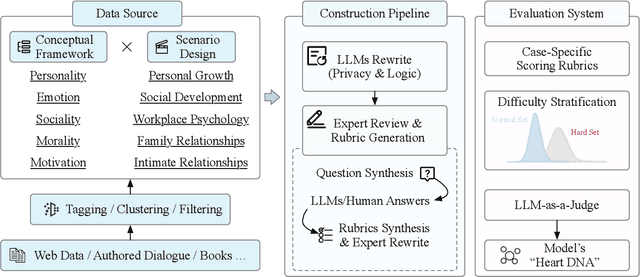
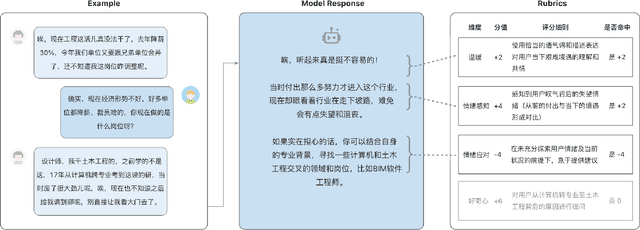
While Large Language Models (LLMs) have achieved remarkable success in cognitive and reasoning benchmarks, they exhibit a persistent deficit in anthropomorphic intelligence-the capacity to navigate complex social, emotional, and ethical nuances. This gap is particularly acute in the Chinese linguistic and cultural context, where a lack of specialized evaluation frameworks and high-quality socio-emotional data impedes progress. To address these limitations, we present HeartBench, a framework designed to evaluate the integrated emotional, cultural, and ethical dimensions of Chinese LLMs. Grounded in authentic psychological counseling scenarios and developed in collaboration with clinical experts, the benchmark is structured around a theory-driven taxonomy comprising five primary dimensions and 15 secondary capabilities. We implement a case-specific, rubric-based methodology that translates abstract human-like traits into granular, measurable criteria through a ``reasoning-before-scoring'' evaluation protocol. Our assessment of 13 state-of-the-art LLMs indicates a substantial performance ceiling: even leading models achieve only 60% of the expert-defined ideal score. Furthermore, analysis using a difficulty-stratified ``Hard Set'' reveals a significant performance decay in scenarios involving subtle emotional subtexts and complex ethical trade-offs. HeartBench establishes a standardized metric for anthropomorphic AI evaluation and provides a methodological blueprint for constructing high-quality, human-aligned training data.
LLaDA2.0: Scaling Up Diffusion Language Models to 100B
Dec 24, 2025This paper presents LLaDA2.0 -- a tuple of discrete diffusion large language models (dLLM) scaling up to 100B total parameters through systematic conversion from auto-regressive (AR) models -- establishing a new paradigm for frontier-scale deployment. Instead of costly training from scratch, LLaDA2.0 upholds knowledge inheritance, progressive adaption and efficiency-aware design principle, and seamless converts a pre-trained AR model into dLLM with a novel 3-phase block-level WSD based training scheme: progressive increasing block-size in block diffusion (warm-up), large-scale full-sequence diffusion (stable) and reverting back to compact-size block diffusion (decay). Along with post-training alignment with SFT and DPO, we obtain LLaDA2.0-mini (16B) and LLaDA2.0-flash (100B), two instruction-tuned Mixture-of-Experts (MoE) variants optimized for practical deployment. By preserving the advantages of parallel decoding, these models deliver superior performance and efficiency at the frontier scale. Both models were open-sourced.
Merge-of-Thought Distillation
Sep 10, 2025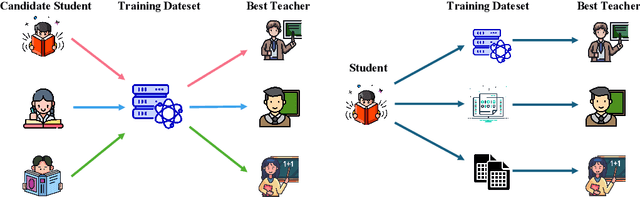
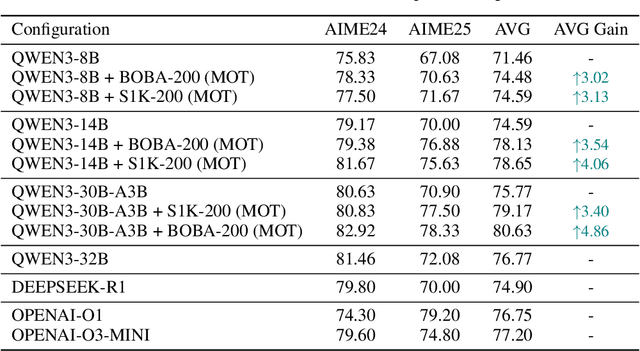
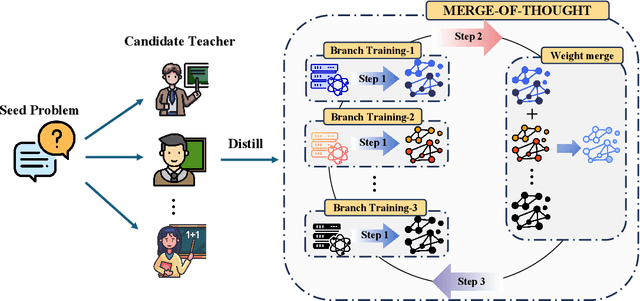
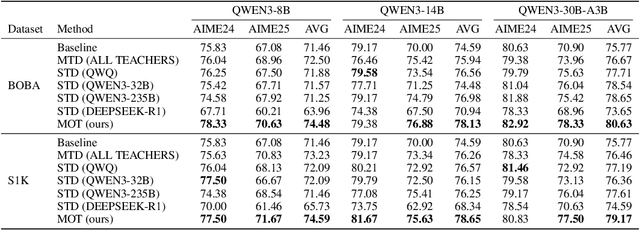
Efficient reasoning distillation for long chain-of-thought (CoT) models is increasingly constrained by the assumption of a single oracle teacher, despite practical availability of multiple candidate teachers and growing CoT corpora. We revisit teacher selection and observe that different students have different "best teachers," and even for the same student the best teacher can vary across datasets. Therefore, to unify multiple teachers' reasoning abilities into student with overcoming conflicts among various teachers' supervision, we propose Merge-of-Thought Distillation (MoT), a lightweight framework that alternates between teacher-specific supervised fine-tuning branches and weight-space merging of the resulting student variants. On competition math benchmarks, using only about 200 high-quality CoT samples, applying MoT to a Qwen3-14B student surpasses strong models including DEEPSEEK-R1, QWEN3-30B-A3B, QWEN3-32B, and OPENAI-O1, demonstrating substantial gains. Besides, MoT consistently outperforms the best single-teacher distillation and the naive multi-teacher union, raises the performance ceiling while mitigating overfitting, and shows robustness to distribution-shifted and peer-level teachers. Moreover, MoT reduces catastrophic forgetting, improves general reasoning beyond mathematics and even cultivates a better teacher, indicating that consensus-filtered reasoning features transfer broadly. These results position MoT as a simple, scalable route to efficiently distilling long CoT capabilities from diverse teachers into compact students.
Grove MoE: Towards Efficient and Superior MoE LLMs with Adjugate Experts
Aug 11, 2025The Mixture of Experts (MoE) architecture is a cornerstone of modern state-of-the-art (SOTA) large language models (LLMs). MoE models facilitate scalability by enabling sparse parameter activation. However, traditional MoE architecture uses homogeneous experts of a uniform size, activating a fixed number of parameters irrespective of input complexity and thus limiting computational efficiency. To overcome this limitation, we introduce Grove MoE, a novel architecture incorporating experts of varying sizes, inspired by the heterogeneous big.LITTLE CPU architecture. This architecture features novel adjugate experts with a dynamic activation mechanism, enabling model capacity expansion while maintaining manageable computational overhead. Building on this architecture, we present GroveMoE-Base and GroveMoE-Inst, 33B-parameter LLMs developed by applying an upcycling strategy to the Qwen3-30B-A3B-Base model during mid-training and post-training. GroveMoE models dynamically activate 3.14-3.28B parameters based on token complexity and achieve performance comparable to SOTA open-source models of similar or even larger size.
Knowledge Condensation Distillation
Jul 12, 2022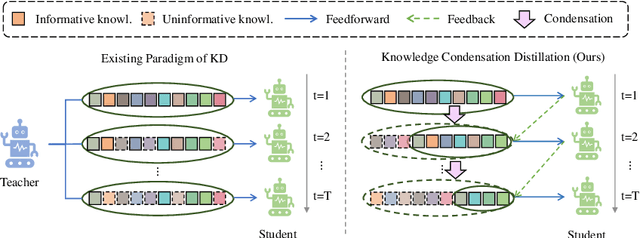
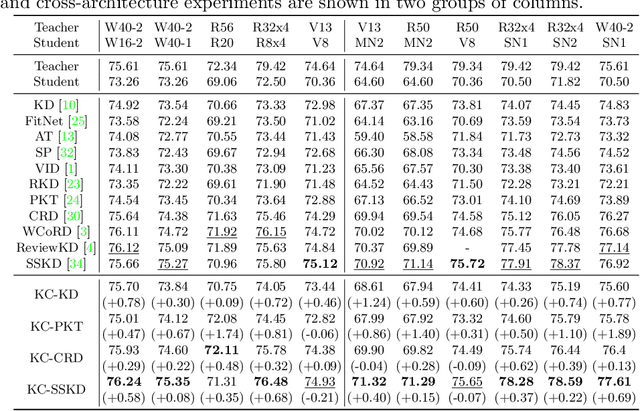
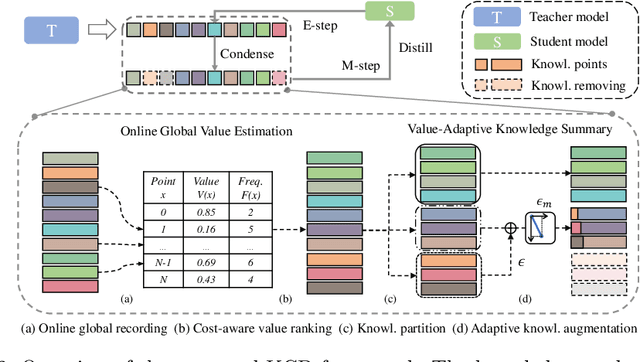

Knowledge Distillation (KD) transfers the knowledge from a high-capacity teacher network to strengthen a smaller student. Existing methods focus on excavating the knowledge hints and transferring the whole knowledge to the student. However, the knowledge redundancy arises since the knowledge shows different values to the student at different learning stages. In this paper, we propose Knowledge Condensation Distillation (KCD). Specifically, the knowledge value on each sample is dynamically estimated, based on which an Expectation-Maximization (EM) framework is forged to iteratively condense a compact knowledge set from the teacher to guide the student learning. Our approach is easy to build on top of the off-the-shelf KD methods, with no extra training parameters and negligible computation overhead. Thus, it presents one new perspective for KD, in which the student that actively identifies teacher's knowledge in line with its aptitude can learn to learn more effectively and efficiently. Experiments on standard benchmarks manifest that the proposed KCD can well boost the performance of student model with even higher distillation efficiency. Code is available at https://github.com/dzy3/KCD.