 Add to Chrome
 Add to Firefox
 Add to Edge
FLAME: Learning to Navigate with Multimodal LLM in Urban Environments
Aug 20, 2024
Large Language Models (LLMs) have demonstrated potential in Vision-and-Language Navigation (VLN) tasks, yet current applications face challenges. While LLMs excel in general conversation scenarios, they struggle with specialized navigation tasks, yielding suboptimal performance compared to specialized VLN models. We introduce FLAME (FLAMingo-Architected Embodied Agent), a novel Multimodal LLM-based agent and architecture designed for urban VLN tasks that efficiently handles multiple observations. Our approach implements a three-phase tuning technique for effective adaptation to navigation tasks, including single perception tuning for street view description, multiple perception tuning for trajectory summarization, and end-to-end training on VLN datasets. The augmented datasets are synthesized automatically. Experimental results demonstrate FLAME's superiority over existing methods, surpassing state-of-the-art methods by a 7.3% increase in task completion rate on Touchdown dataset. This work showcases the potential of Multimodal LLMs (MLLMs) in complex navigation tasks, representing an advancement towards practical applications of MLLMs in embodied AI. Project page: https://flame-sjtu.github.io

Differential Private Stochastic Optimization with Heavy-tailed Data: Towards Optimal Rates
Aug 19, 2024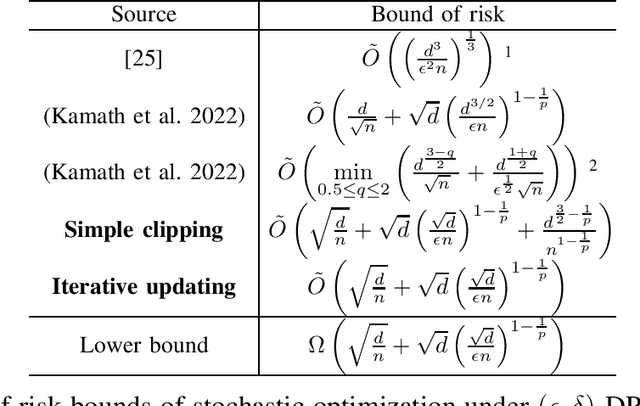
We study convex optimization problems under differential privacy (DP). With heavy-tailed gradients, existing works achieve suboptimal rates. The main obstacle is that existing gradient estimators have suboptimal tail properties, resulting in a superfluous factor of $d$ in the union bound. In this paper, we explore algorithms achieving optimal rates of DP optimization with heavy-tailed gradients. Our first method is a simple clipping approach. Under bounded $p$-th order moments of gradients, with $n$ samples, it achieves $\tilde{O}(\sqrt{d/n}+\sqrt{d}(\sqrt{d}/n\epsilon)^{1-1/p})$ population risk with $\epsilon\leq 1/\sqrt{d}$. We then propose an iterative updating method, which is more complex but achieves this rate for all $\epsilon\leq 1$. The results significantly improve over existing methods. Such improvement relies on a careful treatment of the tail behavior of gradient estimators. Our results match the minimax lower bound in \cite{kamath2022improved}, indicating that the theoretical limit of stochastic convex optimization under DP is achievable.
Contextual Bandits for Unbounded Context Distributions
Aug 19, 2024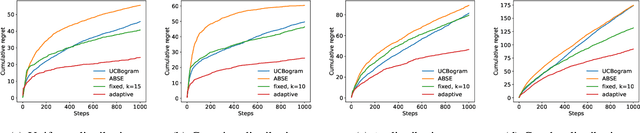
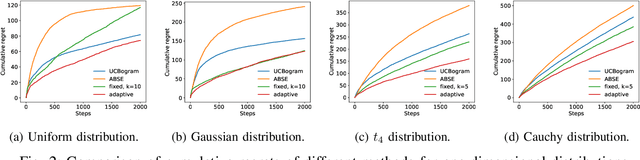
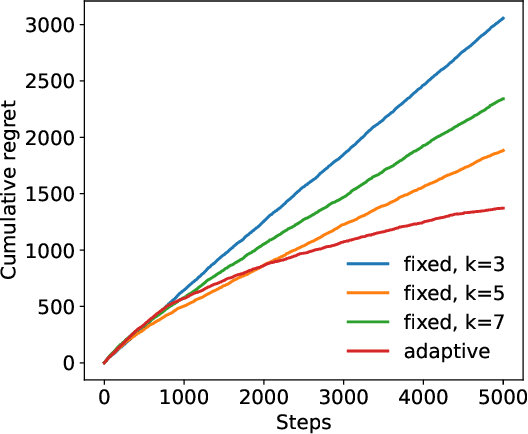
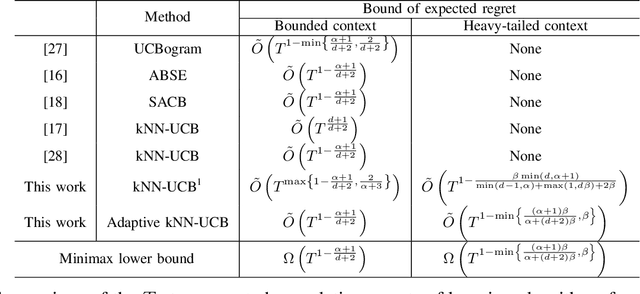
Nonparametric contextual bandit is an important model of sequential decision making problems. Under $\alpha$-Tsybakov margin condition, existing research has established a regret bound of $\tilde{O}\left(T^{1-\frac{\alpha+1}{d+2}}\right)$ for bounded supports. However, the optimal regret with unbounded contexts has not been analyzed. The challenge of solving contextual bandit problems with unbounded support is to achieve both exploration-exploitation tradeoff and bias-variance tradeoff simultaneously. In this paper, we solve the nonparametric contextual bandit problem with unbounded contexts. We propose two nearest neighbor methods combined with UCB exploration. The first method uses a fixed $k$. Our analysis shows that this method achieves minimax optimal regret under a weak margin condition and relatively light-tailed context distributions. The second method uses adaptive $k$. By a proper data-driven selection of $k$, this method achieves an expected regret of $\tilde{O}\left(T^{1-\frac{(\alpha+1)\beta}{\alpha+(d+2)\beta}}+T^{1-\beta}\right)$, in which $\beta$ is a parameter describing the tail strength. This bound matches the minimax lower bound up to logarithm factors, indicating that the second method is approximately optimal.
Mitral Regurgitation Recogniton based on Unsupervised Out-of-Distribution Detection with Residual Diffusion Amplification
Jul 31, 2024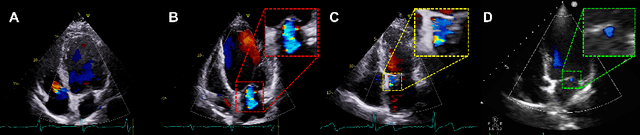
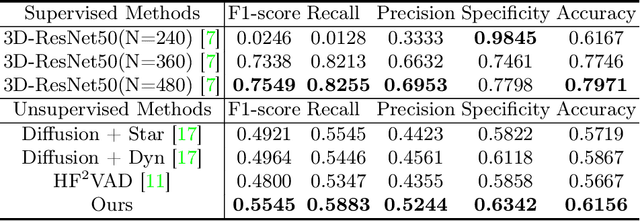
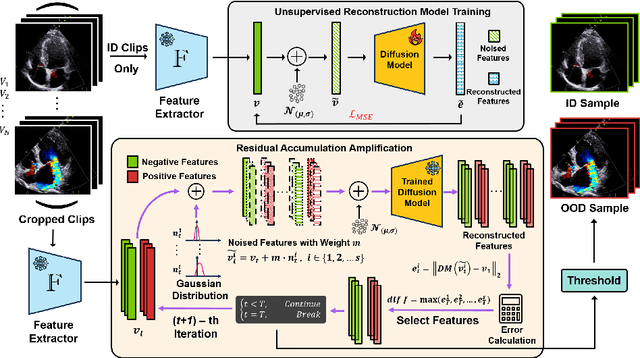

Mitral regurgitation (MR) is a serious heart valve disease. Early and accurate diagnosis of MR via ultrasound video is critical for timely clinical decision-making and surgical intervention. However, manual MR diagnosis heavily relies on the operator's experience, which may cause misdiagnosis and inter-observer variability. Since MR data is limited and has large intra-class variability, we propose an unsupervised out-of-distribution (OOD) detection method to identify MR rather than building a deep classifier. To our knowledge, we are the first to explore OOD in MR ultrasound videos. Our method consists of a feature extractor, a feature reconstruction model, and a residual accumulation amplification algorithm. The feature extractor obtains features from the video clips and feeds them into the feature reconstruction model to restore the original features. The residual accumulation amplification algorithm then iteratively performs noise feature reconstruction, amplifying the reconstructed error of OOD features. This algorithm is straightforward yet efficient and can seamlessly integrate as a plug-and-play component in reconstruction-based OOD detection methods. We validated the proposed method on a large ultrasound dataset containing 893 non-MR and 267 MR videos. Experimental results show that our OOD detection method can effectively identify MR samples.
LION: Linear Group RNN for 3D Object Detection in Point Clouds
Jul 25, 2024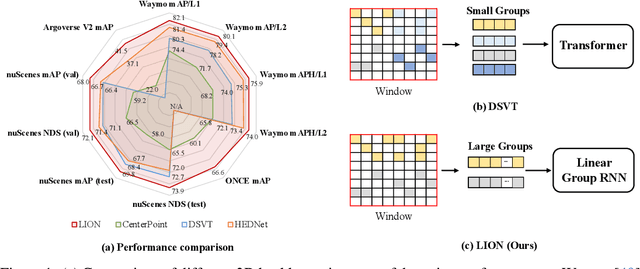
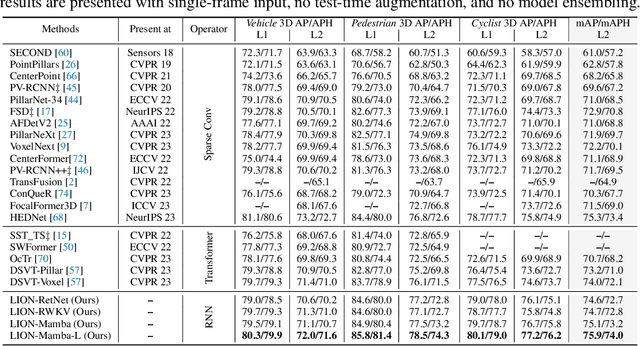

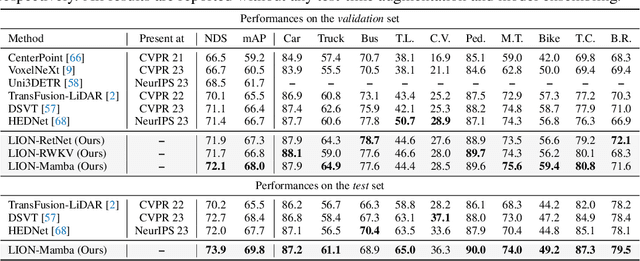
The benefit of transformers in large-scale 3D point cloud perception tasks, such as 3D object detection, is limited by their quadratic computation cost when modeling long-range relationships. In contrast, linear RNNs have low computational complexity and are suitable for long-range modeling. Toward this goal, we propose a simple and effective window-based framework built on LInear grOup RNN (i.e., perform linear RNN for grouped features) for accurate 3D object detection, called LION. The key property is to allow sufficient feature interaction in a much larger group than transformer-based methods. However, effectively applying linear group RNN to 3D object detection in highly sparse point clouds is not trivial due to its limitation in handling spatial modeling. To tackle this problem, we simply introduce a 3D spatial feature descriptor and integrate it into the linear group RNN operators to enhance their spatial features rather than blindly increasing the number of scanning orders for voxel features. To further address the challenge in highly sparse point clouds, we propose a 3D voxel generation strategy to densify foreground features thanks to linear group RNN as a natural property of auto-regressive models. Extensive experiments verify the effectiveness of the proposed components and the generalization of our LION on different linear group RNN operators including Mamba, RWKV, and RetNet. Furthermore, it is worth mentioning that our LION-Mamba achieves state-of-the-art on Waymo, nuScenes, Argoverse V2, and ONCE dataset. Last but not least, our method supports kinds of advanced linear RNN operators (e.g., RetNet, RWKV, Mamba, xLSTM and TTT) on small but popular KITTI dataset for a quick experience with our linear RNN-based framework.
OPEN: Object-wise Position Embedding for Multi-view 3D Object Detection
Jul 15, 2024
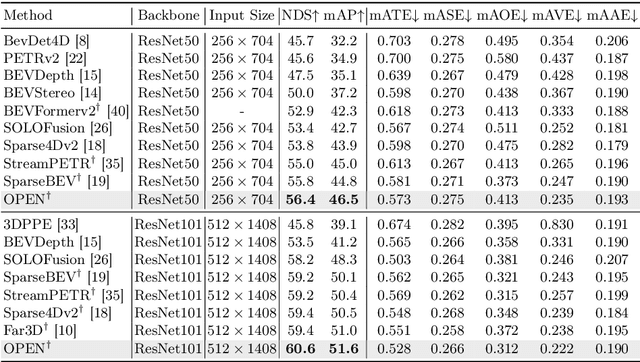
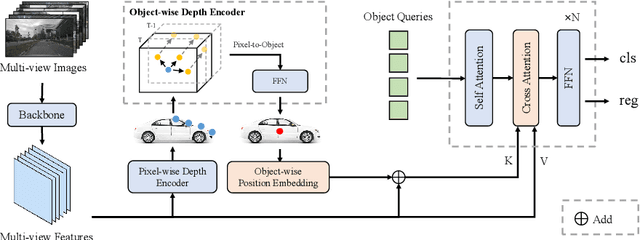
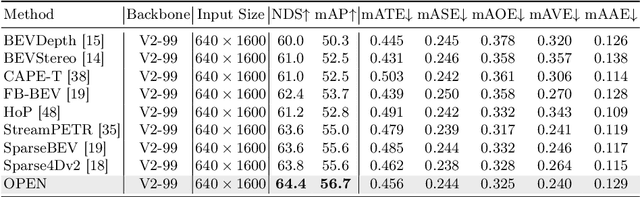
Accurate depth information is crucial for enhancing the performance of multi-view 3D object detection. Despite the success of some existing multi-view 3D detectors utilizing pixel-wise depth supervision, they overlook two significant phenomena: 1) the depth supervision obtained from LiDAR points is usually distributed on the surface of the object, which is not so friendly to existing DETR-based 3D detectors due to the lack of the depth of 3D object center; 2) for distant objects, fine-grained depth estimation of the whole object is more challenging. Therefore, we argue that the object-wise depth (or 3D center of the object) is essential for accurate detection. In this paper, we propose a new multi-view 3D object detector named OPEN, whose main idea is to effectively inject object-wise depth information into the network through our proposed object-wise position embedding. Specifically, we first employ an object-wise depth encoder, which takes the pixel-wise depth map as a prior, to accurately estimate the object-wise depth. Then, we utilize the proposed object-wise position embedding to encode the object-wise depth information into the transformer decoder, thereby producing 3D object-aware features for final detection. Extensive experiments verify the effectiveness of our proposed method. Furthermore, OPEN achieves a new state-of-the-art performance with 64.4% NDS and 56.7% mAP on the nuScenes test benchmark.
SEED: A Simple and Effective 3D DETR in Point Clouds
Jul 15, 2024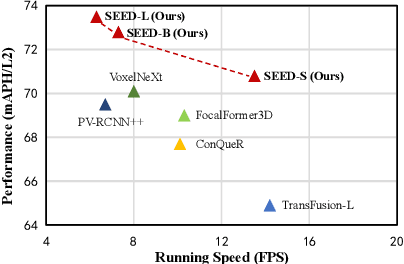
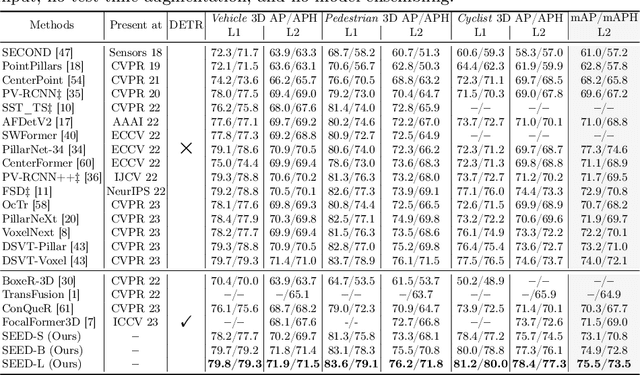

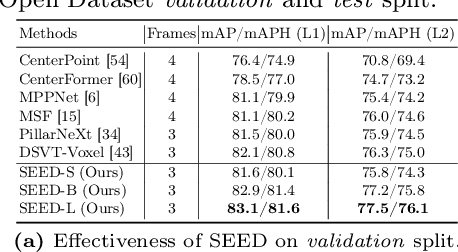
Recently, detection transformers (DETRs) have gradually taken a dominant position in 2D detection thanks to their elegant framework. However, DETR-based detectors for 3D point clouds are still difficult to achieve satisfactory performance. We argue that the main challenges are twofold: 1) How to obtain the appropriate object queries is challenging due to the high sparsity and uneven distribution of point clouds; 2) How to implement an effective query interaction by exploiting the rich geometric structure of point clouds is not fully explored. To this end, we propose a simple and effective 3D DETR method (SEED) for detecting 3D objects from point clouds, which involves a dual query selection (DQS) module and a deformable grid attention (DGA) module. More concretely, to obtain appropriate queries, DQS first ensures a high recall to retain a large number of queries by the predicted confidence scores and then further picks out high-quality queries according to the estimated quality scores. DGA uniformly divides each reference box into grids as the reference points and then utilizes the predicted offsets to achieve a flexible receptive field, allowing the network to focus on relevant regions and capture more informative features. Extensive ablation studies on DQS and DGA demonstrate its effectiveness. Furthermore, our SEED achieves state-of-the-art detection performance on both the large-scale Waymo and nuScenes datasets, illustrating the superiority of our proposed method. The code is available at https://github.com/happinesslz/SEED
Learning with User-Level Local Differential Privacy
May 27, 2024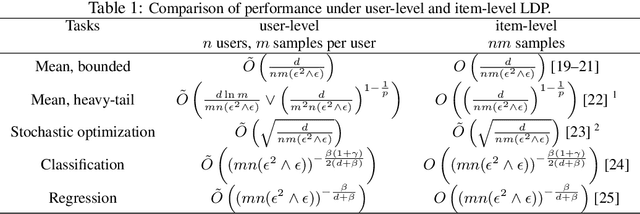
User-level privacy is important in distributed systems. Previous research primarily focuses on the central model, while the local models have received much less attention. Under the central model, user-level DP is strictly stronger than the item-level one. However, under the local model, the relationship between user-level and item-level LDP becomes more complex, thus the analysis is crucially different. In this paper, we first analyze the mean estimation problem and then apply it to stochastic optimization, classification, and regression. In particular, we propose adaptive strategies to achieve optimal performance at all privacy levels. Moreover, we also obtain information-theoretic lower bounds, which show that the proposed methods are minimax optimal up to logarithmic factors. Unlike the central DP model, where user-level DP always leads to slower convergence, our result shows that under the local model, the convergence rates are nearly the same between user-level and item-level cases for distributions with bounded support. For heavy-tailed distributions, the user-level rate is even faster than the item-level one.
Enhancing Learning with Label Differential Privacy by Vector Approximation
May 24, 2024Label differential privacy (DP) is a framework that protects the privacy of labels in training datasets, while the feature vectors are public. Existing approaches protect the privacy of labels by flipping them randomly, and then train a model to make the output approximate the privatized label. However, as the number of classes $K$ increases, stronger randomization is needed, thus the performances of these methods become significantly worse. In this paper, we propose a vector approximation approach, which is easy to implement and introduces little additional computational overhead. Instead of flipping each label into a single scalar, our method converts each label into a random vector with $K$ components, whose expectations reflect class conditional probabilities. Intuitively, vector approximation retains more information than scalar labels. A brief theoretical analysis shows that the performance of our method only decays slightly with $K$. Finally, we conduct experiments on both synthesized and real datasets, which validate our theoretical analysis as well as the practical performance of our method.
Distinguish Any Fake Videos: Unleashing the Power of Large-scale Data and Motion Features
May 24, 2024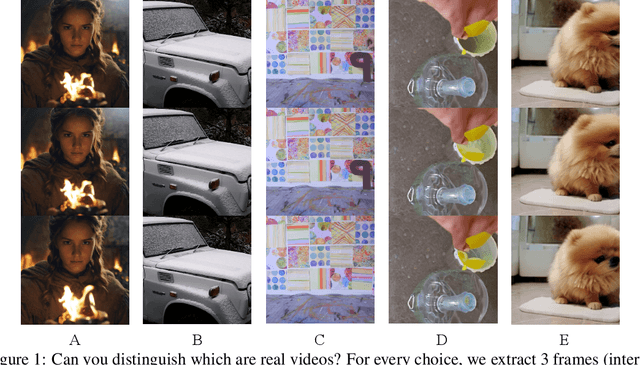
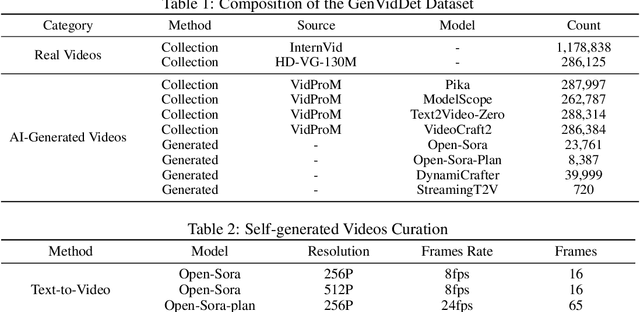
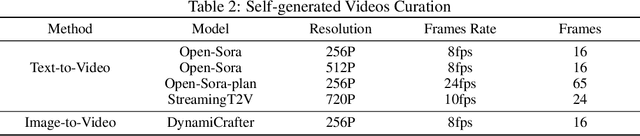
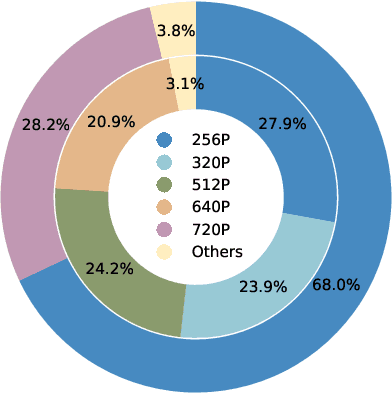
The development of AI-Generated Content (AIGC) has empowered the creation of remarkably realistic AI-generated videos, such as those involving Sora. However, the widespread adoption of these models raises concerns regarding potential misuse, including face video scams and copyright disputes. Addressing these concerns requires the development of robust tools capable of accurately determining video authenticity. The main challenges lie in the dataset and neural classifier for training. Current datasets lack a varied and comprehensive repository of real and generated content for effective discrimination. In this paper, we first introduce an extensive video dataset designed specifically for AI-Generated Video Detection (GenVidDet). It includes over 2.66 M instances of both real and generated videos, varying in categories, frames per second, resolutions, and lengths. The comprehensiveness of GenVidDet enables the training of a generalizable video detector. We also present the Dual-Branch 3D Transformer (DuB3D), an innovative and effective method for distinguishing between real and generated videos, enhanced by incorporating motion information alongside visual appearance. DuB3D utilizes a dual-branch architecture that adaptively leverages and fuses raw spatio-temporal data and optical flow. We systematically explore the critical factors affecting detection performance, achieving the optimal configuration for DuB3D. Trained on GenVidDet, DuB3D can distinguish between real and generated video content with 96.77% accuracy, and strong generalization capability even for unseen types.