 Add to Chrome
 Add to Firefox
 Add to Edge
DashAttention: Differentiable and Adaptive Sparse Hierarchical Attention
May 18, 2026
Current hierarchical attention methods, such as NSA and InfLLMv2, select the top-k relevant key-value (KV) blocks based on coarse attention scores and subsequently apply fine-grained softmax attention on the selected tokens. However, the top-k operation assumes the number of relevant tokens for any query is fixed and it precludes the gradient flow between the sparse and dense stages. In this work, we propose DashAttention (Differentiable and Adaptive Sparse Hierarchical Attention), which leverages the adaptively sparse $α$-entmax transformation to select a variable number of blocks according to the current query in the first stage. This in turn provides a prior for the second-stage softmax attention, keeping the entire hierarchy fully differentiable. Contrary to other hierarchical attention methods, we show that DashAttention is non-dispersive, translating to better long-context modeling ability. Experiments with large language models (LLMs) show that DashAttention achieves comparable accuracy as full attention with 75% sparsity and a better Pareto frontier than NSA and InfLLMv2, especially in high-sparsity regimes. We also provide an efficient, GPU-aware implementation of DashAttention in Triton, which achieves a speedup of up to over FlashAttention-3 at inference time. Overall, DashAttention offers a cost-effective strategy to model long contexts.

APIOT: Autonomous Vulnerability Management Across Bare-Metal Industrial OT Networks
May 04, 2026Bare-metal operational technology (OT) devices -- especially the microcontrollers running Modbus/TCP and CoAP at the base of industrial control systems -- have remained outside the reach of autonomous security attacks. Prior autonomous pentesting studies target Linux and web systems, whose shells and filesystems are familiar to LLM agents. Bare-metal OT has neither, so agents must reason directly over protocol fields and parser semantics. This requires new action-space designs and runtime controls, and opens new research questions about protocol-level exploit reasoning and its deployment envelope. We present APIOT (Autonomous Purple-teaming for Industrial OT), the first large language model (LLM) framework demonstrating an autonomous attack and remediation of bare-metal OT devices, achieving the full discovery -> exploitation -> patching -> verification cycle without step-by-step human intervention. We implemented and evaluated this framework on Zephyr RTOS firmware across heterogeneous industrial IoT (IIoT) topologies. Through 290 experiment runs spanning five frontier LLMs, three network topologies, two impairment levels, and guided versus unguided conditions, APIOT achieved a mission success rate of 90.0% on the full attack-remediation cycle. We found that the runtime governance layer (which we call an overseer) is a critical engineering variable: without it, agents exhibit systematic degenerate patterns, including repetition loops, missing crash verification, and reconnaissance deadlocks. Together, these findings carry two implications beyond our testbed. Attacker expertise is no longer the binding constraint on bare-metal OT exploitation, and defender threat models must now assume LLM-augmented adversaries capable of executing autonomous discovery-through-remediation cycles against industrial firmware.
Simple but Stable, Fast and Safe: Achieve End-to-end Control by High-Fidelity Differentiable Simulation
Apr 12, 2026Obstacle avoidance is a fundamental vision-based task essential for enabling quadrotors to perform advanced applications. When planning the trajectory, existing approaches both on optimization and learning typically regard quadrotor as a point-mass model, giving path or velocity commands then tracking the commands by outer-loop controller. However, at high speeds, planned trajectories sometimes become dynamically infeasible in actual flight, which beyond the capacity of controller. In this paper, we propose a novel end-to-end policy that directly maps depth images to low-level bodyrate commands by reinforcement learning via differentiable simulation. The high-fidelity simulation in training after parameter identification significantly reduces all the gaps between training, simulation and real world. Analytical process by differentiable simulation provides accurate gradient to ensure efficiently training the low-level policy without expert guidance. The policy employs a lightweight and the most simple inference pipeline that runs without explicit mapping, backbone networks, primitives, recurrent structures, or backend controllers, nor curriculum or privileged guidance. By inferring low-level command directly to the hardware controller, the method enables full flight envelope control and avoids the dynamic-infeasible issue.Experimental results demonstrate that the proposed approach achieves the highest success rate and the lowest jerk among state-of-the-art baselines across multiple benchmarks. The policy also exhibits strong generalization, successfully deploying zero-shot in unseen, outdoor environments while reaching speeds of up to 7.5m/s as well as stably flying in the super-dense forest.
Semantic Manipulation Localization
Apr 11, 2026Image Manipulation Localization (IML) aims to identify edited regions in an image. However, with the increasing use of modern image editing and generative models, many manipulations no longer exhibit obvious low-level artifacts. Instead, they often involve subtle but meaning-altering edits to an object's attributes, state, or relationships while remaining highly consistent with the surrounding content. This makes conventional IML methods less effective because they mainly rely on artifact detection rather than semantic sensitivity. To address this issue, we introduce Semantic Manipulation Localization (SML), a new task that focuses on localizing subtle semantic edits that significantly change image interpretation. We further construct a dedicated fine-grained benchmark for SML using a semantics-driven manipulation pipeline with pixel-level annotations. Based on this task, we propose TRACE (Targeted Reasoning of Attributed Cognitive Edits), an end-to-end framework that models semantic sensitivity through three progressively coupled components: semantic anchoring, semantic perturbation sensing, and semantic-constrained reasoning. Specifically, TRACE first identifies semantically meaningful regions that support image understanding, then injects perturbation-sensitive frequency cues to capture subtle edits under strong visual consistency, and finally verifies candidate regions through joint reasoning over semantic content and semantic scope. Extensive experiments show that TRACE consistently outperforms existing IML methods on our benchmark and produces more complete, compact, and semantically coherent localization results. These results demonstrate the necessity of moving beyond artifact-based localization and provide a new direction for image forensics in complex semantic editing scenarios.
Spava: Accelerating Long-Video Understanding via Sequence-Parallelism-aware Approximate Attention
Jan 29, 2026The efficiency of long-video inference remains a critical bottleneck, mainly due to the dense computation in the prefill stage of Large Multimodal Models (LMMs). Existing methods either compress visual embeddings or apply sparse attention on a single GPU, yielding limited acceleration or degraded performance and restricting LMMs from handling longer, more complex videos. To overcome these issues, we propose Spava, a sequence-parallel framework with optimized attention that accelerates long-video inference across multiple GPUs. By distributing approximate attention, Spava reduces computation and increases parallelism, enabling efficient processing of more visual embeddings without compression and thereby improving task performance. System-level optimizations, such as load balancing and fused forward passes, further unleash the potential of Spava, delivering speedups of 12.72x, 1.70x, and 1.18x over FlashAttn, ZigZagRing, and APB, without notable performance loss. Code available at https://github.com/thunlp/APB
D$^2$GSLAM: 4D Dynamic Gaussian Splatting SLAM
Dec 10, 2025Recent advances in Dense Simultaneous Localization and Mapping (SLAM) have demonstrated remarkable performance in static environments. However, dense SLAM in dynamic environments remains challenging. Most methods directly remove dynamic objects and focus solely on static scene reconstruction, which ignores the motion information contained in these dynamic objects. In this paper, we present D$^2$GSLAM, a novel dynamic SLAM system utilizing Gaussian representation, which simultaneously performs accurate dynamic reconstruction and robust tracking within dynamic environments. Our system is composed of four key components: (i) We propose a geometric-prompt dynamic separation method to distinguish between static and dynamic elements of the scene. This approach leverages the geometric consistency of Gaussian representation and scene geometry to obtain coarse dynamic regions. The regions then serve as prompts to guide the refinement of the coarse mask for achieving accurate motion mask. (ii) To facilitate accurate and efficient mapping of the dynamic scene, we introduce dynamic-static composite representation that integrates static 3D Gaussians with dynamic 4D Gaussians. This representation allows for modeling the transitions between static and dynamic states of objects in the scene for composite mapping and optimization. (iii) We employ a progressive pose refinement strategy that leverages both the multi-view consistency of static scene geometry and motion information from dynamic objects to achieve accurate camera tracking. (iv) We introduce a motion consistency loss, which leverages the temporal continuity in object motions for accurate dynamic modeling. Our D$^2$GSLAM demonstrates superior performance on dynamic scenes in terms of mapping and tracking accuracy, while also showing capability in accurate dynamic modeling.
MiniCPM4: Ultra-Efficient LLMs on End Devices
Jun 09, 2025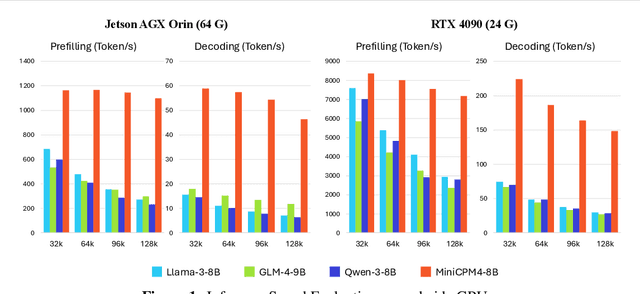

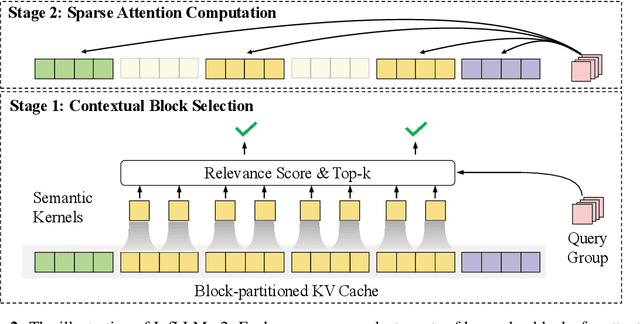
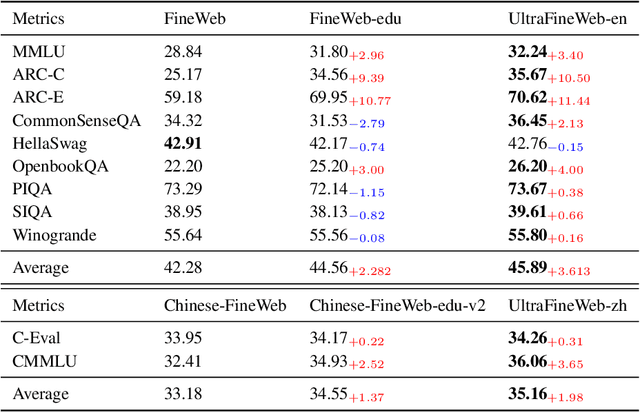
This paper introduces MiniCPM4, a highly efficient large language model (LLM) designed explicitly for end-side devices. We achieve this efficiency through systematic innovation in four key dimensions: model architecture, training data, training algorithms, and inference systems. Specifically, in terms of model architecture, we propose InfLLM v2, a trainable sparse attention mechanism that accelerates both prefilling and decoding phases for long-context processing. Regarding training data, we propose UltraClean, an efficient and accurate pre-training data filtering and generation strategy, and UltraChat v2, a comprehensive supervised fine-tuning dataset. These datasets enable satisfactory model performance to be achieved using just 8 trillion training tokens. Regarding training algorithms, we propose ModelTunnel v2 for efficient pre-training strategy search, and improve existing post-training methods by introducing chunk-wise rollout for load-balanced reinforcement learning and data-efficient tenary LLM, BitCPM. Regarding inference systems, we propose CPM.cu that integrates sparse attention, model quantization, and speculative sampling to achieve efficient prefilling and decoding. To meet diverse on-device requirements, MiniCPM4 is available in two versions, with 0.5B and 8B parameters, respectively. Sufficient evaluation results show that MiniCPM4 outperforms open-source models of similar size across multiple benchmarks, highlighting both its efficiency and effectiveness. Notably, MiniCPM4-8B demonstrates significant speed improvements over Qwen3-8B when processing long sequences. Through further adaptation, MiniCPM4 successfully powers diverse applications, including trustworthy survey generation and tool use with model context protocol, clearly showcasing its broad usability.
FR-Spec: Accelerating Large-Vocabulary Language Models via Frequency-Ranked Speculative Sampling
Feb 20, 2025Speculative sampling has emerged as an important technique for accelerating the auto-regressive generation process of large language models (LLMs) by utilizing a draft-then-verify mechanism to produce multiple tokens per forward pass. While state-of-the-art speculative sampling methods use only a single layer and a language modeling (LM) head as the draft model to achieve impressive layer compression, their efficiency gains are substantially reduced for large-vocabulary LLMs, such as Llama-3-8B with a vocabulary of 128k tokens. To address this, we present FR-Spec, a frequency-ranked speculative sampling framework that optimizes draft candidate selection through vocabulary space compression. By constraining the draft search to a frequency-prioritized token subset, our method reduces LM Head computation overhead by 75% while ensuring the equivalence of the final output distribution. Experiments across multiple datasets demonstrate an average of 1.12$\times$ speedup over the state-of-the-art speculative sampling method EAGLE-2.
APB: Accelerating Distributed Long-Context Inference by Passing Compressed Context Blocks across GPUs
Feb 17, 2025While long-context inference is crucial for advancing large language model (LLM) applications, its prefill speed remains a significant bottleneck. Current approaches, including sequence parallelism strategies and compute reduction through approximate attention mechanisms, still fall short of delivering optimal inference efficiency. This hinders scaling the inputs to longer sequences and processing long-context queries in a timely manner. To address this, we introduce APB, an efficient long-context inference framework that leverages multi-host approximate attention to enhance prefill speed by reducing compute and enhancing parallelism simultaneously. APB introduces a communication mechanism for essential key-value pairs within a sequence parallelism framework, enabling a faster inference speed while maintaining task performance. We implement APB by incorporating a tailored FlashAttn kernel alongside optimized distribution strategies, supporting diverse models and parallelism configurations. APB achieves speedups of up to 9.2x, 4.2x, and 1.6x compared with FlashAttn, RingAttn, and StarAttn, respectively, without any observable task performance degradation. We provide the implementation and experiment code of APB in https://github.com/thunlp/APB.
Locret: Enhancing Eviction in Long-Context LLM Inference with Trained Retaining Heads
Oct 02, 2024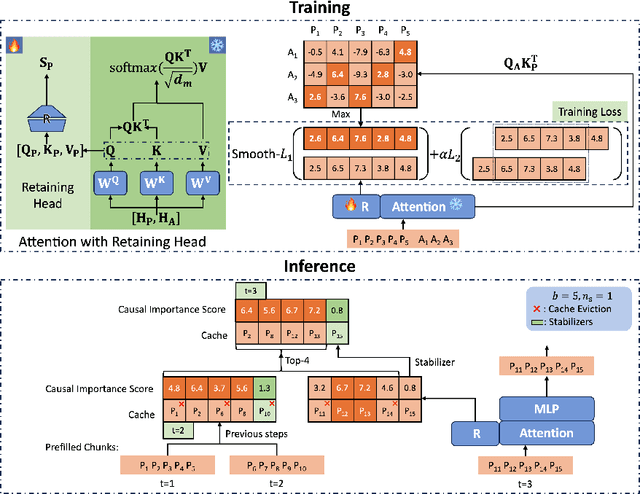
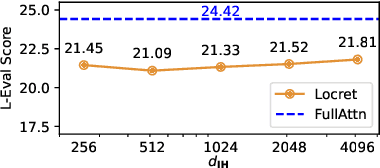
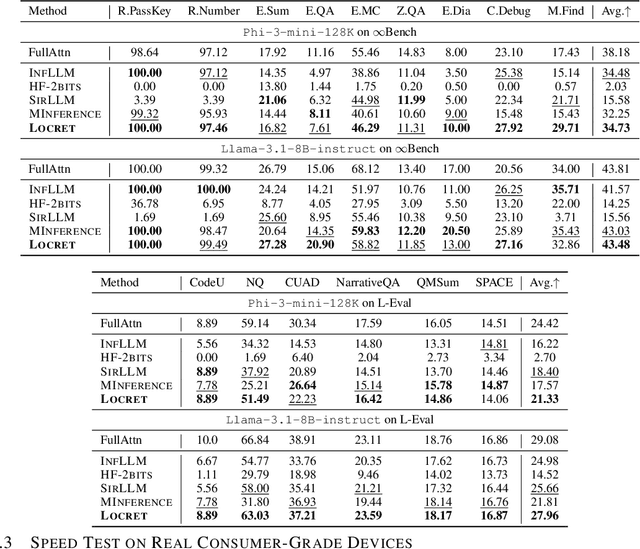
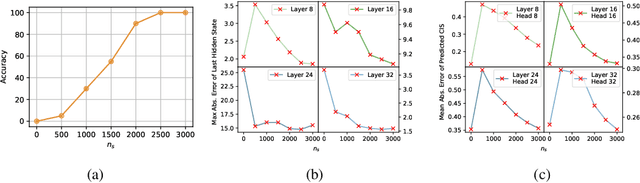
Large language models (LLMs) have shown remarkable advances in supporting long-context comprehension and processing tasks. However, scaling the generation inference of LLMs to such long contexts incurs significant additional computation load, and demands a substantial GPU memory footprint to maintain the key-value (KV) cache of transformer-based LLMs. Existing KV cache compression methods, such as quantization, face memory bottlenecks as context length increases, while static-sized caches, such as eviction, suffer from inefficient policies. These limitations restrict deployment on consumer-grade devices like a single Nvidia 4090 GPU. To overcome this, we propose Locret, a framework for long-context LLM inference that introduces retaining heads to evaluate the causal importance of KV cache units, allowing for more accurate eviction within a fixed cache size. Locret is fine-tuned on top of the frozen backbone LLM using a minimal amount of data from standard long-context SFT datasets. During inference, we evict low-importance cache units along with a chunked prefill pattern, significantly reducing peak GPU memory usage. We conduct an extensive empirical study to evaluate Locret, where the experimental results show that Locret outperforms the recent competitive approaches, including InfLLM, Quantization, SirLLM, and MInference, in terms of memory efficiency and the quality of generated contents -- Locret achieves over a 20x and 8x KV cache compression ratio compared to the full KV cache for Phi-3-mini-128K and Llama-3.1-8B-instruct. Additionally, Locret can be combined with other methods, such as quantization and token merging. To our knowledge, Locret is the first framework capable of deploying Llama-3.1-8B or similar models on a single Nvidia 4090 GPU, enabling 128K long-context inference without compromising generation quality, and requiring little additional system optimizations.