 Add to Chrome
 Add to Firefox
 Add to Edge
Claw AI Lab: An Autonomous Multi-Agent Research Team
May 21, 2026
We present Claw AI Lab, a lab-native autonomous research platform that advances automated research from a hidden prompt-to-paper pipeline into an interactive AI laboratory. Rather than centering the system around a single agent or a fixed serial workflow, we allow users to instantiate a full research team from one prompt, with customizable roles, collaborative workflows, real-time monitoring, artifact inspection, and rollback/resume control through a unified dashboard. The platform also supports distinct research modes for exploration, multi-agent discussion, and reproduction, making autonomous research substantially more steerable and laboratory-like in practice. A key practical contribution of Claw AI Lab lies in its Claw-Code Harness, which connects local codebases, datasets, and checkpoints to runnable experiments and feeds execution artifacts back into the research loop. As a result, the harness improves not only execution integration, but also experimental completion and result integrity: experiments are easier to inspect, iterate on, and faithfully transfer into final papers, reducing common failure modes such as partial runs and malformed result reporting. In our internal evaluation on five AI research case studies, using AutoResearchClaw as the baseline, Claw AI Lab is consistently preferred by AI expert judges on idea novelty, experiment completeness, and paper presentation quality. We view Claw AI Lab as an early step toward a new paradigm: autonomous research as usable, interactive, and reliability-aware scientific infrastructure.

Semantic Manipulation Localization
Apr 11, 2026Image Manipulation Localization (IML) aims to identify edited regions in an image. However, with the increasing use of modern image editing and generative models, many manipulations no longer exhibit obvious low-level artifacts. Instead, they often involve subtle but meaning-altering edits to an object's attributes, state, or relationships while remaining highly consistent with the surrounding content. This makes conventional IML methods less effective because they mainly rely on artifact detection rather than semantic sensitivity. To address this issue, we introduce Semantic Manipulation Localization (SML), a new task that focuses on localizing subtle semantic edits that significantly change image interpretation. We further construct a dedicated fine-grained benchmark for SML using a semantics-driven manipulation pipeline with pixel-level annotations. Based on this task, we propose TRACE (Targeted Reasoning of Attributed Cognitive Edits), an end-to-end framework that models semantic sensitivity through three progressively coupled components: semantic anchoring, semantic perturbation sensing, and semantic-constrained reasoning. Specifically, TRACE first identifies semantically meaningful regions that support image understanding, then injects perturbation-sensitive frequency cues to capture subtle edits under strong visual consistency, and finally verifies candidate regions through joint reasoning over semantic content and semantic scope. Extensive experiments show that TRACE consistently outperforms existing IML methods on our benchmark and produces more complete, compact, and semantically coherent localization results. These results demonstrate the necessity of moving beyond artifact-based localization and provide a new direction for image forensics in complex semantic editing scenarios.
A H.265/HEVC Fine-Grained ROI Video Encryption Algorithm Based on Coding Unit and Prompt Segmentation
Apr 09, 2026ROI (Region of Interest) video selective encryption based on H.265/HEVC is a technology that protects the sensitive regions of videos by perturbing the syntax elements associated with target areas. However, existing methods typically adopt Tile (with a relatively large size) as the minimum encryption unit, which suffers from problems such as inaccurate encryption regions and low encryption precision. This low-precision encryption makes them difficult to apply in sensitive fields such as medicine, military, and remote sensing. In order to address the aforementioned problem, this paper proposes a fine-grained ROI video selective encryption algorithm based on Coding Units (CUs) and prompt segmentation. First, to achieve a more precise ROI acquisition, we present a novel ROI mapping approach based on prompt segmentation. This approach enables precise mapping of ROIs to small $8\times8$ CU levels, significantly enhancing the precision of encrypted regions. Second, we propose a selective encryption scheme based on multiple syntax elements, which distorts syntax elements within high-precision ROI to effectively safeguard ROI security. Finally, we design a diffusion isolation based on Pulse Code Modulation (PCM) mode and MV restriction, applying PCM mode and MV restriction strategy to the affected CU to address encryption diffusion during prediction. The above three strategies break the inherent mechanism of using Tiles in existing ROI encryption and push the fine-grained level of ROI video encryption to the minimum $8\times8$ CU precision. The experimental results demonstrate that the proposed algorithm can accurately segment ROI regions, effectively perturb pixels within these regions, and eliminate the diffusion artifacts introduced by encryption. The method exhibits great potential for application in medical imaging, military surveillance, and remote areas.
Breaking the Resolution Barrier: Arbitrary-resolution Deep Image Steganography Framework
Jan 22, 2026Deep image steganography (DIS) has achieved significant results in capacity and invisibility. However, current paradigms enforce the secret image to maintain the same resolution as the cover image during hiding and revealing. This leads to two challenges: secret images with inconsistent resolutions must undergo resampling beforehand which results in detail loss during recovery, and the secret image cannot be recovered to its original resolution when the resolution value is unknown. To address these, we propose ARDIS, the first Arbitrary Resolution DIS framework, which shifts the paradigm from discrete mapping to reference-guided continuous signal reconstruction. Specifically, to minimize the detail loss caused by resolution mismatch, we first design a Frequency Decoupling Architecture in hiding stage. It disentangles the secret into a resolution-aligned global basis and a resolution-agnostic high-frequency latent to hide in a fixed-resolution cover. Second, for recovery, we propose a Latent-Guided Implicit Reconstructor to perform deterministic restoration. The recovered detail latent code modulates a continuous implicit function to accurately query and render high-frequency residuals onto the recovered global basis, ensuring faithful restoration of original details. Furthermore, to achieve blind recovery, we introduce an Implicit Resolution Coding strategy. By transforming discrete resolution values into dense feature maps and hiding them in the redundant space of the feature domain, the reconstructor can correctly decode the secret's resolution directly from the steganographic representation. Experimental results demonstrate that ARDIS significantly outperforms state-of-the-art methods in both invisibility and cross-resolution recovery fidelity.
A Unified Two-Stage Group Semantics Propagation and Contrastive Learning Network for Co-Saliency Detection
Aug 13, 2022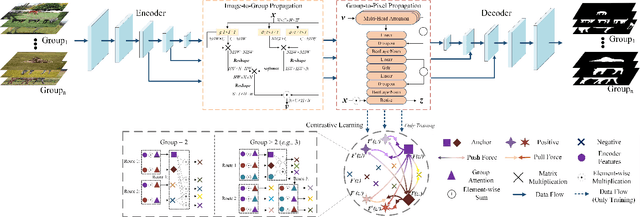
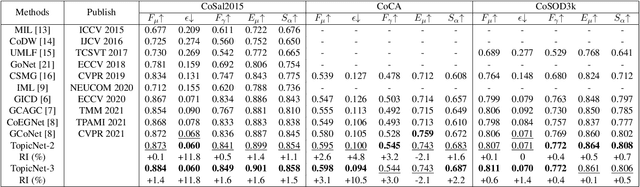
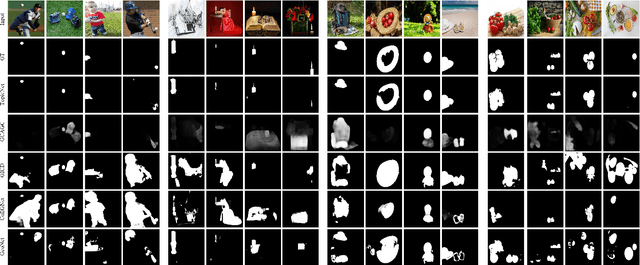
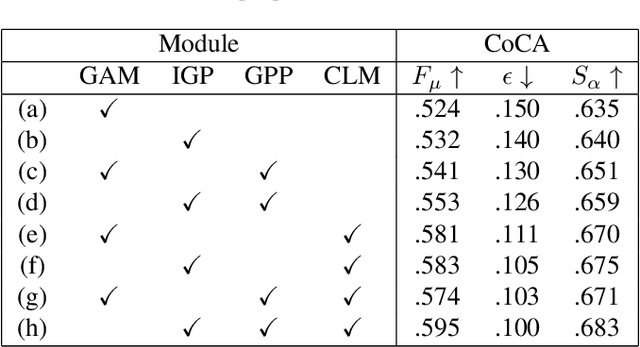
Co-saliency detection (CoSOD) aims at discovering the repetitive salient objects from multiple images. Two primary challenges are group semantics extraction and noise object suppression. In this paper, we present a unified Two-stage grOup semantics PropagatIon and Contrastive learning NETwork (TopicNet) for CoSOD. TopicNet can be decomposed into two substructures, including a two-stage group semantics propagation module (TGSP) to address the first challenge and a contrastive learning module (CLM) to address the second challenge. Concretely, for TGSP, we design an image-to-group propagation module (IGP) to capture the consensus representation of intra-group similar features and a group-to-pixel propagation module (GPP) to build the relevancy of consensus representation. For CLM, with the design of positive samples, the semantic consistency is enhanced. With the design of negative samples, the noise objects are suppressed. Experimental results on three prevailing benchmarks reveal that TopicNet outperforms other competitors in terms of various evaluation metrics.
Contrastive Cross-Modal Knowledge Sharing Pre-training for Vision-Language Representation Learning and Retrieval
Jul 08, 2022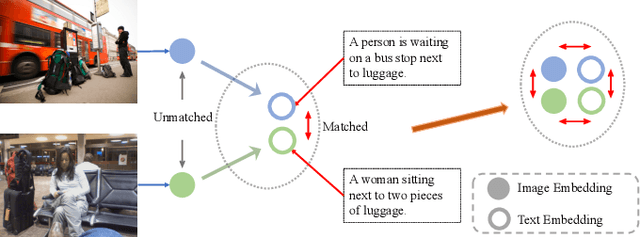
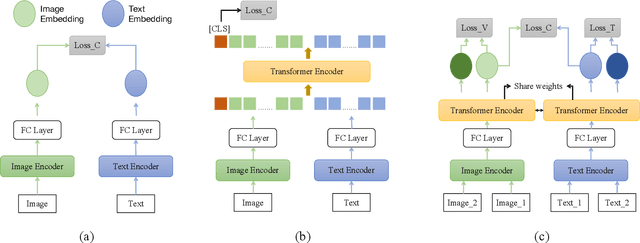
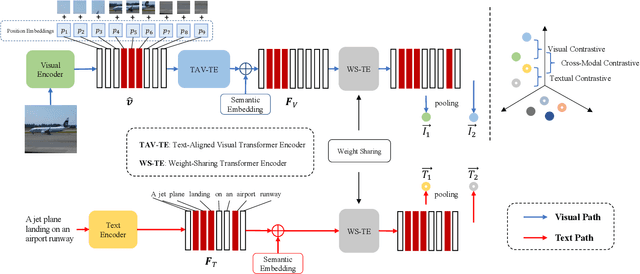
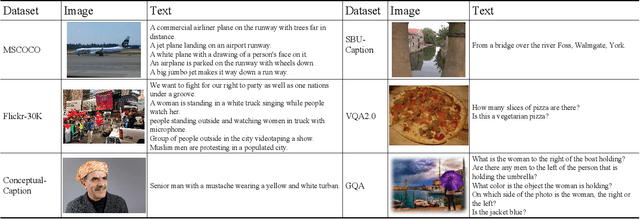
Recently, the cross-modal pre-training task has been a hotspot because of its wide application in various down-streaming researches including retrieval, captioning, question answering and so on. However, exiting methods adopt a one-stream pre-training model to explore the united vision-language representation for conducting cross-modal retrieval, which easily suffer from the calculation explosion. Moreover, although the conventional double-stream structures are quite efficient, they still lack the vital cross-modal interactions, resulting in low performances. Motivated by these challenges, we put forward a Contrastive Cross-Modal Knowledge Sharing Pre-training (COOKIE) to grasp the joint text-image representations. Structurally, COOKIE adopts the traditional double-stream structure because of the acceptable time consumption. To overcome the inherent defects of double-stream structure as mentioned above, we elaborately design two effective modules. Concretely, the first module is a weight-sharing transformer that builds on the head of the visual and textual encoders, aiming to semantically align text and image. This design enables visual and textual paths focus on the same semantics. The other one is three specially designed contrastive learning, aiming to share knowledge between different models. The shared cross-modal knowledge develops the study of unimodal representation greatly, promoting the single-modal retrieval tasks. Extensive experimental results on multi-modal matching researches that includes cross-modal retrieval, text matching, and image retrieval reveal the superiors in calculation efficiency and statistical indicators of our pre-training model.
UTC: A Unified Transformer with Inter-Task Contrastive Learning for Visual Dialog
May 03, 2022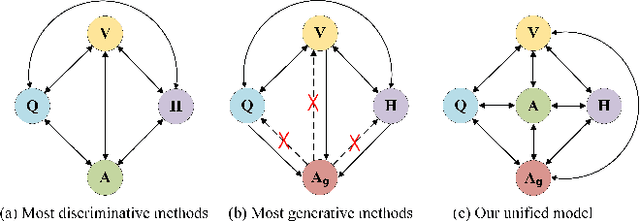
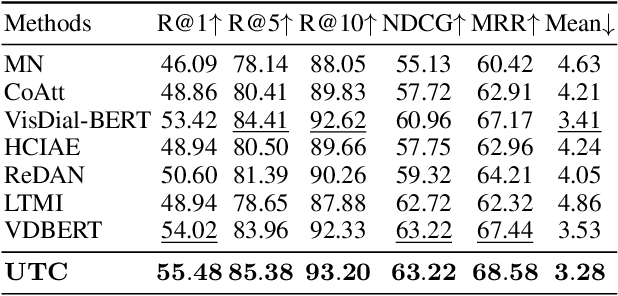
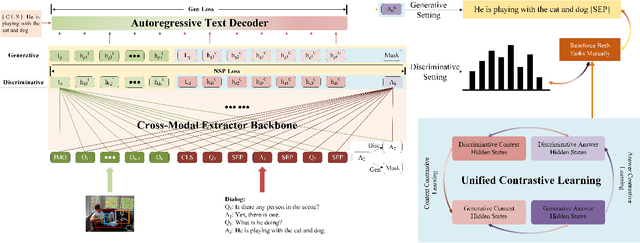
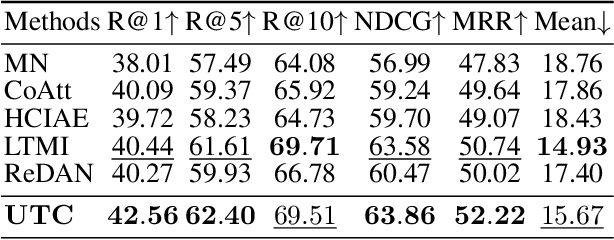
Visual Dialog aims to answer multi-round, interactive questions based on the dialog history and image content. Existing methods either consider answer ranking and generating individually or only weakly capture the relation across the two tasks implicitly by two separate models. The research on a universal framework that jointly learns to rank and generate answers in a single model is seldom explored. In this paper, we propose a contrastive learning-based framework UTC to unify and facilitate both discriminative and generative tasks in visual dialog with a single model. Specifically, considering the inherent limitation of the previous learning paradigm, we devise two inter-task contrastive losses i.e., context contrastive loss and answer contrastive loss to make the discriminative and generative tasks mutually reinforce each other. These two complementary contrastive losses exploit dialog context and target answer as anchor points to provide representation learning signals from different perspectives. We evaluate our proposed UTC on the VisDial v1.0 dataset, where our method outperforms the state-of-the-art on both discriminative and generative tasks and surpasses previous state-of-the-art generative methods by more than 2 absolute points on Recall@1.