 Add to Chrome
 Add to Firefox
 Add to Edge
LiteMVS: Efficient Multi-View Stereo with Foundation Distillation and Expert Aggregation
Aug 04, 2026
Real-time 3D perception is crucial for robotics, augmented reality, and embodied intelligence applications. Existing multi-view stereo (MVS) methods primarily rely on geometric correspondences, which often fail in textureless or repetitive regions, while monocular depth models leverage strong image-level priors but lack robust multi-view geometric constraints. More importantly, in robotics and embodied manipulation scenarios, high-quality 3D geometry is not only essential for static reconstruction, but also serves as a critical foundation for learning temporally consistent 4D representations. To obtain visual representations with stronger structural awareness and greater potential for spatiotemporal extension, we present LiteMVS, a lightweight multi-view depth estimation model that integrates plane-sweep geometric reasoning with strong monocular semantic and structural priors. The central idea of LiteMVS is to efficiently inject high-level monocular knowledge, obtained from lightweight segmentation models and large-scale vision foundation models, into a multi-view stereo framework. In particular, LiteMVS enriches the cost volume with semantic descriptors and employs a Mixture-of-Experts (MoE) formulation to enable adaptive geometric aggregation across depth hypotheses. Moreover, geometric priors distilled from vision foundation models further strengthen monocular guidance without increasing inference cost. Through this design, LiteMVS not only improves depth estimation and 3D reconstruction quality in static scenes, but also provides a more reliable geometric foundation for subsequent temporal modeling and 4D representation learning. Experiments on ScanNetv2 and 7-Scenes demonstrate that LiteMVS achieves high-quality depth prediction and 3D reconstruction while maintaining competitive efficiency.

Learning Agile Navigation in Crowded Environments for Quadruped Robots
Jul 16, 2026Navigating dynamic and crowded environments presents significant challenges for quadruped robots due to severe sensor occlusion and unpredictable human motion. Existing approaches face a trade-off: model-based methods, such as Velocity Obstacles (VO), theoretically guarantee safety but rely on accurate obstacle motion estimates that often fail in dense crowds, while end-to-end learning methods offer robustness but lack motion prediction capability of obstacles, leading to collisions or conservative behaviors. To solve this, we propose VOP-Nav, a novel navigation system that combines the geometric safety of VO with the agile adaptability of end-to-end learning. Using only local onboard observations, our system avoids explicit obstacle detection and tracking pipelines. The VOP-Net processes multi-frame LiDAR data to implicitly encode dynamic constraints and predict a safe velocity region derived from Velocity Obstacle theory. Importantly, the VO predictions serve a dual role: they are used as input to the navigation policy during inference and as a reward signal during training to encourage safe motion. Evaluations in Isaac Gym demonstrate that VOP-Nav achieves higher success rates than all baselines while balancing locomotion speed and collision avoidance. Real-world deployment on a Unitree Go2 quadruped robot further validates the system's robustness and efficiency in complex indoor and outdoor dynamic environments.
E2E-Fly: An Integrated Training-to-Deployment System for End-to-End Quadrotor Autonomy
Apr 14, 2026Training and transferring learning-based policies for quadrotors from simulation to reality remains challenging due to inefficient visual rendering, physical modeling inaccuracies, unmodeled sensor discrepancies, and the absence of a unified platform integrating differentiable physics learning into end-to-end training. While recent work has demonstrated various end-to-end quadrotor control tasks, few systems provide a systematic, zero-shot transfer pipeline, hindering reproducibility and real-world deployment. To bridge this gap, we introduce E2E-Fly, an integrated framework featuring an agile quadrotor platform coupled with a full-stack training, validation, and deployment workflow. The training framework incorporates a high-performance simulator with support for differentiable physics learning and reinforcement learning, alongside structured reward design tailored to common quadrotor tasks. We further introduce a two-stage validation strategy using sim-to-sim transfer and hardware-in-the-loop testing, and deploy policies onto two physical quadrotor platforms via a dedicated low-level control interface and a comprehensive sim-to-real alignment methodology, encompassing system identification, domain randomization, latency compensation, and noise modeling. To the best of our knowledge, this is the first work to systematically unify differentiable physical learning with training, validation, and real-world deployment for quadrotors. Finally, we demonstrate the effectiveness of our framework for training six end-to-end control tasks and deploy them in the real world.
Simple but Stable, Fast and Safe: Achieve End-to-end Control by High-Fidelity Differentiable Simulation
Apr 12, 2026Obstacle avoidance is a fundamental vision-based task essential for enabling quadrotors to perform advanced applications. When planning the trajectory, existing approaches both on optimization and learning typically regard quadrotor as a point-mass model, giving path or velocity commands then tracking the commands by outer-loop controller. However, at high speeds, planned trajectories sometimes become dynamically infeasible in actual flight, which beyond the capacity of controller. In this paper, we propose a novel end-to-end policy that directly maps depth images to low-level bodyrate commands by reinforcement learning via differentiable simulation. The high-fidelity simulation in training after parameter identification significantly reduces all the gaps between training, simulation and real world. Analytical process by differentiable simulation provides accurate gradient to ensure efficiently training the low-level policy without expert guidance. The policy employs a lightweight and the most simple inference pipeline that runs without explicit mapping, backbone networks, primitives, recurrent structures, or backend controllers, nor curriculum or privileged guidance. By inferring low-level command directly to the hardware controller, the method enables full flight envelope control and avoids the dynamic-infeasible issue.Experimental results demonstrate that the proposed approach achieves the highest success rate and the lowest jerk among state-of-the-art baselines across multiple benchmarks. The policy also exhibits strong generalization, successfully deploying zero-shot in unseen, outdoor environments while reaching speeds of up to 7.5m/s as well as stably flying in the super-dense forest.
VisFly-Lab: Unified Differentiable Framework for First-Order Reinforcement Learning of Quadrotor Control
Mar 22, 2026First-order reinforcement learning with differentiable simulation is promising for quadrotor control, but practical progress remains fragmented across task-specific settings. To support more systematic development and evaluation, we present a unified differentiable framework for multi-task quadrotor control. The framework is wrapped, extensible, and equipped with deployment-oriented dynamics, providing a common interface across four representative tasks: hovering, tracking, landing, and racing. We also present the suite of first-order learning algorithms, where we identify two practical bottlenecks of standard first-order training: limited state coverage caused by horizon initialization and gradient bias caused by partially non-differentiable rewards. To address these issues, we propose Amended Backpropagation Through Time (ABPT), which combines differentiable rollout optimization, a value-based auxiliary objective, and visited-state initialization to improve training robustness. Experimental results show that ABPT yields the clearest gains in tasks with partially non-differentiable rewards, while remaining competitive in fully differentiable settings. We further provide proof-of-concept real-world deployments showing initial transferability of policies learned in the proposed framework beyond simulation.
Curriculum Reinforcement Learning for Quadrotor Racing with Random Obstacles
Feb 27, 2026Autonomous drone racing has attracted increasing interest as a research topic for exploring the limits of agile flight. However, existing studies primarily focus on obstacle-free racetracks, while the perception and dynamic challenges introduced by obstacles remain underexplored, often resulting in low success rates and limited robustness in real-world flight. To this end, we propose a novel vision-based curriculum reinforcement learning framework for training a robust controller capable of addressing unseen obstacles in drone racing. We combine multi-stage cu rriculum learning, domain randomization, and a multi-scene updating strategy to address the conflicting challenges of obstacle avoidance and gate traversal. Our end-to-end control policy is implemented as a single network, allowing high-speed flight of quadrotors in environments with variable obstacles. Both hardware-in-the-loop and real-world experiments demonstrate that our method achieves faster lap times and higher success rates than existing approaches, effectively advancing drone racing in obstacle-rich environments. The video and code are available at: https://github.com/SJTU-ViSYS-team/CRL-Drone-Racing.
StableTracker: Learning to Stably Track Target via Differentiable Simulation
Sep 17, 2025FPV object tracking methods heavily rely on handcraft modular designs, resulting in hardware overload and cumulative error, which seriously degrades the tracking performance, especially for rapidly accelerating or decelerating targets. To address these challenges, we present \textbf{StableTracker}, a learning-based control policy that enables quadrotors to robustly follow the moving target from arbitrary perspectives. The policy is trained using backpropagation-through-time via differentiable simulation, allowing the quadrotor to maintain the target at the center of the visual field in both horizontal and vertical directions, while keeping a fixed relative distance, thereby functioning as an autonomous aerial camera. We compare StableTracker against both state-of-the-art traditional algorithms and learning baselines. Simulation experiments demonstrate that our policy achieves superior accuracy, stability and generalization across varying safe distances, trajectories, and target velocities. Furthermore, a real-world experiment on a quadrotor with an onboard computer validated practicality of the proposed approach.
ABPT: Amended Backpropagation through Time with Partially Differentiable Rewards
Jan 24, 2025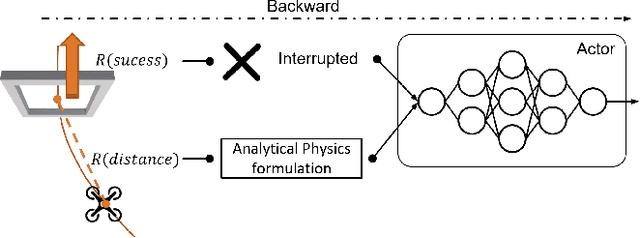

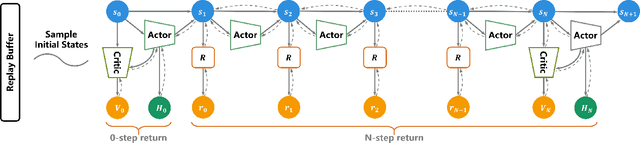
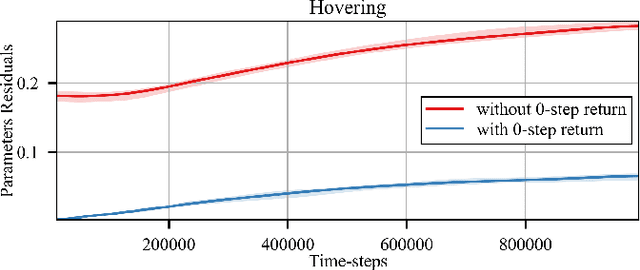
Using the exact gradients of the rewards to directly optimize policy parameters via backpropagation-through-time (BPTT) enables high training performance for quadrotor tasks. However, designing a fully differentiable reward architecture is often challenging. Partially differentiable rewards will result in biased gradient propagation that degrades training performance. To overcome this limitation, we propose Amended Backpropagation-through-Time (ABPT), a novel approach that mitigates gradient bias while preserving the training efficiency of BPTT. ABPT combines 0-step and N-step returns, effectively reducing the bias by leveraging value gradients from the learned Q-value function. Additionally, it adopts entropy regularization and state initialization mechanisms to encourage exploration during training. We evaluate ABPT on four representative quadrotor flight tasks. Experimental results demonstrate that ABPT converges significantly faster and achieves higher ultimate rewards than existing learning algorithms, particularly in tasks involving partially differentiable rewards.
VisFly: An Efficient and Versatile Simulator for Training Vision-based Flight
Jul 26, 2024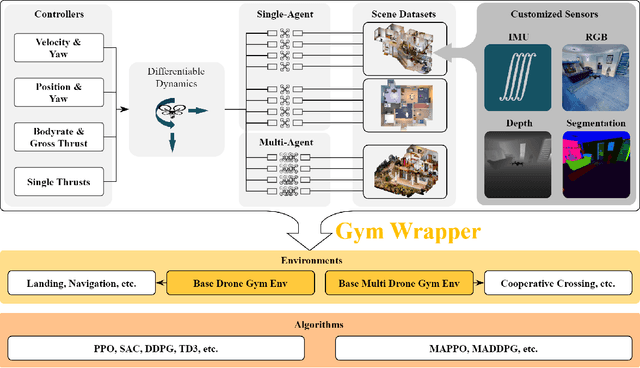
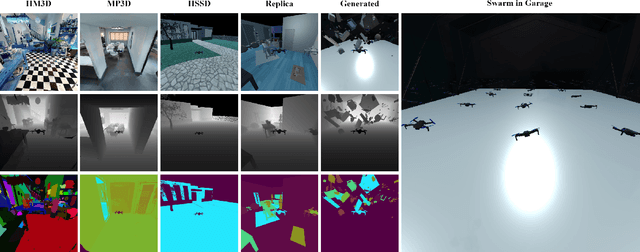
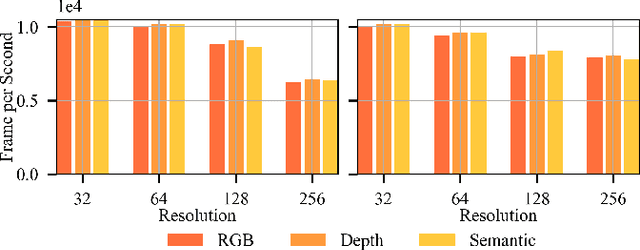
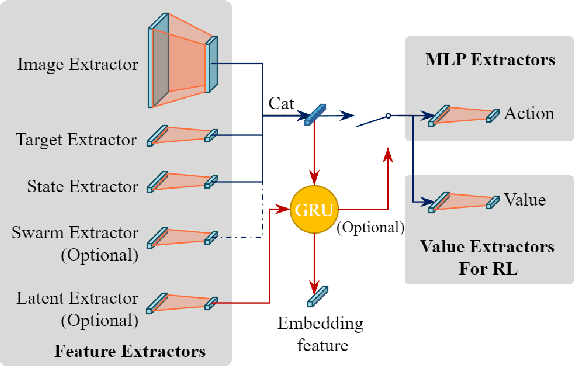
We present VisFly, a quadrotor simulator designed to efficiently train vision-based flight policies using reinforcement learning algorithms. VisFly offers a user-friendly framework and interfaces, leveraging Habitat-Sim's rendering engines to achieve frame rates exceeding 10,000 frames per second for rendering motion and sensor data. The simulator incorporates differentiable physics and seamlessly integrates with the Gym environment, facilitating the straightforward implementation of various learning algorithms. It supports the direct import of all open-source scene datasets compatible with Habitat-Sim, enabling training on diverse real-world environments and ensuring fair comparisons of learned flight policies. We also propose a general policy architecture for three typical flight tasks relying on visual observations, which have been validated in our simulator using reinforcement learning. The simulator will be available at [https://github.com/SJTU-ViSYS/VisFly].