 Add to Chrome
 Add to Firefox
 Add to Edge
DashAttention: Differentiable and Adaptive Sparse Hierarchical Attention
May 18, 2026
Current hierarchical attention methods, such as NSA and InfLLMv2, select the top-k relevant key-value (KV) blocks based on coarse attention scores and subsequently apply fine-grained softmax attention on the selected tokens. However, the top-k operation assumes the number of relevant tokens for any query is fixed and it precludes the gradient flow between the sparse and dense stages. In this work, we propose DashAttention (Differentiable and Adaptive Sparse Hierarchical Attention), which leverages the adaptively sparse $α$-entmax transformation to select a variable number of blocks according to the current query in the first stage. This in turn provides a prior for the second-stage softmax attention, keeping the entire hierarchy fully differentiable. Contrary to other hierarchical attention methods, we show that DashAttention is non-dispersive, translating to better long-context modeling ability. Experiments with large language models (LLMs) show that DashAttention achieves comparable accuracy as full attention with 75% sparsity and a better Pareto frontier than NSA and InfLLMv2, especially in high-sparsity regimes. We also provide an efficient, GPU-aware implementation of DashAttention in Triton, which achieves a speedup of up to over FlashAttention-3 at inference time. Overall, DashAttention offers a cost-effective strategy to model long contexts.

Communication Efficient Split Learning of ViTs with Attention-based Double Compression
Sep 18, 2025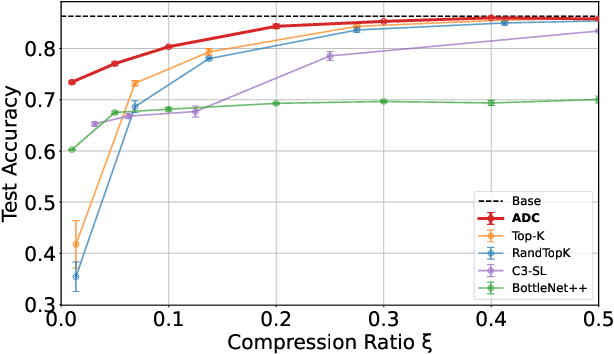
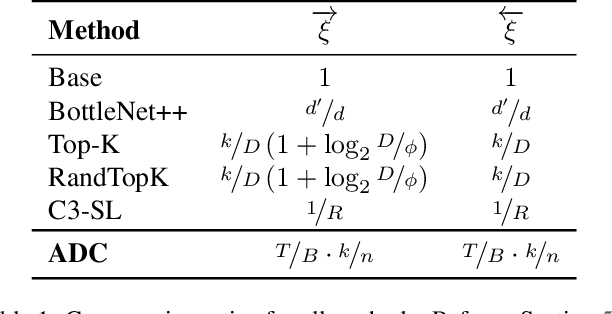
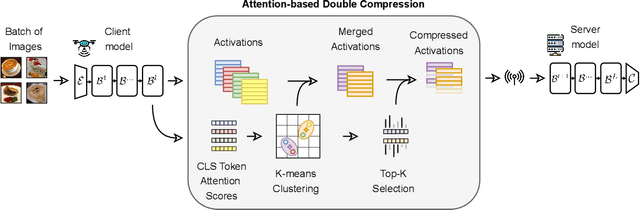

This paper proposes a novel communication-efficient Split Learning (SL) framework, named Attention-based Double Compression (ADC), which reduces the communication overhead required for transmitting intermediate Vision Transformers activations during the SL training process. ADC incorporates two parallel compression strategies. The first one merges samples' activations that are similar, based on the average attention score calculated in the last client layer; this strategy is class-agnostic, meaning that it can also merge samples having different classes, without losing generalization ability nor decreasing final results. The second strategy follows the first and discards the least meaningful tokens, further reducing the communication cost. Combining these strategies not only allows for sending less during the forward pass, but also the gradients are naturally compressed, allowing the whole model to be trained without additional tuning or approximations of the gradients. Simulation results demonstrate that Attention-based Double Compression outperforms state-of-the-art SL frameworks by significantly reducing communication overheads while maintaining high accuracy.
Adaptive Layer Selection for Efficient Vision Transformer Fine-Tuning
Aug 16, 2024
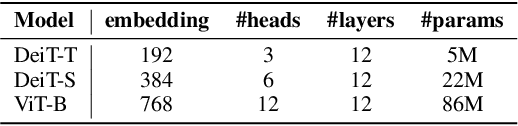


Recently, foundation models based on Vision Transformers (ViTs) have become widely available. However, their fine-tuning process is highly resource-intensive, and it hinders their adoption in several edge or low-energy applications. To this end, in this paper we introduce an efficient fine-tuning method for ViTs called $\textbf{ALaST}$ ($\textit{Adaptive Layer Selection Fine-Tuning for Vision Transformers}$) to speed up the fine-tuning process while reducing computational cost, memory load, and training time. Our approach is based on the observation that not all layers are equally critical during fine-tuning, and their importance varies depending on the current mini-batch. Therefore, at each fine-tuning step, we adaptively estimate the importance of all layers and we assign what we call ``compute budgets'' accordingly. Layers that were allocated lower budgets are either trained with a reduced number of input tokens or kept frozen. Freezing a layer reduces the computational cost and memory usage by preventing updates to its weights, while discarding tokens removes redundant data, speeding up processing and reducing memory requirements. We show that this adaptive compute allocation enables a nearly-optimal schedule for distributing computational resources across layers, resulting in substantial reductions in training time (up to 1.5x), FLOPs (up to 2x), and memory load (up to 2x) compared to traditional full fine-tuning approaches. Additionally, it can be successfully combined with other parameter-efficient fine-tuning methods, such as LoRA.