 Add to Chrome
 Add to Firefox
 Add to Edge
LIMMT: Less is More for Motion Tracking
Jun 05, 2026
We argue that high-quality motion data can steer tracking policies toward better optimization trajectories early in training. In this work, we introduce LIMMT (Less Is More for Motion Tracking). To our knowledge, this is the first data-centric study for physics-based humanoid motion tracking. We go beyond simply removing low-quality and erroneous clips, but define motion data quality through three dimensions: physics feasibility, diversity, and complexity. We show that even training with under 3% of AMASS yields better tracking performance than training with the full dataset. We further conduct data cleaning on the estimated web-sourced mocap data. Extensive experiments and analyses validate the effectiveness of our framework.

Humanoid-GPT: Scaling Data and Structure for Zero-Shot Motion Tracking
Jun 02, 2026We introduce Humanoid-GPT, a GPT-style Transformer with causal attention trained on a billion-scale motion corpus for whole-body control. Unlike prior shallow MLP trackers constrained by scarce data and an agility-generalization trade-off, Humanoid-GPT is pre-trained on a 2B-frame retargeted corpus that unifies all major mocap datasets with large-scale in-house recordings. Scaling both data and model capacity yields a single generative Transformer that tracks highly dynamic behaviors while achieving unprecedented zero-shot generalization to unseen motions and control tasks. Extensive experiments and scaling analyses show that our model establishes a new performance frontier, demonstrating robust zero-shot generalization to unseen tasks while simultaneously tracking highly dynamic and complex motions.
Back to Physics: Operator-Guided Generative Paths for SMS MRI Reconstruction
Feb 08, 2026Simultaneous multi-slice (SMS) imaging with in-plane undersampling enables highly accelerated MRI but yields a strongly coupled inverse problem with deterministic inter-slice interference and missing k-space data. Most diffusion-based reconstructions are formulated around Gaussian-noise corruption and rely on additional consistency steps to incorporate SMS physics, which can be mismatched to the operator-governed degradations in SMS acquisition. We propose an operator-guided framework that models the degradation trajectory using known acquisition operators and inverts this process via deterministic updates. Within this framework, we introduce an operator-conditional dual-stream interaction network (OCDI-Net) that explicitly disentangles target-slice content from inter-slice interference and predicts structured degradations for operator-aligned inversion, and we instantiate reconstruction as a two-stage chained inference procedure that performs SMS slice separation followed by in-plane completion. Experiments on fastMRI brain data and prospectively acquired in vivo diffusion MRI data demonstrate improved fidelity and reduced slice leakage over conventional and learning-based SMS reconstructions.
Combining scEEG and PPG for reliable sleep staging using lightweight wearables
Feb 04, 2026Reliable sleep staging remains challenging for lightweight wearable devices such as single-channel electroencephalography (scEEG) or photoplethysmography (PPG). scEEG offers direct measurement of cortical activity and serves as the foundation for sleep staging, yet exhibits limited performance on light sleep stages. PPG provides a low-cost complement that captures autonomic signatures effective for detecting light sleep. However, prior PPG-based methods rely on full night recordings (8 - 10 hours) as input context, which is less practical to provide timely feedback for sleep intervention. In this work, we investigate scEEG-PPG fusion for 4-class sleep staging under short-window (30 s - 30 min) constraints. First, we evaluate the temporal context required for each modality, to better understand the relationship of sleep staging performance with respect to monitoring window. Second, we investigate three fusion strategies: score-level fusion, cross-attention fusion enabling feature-level interactions, and Mamba-enhanced fusion incorporating temporal context modeling. Third, we train and evaluate on the Multi-Ethnic Study of Atherosclerosis (MESA) dataset and perform cross-dataset validation on the Cleveland Family Study (CFS) and the Apnea, Bariatric surgery, and CPAP (ABC) datasets. The Mamba-enhanced fusion achieves the best performance on MESA (Cohen's Kappa $κ$ = 0.798, Acc = 86.9%), with particularly notable improvement in light sleep classification (F1-score: 85.63% vs. 77.76%, recall: 82.85% vs. 69.95% for scEEG alone), and generalizes well to CFS and ABC datasets with different populations. These findings suggest that scEEG-PPG fusion is a promising approach for lightweight wearable based sleep monitoring, offering a pathway toward more accessible sleep health assessment. Source code of this project can be found at: https://github.com/DavyWJW/scEEG-PPGFusion
Towards Mitigating Modality Bias in Vision-Language Models for Temporal Action Localization
Jan 28, 2026Temporal Action Localization (TAL) requires identifying both the boundaries and categories of actions in untrimmed videos. While vision-language models (VLMs) offer rich semantics to complement visual evidence, existing approaches tend to overemphasize linguistic priors at the expense of visual performance, leading to a pronounced modality bias. We propose ActionVLM, a vision-language aggregation framework that systematically mitigates modality bias in TAL. Our key insight is to preserve vision as the dominant signal while adaptively exploiting language only when beneficial. To this end, we introduce (i) a debiasing reweighting module that estimates the language advantage-the incremental benefit of language over vision-only predictions-and dynamically reweights language modality accordingly, and (ii) a residual aggregation strategy that treats language as a complementary refinement rather than the primary driver. This combination alleviates modality bias, reduces overconfidence from linguistic priors, and strengthens temporal reasoning. Experiments on THUMOS14 show that our model outperforms state-of-the-art by up to 3.2% mAP.
PerfTracker: Online Performance Troubleshooting for Large-scale Model Training in Production
Jun 12, 2025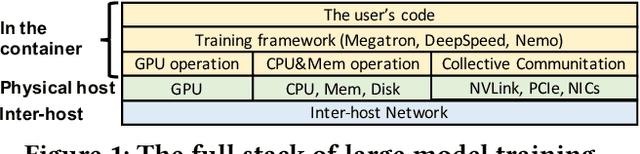
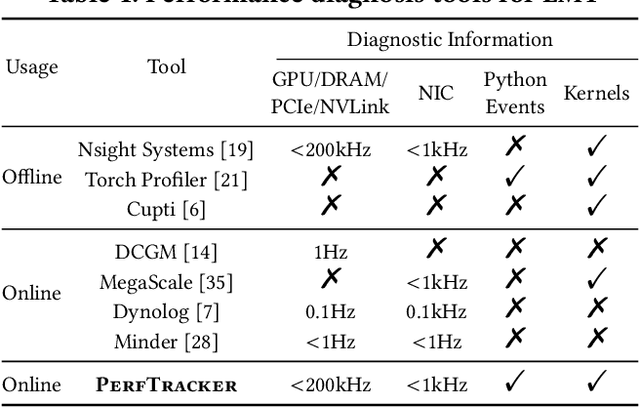
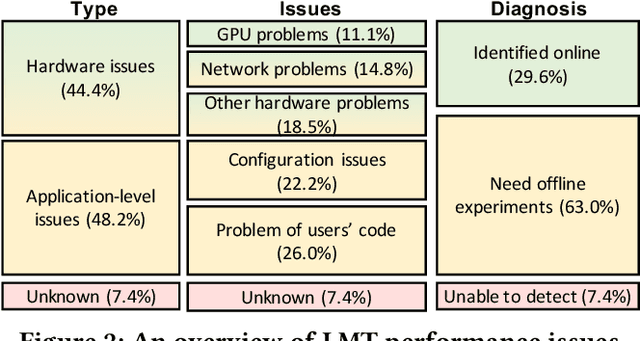
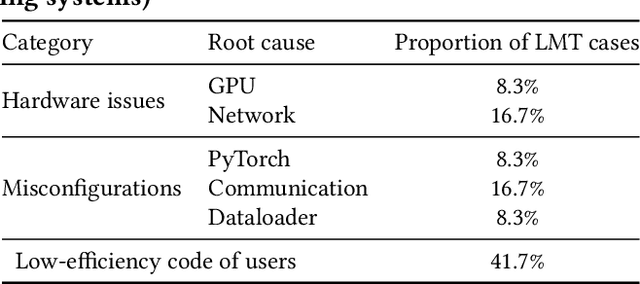
Troubleshooting performance problems of large model training (LMT) is immensely challenging, due to unprecedented scales of modern GPU clusters, the complexity of software-hardware interactions, and the data intensity of the training process. Existing troubleshooting approaches designed for traditional distributed systems or datacenter networks fall short and can hardly apply to real-world training systems. In this paper, we present PerfTracker, the first online troubleshooting system utilizing fine-grained profiling, to diagnose performance issues of large-scale model training in production. PerfTracker can diagnose performance issues rooted in both hardware (e.g., GPUs and their interconnects) and software (e.g., Python functions and GPU operations). It scales to LMT on modern GPU clusters. PerfTracker effectively summarizes runtime behavior patterns of fine-grained LMT functions via online profiling, and leverages differential observability to localize the root cause with minimal production impact. PerfTracker has been deployed as a production service for large-scale GPU clusters of O(10, 000) GPUs (product homepage https://help.aliyun.com/zh/pai/user-guide/perftracker-online-performance-analysis-diagnostic-tool). It has been used to diagnose a variety of difficult performance issues.
REMEDI: Relative Feature Enhanced Meta-Learning with Distillation for Imbalanced Prediction
May 12, 2025Predicting future vehicle purchases among existing owners presents a critical challenge due to extreme class imbalance (<0.5% positive rate) and complex behavioral patterns. We propose REMEDI (Relative feature Enhanced Meta-learning with Distillation for Imbalanced prediction), a novel multi-stage framework addressing these challenges. REMEDI first trains diverse base models to capture complementary aspects of user behavior. Second, inspired by comparative op-timization techniques, we introduce relative performance meta-features (deviation from ensemble mean, rank among peers) for effective model fusion through a hybrid-expert architecture. Third, we distill the ensemble's knowledge into a single efficient model via supervised fine-tuning with MSE loss, enabling practical deployment. Evaluated on approximately 800,000 vehicle owners, REMEDI significantly outperforms baseline approaches, achieving the business target of identifying ~50% of actual buyers within the top 60,000 recommendations at ~10% precision. The distilled model preserves the ensemble's predictive power while maintaining deployment efficiency, demonstrating REMEDI's effectiveness for imbalanced prediction in industry settings.
TrainMover: Efficient ML Training Live Migration with No Memory Overhead
Dec 17, 2024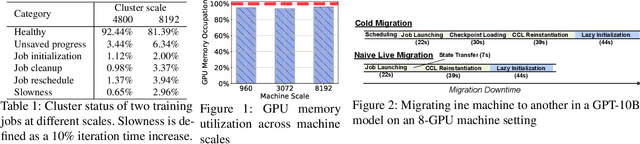
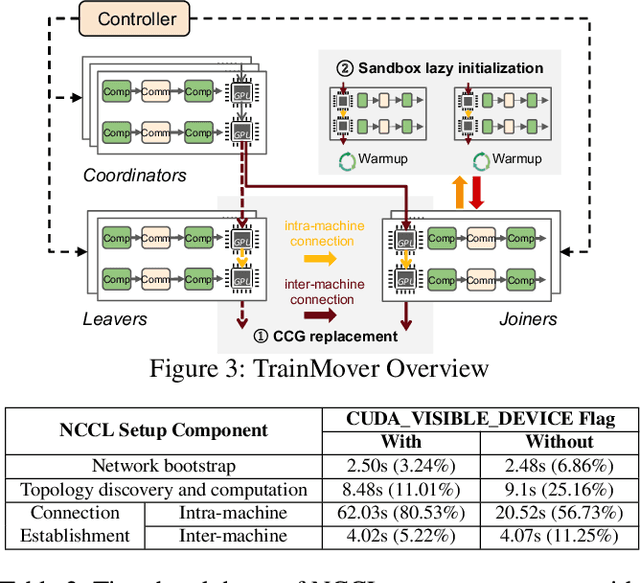
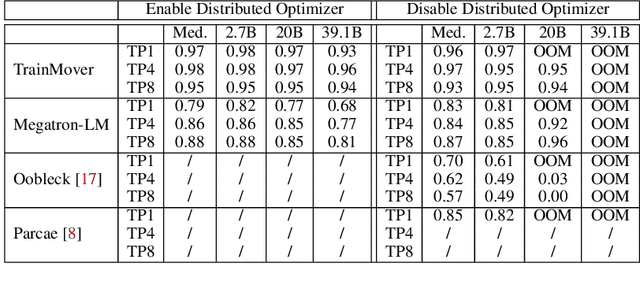
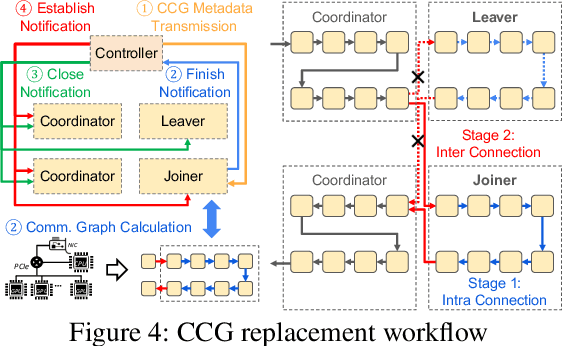
Machine learning training has emerged as one of the most prominent workloads in modern data centers. These training jobs are large-scale, long-lasting, and tightly coupled, and are often disrupted by various events in the cluster such as failures, maintenance, and job scheduling. To handle these events, we rely on cold migration, where we first checkpoint the entire cluster, replace the related machines, and then restart the training. This approach leads to disruptions to the training jobs, resulting in significant downtime. In this paper, we present TrainMover, a live migration system that enables machine replacement during machine learning training. TrainMover minimizes downtime by leveraging member replacement of collective communication groups and sandbox lazy initialization. Our evaluation demonstrates that TrainMover achieves 16x less downtime compared to all baselines, effectively handling data center events like straggler rebalancing, maintenance, and unexpected failures.
DynFocus: Dynamic Cooperative Network Empowers LLMs with Video Understanding
Nov 19, 2024The challenge in LLM-based video understanding lies in preserving visual and semantic information in long videos while maintaining a memory-affordable token count. However, redundancy and correspondence in videos have hindered the performance potential of existing methods. Through statistical learning on current datasets, we observe that redundancy occurs in both repeated and answer-irrelevant frames, and the corresponding frames vary with different questions. This suggests the possibility of adopting dynamic encoding to balance detailed video information preservation with token budget reduction. To this end, we propose a dynamic cooperative network, DynFocus, for memory-efficient video encoding in this paper. Specifically, i) a Dynamic Event Prototype Estimation (DPE) module to dynamically select meaningful frames for question answering; (ii) a Compact Cooperative Encoding (CCE) module that encodes meaningful frames with detailed visual appearance and the remaining frames with sketchy perception separately. We evaluate our method on five publicly available benchmarks, and experimental results consistently demonstrate that our method achieves competitive performance.
Sub-DM:Subspace Diffusion Model with Orthogonal Decomposition for MRI Reconstruction
Nov 06, 2024


Diffusion model-based approaches recently achieved re-markable success in MRI reconstruction, but integration into clinical routine remains challenging due to its time-consuming convergence. This phenomenon is partic-ularly notable when directly apply conventional diffusion process to k-space data without considering the inherent properties of k-space sampling, limiting k-space learning efficiency and image reconstruction quality. To tackle these challenges, we introduce subspace diffusion model with orthogonal decomposition, a method (referred to as Sub-DM) that restrict the diffusion process via projections onto subspace as the k-space data distribution evolves toward noise. Particularly, the subspace diffusion model circumvents the inference challenges posed by the com-plex and high-dimensional characteristics of k-space data, so the highly compact subspace ensures that diffusion process requires only a few simple iterations to produce accurate prior information. Furthermore, the orthogonal decomposition strategy based on wavelet transform hin-ders the information loss during the migration of the vanilla diffusion process to the subspace. Considering the strate-gy is approximately reversible, such that the entire pro-cess can be reversed. As a result, it allows the diffusion processes in different spaces to refine models through a mutual feedback mechanism, enabling the learning of ac-curate prior even when dealing with complex k-space data. Comprehensive experiments on different datasets clearly demonstrate that the superiority of Sub-DM against state of-the-art methods in terms of reconstruction speed and quality.