 Add to Chrome
 Add to Firefox
 Add to Edge
Amber-Image: Efficient Compression of Large-Scale Diffusion Transformers
Feb 19, 2026
Diffusion Transformer (DiT) architectures have significantly advanced Text-to-Image (T2I) generation but suffer from prohibitive computational costs and deployment barriers. To address these challenges, we propose an efficient compression framework that transforms the 60-layer dual-stream MMDiT-based Qwen-Image into lightweight models without training from scratch. Leveraging this framework, we introduce Amber-Image, a series of streamlined T2I models. We first derive Amber-Image-10B using a timestep-sensitive depth pruning strategy, where retained layers are reinitialized via local weight averaging and optimized through layer-wise distillation and full-parameter fine-tuning. Building on this, we develop Amber-Image-6B by introducing a hybrid-stream architecture that converts deep-layer dual streams into a single stream initialized from the image branch, further refined via progressive distillation and lightweight fine-tuning. Our approach reduces parameters by 70% and eliminates the need for large-scale data engineering. Notably, the entire compression and training pipeline-from the 10B to the 6B variant-requires fewer than 2,000 GPU hours, demonstrating exceptional cost-efficiency compared to training from scratch. Extensive evaluations on benchmarks like DPG-Bench and LongText-Bench show that Amber-Image achieves high-fidelity synthesis and superior text rendering, matching much larger models.

PerfTracker: Online Performance Troubleshooting for Large-scale Model Training in Production
Jun 12, 2025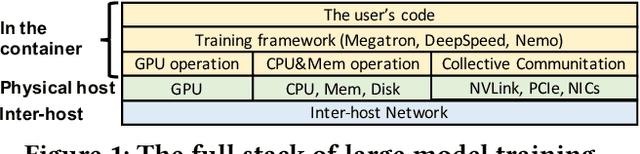
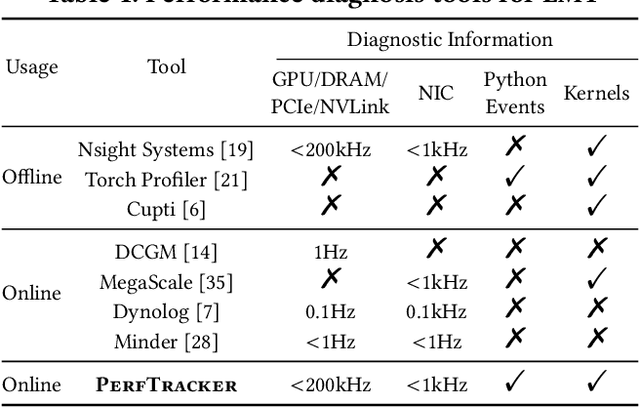
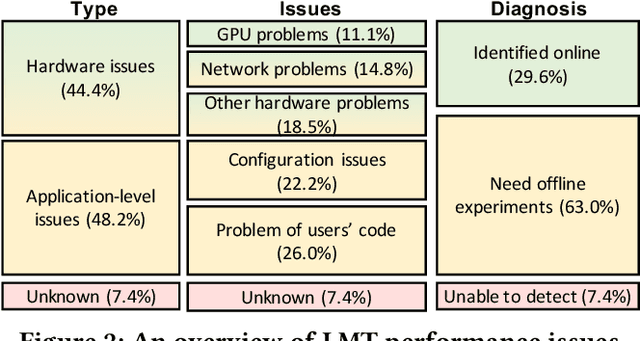
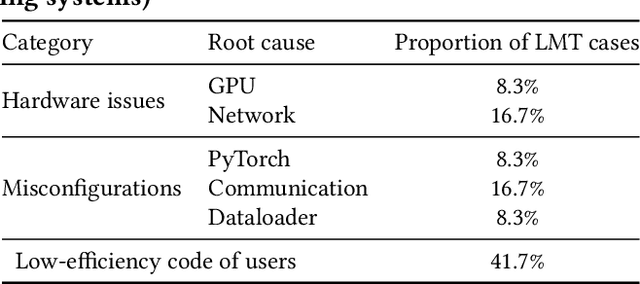
Troubleshooting performance problems of large model training (LMT) is immensely challenging, due to unprecedented scales of modern GPU clusters, the complexity of software-hardware interactions, and the data intensity of the training process. Existing troubleshooting approaches designed for traditional distributed systems or datacenter networks fall short and can hardly apply to real-world training systems. In this paper, we present PerfTracker, the first online troubleshooting system utilizing fine-grained profiling, to diagnose performance issues of large-scale model training in production. PerfTracker can diagnose performance issues rooted in both hardware (e.g., GPUs and their interconnects) and software (e.g., Python functions and GPU operations). It scales to LMT on modern GPU clusters. PerfTracker effectively summarizes runtime behavior patterns of fine-grained LMT functions via online profiling, and leverages differential observability to localize the root cause with minimal production impact. PerfTracker has been deployed as a production service for large-scale GPU clusters of O(10, 000) GPUs (product homepage https://help.aliyun.com/zh/pai/user-guide/perftracker-online-performance-analysis-diagnostic-tool). It has been used to diagnose a variety of difficult performance issues.
HelloMeme: Integrating Spatial Knitting Attentions to Embed High-Level and Fidelity-Rich Conditions in Diffusion Models
Oct 30, 2024


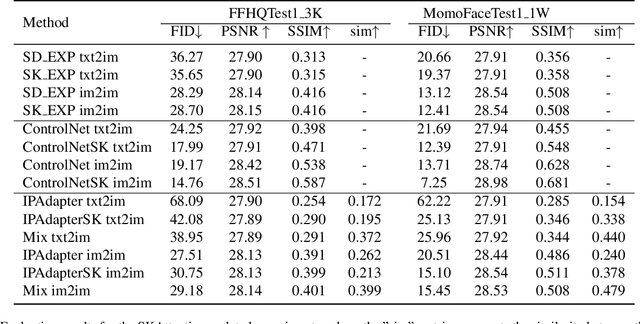
We propose an effective method for inserting adapters into text-to-image foundation models, which enables the execution of complex downstream tasks while preserving the generalization ability of the base model. The core idea of this method is to optimize the attention mechanism related to 2D feature maps, which enhances the performance of the adapter. This approach was validated on the task of meme video generation and achieved significant results. We hope this work can provide insights for post-training tasks of large text-to-image models. Additionally, as this method demonstrates good compatibility with SD1.5 derivative models, it holds certain value for the open-source community. Therefore, we will release the related code (\url{https://songkey.github.io/hellomeme}).