 Add to Chrome
 Add to Firefox
 Add to Edge
X-OmniClaw Technical Report: A Unified Mobile Agent for Multimodal Understanding and Interaction
May 07, 2026
Inspired by the development of OpenClaw, there is a growing demand for mobile-based personal agents capable of handling complex and intuitive interactions. In this technical report, we introduce X-OmniClaw, a unified mobile agent designed for multimodal understanding and interaction in the Android ecosystem. This unified architecture of perception, memory, and action enables the agent to handle complex mobile tasks with high contextual awareness. Specifically, Omni Perception provides a unified multimodal ingress pipeline that integrates UI states, real-world visual contexts, and speech inputs, leveraging a temporal alignment module to decompose raw data into structured multimodal intent representations. Omni Memory leverages multimodal memory optimization to enhance personalized intelligence by integrating runtime working memory for task continuity with long-term personal memory distilled from local data, enabling highly context-aware and personalized interactions. Finally, Omni Action employs a hybrid grounding strategy that combines structural XML metadata with visual perception for robust interaction. Through Behavior Cloning and Trajectory Replay, the system captures user navigation as reusable skills, enabling precise direct-access execution. Demonstrations across diverse scenarios show that X-OmniClaw effectively enhances interaction efficiency and task reliability, providing a practical architectural blueprint for the next generation of mobile-native personal assistants.

Budget-Constrained Agentic Large Language Models: Intention-Based Planning for Costly Tool Use
Feb 12, 2026We study budget-constrained tool-augmented agents, where a large language model must solve multi-step tasks by invoking external tools under a strict monetary budget. We formalize this setting as sequential decision making in context space with priced and stochastic tool executions, making direct planning intractable due to massive state-action spaces, high variance of outcomes and prohibitive exploration cost. To address these challenges, we propose INTENT, an inference-time planning framework that leverages an intention-aware hierarchical world model to anticipate future tool usage, risk-calibrated cost, and guide decisions online. Across cost-augmented StableToolBench, INTENT strictly enforces hard budget feasibility while substantially improving task success over baselines, and remains robust under dynamic market shifts such as tool price changes and varying budgets.
The Llama 4 Herd: Architecture, Training, Evaluation, and Deployment Notes
Jan 15, 2026This document consolidates publicly reported technical details about Metas Llama 4 model family. It summarizes (i) released variants (Scout and Maverick) and the broader herd context including the previewed Behemoth teacher model, (ii) architectural characteristics beyond a high-level MoE description covering routed/shared-expert structure, early-fusion multimodality, and long-context design elements reported for Scout (iRoPE and length generalization strategies), (iii) training disclosures spanning pre-training, mid-training for long-context extension, and post-training methodology (lightweight SFT, online RL, and lightweight DPO) as described in release materials, (iv) developer-reported benchmark results for both base and instruction-tuned checkpoints, and (v) practical deployment constraints observed across major serving environments, including provider-specific context limits and quantization packaging. The manuscript also summarizes licensing obligations relevant to redistribution and derivative naming, and reviews publicly described safeguards and evaluation practices. The goal is to provide a compact technical reference for researchers and practitioners who need precise, source-backed facts about Llama 4.
ROI-Reasoning: Rational Optimization for Inference via Pre-Computation Meta-Cognition
Jan 07, 2026Large language models (LLMs) can achieve strong reasoning performance with sufficient computation, but they do not inherently know how much computation a task requires. We study budgeted inference-time reasoning for multiple tasks under a strict global token constraint and formalize it as a Ordered Stochastic Multiple-Choice Knapsack Problem(OS-MCKP). This perspective highlights a meta-cognitive requirement -- anticipating task difficulty, estimating return over investment (ROI), and allocating computation strategically. We propose ROI-Reasoning, a two-stage framework that endows LLMs with intrinsic, budget-aware rationality. In the first stage, Meta-Cognitive Fine-Tuning teaches models to predict reasoning cost and expected utility before generation, enabling explicit solve-or-skip decisions. Next, Rationality-Aware Reinforcement Learning optimizes sequential decision making under a hard token budget, allowing models to learn long-horizon allocation strategies. Across budgeted mathematical reasoning benchmarks, ROI-Reasoning consistently improves overall score while substantially reducing regret under tight computation budgets.
Rubric-Based Benchmarking and Reinforcement Learning for Advancing LLM Instruction Following
Nov 13, 2025Recent progress in large language models (LLMs) has led to impressive performance on a range of tasks, yet advanced instruction following (IF)-especially for complex, multi-turn, and system-prompted instructions-remains a significant challenge. Rigorous evaluation and effective training for such capabilities are hindered by the lack of high-quality, human-annotated benchmarks and reliable, interpretable reward signals. In this work, we introduce AdvancedIF (we will release this benchmark soon), a comprehensive benchmark featuring over 1,600 prompts and expert-curated rubrics that assess LLMs ability to follow complex, multi-turn, and system-level instructions. We further propose RIFL (Rubric-based Instruction-Following Learning), a novel post-training pipeline that leverages rubric generation, a finetuned rubric verifier, and reward shaping to enable effective reinforcement learning for instruction following. Extensive experiments demonstrate that RIFL substantially improves the instruction-following abilities of LLMs, achieving a 6.7% absolute gain on AdvancedIF and strong results on public benchmarks. Our ablation studies confirm the effectiveness of each component in RIFL. This work establishes rubrics as a powerful tool for both training and evaluating advanced IF in LLMs, paving the way for more capable and reliable AI systems.
Scaling Agent Learning via Experience Synthesis
Nov 10, 2025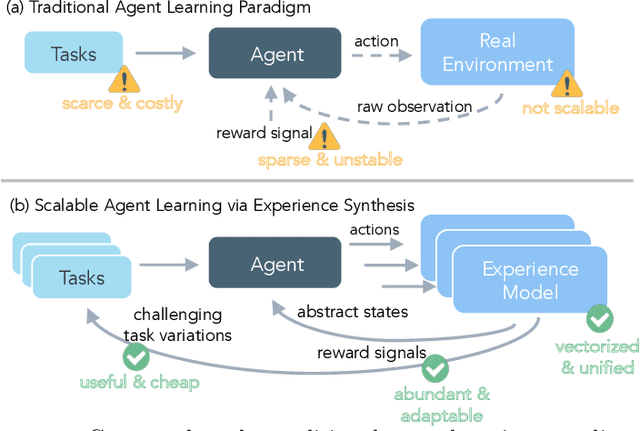
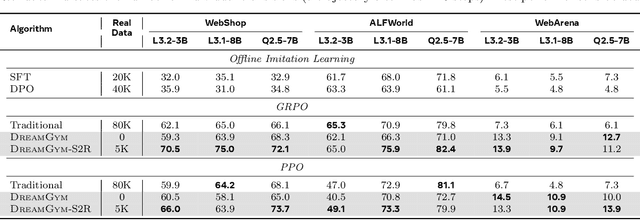
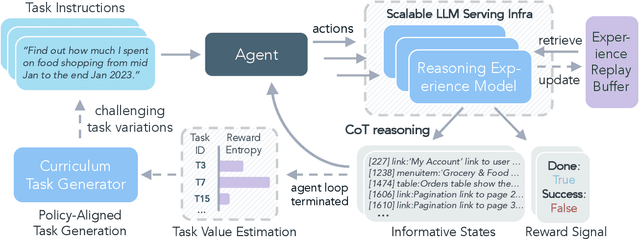
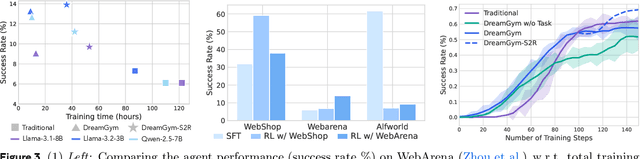
While reinforcement learning (RL) can empower autonomous agents by enabling self-improvement through interaction, its practical adoption remains challenging due to costly rollouts, limited task diversity, unreliable reward signals, and infrastructure complexity, all of which obstruct the collection of scalable experience data. To address these challenges, we introduce DreamGym, the first unified framework designed to synthesize diverse experiences with scalability in mind to enable effective online RL training for autonomous agents. Rather than relying on expensive real-environment rollouts, DreamGym distills environment dynamics into a reasoning-based experience model that derives consistent state transitions and feedback signals through step-by-step reasoning, enabling scalable agent rollout collection for RL. To improve the stability and quality of transitions, DreamGym leverages an experience replay buffer initialized with offline real-world data and continuously enriched with fresh interactions to actively support agent training. To improve knowledge acquisition, DreamGym adaptively generates new tasks that challenge the current agent policy, enabling more effective online curriculum learning. Experiments across diverse environments and agent backbones demonstrate that DreamGym substantially improves RL training, both in fully synthetic settings and in sim-to-real transfer scenarios. On non-RL-ready tasks like WebArena, DreamGym outperforms all baselines by over 30%. And in RL-ready but costly settings, it matches GRPO and PPO performance using only synthetic interactions. When transferring a policy trained purely on synthetic experiences to real-environment RL, DreamGym yields significant additional performance gains while requiring far fewer real-world interactions, providing a scalable warm-start strategy for general-purpose RL.
FinGAIA: An End-to-End Benchmark for Evaluating AI Agents in Finance
Jul 23, 2025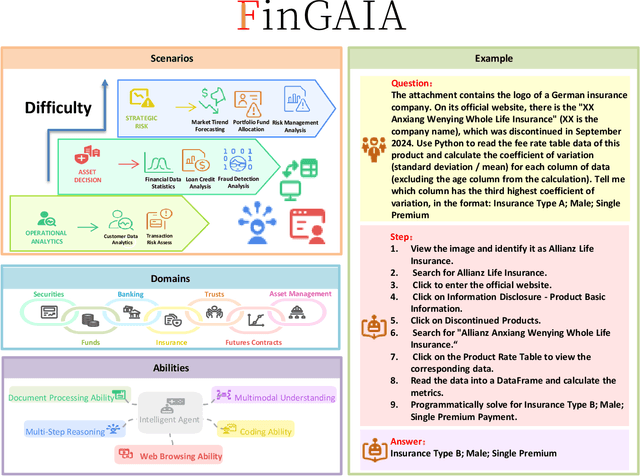
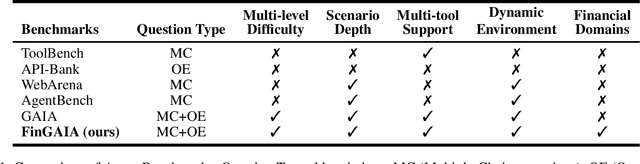
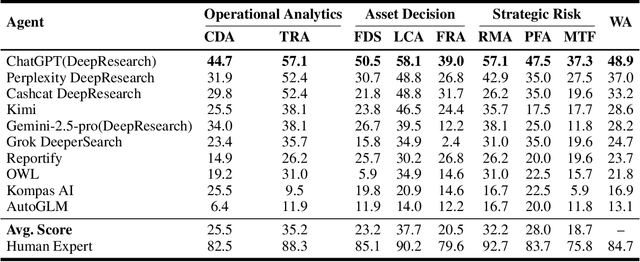
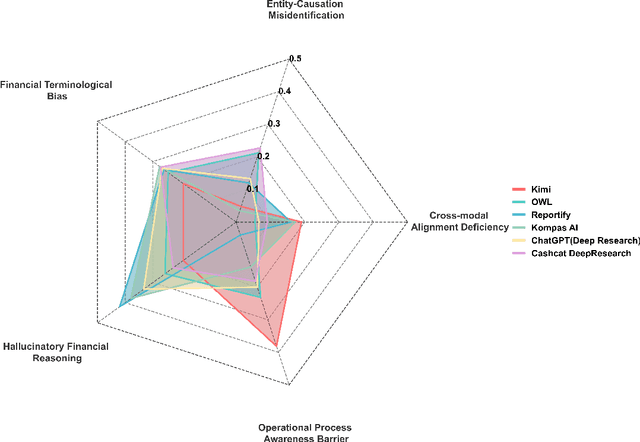
The booming development of AI agents presents unprecedented opportunities for automating complex tasks across various domains. However, their multi-step, multi-tool collaboration capabilities in the financial sector remain underexplored. This paper introduces FinGAIA, an end-to-end benchmark designed to evaluate the practical abilities of AI agents in the financial domain. FinGAIA comprises 407 meticulously crafted tasks, spanning seven major financial sub-domains: securities, funds, banking, insurance, futures, trusts, and asset management. These tasks are organized into three hierarchical levels of scenario depth: basic business analysis, asset decision support, and strategic risk management. We evaluated 10 mainstream AI agents in a zero-shot setting. The best-performing agent, ChatGPT, achieved an overall accuracy of 48.9\%, which, while superior to non-professionals, still lags financial experts by over 35 percentage points. Error analysis has revealed five recurring failure patterns: Cross-modal Alignment Deficiency, Financial Terminological Bias, Operational Process Awareness Barrier, among others. These patterns point to crucial directions for future research. Our work provides the first agent benchmark closely related to the financial domain, aiming to objectively assess and promote the development of agents in this crucial field. Partial data is available at https://github.com/SUFE-AIFLM-Lab/FinGAIA.
Optimal Auction Design in the Joint Advertising
Jul 10, 2025Online advertising is a vital revenue source for major internet platforms. Recently, joint advertising, which assigns a bundle of two advertisers in an ad slot instead of allocating a single advertiser, has emerged as an effective method for enhancing allocation efficiency and revenue. However, existing mechanisms for joint advertising fail to realize the optimality, as they tend to focus on individual advertisers and overlook bundle structures. This paper identifies an optimal mechanism for joint advertising in a single-slot setting. For multi-slot joint advertising, we propose \textbf{BundleNet}, a novel bundle-based neural network approach specifically designed for joint advertising. Our extensive experiments demonstrate that the mechanisms generated by \textbf{BundleNet} approximate the theoretical analysis results in the single-slot setting and achieve state-of-the-art performance in the multi-slot setting. This significantly increases platform revenue while ensuring approximate dominant strategy incentive compatibility and individual rationality.
ChronoSteer: Bridging Large Language Model and Time Series Foundation Model via Synthetic Data
May 15, 2025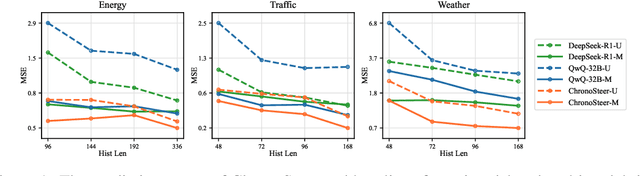
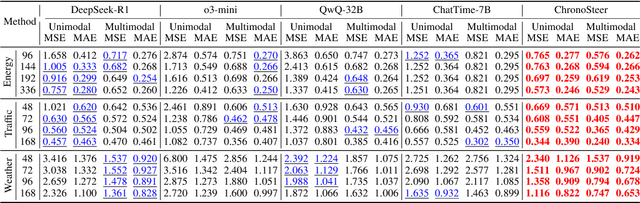
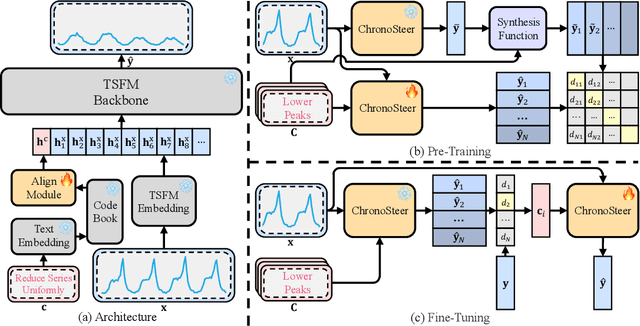
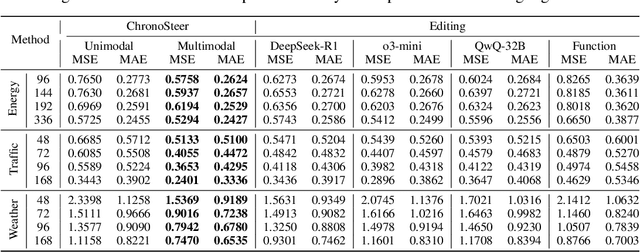
Conventional forecasting methods rely on unimodal time series data, limiting their ability to exploit rich textual information. Recently, large language models (LLMs) and time series foundation models (TSFMs) have demonstrated powerful capability in textual reasoning and temporal modeling, respectively. Integrating the strengths of both to construct a multimodal model that concurrently leverages both temporal and textual information for future inference has emerged as a critical research challenge. To address the scarcity of event-series paired data, we propose a decoupled framework: an LLM is employed to transform textual events into revision instructions, which are then used to steer the output of TSFM. To implement this framework, we introduce ChronoSteer, a multimodal TSFM that can be steered through textual revision instructions, effectively bridging LLM and TSFM. Moreover, to mitigate the shortage of cross-modal instruction-series paired data, we devise a two-stage training strategy based on synthetic data. In addition, we also construct a high-quality multimodal time series forecasting benchmark to address the information leakage concerns during evaluation. After integrating with an LLM, ChronoSteer, which is trained exclusively on synthetic data, achieves a 25.7% improvement in prediction accuracy compared to the unimodal backbone and a 22.5% gain over the previous state-of-the-art multimodal method.
Unlocking the Potential of Linear Networks for Irregular Multivariate Time Series Forecasting
May 01, 2025Time series forecasting holds significant importance across various industries, including finance, transportation, energy, healthcare, and climate. Despite the widespread use of linear networks due to their low computational cost and effectiveness in modeling temporal dependencies, most existing research has concentrated on regularly sampled and fully observed multivariate time series. However, in practice, we frequently encounter irregular multivariate time series characterized by variable sampling intervals and missing values. The inherent intra-series inconsistency and inter-series asynchrony in such data hinder effective modeling and forecasting with traditional linear networks relying on static weights. To tackle these challenges, this paper introduces a novel model named AiT. AiT utilizes an adaptive linear network capable of dynamically adjusting weights according to observation time points to address intra-series inconsistency, thereby enhancing the accuracy of temporal dependencies modeling. Furthermore, by incorporating the Transformer module on variable semantics embeddings, AiT efficiently captures variable correlations, avoiding the challenge of inter-series asynchrony. Comprehensive experiments across four benchmark datasets demonstrate the superiority of AiT, improving prediction accuracy by 11% and decreasing runtime by 52% compared to existing state-of-the-art methods.