 Add to Chrome
 Add to Firefox
 Add to Edge
When Do Graph Foundation Models Transfer? A Data-Centric Theory
May 28, 2026
Graph foundation models (GFMs) aim to reuse a single backbone across diverse graph domains, yet their transfer is often uneven and can exhibit negative transfer. While most prior work improves transfer through architectural or adaptation choices, we ask a data-centric question: which properties of two graph domains determine how much a fixed representation model changes its outputs? Using a graphon-based continuous limit for dense graphs, we show that for both set-based and message-passing tokenizations, any Lipschitz backbone admits an explicit decomposition of cross-domain output shift into (i) graph-specific finite-sample approximation terms and (ii) an intrinsic, relabeling-invariant domain discrepancy capturing structural mismatch. A key ingredient is positional-encoding (PE) stability: we establish stability guarantees for spectral PEs and highlight contrasting behaviors of eigenvector- versus subspace-based PEs. Experiments on synthetic and real graphs validate the theory and translate the decomposition into guidance for data curation in GFM transfer.

Your Agents Are Aging Too: Agent Lifespan Engineering for Deployed Systems
May 25, 2026Long-lived AI agents are increasingly deployed as persistent operational systems, yet they are still evaluated like freshly initialized models. Day-one benchmarks miss a basic systems question: how long does an agent remain reliable after deployment? Even when model weights are frozen, an agent's effective state keeps changing as it compresses interaction history, retrieves from a growing memory store, revises facts after updates, and undergoes routine maintenance. Reliability therefore becomes a lifespan property of the full agent harness, not only a snapshot property of the base model. We introduce AgingBench, a longitudinal reliability benchmark for agent lifespan engineering: measuring not only whether deployed agents degrade, but what form the degradation takes and where repair should target. AgingBench organizes agent aging into four mechanisms: compression aging, interference aging, revision aging, and maintenance aging. To diagnose these failures, AgingBench uses temporal dependency graphs and paired counterfactual probes that produce diagnostic profiles for the write, retrieval, and utilization stages of the memory pipeline. Across 7 scenarios, 14 models, multiple memory policies, and both runner-controlled and autonomous agents, over ~400 runs spanning 8 - 200 sessions show that agent aging is not one-dimensional: behavioral tests can remain clean while factual precision decays; derived-state tracking can collapse sharply within a single model; and the same wrong answer can require different repairs depending on what the diagnostic profile points to. These results suggest that reliable agent deployment requires lifespan evaluation, mechanism-level diagnosis, and stage-targeted repair, not only stronger day-one models.
AutoScout: Structured Optimization for Automating ML System Configuration
Mar 12, 2026Machine learning (ML) systems expose a rapidly expanding configuration space spanning model-parallelism strategies, communication optimizations, and low-level runtime parameters. End-to-end system efficiency is highly sensitive to these choices, yet identifying high-performance configurations is challenging due to heterogeneous feature types (e.g., sparse and dense parameters), conditional dependencies (e.g., valid execution parameters only under specific upstream decisions), and the high search (profiling) cost. Existing approaches either optimize a narrow subset of configuration dimensions or rely on ad-hoc heuristics that fail to generalize as configuration spaces continue to grow. We present AutoScout, a general-purpose systems configurator for ML training, fine-tuning, and inference. It formulates the system configuration as a mixed-discrete/continuous optimization problem with hierarchical dependencies and introduces a hybrid optimization framework that jointly refines sparse structural decisions and dense execution parameters. To reduce profiling cost, AutoScout adaptively prioritizes high-impact configuration features and ensembles simulators with varying fidelity. Across diverse models, hardware platforms, and deployment objectives, AutoScout consistently identifies high-performance configurations, achieving 2.7-3.0$\times$ training speedup over expert-tuned settings.
CUCo: An Agentic Framework for Compute and Communication Co-design
Mar 02, 2026Custom CUDA kernel development is essential for maximizing GPU utilization in large-scale distributed LLM training and inference, yet manually writing kernels that jointly leverage both computation and communication remains a labor-intensive and error-prone process. Prior work on kernel optimization has focused almost exclusively on computation, leaving communication kernels largely untouched even though they constitute a significant share of total execution time. We introduce CUCo, a training-free agent-driven workflow that automatically generates high-performance CUDA kernels that jointly orchestrate computation and communication. By co-optimizing these traditionally disjoint components, CUCo unlocks new optimization opportunities unavailable to existing approaches, outperforming state-of-the-art baselines and reducing end-to-end latency by up to $1.57\times$.
Vulcan: Instance-Optimal Systems Heuristics Through LLM-Driven Search
Dec 31, 2025Resource-management tasks in modern operating and distributed systems continue to rely primarily on hand-designed heuristics for tasks such as scheduling, caching, or active queue management. Designing performant heuristics is an expensive, time-consuming process that we are forced to continuously go through due to the constant flux of hardware, workloads and environments. We propose a new alternative: synthesizing instance-optimal heuristics -- specialized for the exact workloads and hardware where they will be deployed -- using code-generating large language models (LLMs). To make this synthesis tractable, Vulcan separates policy and mechanism through LLM-friendly, task-agnostic interfaces. With these interfaces, users specify the inputs and objectives of their desired policy, while Vulcan searches for performant policies via evolutionary search over LLM-generated code. This interface is expressive enough to capture a wide range of system policies, yet sufficiently constrained to allow even small, inexpensive LLMs to generate correct and executable code. We use Vulcan to synthesize performant heuristics for cache eviction and memory tiering, and find that these heuristics outperform all human-designed state-of-the-art algorithms by upto 69% and 7.9% in performance for each of these tasks respectively.
SuperGen: An Efficient Ultra-high-resolution Video Generation System with Sketching and Tiling
Aug 25, 2025Diffusion models have recently achieved remarkable success in generative tasks (e.g., image and video generation), and the demand for high-quality content (e.g., 2K/4K videos) is rapidly increasing across various domains. However, generating ultra-high-resolution videos on existing standard-resolution (e.g., 720p) platforms remains challenging due to the excessive re-training requirements and prohibitively high computational and memory costs. To this end, we introduce SuperGen, an efficient tile-based framework for ultra-high-resolution video generation. SuperGen features a novel training-free algorithmic innovation with tiling to successfully support a wide range of resolutions without additional training efforts while significantly reducing both memory footprint and computational complexity. Moreover, SuperGen incorporates a tile-tailored, adaptive, region-aware caching strategy that accelerates video generation by exploiting redundancy across denoising steps and spatial regions. SuperGen also integrates cache-guided, communication-minimized tile parallelism for enhanced throughput and minimized latency. Evaluations demonstrate that SuperGen harvests the maximum performance gains while achieving high output quality across various benchmarks.
On-the-Fly Adaptive Distillation of Transformer to Dual-State Linear Attention
Jun 12, 2025Large language models (LLMs) excel at capturing global token dependencies via self-attention but face prohibitive compute and memory costs on lengthy inputs. While sub-quadratic methods (e.g., linear attention) can reduce these costs, they often degrade accuracy due to overemphasizing recent tokens. In this work, we first propose dual-state linear attention (DSLA), a novel design that maintains two specialized hidden states-one for preserving historical context and one for tracking recency-thereby mitigating the short-range bias typical of linear-attention architectures. To further balance efficiency and accuracy under dynamic workload conditions, we introduce DSLA-Serve, an online adaptive distillation framework that progressively replaces Transformer layers with DSLA layers at inference time, guided by a sensitivity-based layer ordering. DSLA-Serve uses a chained fine-tuning strategy to ensure that each newly converted DSLA layer remains consistent with previously replaced layers, preserving the overall quality. Extensive evaluations on commonsense reasoning, long-context QA, and text summarization demonstrate that DSLA-Serve yields 2.3x faster inference than Llama2-7B and 3.0x faster than the hybrid Zamba-7B, while retaining comparable performance across downstream tasks. Our ablation studies show that DSLA's dual states capture both global and local dependencies, addressing the historical-token underrepresentation seen in prior linear attentions. Codes are available at https://github.com/utnslab/DSLA-Serve.
HALoS: Hierarchical Asynchronous Local SGD over Slow Networks for Geo-Distributed Large Language Model Training
Jun 05, 2025Training large language models (LLMs) increasingly relies on geographically distributed accelerators, causing prohibitive communication costs across regions and uneven utilization of heterogeneous hardware. We propose HALoS, a hierarchical asynchronous optimization framework that tackles these issues by introducing local parameter servers (LPSs) within each region and a global parameter server (GPS) that merges updates across regions. This hierarchical design minimizes expensive inter-region communication, reduces straggler effects, and leverages fast intra-region links. We provide a rigorous convergence analysis for HALoS under non-convex objectives, including theoretical guarantees on the role of hierarchical momentum in asynchronous training. Empirically, HALoS attains up to 7.5x faster convergence than synchronous baselines in geo-distributed LLM training and improves upon existing asynchronous methods by up to 2.1x. Crucially, HALoS preserves the model quality of fully synchronous SGD-matching or exceeding accuracy on standard language modeling and downstream benchmarks-while substantially lowering total training time. These results demonstrate that hierarchical, server-side update accumulation and global model merging are powerful tools for scalable, efficient training of new-era LLMs in heterogeneous, geo-distributed environments.
ConfigBot: Adaptive Resource Allocation for Robot Applications in Dynamic Environments
Jan 17, 2025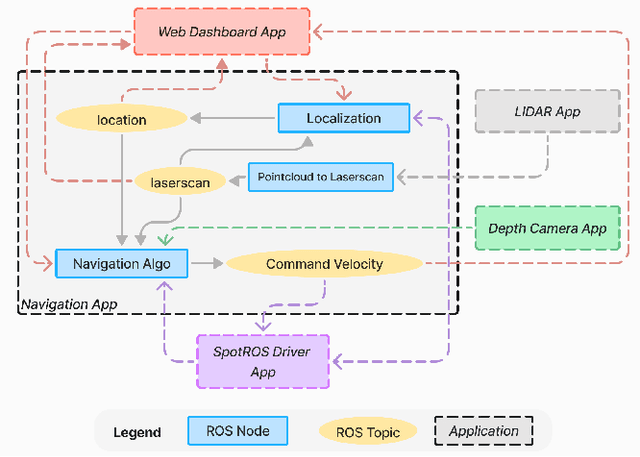

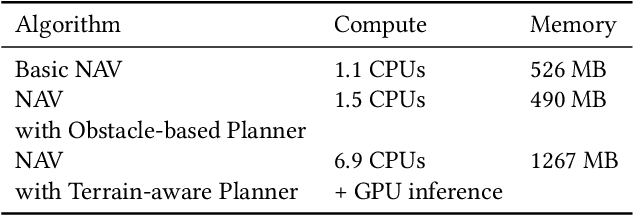
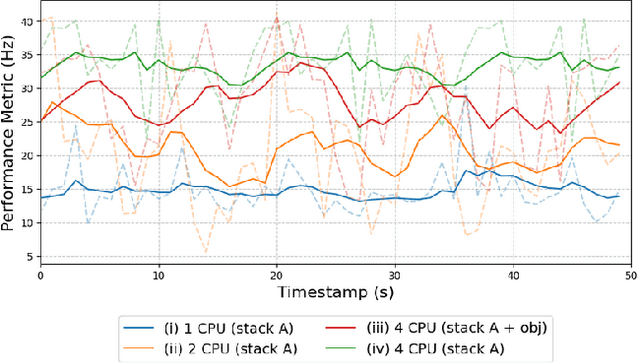
The growing use of autonomous mobile service robots (AMSRs) in dynamic environments requires flexible management of compute resources to optimize the performance of diverse tasks such as navigation, localization, perception, and so on. Current robot deployments, which oftentimes rely on static configurations (of the OS, applications, etc.) and system over-provisioning, fall short since they do not account for the tasks' performance variations resulting in poor system-wide behavior such as robot instability and/or inefficient resource use. This paper presents ConfigBot, a system designed to adaptively reconfigure AMSR applications to meet a predefined performance specification by leveraging runtime profiling and automated configuration tuning. Through experiments on a Boston Dynamics Spot robot equipped with NVIDIA AGX Orin, we demonstrate ConfigBot's efficacy in maintaining system stability and optimizing resource allocation across diverse scenarios. Our findings highlight the promise of tailored and dynamic configurations for robot deployments.
OMEGA: A Low-Latency GNN Serving System for Large Graphs
Jan 15, 2025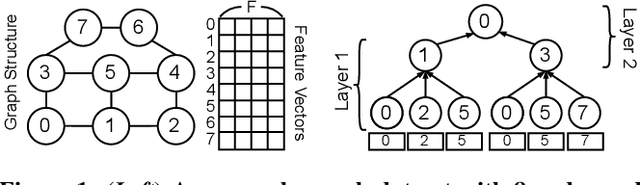

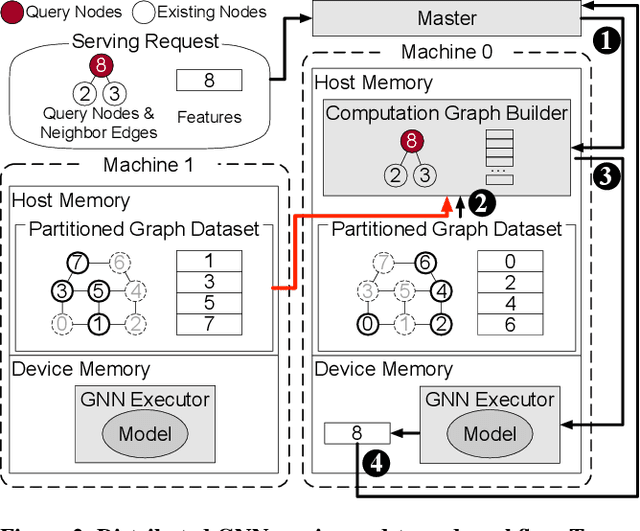

Graph Neural Networks (GNNs) have been widely adopted for their ability to compute expressive node representations in graph datasets. However, serving GNNs on large graphs is challenging due to the high communication, computation, and memory overheads of constructing and executing computation graphs, which represent information flow across large neighborhoods. Existing approximation techniques in training can mitigate the overheads but, in serving, still lead to high latency and/or accuracy loss. To this end, we propose OMEGA, a system that enables low-latency GNN serving for large graphs with minimal accuracy loss through two key ideas. First, OMEGA employs selective recomputation of precomputed embeddings, which allows for reusing precomputed computation subgraphs while selectively recomputing a small fraction to minimize accuracy loss. Second, we develop computation graph parallelism, which reduces communication overhead by parallelizing the creation and execution of computation graphs across machines. Our evaluation with large graph datasets and GNN models shows that OMEGA significantly outperforms state-of-the-art techniques.