 Add to Chrome
 Add to Firefox
 Add to Edge
Comparison Research of Millimeter-Wave/Infrared Co-aperture Reflector Antenna Systems Based on a Specialized Film
Apr 27, 2025
This paper presents a novel co-aperture reflector antenna operating in millimeter-wave (MMW) and infrared (IR) for cloud detection radar. The proposed design combines a back-fed dual-reflector antenna, an IR optical reflection system, and a specialize thin film with IR-reflective/MMW-transmissive properties. Simulations demonstrate a gain exceeding 50 dBi within 94 GHz plush or minus 500 MHz bandwidth, with 0.46{\deg} beamwidth in both azimuth (E-plane) and elevation (H-plane) and sidelobe levels below -25 dB. This co-aperture architecture addresses the limitations of standalone MMW and IR radars, enabling high-resolution cloud microphysical parameter retrieval while minimizing system footprint. The design lays a foundation for airborne/spaceborne multi-mode detection systems.

Revisiting Transformers through the Lens of Low Entropy and Dynamic Sparsity
Apr 26, 2025Compression has been a critical lens to understand the success of Transformers. In the past, we have typically taken the target distribution as a criterion to evaluate a model's compression performance. Nevertheless,it often remains challenging to precisely assess how well the model achieves compression and to compare the information content of the learned distribution with that of the target distribution during compression,as the target distribution is typically unknown and entropy computation often incurs exponential cost. In this work, we explore these issues under a controlled experimental setup. We find that Transformers exhibit a unique inductive bias in data compression: beyond approaching the target distribution, they tend to favor learning lower-entropy distributions, with this tendency becoming more pronounced as the model size increases. This preference prevents Transformers from perfectly aligning with the target distribution, instead further compressing its information content. Furthermore, we show that the FFN module plays a critical role in driving this bias. In addition, while models remove informational redundancy from data during compression, they also exhibit redundancy within their parameters, which enables compression and can be characterized through dynamic sparsity. However, the dynamic sparsity patterns in Transformers, particularly in attention and FFN modules, demand further exploration. As for this, we show that larger Transformers show stronger preferences for bypassing attention computations via residual connections and have lower proportion of active neurons. Interestingly, we also find that training instability in larger models strongly correlates with sudden increases in dead neurons. Our work contributes to a deeper understanding of Transformers from the lens of entropy and dynamic sparsity.
3D Deep-learning-based Segmentation of Human Skin Sweat Glands and Their 3D Morphological Response to Temperature Variations
Apr 24, 2025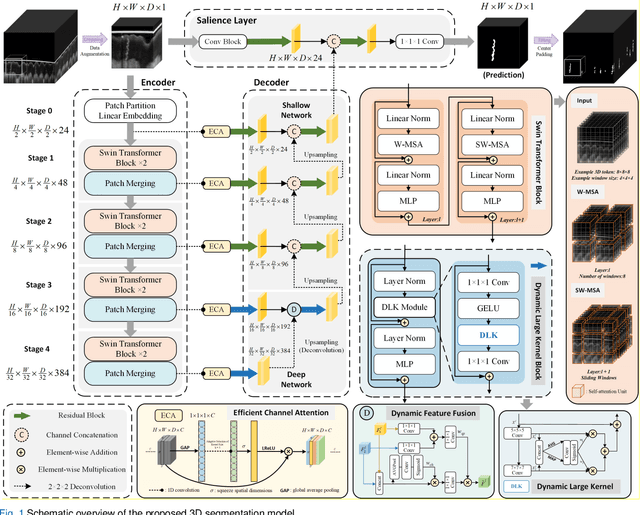
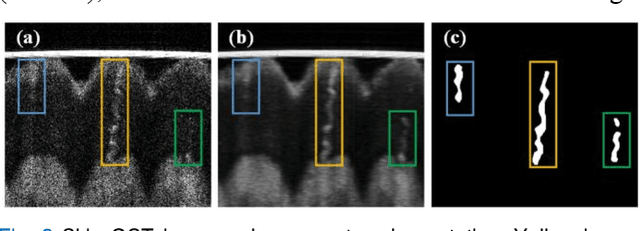
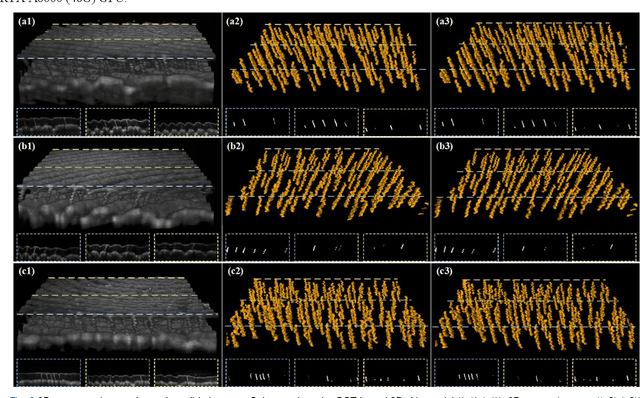

Skin, the primary regulator of heat exchange, relies on sweat glands for thermoregulation. Alterations in sweat gland morphology play a crucial role in various pathological conditions and clinical diagnoses. Current methods for observing sweat gland morphology are limited by their two-dimensional, in vitro, and destructive nature, underscoring the urgent need for real-time, non-invasive, quantifiable technologies. We proposed a novel three-dimensional (3D) transformer-based multi-object segmentation framework, integrating a sliding window approach, joint spatial-channel attention mechanism, and architectural heterogeneity between shallow and deep layers. Our proposed network enables precise 3D sweat gland segmentation from skin volume data captured by optical coherence tomography (OCT). For the first time, subtle variations of sweat gland 3D morphology in response to temperature changes, have been visualized and quantified. Our approach establishes a benchmark for normal sweat gland morphology and provides a real-time, non-invasive tool for quantifying 3D structural parameters. This enables the study of individual variability and pathological changes in sweat gland structure, advancing dermatological research and clinical applications, including thermoregulation and bromhidrosis treatment.
Killing Two Birds with One Stone: Unifying Retrieval and Ranking with a Single Generative Recommendation Model
Apr 23, 2025In recommendation systems, the traditional multi-stage paradigm, which includes retrieval and ranking, often suffers from information loss between stages and diminishes performance. Recent advances in generative models, inspired by natural language processing, suggest the potential for unifying these stages to mitigate such loss. This paper presents the Unified Generative Recommendation Framework (UniGRF), a novel approach that integrates retrieval and ranking into a single generative model. By treating both stages as sequence generation tasks, UniGRF enables sufficient information sharing without additional computational costs, while remaining model-agnostic. To enhance inter-stage collaboration, UniGRF introduces a ranking-driven enhancer module that leverages the precision of the ranking stage to refine retrieval processes, creating an enhancement loop. Besides, a gradient-guided adaptive weighter is incorporated to dynamically balance the optimization of retrieval and ranking, ensuring synchronized performance improvements. Extensive experiments demonstrate that UniGRF significantly outperforms existing models on benchmark datasets, confirming its effectiveness in facilitating information transfer. Ablation studies and further experiments reveal that UniGRF not only promotes efficient collaboration between stages but also achieves synchronized optimization. UniGRF provides an effective, scalable, and compatible framework for generative recommendation systems.
From Human Memory to AI Memory: A Survey on Memory Mechanisms in the Era of LLMs
Apr 22, 2025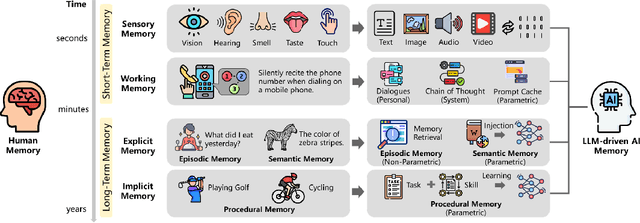
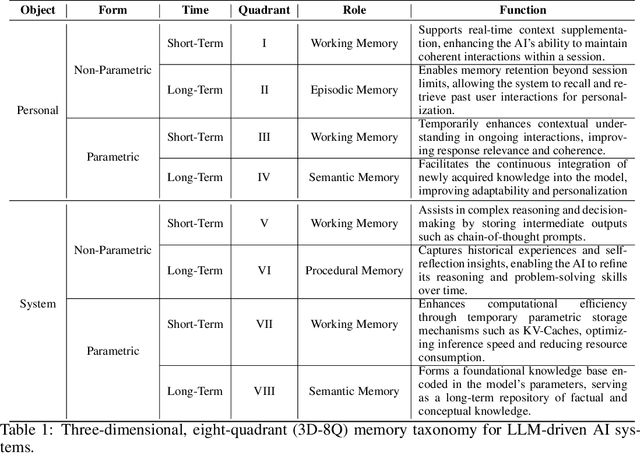
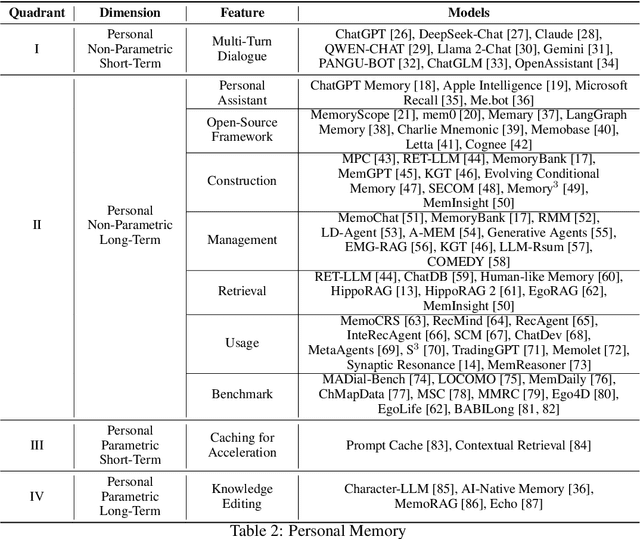
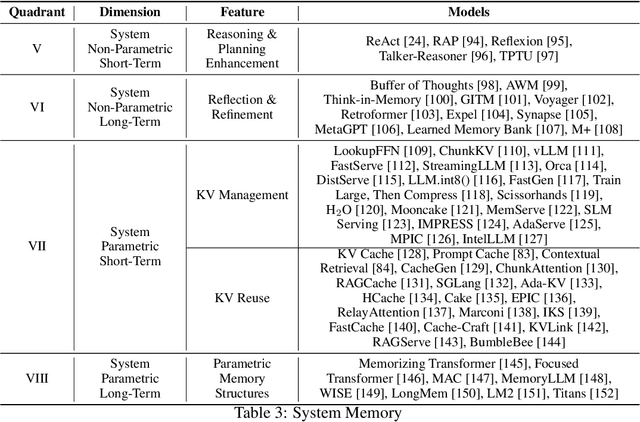
Memory is the process of encoding, storing, and retrieving information, allowing humans to retain experiences, knowledge, skills, and facts over time, and serving as the foundation for growth and effective interaction with the world. It plays a crucial role in shaping our identity, making decisions, learning from past experiences, building relationships, and adapting to changes. In the era of large language models (LLMs), memory refers to the ability of an AI system to retain, recall, and use information from past interactions to improve future responses and interactions. Although previous research and reviews have provided detailed descriptions of memory mechanisms, there is still a lack of a systematic review that summarizes and analyzes the relationship between the memory of LLM-driven AI systems and human memory, as well as how we can be inspired by human memory to construct more powerful memory systems. To achieve this, in this paper, we propose a comprehensive survey on the memory of LLM-driven AI systems. In particular, we first conduct a detailed analysis of the categories of human memory and relate them to the memory of AI systems. Second, we systematically organize existing memory-related work and propose a categorization method based on three dimensions (object, form, and time) and eight quadrants. Finally, we illustrate some open problems regarding the memory of current AI systems and outline possible future directions for memory in the era of large language models.
A Survey of Personalization: From RAG to Agent
Apr 14, 2025Personalization has become an essential capability in modern AI systems, enabling customized interactions that align with individual user preferences, contexts, and goals. Recent research has increasingly concentrated on Retrieval-Augmented Generation (RAG) frameworks and their evolution into more advanced agent-based architectures within personalized settings to enhance user satisfaction. Building on this foundation, this survey systematically examines personalization across the three core stages of RAG: pre-retrieval, retrieval, and generation. Beyond RAG, we further extend its capabilities into the realm of Personalized LLM-based Agents, which enhance traditional RAG systems with agentic functionalities, including user understanding, personalized planning and execution, and dynamic generation. For both personalization in RAG and agent-based personalization, we provide formal definitions, conduct a comprehensive review of recent literature, and summarize key datasets and evaluation metrics. Additionally, we discuss fundamental challenges, limitations, and promising research directions in this evolving field. Relevant papers and resources are continuously updated at https://github.com/Applied-Machine-Learning-Lab/Awesome-Personalized-RAG-Agent.
Chain of Correction for Full-text Speech Recognition with Large Language Models
Apr 02, 2025Full-text error correction with Large Language Models (LLMs) for Automatic Speech Recognition (ASR) has gained increased attention due to its potential to correct errors across long contexts and address a broader spectrum of error types, including punctuation restoration and inverse text normalization. Nevertheless, many challenges persist, including issues related to stability, controllability, completeness, and fluency. To mitigate these challenges, this paper proposes the Chain of Correction (CoC) for full-text error correction with LLMs, which corrects errors segment by segment using pre-recognized text as guidance within a regular multi-turn chat format. The CoC also uses pre-recognized full text for context, allowing the model to better grasp global semantics and maintain a comprehensive overview of the entire content. Utilizing the open-sourced full-text error correction dataset ChFT, we fine-tune a pre-trained LLM to evaluate the performance of the CoC framework. Experimental results demonstrate that the CoC effectively corrects errors in full-text ASR outputs, significantly outperforming baseline and benchmark systems. We further analyze how to set the correction threshold to balance under-correction and over-rephrasing, extrapolate the CoC model on extremely long ASR outputs, and investigate whether other types of information can be employed to guide the error correction process.
L2COcc: Lightweight Camera-Centric Semantic Scene Completion via Distillation of LiDAR Model
Mar 16, 2025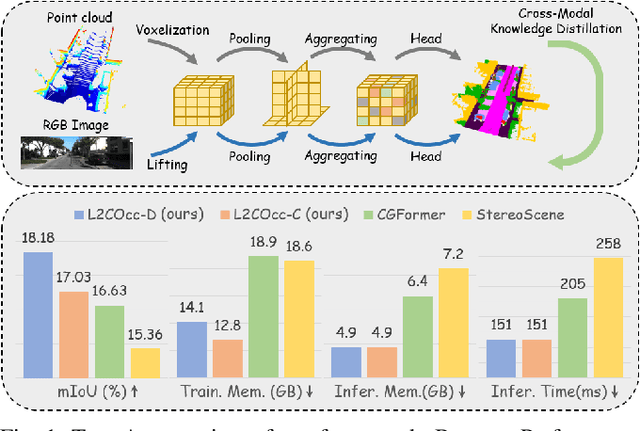
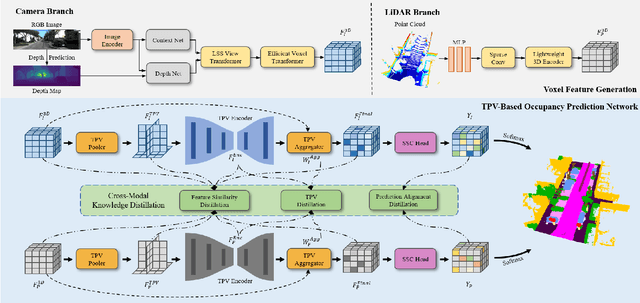
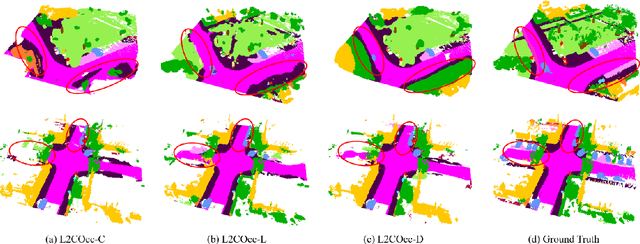
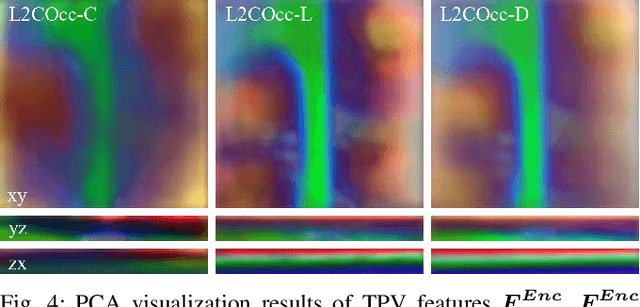
Semantic Scene Completion (SSC) constitutes a pivotal element in autonomous driving perception systems, tasked with inferring the 3D semantic occupancy of a scene from sensory data. To improve accuracy, prior research has implemented various computationally demanding and memory-intensive 3D operations, imposing significant computational requirements on the platform during training and testing. This paper proposes L2COcc, a lightweight camera-centric SSC framework that also accommodates LiDAR inputs. With our proposed efficient voxel transformer (EVT) and cross-modal knowledge modules, including feature similarity distillation (FSD), TPV distillation (TPVD) and prediction alignment distillation (PAD), our method substantially reduce computational burden while maintaining high accuracy. The experimental evaluations demonstrate that our proposed method surpasses the current state-of-the-art vision-based SSC methods regarding accuracy on both the SemanticKITTI and SSCBench-KITTI-360 benchmarks, respectively. Additionally, our method is more lightweight, exhibiting a reduction in both memory consumption and inference time by over 23% compared to the current state-of-the-arts method. Code is available at our project page:https://studyingfufu.github.io/L2COcc/.
Partially Supervised Unpaired Multi-Modal Learning for Label-Efficient Medical Image Segmentation
Mar 07, 2025Unpaired Multi-Modal Learning (UMML) which leverages unpaired multi-modal data to boost model performance on each individual modality has attracted a lot of research interests in medical image analysis. However, existing UMML methods require multi-modal datasets to be fully labeled, which incurs tremendous annotation cost. In this paper, we investigate the use of partially labeled data for label-efficient unpaired multi-modal learning, which can reduce the annotation cost by up to one half. We term the new learning paradigm as Partially Supervised Unpaired Multi-Modal Learning (PSUMML) and propose a novel Decomposed partial class adaptation with snapshot Ensembled Self-Training (DEST) framework for it. Specifically, our framework consists of a compact segmentation network with modality specific normalization layers for learning with partially labeled unpaired multi-modal data. The key challenge in PSUMML lies in the complex partial class distribution discrepancy due to partial class annotation, which hinders effective knowledge transfer across modalities. We theoretically analyze this phenomenon with a decomposition theorem and propose a decomposed partial class adaptation technique to precisely align the partially labeled classes across modalities to reduce the distribution discrepancy. We further propose a snapshot ensembled self-training technique to leverage the valuable snapshot models during training to assign pseudo-labels to partially labeled pixels for self-training to boost model performance. We perform extensive experiments under different scenarios of PSUMML for two medical image segmentation tasks, namely cardiac substructure segmentation and abdominal multi-organ segmentation. Our framework outperforms existing methods significantly.
Benchmarking LLMs in Recommendation Tasks: A Comparative Evaluation with Conventional Recommenders
Mar 07, 2025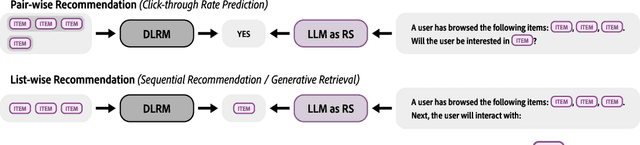
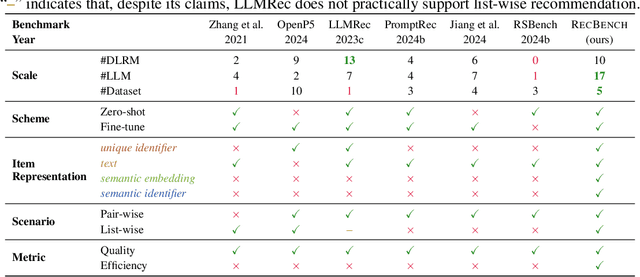
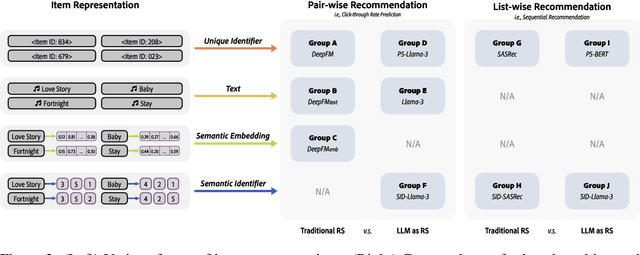
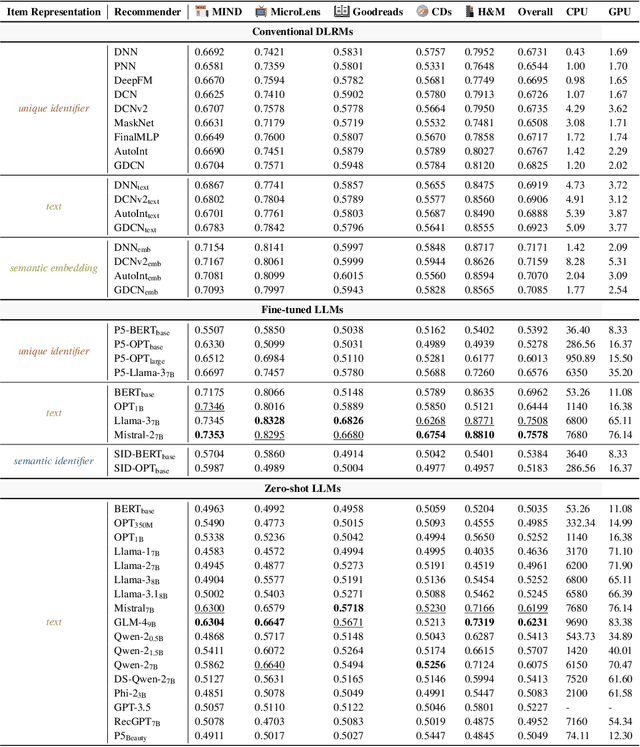
In recent years, integrating large language models (LLMs) into recommender systems has created new opportunities for improving recommendation quality. However, a comprehensive benchmark is needed to thoroughly evaluate and compare the recommendation capabilities of LLMs with traditional recommender systems. In this paper, we introduce RecBench, which systematically investigates various item representation forms (including unique identifier, text, semantic embedding, and semantic identifier) and evaluates two primary recommendation tasks, i.e., click-through rate prediction (CTR) and sequential recommendation (SeqRec). Our extensive experiments cover up to 17 large models and are conducted across five diverse datasets from fashion, news, video, books, and music domains. Our findings indicate that LLM-based recommenders outperform conventional recommenders, achieving up to a 5% AUC improvement in the CTR scenario and up to a 170% NDCG@10 improvement in the SeqRec scenario. However, these substantial performance gains come at the expense of significantly reduced inference efficiency, rendering the LLM-as-RS paradigm impractical for real-time recommendation environments. We aim for our findings to inspire future research, including recommendation-specific model acceleration methods. We will release our code, data, configurations, and platform to enable other researchers to reproduce and build upon our experimental results.