 Add to Chrome
 Add to Firefox
 Add to Edge
Mixture-of-Experts with Gradient Conflict-Driven Subspace Topology Pruning for Emergent Modularity
Dec 23, 2025
Mixture-of-Experts (MoE) architectures achieve parameter efficiency through conditional computation, yet contemporary designs suffer from two fundamental limitations: structural parameter isolation that causes catastrophic forgetting, and instruction-overfitting that degrades performance in instruction-free scenarios. We propose CDSP-MoE (Conflict-Driven Subspace Pruning MoE), a framework that addresses these issues through a paradigm shift from isolated expert containers to dynamic expert instantiation within a shared physical subspace. Grounded in the Universal Weight Subspace Hypothesis, CDSP-MoE maintains a super-complete parameter backbone where logical experts are carved out via learnable topology masks. Unlike prior work that uses gradient conflict for token reassignment or optimization surgery, we leverage it as a structural supervisory signal: a Lagged Gradient Game penalizes interfering connections in the shared manifold, enabling the topology to spontaneously prune conflicting pathways and evolve interpretable modular structures. Experimental results demonstrate that CDSP-MoE achieves robust content-driven routing without human-defined task labels, maintaining semantic specialization even under strict blind inference protocols where explicit instructions are absent. Code is available at: https://github.com/konodiodaaaaa1/Conflict-Driven-Subspace-Pruning-Mixture-of-Experts

3D Deep-learning-based Segmentation of Human Skin Sweat Glands and Their 3D Morphological Response to Temperature Variations
Apr 24, 2025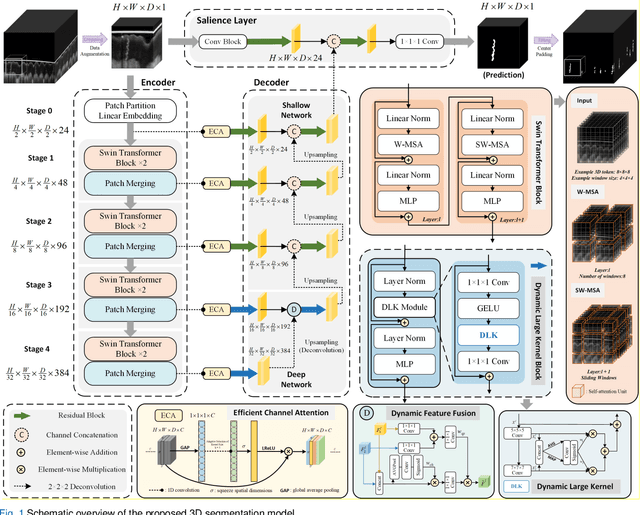
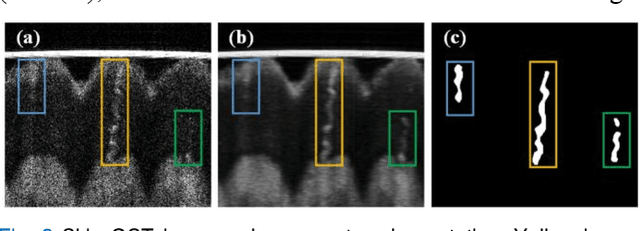
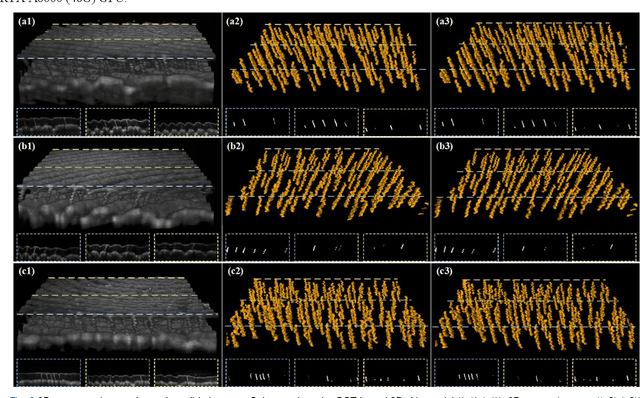

Skin, the primary regulator of heat exchange, relies on sweat glands for thermoregulation. Alterations in sweat gland morphology play a crucial role in various pathological conditions and clinical diagnoses. Current methods for observing sweat gland morphology are limited by their two-dimensional, in vitro, and destructive nature, underscoring the urgent need for real-time, non-invasive, quantifiable technologies. We proposed a novel three-dimensional (3D) transformer-based multi-object segmentation framework, integrating a sliding window approach, joint spatial-channel attention mechanism, and architectural heterogeneity between shallow and deep layers. Our proposed network enables precise 3D sweat gland segmentation from skin volume data captured by optical coherence tomography (OCT). For the first time, subtle variations of sweat gland 3D morphology in response to temperature changes, have been visualized and quantified. Our approach establishes a benchmark for normal sweat gland morphology and provides a real-time, non-invasive tool for quantifying 3D structural parameters. This enables the study of individual variability and pathological changes in sweat gland structure, advancing dermatological research and clinical applications, including thermoregulation and bromhidrosis treatment.